

Executive Summary: Japan’s SaaS market is growing steadily (Grand View Research puts it at USD 12.3 billion in 2025, rising about 12% a year to 2033), but many foreign entrants stall because they run their US or European GTM playbook unchanged. This guide walks through a five-step sequence that separates companies who build durable Japan revenue from those who burn budget on premature localization and misaligned channel bets. You’ll get the validation framework, channel selection, localization priorities, enterprise sales cycle mechanics, and a 12-month launch sequence, all grounded in how Japanese buyers actually purchase software.
Why Japan’s SaaS Market Demands Its Own GTM Playbook
Japan is the world’s fourth-largest economy by nominal GDP (IMF, October 2026), yet many foreign SaaS vendors struggle to build revenue there. The gap usually isn’t product quality or market size; it’s go-to-market architecture. Standard PLG funnels, velocity sales models, and English-first content strategies don’t map onto a market where procurement runs through consensus, trust accrues to local presence, and buyers expect to evaluate in Japanese: in CSA Research’s survey of business software buyers, every Japanese respondent preferred to buy in Japanese.
The numbers make the opportunity hard to ignore. Research Nester puts Japan’s SaaS market at USD 13.8 billion in 2026, rising to USD 38.1 billion by 2035 (about 13.5% a year); Grand View Research puts it at USD 12.3 billion in 2025, about 12% a year to 2033. Japanese companies still run fewer applications: 53 per company on average, against 98 globally (Okta, Businesses at Work 2026). And digital transformation is concentrated at the top: 87.6% of companies with more than 1,000 employees run DX under a company-wide strategy, against 31.0% of companies with 100 or fewer (IPA, DX Trend 2024). The government’s DX initiative took off with METI’s 2018 DX Report, which warned of economic losses of up to JPY 12 trillion a year from 2025 if companies kept their legacy systems.
But opportunity and accessibility aren’t the same thing.
Here’s where the standard GTM motion breaks down. A side-by-side comparison against the typical US/European playbook shows the structural gaps:
| GTM Dimension | US / European Default | Japan Reality |
|---|---|---|
| Buyer Language | English-first; localization optional | Japanese expected for evaluation. In CSA Research’s survey of business software buyers, every Japanese respondent preferred to buy in Japanese. |
| Decision Speed | Shorter mid-market cycles; a champion can push a deal through | Longer: as a planning assumption, nine to twelve months or more for an enterprise deal. Consensus-based nemawashi means several stakeholders must align before approval. |
| Vendor Trust Model | Brand reputation + product demo drives trust | Local entity, Japanese team members, and reference customers carry more weight than global brand. Gaishi-kei (foreign company) status triggers extra due diligence. |
| Localization Depth | Translate UI strings, maybe help docs | Full SaaS localization required: UI, onboarding, contracts, support hours (JST), data residency documentation, invoices that work under the consumption tax invoice system. |
| Channel Mix | PLG + content marketing + SDR outbound | Trade shows, review platforms (BOXIL, ITreview), partner referrals, and eigyō-style relationship selling dominate enterprise. |
| Partnership Role | Nice-to-have; accelerator for specific segments | Often decisive. About 72% of Japan’s ICT professionals work at IT vendors (MIC White Paper 2018), so SIer partners and keiretsu relationships shape access to large enterprises. |
If your Japan go-to-market strategy doesn’t account for each of these dimensions, you’re not adapting, you’re hoping.
The Structural Differences That Break Standard GTM Motions
Three cultural and institutional structures, nemawashi (根回し), eigyō (営業) and gaishi-kei (外資系) perception, aren’t “soft” factors you can acknowledge in a slide deck and move past. They’re load-bearing walls in the Japanese B2B purchasing process, and your GTM architecture either supports them or collapses against them.
Nemawashi and the Ringi System
Nemawashi, the practice of building informal consensus before any formal decision, isn’t a cultural curiosity. It’s the operating system of Japanese enterprise procurement. Before a ringi-sho (稟議書, the formal approval document) circulates for stamps, your internal champion has already had one-on-one conversations with every stakeholder who’ll touch that document. If any one of them has an unresolved objection, the ringi stalls.
What this means operationally: you don’t sell to one buyer. You sell to a buying group, sequentially, through your champion; One Marketing’s 2025 survey of 600 Japanese B2B buyers put the average group at 5.6 to 18.3 people, depending on the purchase. Your job is to arm that champion with materials (in Japanese) that answer each stakeholder’s specific concerns, security for IT, ROI for finance, workflow impact for the department head, strategic alignment for the executive sponsor. The decision framework models used in Japanese enterprises reflect this multi-stakeholder reality.
Time implication: plan for a longer cycle than you are used to. In the same survey, 54% of high-price purchases took six months or more.
Eigyō: The Relationship-First Sales Culture
Western SaaS sales culture optimizes for efficiency, qualify fast, demo fast, close fast. Japanese eigyō (B2B sales) optimizes for relationship durability. Your sales rep isn’t just closing a deal; they’re establishing a partnership that the buyer expects to last years. This means more face-to-face meetings, more post-sale check-ins, and a willingness to invest time before any contract is signed.
The practical impact is that your first Japanese sales hire (or fractional sales team) needs to be someone who understands this rhythm. A high-velocity SDR who’s brilliant at cold outreach in the US will likely alienate Japanese prospects within the first call. Conversely, an eigyō-trained rep builds relationships that carry the deal through procurement and hold up at renewal.
The Gaishi-kei Trust Deficit
Being a gaishi-kei (foreign-capital company) in Japan carries a specific set of buyer anxieties: Will you still be here in three years? Will your support team understand our workflows? Will you exit the market if Japan revenue doesn’t hit targets? These aren’t irrational fears: foreign vendors have withdrawn from Japan before, leaving customers to migrate.
You counter this with signals of commitment: a K.K. (Kabushiki Kaisha) entity (or at minimum a GK), Japanese-speaking support during JST hours, local customer references, and Japanese-language contracts. Each signal reduces the gaishi-kei discount that buyers mentally apply to your product. (More on entity timing in the 12-month sequence below.)
Sectors Leading SaaS Adoption
Japan’s SaaS adoption isn’t uniform: four sectors stand out, and each one presents a distinct entry angle. Understanding which sector aligns with your product’s strengths determines whether you’re swimming with or against the current.
Financial Services
Japan’s banks, insurers and securities firms are large IT buyers under pressure to modernize core systems, and many now work with cloud vendors. If your product touches compliance, risk management, or customer data platforms, the FinTech market entry path is well-defined, but expect the FISC security guidelines, which Japanese financial institutions apply to their systems and outsourced services, and long sales cycles at the largest banks. Partnering with a major SIer is common.
Manufacturing
Japan’s manufacturing base is going through a generational IT overhaul, pushed by labour shortages: Recruit Works Institute projects a shortfall of about 11 million workers across Japan by 2040. The automotive supply chain is a large buyer group for ERP, MES and supply-chain software. The Ministry of Economy, Trade and Industry’s “Connected Industries” policy, announced in 2017, targets manufacturing digitization and sits alongside the broader DX push. SIer partnerships are close to essential here; the keiretsu structure means your direct sales motion will hit walls that only a trusted systems integrator can open.
Healthcare
Electronic medical records are still spreading: 65.6% of general hospitals had an EMR system in 2023, up from 57.2% in 2020 (MHLW Survey of Medical Institutions), and the government’s goal is near-universal adoption by 2030. That means greenfield opportunity but also longer education cycles. Health data rules layer on top of APPI: MHLW’s security guidelines for medical information systems apply, and software that is itself a medical device falls under the Pharmaceuticals and Medical Devices Act.
Logistics and Government
The “2024 problem” in logistics (from April 2024, truck drivers’ overtime has been capped at 960 hours a year) pushed carriers and shippers toward route optimization, warehouse management, and supply chain visibility tools. Meanwhile, government procurement, historically hard for foreign vendors, is opening up through the Digital Agency’s Government Cloud and the cloud-first policy. Central government agencies procure cloud services in principle from services registered under ISMAP, so registration matters if government is in your plan; the contracts are long-term.
Step 1: Market Validation and Japan-Specific ICP Definition
Most Japan market entry failures trace back to skipping validation, or running validation that tests the wrong things. Your product-market fit in the US tells you nothing about Japan-market fit. The buyer’s workflow, competitive landscape, pricing tolerance, and procurement process are all different enough that you need Japan-specific evidence before committing budget.
The 15-Point Japan Market Fit Checklist
Before you spend a yen on localization, work through this checklist. If you can’t check at least 10 of 15, you need more market validation research before proceeding.
- Category exists in Japan, Japanese buyers are already purchasing solutions in your category (even if legacy/on-prem).
- Search demand exists, Japanese-language search volume for your category is measurable (check a keyword tool set to Japan and Japanese).
- Competitor landscape mapped, You can name at least 3 domestic competitors and 2 foreign entrants.
- Pricing benchmark established, You know what Japanese buyers pay for comparable solutions (start from domestic competitors’ published prices).
- Regulatory clearance confirmed, No sector-specific regulation blocks your product category. Regulatory requirements have been reviewed.
- Data residency requirements understood, You know whether your target segment requires Japan-hosted data.
- APPI compliance mapped, Your data handling practices align with Japan’s privacy law.
- Integration landscape identified, You know which Japanese tools (freee, Money Forward, Sansan, Cybozu) your product needs to connect with.
- Buyer persona validated, You’ve talked to at least 5 potential Japanese buyers (not just channel partners).
- Champion profile defined, You know who inside Japanese companies will advocate for your product and what motivates them.
- Workflow delta assessed, You understand specifically how Japanese user workflows differ from your current users.
- Support model designed, You have a plan for JST-hours support in Japanese.
- Contract format prepared, You can issue contracts that conform to Japanese commercial practice (bilingual, hanko (判子, personal seal) or e-signature ready).
- Reference customer path identified, You have a realistic plan to get your first 3 Japanese reference customers.
- Unit economics viable, At Japan pricing, with Japan-specific CAC and longer sales cycles, your payback period is under 24 months.
Mapping the Japanese Buying Center
Understanding how Japanese companies buy SaaS means mapping five distinct roles in the purchasing committee. Each role has different concerns, different information needs, and different power dynamics:
| Role | Japanese Title | Primary Concern | What They Need From You |
|---|---|---|---|
| Executive Sponsor | Buchō (部長) / Department General Manager | Strategic alignment, budget justification | ROI projections tied to company’s mid-term plan, competitive positioning data |
| Department Manager | Kachō (課長) / Section Chief | Workflow impact, team adoption risk | Detailed implementation plan, training timeline, change management support |
| IT Department | Jōhō Shisutemu-bu (情報システム部) | Security, integration, compliance | ISMS certificate or SOC 2 report, security checklist answers (ISMAP only for central government), architecture diagrams, APPI vs GDPR mapping |
| Procurement | Kōbai-bu (購買部) | Contract terms, vendor viability, pricing | Japanese-language MSA, local entity documentation, reference customer list |
| End Users | Tantōsha (担当者) | Usability, daily workflow fit | Japanese UI demo, trial environment, comparison to current tools |
Your champion, usually the Kachō or a senior Tantōsha, needs to carry your value story through each of these conversations during the nemawashi phase. If you haven’t armed them with role-specific materials in Japanese, you’ve sent them into battle unarmed.
When to Adapt vs. Hold the Line
Not every feature request from Japanese prospects warrants a product change. The discipline is distinguishing between market-critical adaptations (without which you can’t sell) and preference-based requests (which you can address through configuration, training, or simply saying no). Validating PMF in Japan means testing this boundary deliberately.
Adapt when: the request reflects a structural difference in Japanese business process (e.g., approval workflows, Japanese invoice formats, hanko/e-signature support). Hold when: the request reflects an individual company’s preference that doesn’t generalize across your ICP.
Step 2: Channel Selection, Where Japanese Buyers Actually Discover SaaS
Channel selection in Japan isn’t about picking the highest-ROI channel from a universal menu, it’s about matching channel to buyer segment and purchase stage. Japanese enterprise buyers rely on channels that Western SaaS marketers underweight, and the channels that drive US pipeline (PLG virality, LinkedIn outbound, G2 reviews) carry less weight here.
Here’s how the seven primary channels compare for Japan SaaS GTM. The comparison helps you decide between a PLG vs. SLG approach based on your target segment:
| Channel | Best For | Lead Time to Pipeline | Relative Cost | Japan-Specific Notes |
|---|---|---|---|---|
| Content / SEO | SME, mid-market | Long: builds over a year or more | Medium | Japanese-language content required. Google SEO also covers Yahoo! JAPAN, which uses Google’s search engine. |
| SEM (Google/Yahoo) | All segments | Immediate | High | Build keyword lists from Japanese words and the English product terms Japanese IT buyers also search for. Yahoo! JAPAN sells its own ad inventory. |
| Trade Shows | Enterprise, mid-market | Months: plan around the show calendar | High | Japan IT Week, CEATEC and sector shows. Still a common place to start enterprise conversations. |
| Partner / SIer Channel | Enterprise | Slowest: partner enablement comes before the first deal | Medium (rev share) | Channel partner development takes time but unlocks enterprise accounts unreachable through direct sales. |
| Review Platforms | SME, mid-market | Months: reviews accumulate gradually | Medium | BOXIL vs ITreview are the closest equivalents of G2 and Capterra. In ITreview’s March 2026 survey, 37.7% had found candidates on comparison or review sites, and 87.4% had dropped a product with too few reviews; see BOXIL. |
| PR / Media | Brand building, enterprise | Ongoing | Medium-High | Coverage in Nikkei, ITmedia and other business and IT media builds gaishi-kei credibility. Press releases go out via PR TIMES, used by 65.8% of listed companies (May 2026). |
| Outbound (Eigyō) | Enterprise, named accounts | Months: depends on deal size | High | Requires Japanese-speaking reps. Cold email/call works but must follow Japanese business etiquette. Hiring the right rep is critical. |
Japanese SEO: The Long Game That Compounds
Japanese-language SEO is one of the highest-leverage channels for mid-market SaaS, but only if you commit for the long term. Yahoo! JAPAN has used Google’s search engine since 2010, so ranking on Google covers both. In ITreview’s March 2026 survey, web search was the most common way buyers found SaaS candidates (47.3%). The content expectations differ from English SEO: Japanese searchers tend to expect detailed articles, thorough comparison tables, and clear pricing information upfront.
Your marketing funnel development for Japan should treat organic content as the mid-funnel workhorse. Top-funnel awareness comes from trade shows and PR. Bottom-funnel conversion comes from sales. But the middle, where buyers research, compare, and shortlist, happens on Google, BOXIL, and ITreview.
The distinction between localization and translation matters here. Translated content reads like translated content. Localized content reads like it was written for the Japanese reader from scratch, because it was. If you’re producing Japanese SEO content, it needs to be created by native speakers who understand the search intent behind Japanese queries, not machine-translated from your English blog.
Trade Shows: Still the Enterprise On-Ramp
Exhibitions play a bigger part in Japanese enterprise purchasing than many Western teams expect. Japan IT Week, run by RX Japan, holds a spring edition at Tokyo Big Sight, an autumn edition at Makuhari Messe in Chiba, and regional editions in Osaka and Nagoya. CEATEC and sector-specific shows add further pipeline. In ITreview’s March 2026 survey, 24.3% of respondents had found SaaS candidates at events.
Your booth doesn’t need to be enormous, but it does need Japanese-speaking staff, Japanese-language collateral, and ideally a live product demo running in Japanese. The real pipeline happens in the follow-up, scan the badge, send a personalized thank-you email within 24 hours (in Japanese), and schedule a follow-up meeting within the week.
The Partner Channel: Slow to Build, Hard to Replace
For large enterprise deals, the SIer (Systems Integrator) partner channel is often the most realistic path. About 72% of Japan’s ICT professionals work at IT vendors rather than user companies (MIC White Paper 2018), and firms such as Fujitsu, Hitachi, NEC and NTT Data, the leading vendors in IDC Japan’s 2024 IT services ranking, hold the IT relationships of many of Japan’s largest corporations. Their recommendation carries weight that no amount of direct marketing can replicate. The direct vs. partner model decision is one of the most consequential strategic choices you’ll make.
Building SIer partnerships requires genuine investment: technical training for their consultants, joint go-to-market materials, deal registration and margin structures that make economic sense for them, and patience. A lot of patience. No public benchmark says how long the first partner-sourced deal takes, so plan in quarters, not weeks.
Step 3: Localization That Converts, Not Just Translates
One of the most expensive mistakes in Japan SaaS GTM is premature full localization: paying to translate your entire product before you’ve validated that Japanese buyers want what you’re selling. The second most expensive mistake is insufficient localization, trying to sell an English-only product and wondering why conversion rates are near zero. The right answer is staged SaaS localization timed to your sales stage.
Minimum Viable Localization: Two Stages
Before outreach (Stage 1):
- Website landing page in Japanese (one page, not the full site)
- Product overview deck in Japanese (10-15 slides)
- One-pager / leave-behind in Japanese
- Japanese-language email templates for sales outreach
- Pricing page with yen pricing and Japanese billing norms (localized pricing guidance)
Before POC / pilot (Stage 2):
- Core product UI localized (the screens most users touch)
- Onboarding flow in Japanese
- Help documentation for core workflows (Japanese)
- Japanese-language support channel (email minimum; chat preferred)
- Bilingual MSA / order form conforming to Japanese commercial practice
- Security documentation in Japanese: ISMS certificate or SOC 2 report, security checklist answers, and ISMAP only if you sell to central government
Everything else, full UI translation, complete help center, Japanese blog content, localized integrations, comes after you’ve closed your first few paying customers and confirmed the ICP. The phased entry vs. full launch approach protects your capital while you learn.
Data Residency, ISMAP, and APPI
Three compliance frameworks shape your localization requirements. Getting them wrong doesn’t just lose deals; it can block you from entire segments. Settle your position with Japanese counsel.
APPI (Act on the Protection of Personal Information): Japan’s privacy law. The 2020 amendment, fully in force since April 2022, made breach reports mandatory, and an amendment passed in July 2026 adds a gain-based surcharge, in force by July 2028. If you handle the personal information of people in Japan when supplying them goods or services, the APPI applies even without an office or servers in Japan. The APPI vs. GDPR comparison shows meaningful differences, so don’t assume GDPR compliance covers you. Key requirements include a stated purpose of use, consent or equivalent safeguards for transfers abroad (the EU and the UK are the only designated countries), and a preliminary breach report to the Personal Information Protection Commission (PPC) within about 3 to 5 days, with a final report within 30 days (60 for wrongful-purpose cases). There is no requirement to appoint a data protection officer or a local representative.
ISMAP (Information system Security Management and Assessment Program): The government’s list of assessed cloud services. Central government agencies procure cloud services in principle from services registered on it; it is not required for private-sector sales. Registration needs an external audit against the ISMAP control criteria, which are being revised with no set application date, so if government is in your ICP, start early.
ISMS (ISO/IEC 27001): The standard is global, but Japanese enterprise buyers expect you to speak their security language: they’ll ask for answers to their own security checklist (sekyuriti chekku shīto, セキュリティチェックシート) in a format they recognize. Having an ISMS certification (or SOC 2 Type II with a Japanese-language mapping document) removes friction from the IT department’s evaluation. Your APPI compliance checklist should address all of these.
Step 4: Pipeline Building and the Enterprise Sales Cycle
No public benchmark exists for Japanese SaaS sales cycles. As a planning assumption, allow nine to twelve months or more for a large enterprise deal; in One Marketing’s 2025 survey, 54% of high-price B2B purchases took six months or more. That’s not a dysfunction to work around; it’s the rhythm of consensus-driven procurement, and fighting it will cost you more than adapting to it. Your pipeline model, forecasting, and cash planning need to account for this cadence from day one.
The Seven-Stage Japan Enterprise Sales Cycle
| Stage | Duration | Key Activity | Your Goal |
|---|---|---|---|
| 1. Introduction | First weeks | Initial meeting (often via referral or trade show). Relationship establishment. | Understand their pain in their language. Don’t pitch yet. |
| 2. Information Exchange | Weeks | Share detailed product materials. Answer preliminary technical questions. | Arm your champion with materials for internal nemawashi. |
| 3. Internal Socialization | Often the longest stage | Your champion runs nemawashi with stakeholders. You may have zero visibility. | Stay available. Provide requested materials within 24 hours. Don’t pressure. |
| 4. Technical Evaluation | Weeks to months, alongside stage 3 | IT department security review. Integration assessment. May overlap with Stage 3. | Respond to security questionnaires completely and in Japanese. Offer a technical deep-dive session. |
| 5. POC / Pilot | As agreed: 30 to 60 days is a sensible cap | Proof of concept with defined success criteria. | Design the POC for success: tight scope, clear metrics, dedicated support. This is your audition. |
| 6. Commercial Negotiation | Weeks to months | Pricing, contract terms, SLA definition. Procurement department takes the lead. | Be prepared for annual vs. monthly billing discussions. Japanese enterprises default to annual contracts. |
| 7. Ringi Approval | Varies by company and budget cycle | Formal approval document circulates for stamps through every affected manager. | Nothing to do here but wait. If nemawashi was done properly, this is ceremonial. If it wasn’t, the deal stalls or dies. |
Champion Building: The Make-or-Break Skill
Your champion is the person inside the target organization who wants your product to win. In Japan, this person is doing more work on your behalf than champions in any other market, they’re running the nemawashi conversations, translating your value proposition into internal language, managing objections from IT and procurement, and putting their professional reputation on the line.
You owe them extraordinary support. That means: role-specific leave-behinds they can hand to each stakeholder, ROI models customized with their company’s numbers, a reference call with a similar Japanese customer (if you have one), and responsiveness measured in hours not days. The omotenashi (おもてなし, Japanese hospitality) standard of care isn’t just for post-sale customer success, it starts during the sales process.
POC Design That Doesn’t Backfire
POCs (proof of concept) are standard in Japanese enterprise SaaS procurement. The danger is scope creep, a POC that tries to prove everything proves nothing, runs over timeline, and gives stakeholders reasons to say no. Design your POC with these constraints:
- Duration: 30 days maximum. (60 days if the workflow is genuinely complex.) Anything longer loses momentum.
- Scope: One use case, one team, one success metric. Write it down and get agreement before the POC starts.
- Success criteria: Quantitative where possible (e.g., “reduce report generation time from 4 hours to 30 minutes”). Avoid subjective criteria like “team satisfaction.”
- Support: Assign a dedicated CSM for the POC period. Weekly check-ins with the champion. Immediate response to blockers.
- Exit criteria: Define what happens when the POC succeeds. If there’s no pre-agreed path from successful POC to contract, you’ve just given away free consulting.
Leading Pipeline Metrics for Japan
Standard SaaS pipeline metrics need recalibration for Japan. Here’s what to track:
- Nemawashi progress: How many of the identified stakeholders has your champion spoken with? Track this as a percentage.
- Time-in-stage: Benchmark each stage against the table above. If a deal is 2x the expected duration in any stage, it’s likely stalled.
- Champion engagement frequency: If your champion goes quiet for more than 2 weeks, the deal is at risk. (They may be busy with internal resistance.)
- Materials requested: An increase in material requests, especially technical documentation or case studies, signals forward movement.
- Stakeholder meetings scheduled: Each new stakeholder meeting you’re invited to is a buying signal. Being excluded from stakeholder conversations is normal, being asked to join one is progress.
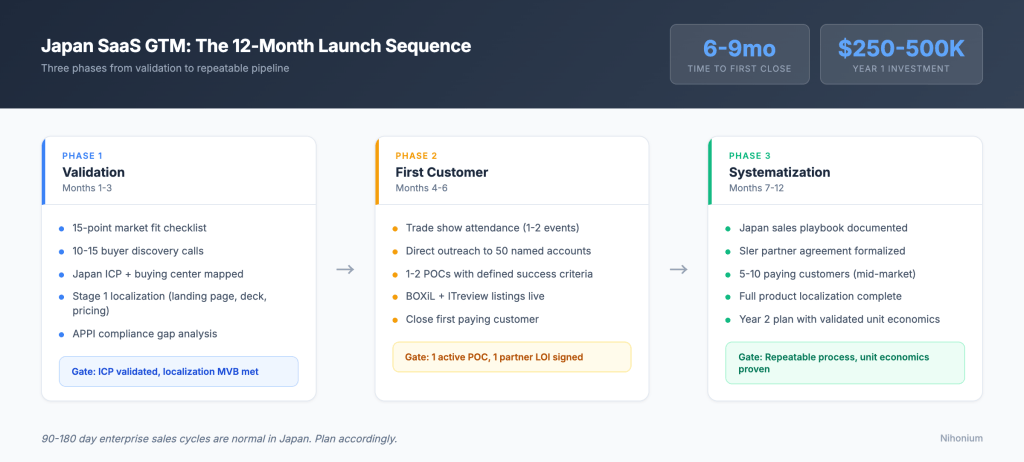
Step 5: The 12-Month Launch Sequence
A structured 12-month sequence prevents the two most common failure modes: moving too fast (burning cash on localization before validation) and moving too slow (losing market timing to competitors who commit). This timeline assumes you’ve decided Japan is a priority market and have allocated budget. The total cost of Japan market entry has no public benchmark; it depends mostly on whether you set up an entity and hire. JETRO’s Tokyo model case puts the set-up of a two-person subsidiary at USD 264,000 to 289,000, including JPY 30 million of paid-in capital and before salaries, which is why this sequence starts without one.
Phase 1: Validation Foundation (Months 1-3)
Month 1, Research and ICP:
- Complete the 15-point market fit checklist above
- Conduct 10-15 discovery calls with potential Japanese buyers (use your network, JETRO introductions, or a fractional sales team)
- Map competitive landscape: domestic competitors, foreign entrants, incumbent solutions
- Define Japan-specific ICP with firmographic and behavioral criteria
Month 2, Minimum viable localization (Stage 1):
- Japanese landing page live
- Product deck and one-pager in Japanese
- Pricing structure adapted for Japan (yen pricing, billing model decided)
- Japanese-language outreach templates ready
- APPI compliance gap analysis complete
Month 3, Channel activation:
- Register on BOXIL and ITreview
- Submit to 1-2 upcoming trade shows (Japan IT Week, sector-specific events)
- Begin SIer partner conversations (2-3 targets identified)
- First outbound campaign launched targeting 50 named accounts
Phase 2: First Customer (Months 4-6)
Month 4, Pipeline building:
- First trade show attended (or scheduled)
- A first set of qualified opportunities in pipeline, against the target you set in month 1
- Japanese content marketing started (2 articles/month minimum)
- SEM campaigns running on Google and Yahoo! Japan
Month 5, POC launch:
- First 1-2 POCs underway with defined success criteria
- Core UI localization in progress (Stage 2 localization)
- Japanese support channel operational (email + chat during JST)
- Onboarding flow localized
Month 6, First close:
- Close first paying Japanese customer
- Begin customer success program with omotenashi-grade support
- Collect first Japanese case study / reference
- Evaluate entity structure decision: K.K. vs. GK vs. branch office
Six months to first customer might sound slow if you’re used to US sales velocity. For Japan it is ambitious: as a planning assumption, allow 6 to 12 months to first mid-market revenue and 12 to 18 months to meaningful enterprise revenue. A bad-fit customer rushed through in month 3 is more likely to churn and makes a poor reference.
Phase 3: Systematization (Months 7-12)
Months 7-9, Scale what works:
- Double down on the channel(s) that generated your first customers
- Hire or contract your first Japan-dedicated sales resource (if not already done)
- Expand content production to 4 articles/month
- Formalize SIer partner agreement (if enterprise is your target)
- Complete full product localization for core workflows
- File for local entity if deal flow justifies it
Months 10-12, Build the flywheel:
- Paying customers against the targets you set in month 1 (there is no public benchmark for customer counts)
- Japanese reference customers willing to take calls
- Repeatable sales process documented (your Japan sales playbook)
- Unit economics validated: CAC, LTV, payback period at Japan pricing
- Year 2 plan defined: headcount, channel investment, product roadmap for Japan
- Assess ROI timeline against original projections
By month 12, you should have enough data to make a go/no-go decision on scaling Japan investment. If unit economics work and pipeline is growing, you’ve found something. If not, you’ve learned it before funding an entity and a full Japan team.
Key Takeaways
- Japan’s SaaS market (USD 12.3 billion in 2025, per Grand View Research) is real but structurally different. Your US/European GTM playbook will underperform unless you rebuild it for consensus-driven procurement, relationship-first sales, and local-presence trust signals.
- Validate before you localize. Run the 15-point market fit checklist and talk to 10+ potential Japanese buyers before spending on full product translation. Staged localization protects your capital.
- Nemawashi is your sales cycle. You’re not selling to a buyer, you’re equipping a champion to build internal consensus across a buying group of several people. Arm them accordingly.
- Channel selection is segment-dependent. Trade shows and SIer partnerships for enterprise; review sites such as BOXIL and ITreview, content SEO, and SEM for mid-market. PLG works for SME only if your product can self-serve in Japanese.
- Plan for long sales cycles. As a planning assumption, allow nine to twelve months or more for an enterprise deal; cash planning, pipeline forecasting, and team expectations all need to reflect that cadence.
- Compliance is a gate, not a checkbox. APPI applies to almost every SaaS product, ISMAP to central government sales, and ISMS or equivalent evidence to most enterprise security reviews. Start compliance work in parallel with sales, not after your first deal stalls.
- The 12-month sequence works because it’s sequential. Validate, then localize, then sell, then systematize. Skipping steps is how you burn budget with nothing to show for it.
- Your first Japanese customer is your most valuable asset. A referenceable Japanese customer unlocks the nemawashi process for every subsequent deal. Treat them with omotenashi-grade care.
Working with Nihonium. We are a Japan go-to-market partner for B2B SaaS companies: Japan go-to-market strategy and localization by SaaS experts. Talk to us about your Japan entry.
Sources
- Grand View Research, Japan SaaS market outlook: USD 12.3 billion in 2025, USD 31.3 billion forecast for 2033. Research Nester, Japan SaaS market: USD 13.8 billion in 2026, USD 38.1 billion by 2035.
- Okta, Businesses at Work 2026: 53 apps per company in Japan, 98 globally.
- JETRO, Digital Technology sector overview (from IPA, DX Trend 2024), and Tokyo model case for set-up costs.
- CSA Research, “Businesses Prefer Local Language Purchasing” (2008 survey of business software buyers).
- ITreview, SaaS selection survey white paper (March 2026 survey): discovery routes, review effects.
- Ministry of Internal Affairs and Communications, Information and Communications White Paper 2018: share of ICT professionals at IT vendors.
- Ministry of Health, Labour and Welfare, electronic medical record plan (9 September 2026), with the Survey of Medical Institutions figures, and overtime cap for drivers from April 2024.
- Personal Information Protection Commission, APPI General Rules guidelines; ISMAP portal.
- Japan IT Week (RX Japan), show overview. Recruit Works Institute, Future Predictions 2040.
- Also relied on, cited in plain text: IMF World Economic Outlook, October 2026 (GDP rank); METI DX Report (September 2018) and Connected Industries (2017), whose site blocks automated access; One Marketing, BtoB購買プロセス白書2025 (600 buyers); IDC Japan 2024 IT services vendor ranking; PR TIMES user figures (May 2026).
Frequently Asked Questions
How long does it take to close the first enterprise SaaS deal in Japan?
There is no public benchmark. As a planning assumption, allow nine to twelve months or more for a large enterprise deal; smaller mid-market deals can close sooner if you have a strong champion and the nemawashi process moves smoothly. The key variable is whether your champion can build consensus efficiently, and whether you’ve given them the materials to do so. Read more about how Japanese companies buy SaaS.
Do I need a local entity (K.K. or GK) to sell SaaS in Japan?
Not at the start. Many companies close their first deals from the foreign entity, through partners or with a fractional sales team, and set up an entity when deal flow justifies it; some enterprise buyers prefer or require a Japanese counterparty. A GK (Godo Kaisha) is cheaper to set up (statutory fees of JPY 60,000 to 100,000); a K.K. (Kabushiki Kaisha) (about JPY 180,000 to 240,000) is more familiar to large enterprises. Our KK vs GK comparison covers the choice.
How much should I budget for Year 1 of Japan market entry?
There is no public benchmark, so build it from the plan: validation, Stage 1 and 2 localization, initial channel activation, a fractional or contracted sales resource, and trade show participation. The largest swing is the entity and full-time headcount: JETRO’s Tokyo model case puts the set-up of a two-person subsidiary at USD 264,000 to 289,000 including capital, before salaries. See our detailed breakdown of Japan market entry costs.
Should I use a PLG or sales-led motion in Japan?
For enterprise and upper mid-market, sales-led is the default, consensus procurement doesn’t self-serve. PLG can work for SME segments if (and only if) your product delivers value in Japanese without human assistance. Many Japan SaaS entrants run a hybrid: PLG for SME acquisition with sales-led conversion for mid-market and above. Our PLG vs. SLG comparison breaks this down by segment.
What’s the biggest mistake foreign SaaS companies make entering Japan?
Premature scaling before validation. Specifically: hiring a country manager, signing an expensive office lease, and committing to full localization before confirming that Japanese buyers want and will pay for the product. The second biggest mistake is hiring a country manager who’s great at operations but can’t sell, your first Japan hire needs to be a seller, not an administrator.
How important are SIer partnerships for Japan SaaS GTM?
For large enterprise deals, SIer partnerships are often decisive. Fujitsu, Hitachi, NEC, NTT Data and similar firms run the systems of many of Japan’s largest corporations, and about 72% of Japan’s ICT professionals work at IT vendors (MIC White Paper 2018). Even if you can reach a buyer directly, having an SIer endorsement accelerates the trust-building process. Learn more about SIer partner management and the direct vs. partner model tradeoffs.
Is APPI compliance mandatory for selling SaaS in Japan?
Yes, if you handle the personal information of people in Japan, which nearly every SaaS product does. The 2020 amendment (fully in force in April 2022) made breach reports mandatory, tightened the rules on transfers abroad, and set fines of up to JPY 100 million for a company that breaches a PPC order; the July 2026 amendment adds a gain-based surcharge by July 2028. GDPR compliance helps, but Japan has its own rules, such as the information you must give before transferring data abroad on consent. Start with our APPI compliance checklist.
What review platforms matter for SaaS in Japan?
BOXIL and ITreview are the two main SaaS review and comparison platforms in Japan, the closest equivalents of G2 and Capterra. ITreview, run by ITcrowd (a joint venture of SB C&S and ITmedia), offers a free listing and ranks products by user reviews. BOXIL, run by SmartCamp, has no free plan: JPY 50,000 a month on a one-year minimum, plus a per-lead fee. Being listed is table stakes for any SaaS product targeting the Japanese mid-market. Our BOXIL vs ITreview comparison details the differences.
How should I price my SaaS product for Japan?
No reliable public benchmark compares Japanese and US SaaS prices, so price against domestic competitors; at the enterprise level, custom pricing is the norm. Japanese enterprises tend to prefer annual billing and yen-denominated invoices. A registered issuer can issue qualified invoices under the invoice system in force since 1 October 2023, while a foreign vendor selling services across the border to businesses may fall under the reverse charge instead; settle which applies with a tax adviser. Volume discounts and multi-year commitment pricing work well. See our guide on localizing SaaS pricing for Japan.
Can I run my Japan GTM remotely from the US or Europe?
You can run Phase 1 (validation) remotely, and many companies do, using fractional sales teams, consultants, and video calls. By Phase 2 (first customer), you need at minimum a Japan-based sales resource available for in-person meetings. By Phase 3 (systematization), most entrants that scale have people on the ground in Japan. The market rewards physical presence; buyers interpret remote-only engagement as a lack of commitment, which reinforces the gaishi-kei trust deficit.