
Japan market entry presents particular challenges for global SaaS companies, and a large opportunity. Japan is the fourth-largest economy by nominal GDP in the IMF’s October 2026 projections, and its 122.97 million people (2025 Census) are concentrated in a few metropolitan areas. The opportunity is open to companies that understand how Japanese businesses buy, how the regulations apply to their product, and what Japanese users expect from software. A full market entry program covers strategy, localization, regulatory preparation, partners, sales and marketing, and the entity and hiring decisions; no single provider does all of it, so the useful question is who does which part.
Japan Market Entry Services Overview
Japan market entry services help global SaaS companies enter the Japanese market: market research, go-to-market strategy, localization, sales and marketing execution, and coordination with the specialists who handle regulation, the entity and hiring.
These services address the needs of software companies entering a market where business relationships, regulatory compliance and cultural adaptation decide the outcome. Purchasing power is concentrated. The Tokyo area (Tokyo, Kanagawa, Saitama and Chiba) had 36.98 million people at the 2025 Census, about 30% of Japan’s population, which puts a dense network of potential enterprise customers and early adopters within reach of one sales team (Statistics Bureau of Japan, 2025 Census).
But accessing this opportunity requires more than translation. It demands an understanding of Japanese business practice, from nemawashi (根回し, informal consensus-building before a decision) to the ringi (稟議, the written proposal circulated for approval) that can make enterprise deal cycles long: as a planning assumption, not a benchmark, allow nine to twelve months or more for an enterprise deal.
Market entry services have moved beyond the traditional consulting model of a report and a recommendation. Today’s providers combine market knowledge, localization, sales execution and partner work, and they coordinate with lawyers, tax accountants and corporate services firms for the parts that need a licence. The companies that enter well usually separate the decisions that can wait (the entity, the first full-time hires) from the ones that cannot (positioning, Japanese materials, the first customer conversations).
Nihonium is a Japan go-to-market partner for B2B SaaS companies, and our part of such a program is five services, as listed on our services page: Japan go-to-market strategy; localization by SaaS experts; a sales and marketing funnel (awareness, SEO, local leads); a fractional sales team that runs Japanese-speaking sales from the first email to closing and account management; and local thought leadership, including evangelism alongside local thought leaders. The other parts of a full program sit with licensed specialists: a judicial scrivener (司法書士, shihō shoshi) or corporate services provider for the entity, a Japanese lawyer (弁護士, bengoshi) for regulatory and contract questions, a tax accountant (税理士, zeirishi) for tax, and a recruiting agency for permanent hires.
The scope of a program extends well beyond market research. A modern Japan go-to-market strategy has to account for everything from APPI compliance to partnerships with Systems Integrators (SIers). For SaaS companies specifically, it means billing preferences, enterprise security reviews, and integration with the established IT systems that Japanese enterprises run.
Core Service Capabilities
A full program covers market analysis, strategy, localization, sales and marketing execution, and partner work, with regulatory, entity and M&A questions handled by specialists alongside.
These capabilities address the full spectrum of market entry, from the first feasibility questions to post-launch improvement. Relationships matter more in Japan than in many markets. The U.S. Commercial Service advises companies entering Japan to visit frequently to cultivate contacts and understand business conditions, and notes that most U.S. exporters start by finding a local partner to act as agent, distributor or representative. A provider that already sells in Japan brings working relationships with buyers, partners and media that a new entrant would otherwise build from zero.
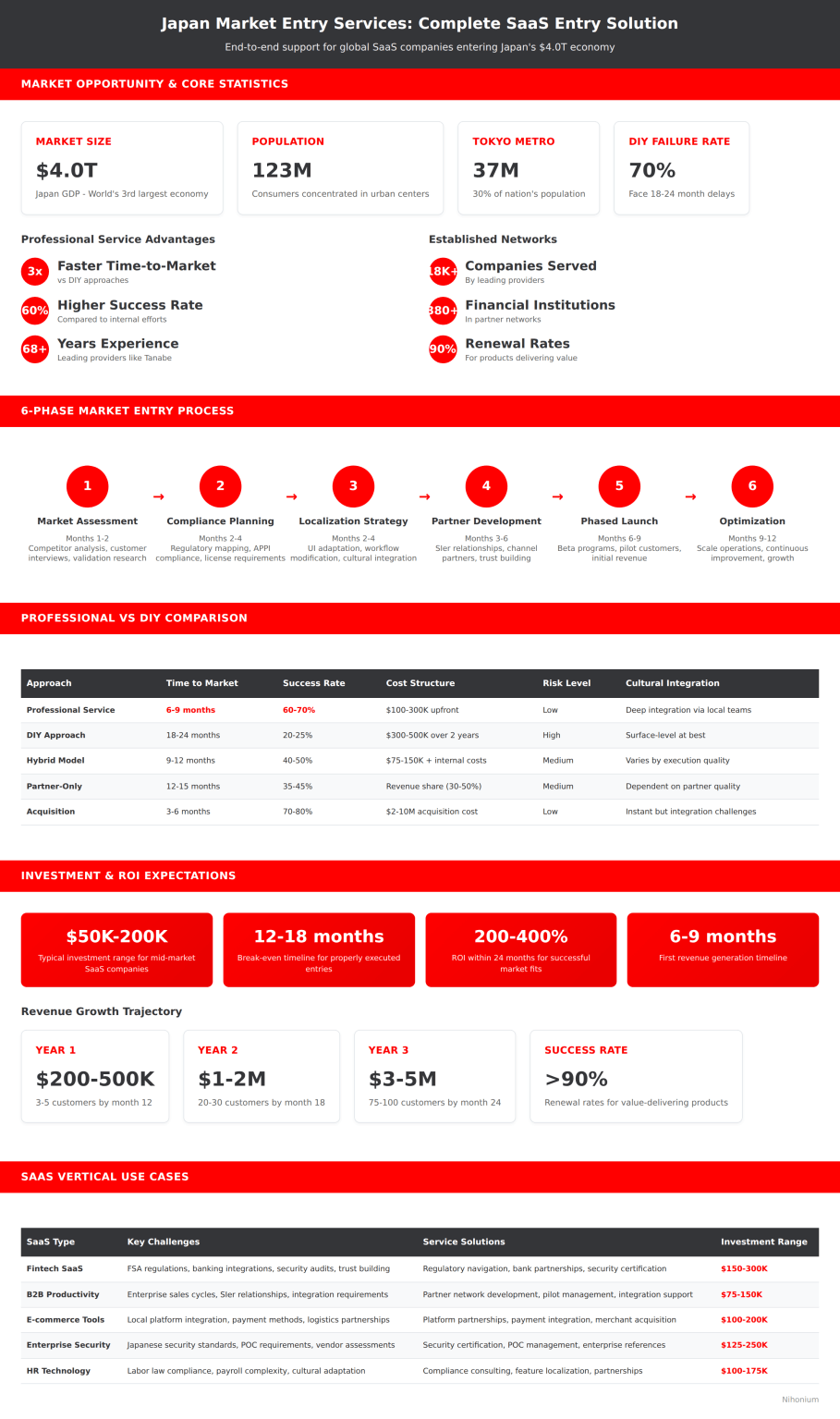
The table below shows the main areas of a program and how each applies to SaaS. It describes the program as a whole, including the parts that licensed specialists deliver.
| Service Category | Core Capabilities | SaaS-Specific Applications |
|---|---|---|
| Market Analysis | Competitor landscape mapping, customer segmentation, pricing research, a first view of regulatory questions | Which industries already buy SaaS, subscription and billing preferences, integration requirements with Japanese enterprise systems |
| Strategy Development | Go-to-market planning, positioning, channel strategy, localization roadmap | Product-led vs sales-led motion, SIer partnership strategies, community building approaches |
| Implementation Support | Sales enablement and marketing execution; legal entity setup by a judicial scrivener or corporate services provider; hiring through a recruiting agency | KK vs GK entity choice, fractional sales team deployment, review site presence |
| M&A Advisory | Target identification, due diligence, integration planning, valuation (M&A advisers, banks and lawyers) | SaaS company acquisitions, technology asset purchases, strategic partnership structuring |
| Compliance Management | Regulatory mapping, licence applications and ongoing compliance (Japanese lawyers and administrative scriveners) | APPI compliance, financial services rules for fintech, healthcare data guidelines |
| Digital Marketing | Content localization, SEO, social media, events and webinars | Technical content adaptation, BOXIL and ITreview presence, webinar programs |
Why not just hire local sales reps instead? A single hire can work, but it carries a lot of weight. A salesperson, however talented, cannot also own regulatory questions, partner development, localization and the marketing funnel while selling, and an early hire is hard to reverse: under Article 16 of the Labor Contracts Act, a dismissal without objectively reasonable grounds is invalid. Hiring also usually means setting up an entity first. Many companies start with outside support and hire once the market has responded.
Japan Market Entry Process
A Japan market entry program usually runs in four stages: market assessment and competitor analysis, compliance and localization planning, partner development, and a phased launch with continuous improvement. As a planning assumption, allow 6 to 12 months to first mid-market revenue.
The stages overlap, and their length depends on the product and the segment. The U.S. Commercial Service’s guide for exporters notes that agents and distributors are the most common way foreign firms gain their first foothold in Japan. But partner selection needs care. The right partner accelerates growth; the wrong one creates years of cleanup work.
Market Assessment Phase
The foundation is market research, and in Japan desk research is not enough: it needs validation on the ground. Teams analyze competitor positioning, pricing models and feature sets through customer interviews and partner discussions. Market validation answers the questions that matter: which features resonate, which pricing model works, how buyers evaluate solutions.
Competitive analysis in Japan goes deeper than feature comparisons. You are mapping relationship networks: which SIers recommend which products, and who influences purchases in your target segments. For many business applications, the real competitor is not another SaaS product but a spreadsheet maintained with help from a consultant or an SIer, which a feature comparison never shows.
Compliance and Localization Planning
Regulatory requirements vary by vertical. Fintech meets financial services registration, HR tech meets labour law, and healthcare software meets the medical information guidelines and, for software that is a medical device, the Pharmaceuticals and Medical Devices Act. Planning starts with a map of which rules could apply, for Japanese counsel to confirm, before localized code is written.
Localization planning extends beyond translation. It means adapting the product for Japanese users: UI layouts and fonts that handle Japanese text, workflows that fit approval processes, and integrations with the systems Japanese enterprises use. SaaS localization touches everything from onboarding flows to support documentation.
Partner Network Development
Relationship building cannot be rushed. The U.S. Commercial Service advises visiting Japan frequently to cultivate contacts and understand business conditions. First meetings rarely produce immediate results; they are investments in a long-term partnership.
Partner types vary by go-to-market model. Enterprise SaaS typically needs SIer partnerships for credibility and access: about 72% of Japan’s ICT professionals work at IT vendors rather than at user companies (MIC White Paper 2018), so many enterprises buy software through the SIer that runs their systems. SMB-focused products may prioritize digital marketing and review sites. Channel partner development means matching your needs with each partner’s capabilities and incentives, and partners that serve different industries can complement each other.
Launch and Optimization
Smart launches start small. A pilot with a small group of friendly customers provides feedback before a broader rollout. These early adopters, often introduced through partners, shape product-market fit and become the first Japanese case studies, which later buyers ask for.
Many B2B SaaS entries begin in the Tokyo area, where the largest concentration of people and companies sits. Some products find their first customers in other regions, such as Osaka or Nagoya, where a specific industry cluster or a partner’s customer base gives them an opening.
Post-launch improvement never stops. Japanese customers expect continuous improvement and responsive support: regular reviews with early customers, regular business reviews with partners, and constant iteration on messaging and positioning. The companies that succeed treat launch as the beginning, not the end.
SaaS Market Entry Use Cases
Japan market entry programs address different SaaS scenarios: B2B software expansion, fintech regulatory requirements, e-commerce platform localization and enterprise deployments, with an approach and a budget that depend on the vertical and the company’s stage.
Each vertical has its own challenges. Isn’t Japan market entry too expensive and time-consuming for mid-size SaaS companies? Not necessarily. Mid-market companies can often move quickly and adapt to market feedback, and the investment scales with ambition: a phased entry commits money step by step, while a full entry with an entity and local hires commits most of it up front.
Japan’s Digital Transformation (DX) agenda, which the Ministry of Economy, Trade and Industry (METI) launched with its 2018 DX Report, keeps enterprise software on the board agenda. METI’s report warned of losses of up to JPY 12 trillion a year from 2025 if legacy systems were not modernized.
| Company Type | Entry Challenges | Service Solutions | What Drives the Cost |
|---|---|---|---|
| Fintech SaaS | FSA registrations, banking integrations, security reviews, trust building | Regulatory questions mapped for counsel, bank partnerships, security review materials in Japanese | Legal review of the licence position, security reviews, length of bank sales cycles |
| B2B Productivity | Enterprise sales cycles, SIer relationships, integration requirements | Partner network development, pilot program management, integration requirements for your engineers | Depth of localization, SIer enablement, number of pilots |
| E-commerce Tools | Local platform integration, payment methods, logistics partnerships | Platform partnerships, payment localization, merchant acquisition | Integrations with Japanese platforms and payment methods |
| Enterprise Security | Japanese security standards, POC requirements, vendor assessments | Security certification readiness, POC management, enterprise reference building | Certifications (ISMAP only for central government sales), proofs of concept |
| HR Technology | Labour law fit, payroll complexity, cultural adaptation | Labour law fit confirmed by specialists, feature localization, partnership facilitation | Payroll and year-end adjustment features, review by a labour and social security attorney |
Patterns repeat across verticals. Companies that budget for proper localization, Japanese-speaking sales and patience usually reach their first reference customers; companies that treat Japan as a translation project often stall. As a planning assumption, allow 12 to 18 months to meaningful enterprise revenue and judge break-even over two to three years.
A common failure pattern looks like this: the company translates the product and marketing site, sells directly from headquarters in English-language meetings, and after a year has meetings but no signed deals. The usual fixes are the ones in this article: Japanese-speaking sales, deeper localization, a partner or two, and a pricing and contract model that fits Japanese procurement.
Professional vs DIY Market Entry Comparison
Working with experienced partners shortens the learning curve and lowers the upfront commitment compared with a do-it-yourself entry, while a do-it-yourself entry keeps full control but commits the entity and salaries before the market has responded.
Can’t we just use automated translation and skip the full localization process? That question carries a risk. English proficiency in Japan is limited: Japan ranks 86th of 117 countries in the EF English Proficiency Index 2026, so business communication, user expectations and decision-making all run in Japanese. Machine translation can be a useful first draft, but on its own it misses the tone and terminology business users expect, and the cultural adaptation that drives adoption.
Japan’s business culture rewards attention to procedure. A product with machine-translated screens and English-only outreach to enterprises risks being seen as a typical gaishi-kei (外資系, foreign-affiliated company) vendor in the negative sense: out of touch with how Japanese businesses work and unlikely to stay.
| Approach | Time to Market | Main Risk | Cost Structure | Risk Level | Cultural Integration |
|---|---|---|---|---|---|
| Professional Service | Once positioning and Japanese materials are ready | Dependence on the provider’s quality; plan the knowledge transfer | Service fees that scale with scope; no entity needed to start selling software | Lower: the commitment can be scaled | Deep integration via local teams |
| DIY Approach | Slowest: entity, hiring and learning first | Slow learning and hard-to-reverse early hires | Entity (JETRO Tokyo model case: USD 264,000 to 289,000 for a two-person subsidiary, before salaries) plus salaries | Higher: fixed costs before revenue | Depends on who you hire |
| Hybrid Model | Between the two | An unclear split of roles | Service fees plus internal team costs | Medium | Varies by execution quality |
| Partner-Only | Depends on the partner’s priorities and sales cycle | Your product is one of many in the partner’s catalogue | Partner margin or revenue share, negotiated per agreement | Medium | Dependent on partner quality |
| Acquisition | Fastest route to an existing customer base | Integration and keeping the acquired team | Purchase price plus integration costs | Capital at risk up front | Instant but integration challenges |
Experienced partners compress learning curves. They prevent avoidable mistakes such as arriving at meetings without business cards (meishi, 名刺), proposing aggressive discounts that signal low quality, or overlooking a data-handling question that a buyer’s legal team will raise. On data, the Act on the Protection of Personal Information (APPI) has no general data-localization requirement, but a transfer abroad needs the person’s consent, a recipient in a country the regulator has designated (the EU or the UK) or a recipient with equivalent safeguards, and enterprise buyers ask where data is stored.
The hybrid model is a middle ground for companies with some internal capabilities. You might handle product and engineering while outsourcing sales and marketing, with Japanese counsel on compliance. Success depends on a clear split of roles and on choosing partners who complement rather than duplicate your strengths.
Investment and ROI Considerations
What Japan market entry costs depends mostly on whether you set up an entity and hire; with a phased entry, break-even is usually judged over two to three years, as a planning assumption rather than a benchmark.
That horizon is why a market entry program needs a commitment from the company’s leadership, not only from the team that runs it.
Cost Structure Breakdown
Entry costs fall into three groups: setup, operations and growth. Setup includes the legal entity, if you form one: statutory fees are JPY 60,000 to 100,000 for a GK and about JPY 180,000 to 240,000 for a KK at the minimum registration tax, before professional fees and capital. It also includes the first localization and the market research. Don’t skimp on the foundations; weak ones multiply costs later.
Operating costs vary by model. Fractional sales teams have no public price benchmark: fees depend on scope and the number of people. A full-time country manager for a software company earns JPY 30 to 60 million in base salary in Japan (Robert Walters Japan Salary Survey 2026), plus about 15% employer social insurance. Marketing budgets cover the Japanese website, content, review sites and events. Many companies underestimate the conference and relationship-building budget.
Growth investments scale with ambition. Expanding beyond the Tokyo area means regional coverage. Enterprise sales demands reference customers and proofs of concept. Each new vertical may need its own partners. The companies that plateau often stop investing after the initial entry.
ROI Timeline and Expectations
As a planning assumption, allow 6 to 12 months to first mid-market revenue and 12 to 18 months to meaningful enterprise revenue, and do not expect profitability in the first year. Early deals often carry high acquisition costs, because the first customers also become your references. The economics improve when customers renew, which makes customer success in Japanese part of the entry budget rather than an afterthought.
ROI timelines vary by vertical and sales model. Enterprise security software with long sales cycles follows a different curve from SMB productivity tools. There is no public benchmark for customer counts or revenue by month; set your own milestones in advance (pipeline, pilots, first contracts, renewals) and decide what result would justify the next phase.
Geographic focus speeds up learning. With about 30% of Japan’s population in the Tokyo area, many companies concentrate there until they have product-market fit, then expand to Osaka, Nagoya and other regions through partners.
Risk Mitigation Value
Experienced help is not only about speed; it is insurance against expensive mistakes. The common ones are hiring the wrong country manager (hard to reverse under Japanese employment law), missing a regulatory requirement that blocks a sale, choosing a partner whose customers are the wrong segment, and a cultural misstep that damages the brand early.
A typical sequence of mistakes runs like this: a company enters on its own, hires a country manager with strong credentials but a poor fit, builds features Japanese customers did not ask for, and signs a distributor serving the wrong segment. Each step is reasonable in isolation, and together they cost a year or more. A program that validates demand before hiring, and chooses partners by customer fit rather than size, avoids most of them.
For companies with a validated product and a genuine commitment to Japan, the question is less whether to use outside help than which parts to buy, which to build and which to leave to licensed specialists.
Key Success Factors
The main success factors are genuine local partnerships, cultural adaptation beyond translation, regulatory compliance from day one, long-term relationship strategies, and a realistic view of how Japan fits the company’s wider Asia-Pacific plans.
These are prerequisites rather than best practices. Genuine partnerships require more than contracts. Japanese business runs on trust built through consistent contact, demonstrated commitment and mutual benefit. The most successful entrants invest in relationships before expecting returns: regular visits, consistent communication, and helping partners with their problems as well as your own. A partner that sees you invest in its success is more likely to bring you its customers.
Cultural adaptation touches everything. Omotenashi (おもてなし, Japanese hospitality) shapes customer success expectations. Nemawashi shapes how decisions get made. Eigyō (営業, Japanese B2B sales) follows different rhythms from Western sales processes. Companies that understand these concepts sell and retain customers more easily than those that do not.
Regulatory compliance cannot be an afterthought. Japanese regulators publish detailed guidelines, and enterprise buyers check vendors against them during procurement. Companies that settle their position early with Japanese counsel, and document it in Japanese, answer buyers’ questions faster and build a reputation that helps later sales.
Long-term thinking leads to different decisions. Annual contracts versus monthly billing is not just a pricing decision; it signals commitment to the market. Investing in Japanese-language support before it pays shows dedication customers notice. Building features for Japanese workflows demonstrates the understanding that drives word-of-mouth growth.
Japan can also anchor a wider Asia-Pacific strategy. Success with Japanese customers is a strong reference elsewhere, their quality expectations prepare a product for other demanding markets, and partnerships with Japanese multinationals can open doors across the region. Treat that as an upside of doing Japan well, not a reason to spread thin before Japan works.
Key Takeaways
A full Japan market entry program for SaaS covers strategy, localization, sales and marketing, partners, regulatory preparation, and the entity and hiring decisions; providers and licensed specialists split that work, and the useful question is who does which part. Japan is the fourth-largest economy by nominal GDP (IMF, October 2026), with about 30% of its people in the Tokyo area. Costs depend mostly on whether you set up an entity and hire: JETRO’s Tokyo model case puts the set-up of a two-person subsidiary at USD 264,000 to 289,000 before salaries. As a planning assumption, allow 6 to 12 months to first mid-market revenue and judge break-even over two to three years. Success requires genuine partnerships, localization beyond translation, early regulatory clarity and patience.
Sources
International Monetary Fund, World Economic Outlook, October 2026 (nominal GDP ranking).
Statistics Bureau of Japan, 2025 Population Census results (population, Tokyo area).
U.S. International Trade Administration, Japan Country Commercial Guide: Market Entry Strategy.
JETRO, Setting up a business in Tokyo: model case.
Robert Walters, Japan Salary Survey 2026.
Also relied on, cited in plain text: Labor Contracts Act Article 16 and the APPI (Japanese Law Translation); MIC Information and Communications White Paper 2018; METI DX Report (September 2018); EF English Proficiency Index 2026; KK and GK fees as in our kabushiki kaisha and godo kaisha articles.
Frequently Asked Questions
How long does Japan market entry typically take for SaaS companies?
There is no public benchmark, so use planning assumptions: 6 to 12 months to first mid-market revenue and 12 to 18 months to meaningful enterprise revenue, with enterprise deal cycles of nine to twelve months or more. The first months go to research, positioning and localization; setting up an entity and hiring add time if you do them first. SMB-focused SaaS with self-serve sign-up and inside sales can see revenue sooner.
What are the main regulatory requirements for SaaS companies?
Regulatory requirements vary by vertical. Every SaaS company handling personal data falls under APPI, which requires a stated purpose of use, security measures, breach reports to the regulator and rules for transfers abroad. Fintech may need registration under the Payment Services Act or the Financial Instruments and Exchange Act; software that is a medical device falls under the Pharmaceuticals and Medical Devices Act. Confirm your position with Japanese counsel before launch.
How important is cultural localization beyond translation?
It decides adoption more than any single feature. Japanese users expect workflows that fit approval processes, hanko (判子, personal seal) or electronic approval support, detailed documentation and more guided onboarding. Error messages need a polite tone, and payment flows should support Japanese methods such as bank transfer (振込, furikomi) and, for smaller customers, konbini (コンビニ, convenience store) payment.
What partnership models work best for SaaS market entry?
Partnership models depend on the target market and sales complexity. Enterprise SaaS typically works with SIers such as Fujitsu, Hitachi, NEC and NTT Data, the leading IT services vendors in IDC Japan’s 2024 ranking. SMB-focused SaaS may partner with digital agencies, accounting software vendors or industry associations. Japanese partners expect more than a resale agreement: joint marketing, technical support and a long-term commitment, and terms are negotiated per agreement.
How do you measure market entry success in Japan?
Metrics change with the phase. Early on, track activity: positioning tested, product localized, partners engaged, first meetings held. Next, track early revenue indicators: pipeline, pilots, first customers and usage. Later, track sustainable growth: acquisition cost, renewal rates, expansion and partner-sourced revenue. Set the targets for each phase before you start.
What are the common mistakes to avoid in Japan market entry?
The most expensive mistakes come from cultural misunderstanding and impatience: treating translation as localization, hiring local leadership before the market is validated, choosing partners for size rather than fit, leaving compliance until a buyer’s legal team raises it, applying Western sales tactics unchanged, and underfunding the effort. Careful planning, cultural awareness and patient execution avoid most of them.