
The Act on the Protection of Personal Information (個人情報の保護に関する法律, commonly known as APPI) is Japan’s main data protection law, governing how businesses acquire, use, store and share personal information about people in Japan. It applies to foreign companies too: an overseas business that handles the personal information of people in Japan in connection with supplying goods or services to them falls under it (Article 171). For a foreign SaaS company with Japanese customers or users, APPI compliance is not optional, and the law has just been amended again, in July 2026.
Historical Context and Evolution
APPI was enacted in 2003 and took full effect in 2005, making it one of Asia’s earliest comprehensive data protection laws. The original law was light-touch, reflecting a policy of balancing data use against privacy. Growing concern about data breaches, the global shift toward stronger privacy regulation and the wish for EU adequacy recognition drove a series of amendments.
The first major overhaul was the 2015 amendment, fully in force from 30 May 2017. It made the Personal Information Protection Commission (PPC), set up in January 2016, the independent supervisory authority, extended the law to businesses of every size, introduced anonymously processed information and added rules for transfers abroad. These changes paved the way for the mutual adequacy arrangement with the European Union, which took effect on 23 January 2019.
The 2020 amendment, fully in force from 1 April 2022, made breach reporting mandatory, raised penalties (from December 2020), expanded individual rights, introduced pseudonymously processed information and tightened the information required for transfers abroad. It also gave the PPC enforcement powers, including orders, over foreign businesses. The latest amendment was passed by the Diet on 10 July 2026 and promulgated on 17 July 2026. It introduces administrative surcharges and new rules on children’s data and facial recognition data, and takes effect within two years of promulgation (see “2026 Amendment” below).
Scope and Extraterritorial Application
APPI applies to any “business operator handling personal information” (kojin jōhō toriatsukai jigyōsha, 個人情報取扱事業者), meaning anyone using a personal information database for business, regardless of size. For foreign SaaS companies, three situations matter:
Providing services to people in Japan. A SaaS company with Japanese users, whether it sells directly or through partners, is covered when it handles their personal information in connection with that service, wherever the company is headquartered or its servers are located.
Collecting personal information from Japan. Gathering names, email addresses, usage data tied to an account, or other personal information from people in Japan triggers APPI obligations.
Processing data for Japanese companies. A SaaS company running a CRM, HR platform or analytics tool for Japanese businesses is usually their entrustee (委託先, itakusaki). The Japanese customer must supervise it and, because it is abroad, meet the cross-border rules, so in practice the contract will impose APPI-level obligations on the vendor.
Non-compliance is not theoretical. The PPC can request reports, give guidance and advice, issue recommendations and binding orders, and refer violations for criminal prosecution. In fiscal 2025 it processed 17,139 breach reports from private businesses and issued 455 instances of guidance and advice, 2 recommendations and 1 order.
What Constitutes Personal Information Under APPI
APPI defines personal information as information about a living individual that can identify that person, by name, date of birth or other description, including information that can easily be matched with other information to identify them, or that contains an “individual identification code”. The categories build on one another:
Personal information (個人情報): any information that identifies a specific individual, such as a name, an email address that identifies a person, an employee ID combined with a company name, facial recognition data, passport and driver’s license numbers, and My Number (Japan’s national ID number).
Personal data (個人データ): personal information that forms part of a personal information database, meaning information organized so it can be searched. Most SaaS platforms store personal information in databases, so it is personal data under APPI.
Retained personal data (保有個人データ): personal data that the business operator has the authority to disclose, correct, delete or stop using. Since 2022 this includes data kept for less than six months. It carries additional duties, including responding to disclosure and correction requests.
Special care-required personal information (要配慮個人情報): sensitive categories such as race, creed, social status, medical history, criminal record, history of being a victim of crime and disability. Acquiring it requires the individual’s prior consent, and it cannot be shared through the opt-out route.
Key Compliance Requirements
SaaS companies handling personal data of people in Japan must meet several core obligations:
Purpose specification and limitation: Specify the purpose of use as concretely as possible and do not use the information beyond it without consent. Publish the purpose in advance or notify the individual promptly after acquisition; where you collect information directly from the person in writing, including web forms, state the purpose before collection.
Proper acquisition: Personal information must be acquired by legitimate means; deception and other improper methods are prohibited, as is use that may encourage unlawful or unjust acts. Special care-required personal information needs prior consent.
Accuracy and security: Keep personal data accurate to the extent the purpose requires, take security measures against leakage, loss and damage, and supervise the employees and contractors who handle it.
Third-party provision restrictions: Providing personal data to a third party generally needs the individual’s prior consent. Entrustment (where a contractor handles data on your behalf), business succession and joint use are not treated as third-party provision. An opt-out route exists for some data, but it requires prior notification to the PPC and is not available for sensitive data.
Individual rights: Individuals can request disclosure of their retained personal data (including in electronic form), correction of inaccurate data, cessation of use or deletion where data was improperly obtained or used, is no longer needed, has been involved in a reportable breach or puts their rights at risk, and cessation of third-party provision.
Breach Notification Requirements
Since April 2022, reporting is mandatory for breaches (actual or likely) that involve:
Special care-required personal information, a risk of financial loss from misuse, a wrongful purpose such as unauthorized access, or more than 1,000 individuals. In those cases the business operator must:
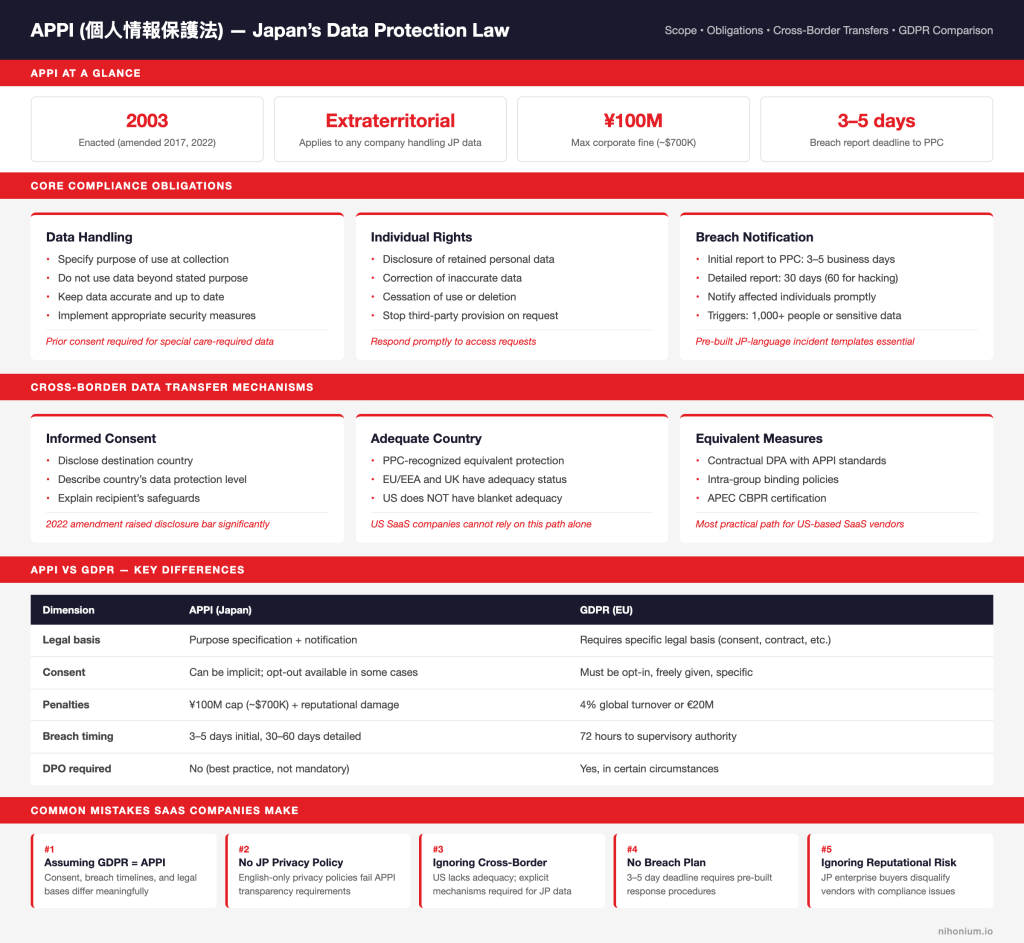
Report to the PPC: A preliminary report is due promptly, which the PPC’s guidelines put at about 3 to 5 days after the company learns of the breach, covering what is known at that point. A final report follows within 30 days, or 60 days where a wrongful purpose such as unauthorized access is involved. The report covers what happened, the categories and number of individuals affected, the cause, the potential harm and the measures taken.
Notify affected individuals: The operator must notify the individuals affected, promptly and by appropriate means, describing the breach and what is being done. Once the 2026 amendment takes effect, this duty is relaxed where the risk to individuals is low.
For a SaaS company, this means a ready incident response plan, Japanese-language notification templates and clear escalation to whoever files with the PPC.
Penalties and Enforcement
APPI enforcement has been strengthened step by step. The current framework:
PPC orders: The PPC can issue recommendations and, if they are not followed (or in urgent cases directly), binding orders to stop or correct a violation.
Criminal penalties for individuals: Violating a PPC order can lead to imprisonment of up to one year or a fine of up to JPY 1 million for the responsible individual.
Corporate penalties: Since December 2020 a company can be fined up to JPY 100 million for violating a PPC order and up to JPY 100 million for providing or stealing a personal information database for illicit gain. Before the 2020 amendment, a company faced the same small fine as the individual offender. The 2026 amendment adds an administrative surcharge (課徴金, kachōkin) for serious, large-scale violations, equal to the financial gain from the violation, and raises the criminal penalties for database misuse.
Reputational damage: In Japan’s relationship-driven business culture, a publicized data protection failure can cost far more than the fine. Japanese enterprise buyers run thorough vendor due diligence, and a record of APPI problems can take a vendor out of consideration.
Cross-Border Data Transfer Rules
Transfers abroad are the most practically significant APPI rule for foreign SaaS companies, since most handle Japanese customer data outside Japan. First check whether there is a transfer at all: the PPC does not treat storage on a foreign cloud provider’s servers as a provision to a third party if the provider does not handle the data (its contract excludes access and access is controlled), although you must still understand that country’s rules and tell users where the data is. Where a recipient abroad will handle the data, Article 28 allows three routes:
Consent: The individual consents after being told the destination country, that country’s personal information protection system and the measures the recipient takes. The 2020 amendment made this information mandatory.
Designated country: Transfers to a country the PPC has designated as having equivalent protection need no consent. Only the EU and the UK are designated. The United States is not, which matters for US-based SaaS companies.
Equivalent measures: Transfers are permitted when the recipient has a system for handling personal data that meets the PPC’s standards, set up by contract (a data processing agreement), intra-group rules or APEC CBPR certification. The sender must also take steps to make sure those measures continue to be applied, and give information on them to individuals on request.
For US-based SaaS companies, the usual approach is the contractual route or informed consent. Offering Japan-based hosting (for example AWS Tokyo, Azure Japan East or Google Cloud Tokyo) simplifies compliance and answers a question Japanese enterprise customers usually ask.
2026 Amendment
APPI is reviewed every three years. The latest review produced an amendment enacted in July 2026, to take effect within two years of promulgation, with rules and guidelines being drafted by the PPC now. Its main points for SaaS companies:
AI and statistics: Personal data may be provided to third parties, and published sensitive data acquired, without consent where it is used only to create statistical information, which expressly includes AI development that qualifies as statistics creation, subject to publication and written agreement requirements.
Children’s data: For individuals under 16, consent and notices go to the legal representative, children gain easier rights to stop use of their data, and businesses must give priority to the child’s best interests.
Facial feature data: Businesses must publish specified information about their handling of facial feature data, individuals get easier cessation rights, and sharing it through the opt-out route is banned.
Entrustees and tracking data: Contractors may not use entrusted data beyond the entrusted work. Misuse and improper acquisition of information that is not personal information but can be used to contact or target a specific person are prohibited, and businesses using the opt-out route must verify who their recipients are.
Stronger enforcement: The surcharge applies to serious violations such as unlawful third-party provision or improper acquisition where the rights of 1,000 or more people are harmed and the company did not take reasonable care. The PPC also gains wider order powers and new criminal penalties apply to acquiring personal information by fraud. Breach notices to individuals are relaxed where risk is low.
The amendment does not add a data portability right. Watch the PPC’s implementing rules over the next year; several thresholds, including the scope of facial feature data, will be set there.
APPI vs. GDPR: Key Differences
SaaS companies that already comply with the GDPR have a strong foundation for APPI, but several differences matter:
Legal basis for processing: The GDPR requires a legal basis (consent, contract, legitimate interest and others) for every processing activity. APPI relies on specifying and publishing the purpose of use, with consent required mainly for use beyond that purpose, sensitive data, third-party provision and as one route for transfers abroad.
Consent mechanisms: GDPR consent must be freely given, specific, informed and unambiguous. APPI has no equivalent definition and allows an opt-out route for some third-party provision, though it is narrowing that route.
Penalties: GDPR fines reach EUR 20 million or 4% of worldwide annual turnover, whichever is higher. APPI’s criminal fines are capped at JPY 100 million, and its new surcharge is tied to the gain from a violation rather than to turnover.
Breach notification timing: The GDPR requires notification to the authority within 72 hours where feasible. APPI expects a preliminary report in about 3 to 5 days and a final report within 30 or 60 days.
Data Protection Officer: The GDPR requires a DPO in certain circumstances. APPI has no DPO requirement, though naming a privacy lead is good practice.
Practical Considerations for SaaS Companies
For a SaaS company serving Japan, the practical steps are: publish a Japanese privacy policy that states your purposes of use, your company’s name, address and representative, and the countries where data is held; choose a lawful route for each transfer abroad; prepare a breach response plan that meets the PPC’s timelines; keep the third-party provision records the law requires and be ready to answer disclosure requests; and put entrustment contracts in place with your vendors and sub-processors. Doing this early avoids penalties, and it also wins trust with Japanese enterprise buyers, who increasingly check data protection in vendor evaluation.
Key Takeaways
- Extraterritorial application: APPI applies to foreign SaaS companies that handle personal information of people in Japan in connection with services to them, wherever they are headquartered, and the PPC can issue them orders.
- Breach reporting is mandatory: Since April 2022, reportable breaches (sensitive data, financial risk, wrongful purpose, or more than 1,000 people) need a preliminary report to the PPC in about 3 to 5 days and a final report within 30 or 60 days.
- Cross-border transfers need a lawful route: Informed consent, a designated country (only the EU and the UK) or a recipient system meeting PPC standards. The US is not designated.
- Penalties are rising: Corporate fines of up to JPY 100 million since December 2020, a gain-based surcharge from the 2026 amendment, and reputational damage that can take a vendor out of Japanese enterprise procurement.
- GDPR compliance is a foundation, not a substitute: Differences in legal bases, consent, breach timelines, entrustment and the 2026 rules on children and facial data call for a specific APPI gap analysis.
Working with Nihonium. We are a Japan go-to-market partner for B2B SaaS companies: Japan go-to-market strategy. Talk to us about your Japan entry.
Sources
- Act on the Protection of Personal Information, English translation (Japanese Law Translation, Ministry of Justice)
- Personal Information Protection Commission: laws and policies (English)
- PPC: APPI Guidelines (General Rules), including breach reporting (Japanese)
- PPC Q&A 12-3: storing personal data on servers outside Japan (Japanese)
- PPC: EU-Japan mutual adequacy framework (Japanese)
- PPC: the 2026 amendment to the APPI (Japanese) and its overview, July 2026
- ScanNetSecurity: PPC annual report for fiscal 2025 (Japanese)
Frequently Asked Questions
Does APPI require a Data Protection Officer?
No. Unlike the GDPR, APPI does not require a Data Protection Officer. Naming a privacy lead is still good practice, and Japanese enterprise buyers increasingly expect one during vendor evaluation. A named contact for privacy questions shows maturity, and you will need someone who can handle requests from users and the PPC in Japanese. In early market entry, many companies give the role to their Japan country manager or general counsel.
How does the My Number system affect SaaS companies?
My Number (マイナンバー) is Japan’s individual number for tax, social security and disaster response, and it is governed by its own law, the My Number Act, with rules stricter than APPI’s. Businesses may use My Number only for the purposes the law allows, mainly tax and social insurance filings. SaaS companies processing HR, payroll or tax data will handle it and need stronger security controls, access logging, strict purpose limitation and proper disposal. HR tech and payroll SaaS providers must build these into their products.
What constitutes valid consent for cross-border data transfers?
Since April 2022, consent to a transfer abroad is valid only if the individual was first told the name of the destination country, the personal information protection system in that country (based on appropriate and reasonable research) and the measures the recipient takes to protect the data. If the country cannot yet be identified, you must explain why and give what information you can. A general statement in a privacy policy is usually not enough. Build a specific consent step that describes the transfer and its protections.
Are SaaS companies considered data processors or controllers under APPI?
APPI does not use those terms. Companies are “business operators handling personal information”. A SaaS company can be a business operator for its own user and prospect data and, at the same time, an entrustee for the customer data stored on its platform. The customer must supervise the entrustee, and the relationship should be documented in a written agreement that sets out how the data is handled. Once the 2026 amendment takes effect, entrustees will be expressly barred from using entrusted data beyond the entrusted work. Define your role for each category of data you hold.