
ITreview is a Japanese review and comparison site for business software and cloud services, launched in 2018 in a business partnership with G2 and often described as Japan’s G2; with about 16,000 products and 166,000 user reviews, it is, together with the lead-generation site BOXIL, one of the two review platforms a SaaS company entering Japan should plan for.
ITreview: Japan’s G2 Equivalent
ITreview is operated by ITcrowd (アイティクラウド), founded in April 2018 as a joint venture of SB C&S, a SoftBank group company, and the media company ITmedia. The site opened in October 2018 and works much like G2: user reviews, category grids and quarterly awards. Its live counter shows 15,990 products, 166,017 reviews, 944 categories and about 210,000 users (19 November 2026). Japanese IT and business buyers use it to research, compare and shortlist software, and it is the most review-centred of the Japanese platforms.
Review sites carry weight in Japan because of how companies buy. Japanese business buyers tend to be cautious and value peer validation and third-party evidence before they commit to a product. In a Western market a prospect might request a demo after reading a blog post or clicking an ad. In Japan the evaluation usually includes checking review sites, reading comparison material and asking trusted colleagues. In a March 2026 survey of 300 people involved in IT purchases, run by ITcrowd, 79.7% of those asked said they always or usually check user reviews when choosing an IT tool.
ITreview meets this need with reviews from Japanese users, in Japanese, about the product as used in Japan. That distinction matters. Japanese buyers want to know how a product performs in their context: Is the interface properly localized? Does support answer in Japanese? Is the documentation available in Japanese? Does the product handle yen billing, Japanese date formats and address fields? Reviews on ITreview answer these questions in a way that reviews on G2 or Capterra rarely do.
Products are organized by category (CRM, project management, HR, security and so on). Within each category, the ITreview Grid places products on a four-quadrant map that combines a satisfaction score, the average of user ratings, with a recognition score built from the number of reviews, the vendor’s headcount and web search volume. A product appears on the Grid once it has more than three user reviews; the Grid is updated monthly, and newer reviews count more, with reviews older than a year gradually losing weight. Each quarter the ITreview Grid Award gives “Leader” badges to products rated high on both satisfaction and recognition and “High Performer” badges to products rated high on satisfaction, among products with at least ten reviews in the category. Vendors use these badges as social proof in sales and marketing materials, and ITreview also names an annual “Best Software in Japan”.
BOXIL: The Comparison and Lead Generation Platform
While ITreview focuses on user reviews, BOXIL, operated by SmartCamp, serves a complementary function as a SaaS comparison and lead generation site; SmartCamp describes it as one of Japan’s largest. BOXIL lists more than 4,000 services and has more than 200,000 members (November 2025). Buyers compare features and prices, read reviews and request documents from several vendors at once.
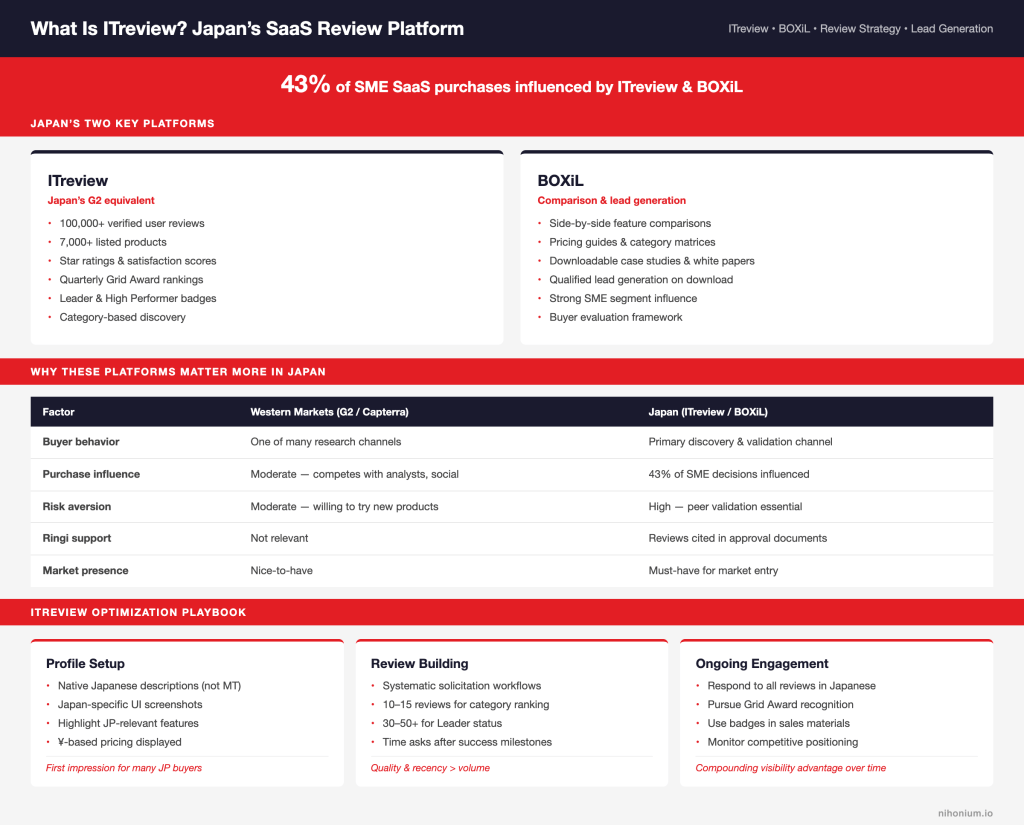
BOXIL’s business model is paid lead generation. Vendors pay a base fee of JPY 50,000 a month on a minimum one-year term, plus a fee per document request (shiryō seikyū, 資料請求) that varies by category; there is no free plan. When a buyer requests a vendor’s materials, BOXIL passes the request to the vendor as a lead. This makes BOXIL a direct pipeline contributor rather than only an awareness channel.
BOXIL is particularly useful with smaller companies, which often lack dedicated IT procurement teams and lean on online comparison to guide their choices. Its category pages, comparison tables and BOXIL Magazine articles give these buyers a structured way to narrow their options before they speak to a vendor.
How Much Review Sites Influence Japanese Buyers
There is no independent market statistic for how many Japanese SaaS purchases review sites influence. The most detailed recent data comes from ITreview’s own operator, so read it as such. In its March 2026 survey of 300 people involved in IT purchases, 37.7% of those who answered had found candidate products on IT comparison or review sites (web search was the most common route, at 47.3%), 79.7% of those asked always or usually check user reviews, and 87.4% said that too few reviews had led them to drop a product or lower its priority. The survey’s own note says that people involved in IT purchases over-represent users of comparison sites.
The influence shows at two stages of the buying journey. At the discovery stage, buyers browse categories on ITreview or BOXIL to see which products exist; a product that does not appear there may never enter the consideration set, whatever its standing elsewhere. At the validation stage, buyers who met a product through other channels (partners, events or direct outreach) check its reviews before they decide. A product with few or no Japanese reviews raises questions, while one with solid reviews and ratings receives an implicit endorsement.
How to Optimize Your ITreview Listing
For SaaS companies entering Japan, an ITreview listing is cheap to start: the free plan includes a product page and review collection, and ITcrowd says it prepares the page within a few business days of the application. Make it an early task, before your sales effort needs the reviews.
A complete product profile is the foundation. Write it in native Japanese (not machine-translated), use screenshots of the localized interface, highlight the features and integrations that matter to Japanese users, and give prices in yen. For many Japanese buyers the profile is the first real encounter with the product, and its quality decides whether they look further.
Review volume needs a plan. ITreview’s own advice to vendors is to create a review campaign and ask the customers you know best, through your sales and customer success teams, to write a review. Ask after a successful go-live or a positive support interaction. Every review is checked by ITreview’s screening team before it is published: reviewers register with their real name and company, the company affiliation is checked, and reviews of your own or a competitor’s product are not allowed.
Responding to reviews shows commitment to the Japanese market. Paid plans let vendors comment back on reviews; thoughtful, personal replies in Japanese signal that the company listens to its Japanese users, which counts in a relationship-driven business culture.
Grid Award badges are useful marketing assets. Products that earn “Leader” or “High Performer” badges can use them in Japanese marketing materials, sales decks and partner communications; reusing badges, reviews and comparison tables outside ITreview is a feature of the paid plans. Paid plans (annual contracts, per product, with a JPY 100,000 initial fee) run from JPY 150,000 a month (Basic) to JPY 250,000 (Pro) and JPY 400,000 (Expert), and add buyer intent data, lead capture and content reuse; the free plan allows a trial of up to three leads once a product has collected three reviews.
BOXIL Optimization and Lead Generation
Optimizing a BOXIL presence is about comparison positioning and lead generation content. Make sure the listing covers the feature criteria Japanese buyers use in your category; an incomplete feature list makes the product look weaker in comparisons even when it has the missing capabilities.
Downloadable materials drive BOXIL leads, because a lead is a request for your documents. White papers, case studies, ROI calculators and implementation guides written in Japanese for Japanese concerns give buyers a reason to ask for them, and each request arrives with the buyer’s contact details. BOXIL’s review guidelines also matter: reviews paid for or solicited by the vendor are not allowed outside review campaigns run jointly with SmartCamp.
Japanese case studies are particularly persuasive on BOXIL. Buyers want evidence that the product works in Japanese organizations, with results described in terms that fit the Japanese business context. One well-written Japanese case study is worth more than several translated global ones. And because you pay per lead, answer every request within a business day, in Japanese.
Integration with Broader Japan Marketing Strategy
ITreview and BOXIL should not be treated as standalone channels but as part of a broader Japan marketing plan. Content on these platforms should match the messaging on your Japanese website, in advertising, at events and in partner materials. Review data (sentiment, competitive position and lead metrics) should feed product priorities, customer success work and positioning decisions.
Consistent investment compounds. As reviews accumulate and ratings hold up, the product becomes easier to find and easier to shortlist, which brings more customers and, in turn, more reviews. Our guide to Japanese SaaS review sites compares ITreview, BOXIL and the smaller platforms, and the BOXIL guide covers BOXIL’s plans and review rules in detail.
Key Takeaways
- ITreview is Japan’s main B2B software review platform: About 16,000 products, 166,000 reviews and 944 categories (live counter, November 2026); IT teams use it to research, compare and shortlist software.
- Reviews support internal approval: Champions can use ITreview ratings and reviews as third-party evidence during nemawashi (根回し, informal consensus-building) and in the ringi (稟議, formal approval) document.
- Grid position drives visibility: A product appears on the ITreview Grid once it has more than three reviews; Leader and High Performer badges go to products with at least ten reviews in the category, every quarter.
- Screened reviews need active customer engagement: ITreview checks every reviewer’s company and every review, so building a review base means asking real Japanese customers, through a review campaign, at the right moment.
- Reviews affect shortlists: In ITreview’s March 2026 survey, 87.4% of buyers asked said too few reviews had led them to drop a product or lower its priority.
Working with Nihonium. We are a Japan go-to-market partner for B2B SaaS companies: sales and marketing funnel (awareness, SEO, local leads) and Japan go-to-market strategy. Talk to us about your Japan entry.
Sources
- ITcrowd, ITreview: live counter of products, reviews, categories and users (19 November 2026).
- ITcrowd, How the ITreview Grid is calculated: satisfaction and recognition scores, the review threshold, Leader and High Performer (revised February 2024).
- ITcrowd, ITreview for vendors and plans: free listing, review screening, review campaigns, paid plans (27 October 2026).
- ITcrowd, IT product selection white paper: survey of 300 people involved in IT purchases, March 2026.
- SmartCamp, BOXIL service page: listed services, members, plans and pricing (updated 10 November 2026).
Frequently Asked Questions
How do we get our product listed on ITreview?
Apply for a free listing on ITreview’s vendor site; ITcrowd prepares the product page within a few business days, and you complete the Japanese description, prices and features. The free plan covers the product page and review collection. Reuse of reviews and badges, intent data and lead capture are paid features, on annual contracts from JPY 150,000 a month per product. Write the profile in natural Japanese, not machine-translated text, because it is what buyers see first.
How many reviews do we need to be competitive on ITreview?
A product appears on the category Grid once it has more than three user reviews, and it can win a Grid Award badge once it has at least ten reviews in that category. Beyond that ITreview publishes no target, and crowded categories need more. Recent reviews count more than old ones, so collect reviews steadily rather than in a single push.
How does ITreview compare to G2 or Capterra?
ITreview was launched in partnership with G2 and uses a similar grid, but its reviews come from Japanese users at Japanese companies, in Japanese. Japanese buyers checking a product in Japan will find those reviews, not your English ones, so a strong G2 presence does not replace ITreview. Keep both, and give ITreview priority for your Japan plan.
Can ITreview reviews help with the ringi approval process?
Yes. Champions can attach ITreview ratings, reviews and Grid Award status to the ringi document as third-party evidence, and use them in their nemawashi conversations with stakeholders. Reviews from companies of a similar size or industry are the most persuasive; ITreview shows ratings by company size. Our guide to ringi decision-making explains what the approval document needs.