

When entering the Japanese SaaS market, tone is everything. It’s not just about translating your content into Japanese – it’s about using the right tone to show respect, build trust, and align with cultural expectations. Missteps in tone can hurt your credibility and derail potential deals. Here’s what you need to know:
- Trust is key: Japanese buyers prioritize long-term partnerships and value a sense of safety (anseikan). Aggressive or casual messaging can harm trust.
- Language matters: 72% of Japanese users prefer product information in Japanese. But it’s not just translation – formality and professionalism are crucial.
- Cultural alignment: Japanese audiences respond better to humble, detailed communication that emphasizes harmony (wa) over bold claims.
To succeed, SaaS companies must master Japanese speech levels (keigo, teinei-go, and plain form), respect business hierarchies, and tailor their tone to align with local norms. Using professional localization services and testing your content can help you avoid costly mistakes and build lasting trust.
Japanese Speech Levels and Business Communication
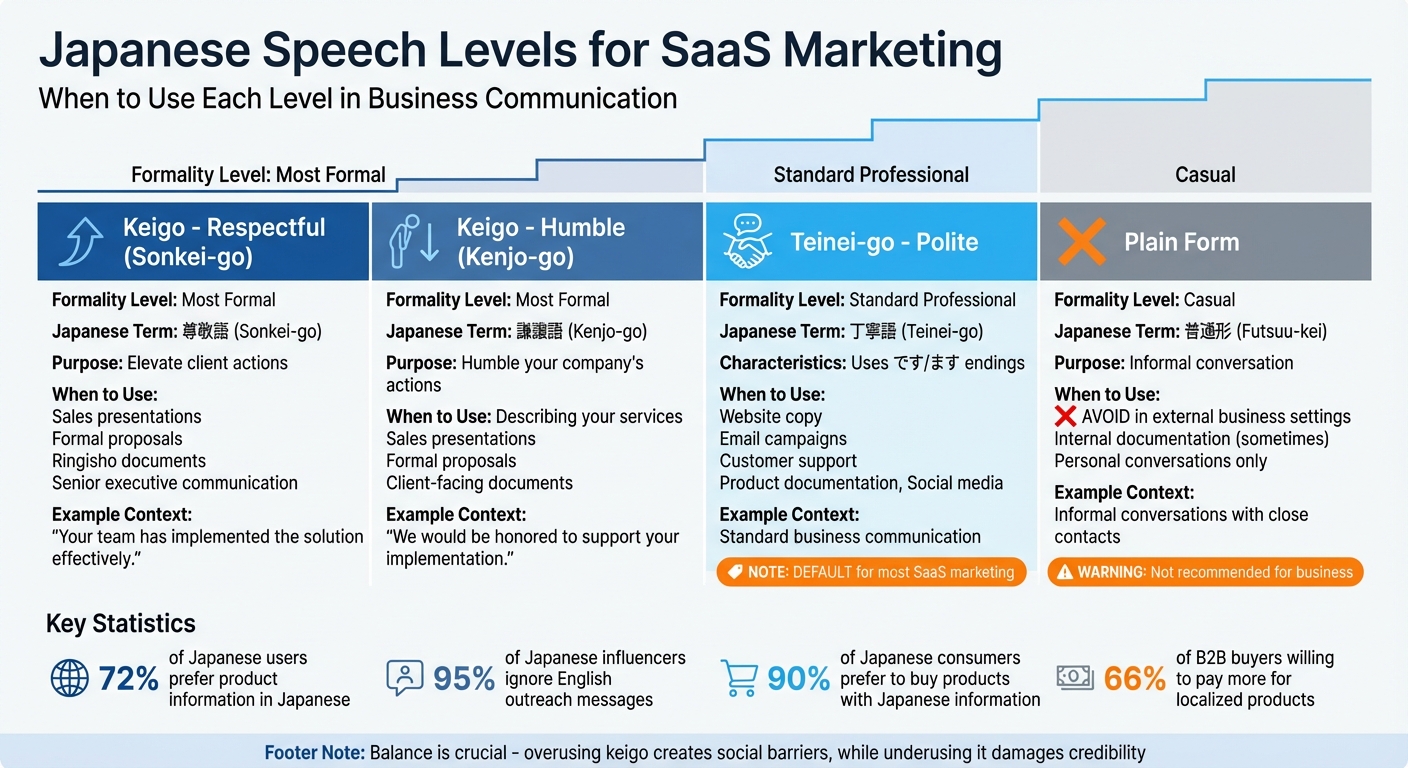
Japanese Speech Levels Guide for SaaS Marketing
In Japanese, speech levels play a crucial role in determining how professional and respectful your communication comes across. For SaaS marketing, understanding these levels is essential – getting them wrong can harm your brand’s image.
There are three primary speech levels in Japanese: Keigo (honorific speech), Teinei-go (polite speech), and Plain form. Each serves a specific purpose:
- Keigo is the most formal and respectful, used in situations requiring deep deference.
- Teinei-go, characterized by desu and masu endings, is the standard for professional communication.
- Plain form is casual and reserved for personal conversations with close friends or family.
Mixing these levels inappropriately can signal a lack of understanding of Japanese business etiquette, which could negatively impact how your brand is perceived.
Keigo: Formal Business Communication
Keigo is divided into two distinct systems: Sonkei-go (respectful language) and Kenjo-go (humble language). These systems reflect the uchi-soto (inside–outside) dynamic, where you elevate the client (Sonkei-go) while humbling your own company (Kenjo-go).
For SaaS companies, keigo is critical in materials like sales presentations, proposals, and documents reviewed through the Ringisho process. This process involves collective decision-making by senior executives and procurement committees, who expect a high degree of formality. As Argos Multilingual explains:
"A certain level of politeness must be maintained. You will not find informal writing on a website though, even if the ‘tone’ of the company in English is very relaxed".
However, overusing keigo can backfire. Cassandra Ling from FluentU points out:
"Overusing keigo can create a social barrier, making communication overly formal and distant. Balance is crucial".
Polite and Plain Forms: When to Use Each
For most SaaS marketing efforts, Teinei-go should be your default. It strikes the right balance – professional yet approachable – and works well for website content, email campaigns, customer support, and general documentation.
Avoid Plain form in external business communication. Even if your English branding leans casual, using plain form in Japanese can come across as unprofessional or even disrespectful. The only exception might be internal technical documentation, but many companies still prefer polite form to maintain consistency and respect.
A growing trend among modern SaaS companies is adopting what some call "friendly formality." This involves using polite form (Teinei-go) while incorporating a warm, approachable tone. It’s particularly effective for customer support and social media, where the goal is to be respectful yet engaging.
Here’s a quick reference for when to use each speech level:
| Speech Level | Japanese Term | When to Use | Example Context |
|---|---|---|---|
| Respectful | Sonkei-go | Describing client actions | "Your team has implemented the solution effectively." |
| Humble | Kenjo-go | Describing your company’s actions | "We would be honored to support your implementation." |
| Polite | Teinei-go | Standard business communication | Website copy, support emails, product documentation |
| Plain | Plain form | Avoid in external business settings | Informal conversations or internal use (if appropriate) |
Understanding these speech levels is key to aligning your SaaS marketing tone with Japanese business norms. Up next, we’ll dive into how these language subtleties tie into broader cultural preferences and market behaviors.
sbb-itb-a752276
How Japanese Culture Shapes Tone Preferences
Understanding Japanese speech levels is just the beginning. The real challenge lies in grasping why some tones resonate while others fall flat. Two key concepts – wa (harmony) and hierarchy – play a central role in shaping how Japanese audiences respond to SaaS marketing. Let’s explore how these cultural pillars influence tone and messaging preferences.
Wa and Indirectness: The Preference for Harmony
Wa, which translates to social harmony, is at the heart of Japanese communication. It emphasizes subtlety, group well-being, and avoiding conflict. For SaaS marketers, this means that bold, assertive tactics often miss the mark. Kohei Nagao, a Japanese influencer marketing expert, explains:
"brand campaigns, particularly those that are designed with Western-style assertiveness, can sometimes feel too aggressive or off-putting to Japanese audiences".
Direct calls to action like "Buy this now" disrupt the sense of wa. Instead, successful campaigns use softer, more inviting language that respects the buyer’s independence. For example, phrases like "I’ve noticed it getting popular lately" perform better because they invite consideration without applying pressure. This aligns with the honne vs. tatemae dynamic – balancing private feelings (honne) with a socially acceptable public facade (tatemae). Marketing that respects tatemae provides straightforward, non-aggressive information, allowing buyers to rationalize their decisions privately, which enhances SaaS engagement.
Social harmony also explains Japan’s heavy reliance on social proof. Since making a poor choice can lead to social embarrassment, buyers tend to seek validation through reviews, adoption rates, and collective opinions. Roughly 70% of Japanese consumers prefer brands that genuinely reflect local values and cultural nuances. This cultural alignment is also fueling Japan’s influencer marketing industry, which is expected to reach ¥86 billion (around $570 million) by 2025.
Some SaaS brands even incorporate kawaii (cute) elements to make complex products more approachable. This strategy reflects wa principles by softening the presentation of enterprise software and making it more relatable. Beyond harmony, Japan’s structured business hierarchy also shapes tone preferences in significant ways.
Hierarchy and Formality: Understanding Social Structures
Japanese business culture is deeply rooted in hierarchy, and this structure heavily influences tone and messaging. Just as proper speech levels convey respect, marketing must also acknowledge these hierarchical frameworks. Decisions in Japanese businesses are rarely made by one person; instead, they go through a consensus-driven process called Ringisho, involving multiple stakeholders at different levels. Effective marketing materials need to appeal to this diverse buying committee, which often includes executives who control budgets but may never directly use the product.
Formality is essential to respect this hierarchy. Japan Intercultural Consulting notes:
"the level of formality maintained directly reflects the respect shown toward a prospective client, partner, or stakeholder".
Mistakes in keigo (formal Japanese) or overly casual language can tarnish a brand’s credibility, signaling a lack of commitment to understanding the market. For instance, 95% of Japanese influencers ignore outreach messages written in English, as unnatural phrasing raises doubts about the sender’s cultural awareness.
The numbers highlight this preference for localization: 90% of Japanese consumers prefer to buy products with information presented in Japanese – far higher than the global average of 76%. Additionally, only 50% of Japanese buyers would choose a global brand over one with proper Japanese-language content, compared to a global average of 69%. In B2B scenarios, 66% of buyers are even willing to pay more for localized products to ensure accurate instructions and support. This isn’t just about translation; it’s about demonstrating respect for the hierarchical and cultural frameworks that define Japanese business relationships.
What Happens When Tone Doesn’t Match Expectations
Understanding the nuances of language is one thing, but failing to match your tone to Japanese expectations can have far-reaching consequences. In Japanese SaaS marketing, even slight missteps in tone can disrupt the entire customer journey – from the first interaction to long-term loyalty. When your messaging misses the mark, it signals a lack of cultural awareness, which can undermine trust and, ultimately, your bottom line.
Effects on Engagement and Conversion Rates
A mismatched tone can stop conversions in their tracks. Japanese buyers are quick to notice improper phrasing or an unsuitable level of formality, and this can make them question your commitment to the market.
The data is clear: 40% of Japanese consumers will completely avoid buying products if the information isn’t provided in their native language. Even more striking, only 50% of Japanese buyers would choose a well-known global brand over a competitor offering properly localized content – compared to a 69% global average. This goes beyond just language; tone plays a key role in demonstrating respect and understanding.
Research highlights how critical trust is in this context. Trustworthiness accounts for 52% of the variability in whether users recommend a brand, while friendliness contributes only 8%. Efforts to appear "friendly" through playful or overly casual tones can backfire, especially in Japan’s consensus-driven B2B environment. In decision-making processes like Ringisho, where multiple stakeholders weigh in, even one person’s discomfort with your tone can derail the entire deal.
The damage isn’t limited to conversions. Over time, tone misalignment can erode trust, leaving a lasting impact on customer relationships.
Customer Retention and Loss of Trust
While the effects on conversions are immediate, the long-term damage caused by tone missteps can be even more severe. Getting the tone wrong doesn’t just cost you a sale – it can harm ongoing relationships. In Japan, business culture prioritizes stability and partnership over quick wins. Missteps like using the wrong keigo (formal language) in support materials or overly casual communication can make your company seem unreliable.
As Kate Moran, Senior Vice President at Nielsen Norman Group, explains:
"Tone of voice is a powerful tool for influencing that perception of trustworthiness, and the right tone to evoke trust will differ based on your users and their concerns".
The financial stakes are high. 66% of B2B buyers in Japan are willing to pay more for properly localized products. This isn’t just about translation – it’s about showing you understand their needs and are committed to providing accurate instructions and reliable local support. When your tone feels off, it raises doubts about your long-term dedication to the market and your ability to offer consistent support.
Mistakes like using incorrect honorifics, pushing overly aggressive sales tactics, or responding too casually in support interactions can chip away at trust. Over time, these missteps add up, reinforcing doubts about your understanding of Japanese business norms and increasing the likelihood of customer churn.
Ultimately, refining your tone isn’t just about making a good first impression – it’s about ensuring sustainable success in the market.
How to Get Tone Right in Japanese SaaS Marketing
Getting the tone just right in Japanese SaaS marketing isn’t something you can leave to chance. The companies that succeed in Japan treat tone as a core business function rather than an afterthought. Here’s how to ensure your messaging connects with Japanese audiences and delivers real results.
Professional Localization Services
Translation alone won’t cut it. To truly resonate with Japanese audiences, you need professional localization services that go beyond words. Companies like Nihonium specialize in transcreation – adapting your message to fit Japanese values like harmony (wa) and humility. This involves navigating complex linguistic nuances, such as the correct use of honorifics (keigo), choosing between formal and casual speech, and ensuring your tone conveys trustworthiness rather than pushiness.
Why is this so important? Consider this: only 50% of Japanese consumers would opt for a major global brand over a product with information in their own language. That’s far below the global average of 69%. This isn’t just about language; it’s about showing commitment. Nihonium‘s services – ranging from product localization to marketing funnel creation and tailored market entry strategies – help SaaS companies craft messages that highlight craftsmanship (monozukuri), steady improvement, and partnership. The result? Your brand is seen as a dependable partner, not an overbearing outsider.
Once your content reflects these cultural adjustments, the next step is customizing your tone for different audience segments.
Segmenting Audiences for Tone Customization
Different audiences in Japan expect different tones. For example, enterprise clients typically require highly formal keigo and indirect phrasing that respects hierarchy and group dynamics. In contrast, younger tech users or startup audiences might prefer a more casual and approachable tone.
To get this right, segment your audience based on demographics, communication preferences, and behaviors. Business leaders may respond best to ROI-driven case studies with formal language, while mid-level managers might prefer straightforward guides with simpler phrasing. Similarly, platforms like Yahoo! Japan are better suited for formal tones, whereas a friendlier tone works well on LINE.
This isn’t just theory – it works. Japanese SaaS campaigns that tailor tone by channel and audience segment often see noticeable improvements in lead quality and funnel speed. Even small tweaks, like adjusting phrasing, can lead to significant engagement boosts.
After segmenting and tailoring your messaging, the next step is to test and refine it using data.
Testing and Refinement: Using Data to Improve Tone
Data is your best friend when it comes to fine-tuning your tone. A/B testing lets you compare different levels of formality (keigo versus polite forms), phrasing, imagery, and trust-building elements like Japanese testimonials across various channels – emails, landing pages, and ads. Even subtle adjustments, like kanji choices or color schemes, can affect key metrics like click-through rates (CTR), conversion rates, and customer acquisition cost (CAC).
Keep an eye on Japan-specific metrics, such as lead quality and funnel velocity, to gain deeper insights. Regular multivariate testing helps you continuously optimize your tone while reinforcing your brand’s cultural credibility.
Feedback is just as important. Use surveys, support interactions, and analytics to spot tone mismatches – for instance, low engagement caused by overly direct messaging. Adjust accordingly by incorporating more humility or precision. This iterative process builds on your localization and segmentation efforts, ensuring your tone remains respectful and effective. By combining these feedback loops with professional localization, you can keep your messaging aligned with local expectations and maintain trust across all touchpoints.
Case Studies: Companies That Got Tone Right
When it comes to tailoring tone for a specific market, a few companies have nailed it in Japan. These examples show how adapting communication styles to meet local expectations can lead to impressive growth and stronger customer relationships.
Take Mackerel, for instance. This Japanese infrastructure monitoring SaaS, developed by Hatena, saw a staggering 487% customer growth in just its second full year. How? By focusing on a localized user interface and providing dedicated support. This was during a time when global competitors like Datadog and New Relic had yet to fully optimize their offerings for the Japanese market.
Slack, on the other hand, adjusted its approach by adopting formal business communication to align with Japan’s work culture. Recognizing the importance of keigo (honorific language) in Japanese B2B communication, Slack ensured its messaging met the high standards of politeness required in this context. Even small mistakes in this area can damage credibility, so this adjustment was critical.
Then there’s Stripe, which localized its website to establish trust and build a stronger local presence. Stripe understood that Japanese consumers are far more likely to engage with products presented in their native language. In fact, B2B buyers in Japan are often willing to pay more for localized offerings that include clear instructions and dependable support.
Before and After: Performance Metrics
The impact of these localization efforts is evident in several key metrics:
| Metric Category | Pre-Adjustment | Post-Adjustment | Source |
|---|---|---|---|
| Customer Growth | Baseline | 487% increase in one year (Mackerel) | |
| Language Preference | 50% choose a global brand | 90% prefer products in their own language | |
| Lead Acquisition | Standard rates | Higher with native case studies | |
| Customer Retention | Baseline | 12% higher with regional KPI monitoring | |
| Price Sensitivity | Standard pricing | 66% willing to pay a premium for localization |
For companies that actively monitor regional KPIs and adjust their tone accordingly, the results are clear. Retention rates in new markets improve by 12%, and localized case studies lead to better lead acquisition. These numbers highlight how aligning tone and messaging with local expectations doesn’t just drive growth – it builds trust and keeps customers coming back. These success stories underscore the importance of culturally attuned communication for long-term success in Japan.
Conclusion
In the world of Japanese SaaS marketing, tone isn’t just a detail – it’s the foundation for building trust and credibility. As Naoki Togawa from Nikkei Business Publications points out, using polished, idiomatic Japanese communicates a genuine commitment to the market. Research backs this up: content crafted in the local language with culturally relevant messaging plays a major role in winning over both consumers and B2B clients in Japan.
Tone influences every step of the customer journey. Using keigo (respectful language) appropriately shows respect and dedication, while messaging that highlights collective well-being over individual achievements aligns perfectly with values like wa (harmony). Clear, professional communication also supports Japan’s consensus-driven decision-making process. This makes it clear that tailoring your language to fit cultural norms isn’t just a nice-to-have – it’s a must at every touchpoint.
By embracing principles like keigo and wa, companies that invest in high-quality transcreation and master the subtleties of Japanese communication often see better customer retention and can command premium pricing. The message is simple: adapt your tone to fit Japanese expectations, or risk being perceived as an outsider lacking genuine commitment.
For SaaS businesses aiming to succeed in Japan, working with experts who understand these cultural and linguistic nuances can be a game-changer. The Japanese market rewards those who take the time to get it right. Ready to elevate your approach? Partner with specialists like Nihonium to connect meaningfully with local audiences and build lasting success.
FAQs
How can SaaS companies use keigo effectively in Japanese marketing?
To use keigo effectively in Japanese SaaS marketing, focusing on respect and cultural sensitivity is essential. Your communication should reflect an understanding of Japanese etiquette, particularly when addressing decision-makers or executives. Polite and humble expressions are key. For instance, phrases like "Our company humbly offers…" or "We will strive to meet your expectations" showcase professionalism and humility.
Avoid using direct refusals or overly assertive language. Instead, opt for softer, indirect expressions such as "We will carefully consider your request" or "We kindly ask for your understanding." These phrases help maintain a respectful tone while addressing potentially sensitive topics. Including seasonal greetings, like "As spring approaches," in emails can also demonstrate thoughtfulness and align with traditional Japanese communication styles.
Consistency matters. Ensure that this respectful tone carries across all platforms – whether it’s your website, emails, or customer support interactions. Doing so strengthens trust, reinforces your brand’s alignment with Japanese cultural norms, and fosters stronger engagement.
Why is cultural alignment important for gaining trust in the Japanese SaaS market?
Building trust in the Japanese SaaS market involves much more than simply translating your content into Japanese – it requires a deep understanding of local business values and practices. In Japan, trust, quality, and respect are cornerstones of professional relationships. Decision-making often follows a careful, step-by-step approval process, with an emphasis on consensus. A direct or overly global tone might feel too aggressive or insincere, making it challenging to connect on a meaningful level.
To build lasting relationships, companies should prioritize polite and respectful communication, adopt an indirect approach when necessary, and align with local business etiquette. This effort isn’t limited to language – it extends to adapting product interfaces and marketing strategies to reflect Japanese norms and expectations. By showing genuine respect and a willingness to embrace these values, businesses can establish themselves as dependable, long-term partners for Japanese clients.
How does localization enhance engagement with Japanese customers?
Localization is key to engaging with Japanese customers effectively. It ensures that content, products, and experiences align with their language and cultural nuances. By communicating in their native language and meeting local expectations, businesses can build trust, lower website abandonment rates, and boost customer engagement, ultimately driving purchase intent.
For SaaS companies, localization isn’t just about translating words – it’s about tailoring marketing strategies, user interfaces, and customer support to connect with Japanese consumers. This thoughtful adaptation not only strengthens customer loyalty but also establishes your brand as a dependable, customer-centric solution in the Japanese market.
Related Blog Posts
- Japanese Email Etiquette for SaaS Companies
- Study: Impact of Cultural Nuances on SaaS Partnerships in Japan
- Why Long-Term Commitment Matters in Japan SaaS Sales
- How Japanese Culture Shapes SaaS Messaging
 English
  Japanese