
Ringi (稟議) is the formal approval process in Japanese organizations in which a written proposal, the ringisho, circulates through every manager the decision affects for their seal of approval; together with nemawashi, the informal one-on-one alignment that comes before it, it shapes how SaaS products are evaluated, approved and bought in Japanese enterprises, and it is the main reason enterprise deals take longer than in Western markets.
Understanding the Ringi System
The word has two parts: “rin” stands for submitting a proposal to one’s superior and receiving approval, and “gi” for deliberation and decision (Sagi, “Ringi System,” International Journal of Management and Humanities, 2015). Ringi is usually described as bottom-up. Unlike Western procurement, where a single decision-maker or a small buying committee can approve a purchase, ringi requires a formal written proposal, the ringisho (稟議書), which is drafted and then circulated through the departments and management levels the decision affects.
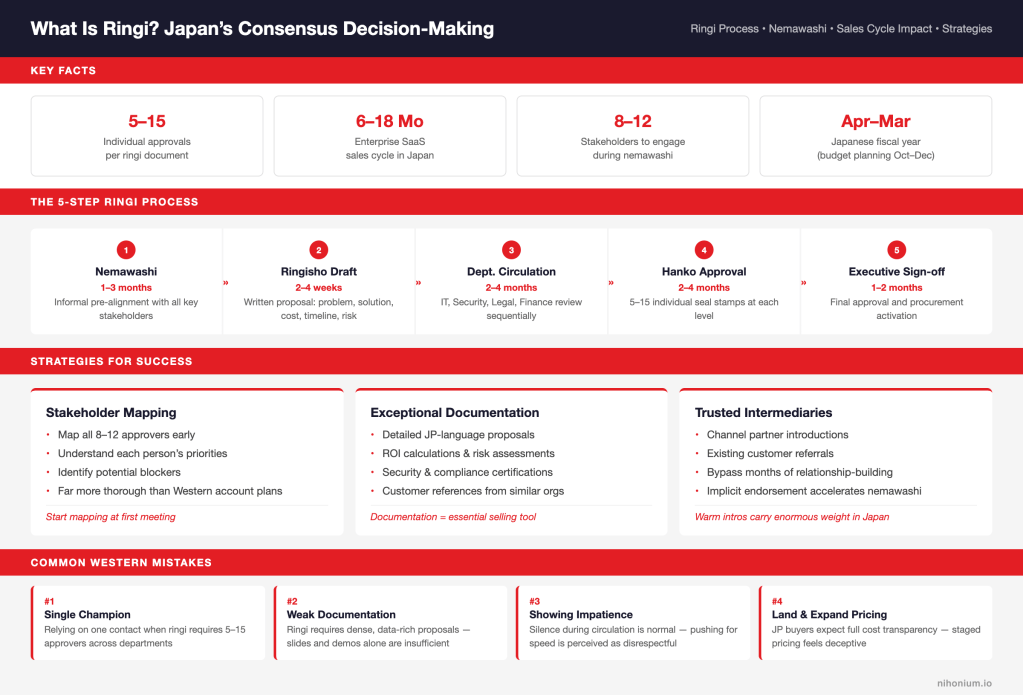
The process usually starts lower in the organization. Even when the idea comes from a senior manager, it is typically handed to a subordinate to propose. The originator drafts the ringisho, and in doing so frames the question: the problem, the proposed solution, the vendors compared, the cost, the implementation plan and the risks. The document then passes from approver to approver. Each one reviews it and affixes a personal seal (hanko, 判子) to show approval. An approver with concerns can send it back for revision, and the originator may have to modify and resubmit it. Japan Intercultural Consulting notes subtler signals too: a seal stamped upside down to register displeasure, or a ringisho left sitting in a desk drawer as a quiet veto. When the president or the final approver signs off, the decision is final.
For a significant SaaS purchase, the chain may include the requesting department, IT, information security, legal and compliance, finance and one or more executives. How many approvers there are, and how long each takes, depends on the company, its approval rules (often tied to the amount) and the time of year; there is no reliable public figure. Many companies now route the ringisho through an electronic workflow rather than paper stamps. The form changes; the logic does not.
The Role of Nemawashi
If ringi is the formal mechanism of Japanese decision-making, nemawashi (根回し, informal consensus-building) is its informal counterpart, and arguably the more important of the two. The word comes from horticulture: before a large tree is moved, the roots are dug around and cut back so that it survives the transplant. In business it means talking to each stakeholder privately before the proposal is formally put forward. Our nemawashi glossary entry covers the practice in detail.
The purpose of nemawashi is to surface concerns, build alignment, gather input and make sure the formal proposal goes through smoothly. A ringisho that meets objections during circulation is usually a sign that the groundwork was incomplete. The expectation is that substantive concerns are raised and settled during nemawashi, so that the ringi itself mostly confirms what has been agreed; the EU-Japan Centre for Industrial Cooperation describes the decision reaching the top as “confirmed (rather than made)”.
Effective nemawashi means identifying everyone who will approve or influence the decision, understanding each person’s priorities and likely concerns, framing the proposal in terms of their interests, folding their feedback into the proposal before it is submitted, and building the goodwill that carries the proposal and the vendor behind it.
For SaaS vendors, this means a Japanese sale involves more people than a typical Western enterprise deal, even when the first contact is a single champion. The vendor does not run the buyer’s internal nemawashi; the champion does. The vendor can support it from outside, including meetings with individual stakeholders when the champion arranges them.
Impact on SaaS Sales Cycles
Nemawashi and ringi make Japanese enterprise sales cycles longer than Western ones. No reliable public statistic measures by how much, so plan with assumptions you can test against your own pipeline: two to three quarters from first meaningful contact to a signed contract for mid-market deals, and nine months to a year or more for enterprise deals. Deals with regulatory questions or deep integration can take longer.
The time divides into recognizable phases rather than fixed durations. In the first, the vendor establishes credibility, demonstrates the product and starts to map the people who will influence the purchase. In the second, the champion, supported by the vendor’s materials, builds alignment through nemawashi; the number of departments involved and how quickly the vendor answers questions set the pace. Then the ringisho circulates, at a speed set by the length of the approval chain and the company’s budget calendar. Procurement, legal review and contract signature follow approval. Our guide to how nemawashi shapes B2B SaaS deal cycles covers the planning side.
These timelines are hard for SaaS companies used to closing within a quarter. But they are a structural feature of how Japanese companies decide, not a sign of disinterest. Western urgency tactics, such as artificial deadlines, limited-time discounts or escalating to an executive over the champion’s head, usually backfire: Japanese buyers read them as pressure and as a sign that the vendor does not understand how they work.
Common Mistakes Western SaaS Companies Make
SaaS companies that enter Japan without understanding ringi and nemawashi tend to make the same mistakes. The most common is relying on a single champion. In Western enterprise sales, finding and empowering a strong internal champion is a proven strategy. In Japan a champion is necessary but not sufficient: the ringisho has to pass people outside the champion’s direct influence.
Another frequent mistake is underinvesting in documentation. The ringisho needs written justification: ROI, risks and how they are mitigated, and how the vendors compare. Vendors who rely on a persuasive presentation and a demo, without the detailed written material Japanese approvers expect, find their proposals stalling during circulation.
Impatience may be the most damaging error. When a deal goes quiet for weeks, Western sales teams may assume it is dead and move on. In reality the ringisho may be circulating, with no visibility from outside. Patient, regular follow-up that does not feel pushy is essential, and doing it well takes cultural fluency.
Unclear pricing also causes problems. Japanese buyers want the full cost picture up front: implementation fees, support costs and the price of extra seats or upgrades. Land-and-expand pricing, where the first deal is small and revenue grows through upselling, can create distrust if buyers feel the first quote was incomplete, and every later increase may need a new ringi.
Strategies for Navigating Ringi Successfully
Companies that get through ringi in Japan share several practices. First, they map stakeholders early: with the champion, they identify everyone who must approve or will influence the decision, and what each person cares about. This goes well beyond the account planning typical of Western enterprise sales.
Second, they provide strong documentation in Japanese that answers the questions approvers are likely to raise: technical architecture, security and compliance certifications, where data is stored, service levels, references from comparable organizations and an implementation plan. Third-party evidence such as reviews on ITreview can go into the ringisho as well. These materials are not afterthoughts: the champion reuses them directly, and they decide how smoothly the document circulates.
Third, they use trusted intermediaries. An introduction from a respected third party, such as a channel partner, a consulting firm or an existing customer, carries weight in Japanese business and can shorten the relationship-building that cold outreach would need.
Fourth, they set the right rhythm. Instead of pushing for frequent meetings and fast answers, effective sellers in Japan keep steady, respectful contact: regular updates, considered follow-ups and quick replies to requests for information. That consistency signals the reliability and long-term commitment Japanese buyers look for. The EU-Japan Centre’s advice to outsiders is direct: identify the key stakeholders, take part in the informal side of the relationship, and ask them how nemawashi for your proposal should be done and what data the ringi will need.
The Long-Term Payoff
Ringi and nemawashi make sales cycles longer, but they also bring benefits. An approved ringisho represents real organizational agreement, not the preference of a single executive. Because the people affected agreed before the contract was signed, implementation tends to be quick: Sagi notes that implementation is fast because agreement has already been reached, and the EU-Japan Centre describes implementation after approval as swift and hardly ever questioned. Customers who have taken a SaaS purchase through ringi have invested organizational capital in it and want the rollout to succeed. The patience ringi requires is an investment in a customer relationship that is built to last.
Key Takeaways
- Ringi is a formal written approval process: A ringisho circulates to every manager the decision affects, each of whom approves with a hanko (or in an electronic workflow); the number of approvers depends on the company and the amount.
- Nemawashi determines ringi outcomes: The informal consensus-building before the ringisho is submitted largely decides whether it is approved; the formal step confirms rather than makes the decision.
- Sales cycles are longer by design: As a planning assumption, not a statistic, give mid-market deals two to three quarters and enterprise deals nine months to a year or more; the time builds commitment, and implementation after approval tends to be quick.
- Champions need specific ringi support: Equip your champion with Japanese-language ROI analyses, security documentation, vendor comparisons and reference customers that can go straight into the ringisho.
- Budget cycles create natural windows: The national government and most large Japanese companies run an April to March fiscal year, and IT budgets for the coming year are usually settled between January and March; check each prospect’s year-end and time the ringisho to it.
Working with Nihonium. We are a Japan go-to-market partner for B2B SaaS companies: Japan go-to-market strategy. Talk to us about your Japan entry.
Sources
- Sagi, S., “Ringi System”: The Decision Making Process in Japanese Management Systems: An Overview. International Journal of Management and Humanities, Vol. 1, Issue 7, April 2015. The meaning of ringi, how the ringisho circulates, and why implementation is fast.
- Japan Intercultural Consulting, How do the Japanese put in their two cents? Ringi! (Rochelle Kopp). How the ringisho circulates and how nemawashi precedes it.
- EU-Japan Centre for Industrial Cooperation, From Understanding to Navigating Japanese Business Culture (Martin Glisby, January 2018). Nemawashi, the ringi system, and how outsiders can influence decisions.
Frequently Asked Questions
How long does a typical ringi approval take?
There is no standard duration: it depends on how many approvers the chain has, how many departments the decision touches and where the company is in its budget year. A ringisho backed by thorough nemawashi moves much faster than one submitted without it, while one that meets unresolved concerns can be sent back for revision, adding weeks or months. Ask your champion how ringi works in their company and plan around the answer.
What should a ringi document include for a SaaS procurement?
A ringisho for a SaaS purchase usually covers the business problem and the proposed solution, a comparison of vendors, the total cost of ownership, the implementation plan and resources, a security and compliance assessment, and references from similar companies. It is written in formal Japanese and follows the company’s own template. Third-party evidence, such as ITreview ratings and Japanese customer case studies, strengthens it.
Can we speed up the ringi process?
You cannot bypass ringi, but you can help it move: support thorough nemawashi and give your champion ready-made materials that answer each approver’s likely concerns. Timing the submission to the budget cycle helps, and a pilot or proof of concept before the full purchase can build momentum. Rushing the process or applying pressure signals a lack of understanding and usually backfires.
What happens if a ringi is rejected?
Outright rejection is uncommon, because nemawashi is meant to surface and resolve objections before the ringisho is submitted. A ringisho that comes back is usually returned for revision, with specific concerns for the originator to address, and can then be resubmitted. A real rejection usually points to a basic problem with fit, price or competitive position, which calls for a rethink rather than resubmitting the same proposal.