
Nemawashi (根回し, informal consensus-building) is the Japanese business practice of building agreement among stakeholders through one-on-one or small-group conversations before a formal proposal or decision is presented, so that objections are surfaced and resolved in private and the formal meeting confirms a decision rather than debating it.
Origins and Meaning
The word combines 根 (ne, root) and 回し (mawashi, going around). It comes from horticulture: a year or two before a large tree is moved, the gardener digs around it and cuts back the spreading roots so that the tree grows fine new roots close to the trunk and survives the transplant. The business sense, preparing the ground before a negotiation or meeting so that it goes smoothly, grew out of that image (Kotobank, from the Digital Daijisen and Heibonsha dictionaries). The metaphor holds: before an idea is moved into the formal decision process, the people around it are prepared one by one.
Nemawashi is not a social nicety. It is an organizational practice rooted in a business culture that values wa (和, harmony), consensus, and saving face over speed and individual initiative. The EU-Japan Centre for Industrial Cooperation describes it as a respected, constructive activity that keeps information flowing, discourages disharmony, removes unwanted surprises, and avoids loss of face. For companies selling into Japanese enterprises, understanding it is a basic requirement.
How Nemawashi Works in Practice
In a typical Japanese enterprise, a decision such as adopting a new SaaS platform does not start with a formal vendor presentation or an RFP. It follows a sequence:
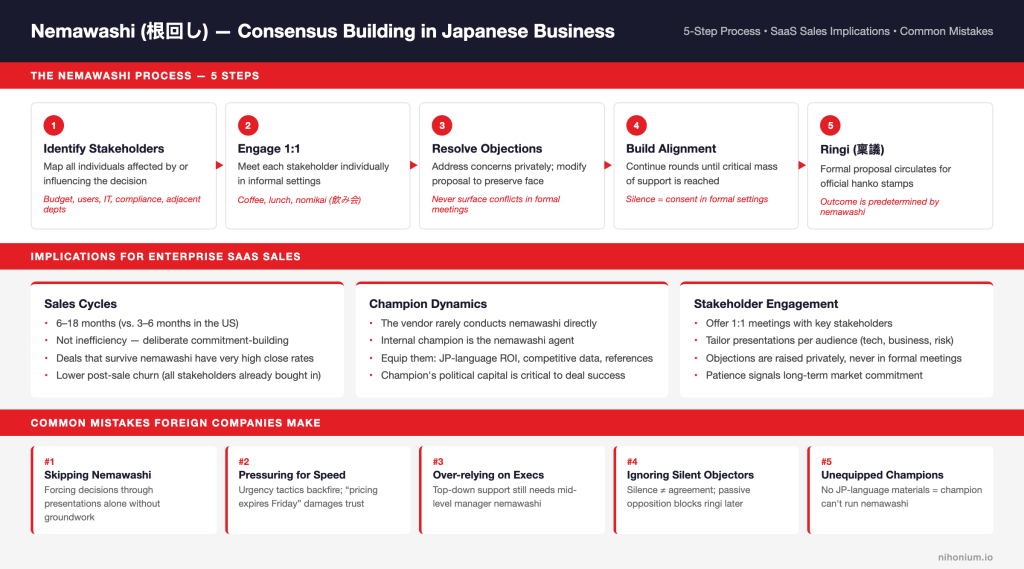
Step 1, Identify Stakeholders: The internal champion (with the vendor’s sales team, where the champion invites it) maps everyone who will be affected by the decision or can influence it. In Japanese enterprises this group is often wider than Western companies expect: not only the budget holder and end users but also adjacent department heads, IT security, compliance, and sometimes senior executives who will never use the product.
Step 2, Individual Conversations: The champion meets each stakeholder individually, often informally: over coffee, at lunch, or at after-work drinks (nomikai, 飲み会). These conversations explain the proposal, uncover each person’s concerns and priorities, gauge support, and identify likely objections.
Step 3, Address Objections Privately: Concerns are handled through further one-on-one conversations, more information, or changes to the proposal. The goal is to resolve disagreements before they become public: openly opposing a proposal in a formal meeting costs both the proposer and the objector face, so conflicts are settled behind the scenes.
Step 4, Build Sufficient Support: The champion continues until enough stakeholders support the proposal, or at least no longer oppose it. In the formal meeting that follows, the absence of objection is read as agreement, which is why objections have to come out earlier, in private. Silence during nemawashi itself is not agreement.
Step 5, Formal Proposal: Once nemawashi is substantially complete, the proposal goes into ringi (稟議, the formal approval process): a written proposal, the ringisho (稟議書), circulates to each stakeholder for their hanko (判子, personal seal). By then the outcome is largely settled; as the EU-Japan Centre puts it, the decision reaching the president or executive committee is confirmed rather than made.
Nemawashi and the Ringi System
Nemawashi and ringi work together as the backbone of Japanese corporate decision-making. Nemawashi is the informal, relationship-driven phase that builds consensus. Ringi is the formal, document-driven phase that records and authorizes the decision. Proposals usually start with middle managers and circulate to every manager affected by the decision, which is why the system is described as bottom-up and participatory (Sagi, IJMH, 2015). More on the formal side is in our ringi glossary entry.
A common mistake foreign companies make is to focus on the ringi document itself (impressive proposals, detailed specifications, ROI analyses) while neglecting the nemawashi that decides whether the ringi is approved. A polished ringisho submitted without enough nemawashi stalls, comes back for revisions, or is quietly shelved. A simple ringisho backed by thorough nemawashi can move quickly.
The ringisho passes through every approver on the chain, and each can hold it. If one approver has concerns that were not addressed during nemawashi, the document can be returned for revision and the whole process delayed by weeks or months. Many companies now route the ringisho through an electronic workflow instead of paper stamps; the EU-Japan Centre cites Astellas as one example. The form changes, the logic does not.
Why Nemawashi Matters for Enterprise SaaS Sales
For SaaS companies selling into Japanese enterprises, nemawashi shapes sales strategy, cycle length, and deal success:
Sales cycles are longer: Nemawashi adds time, which is a large part of why Japanese enterprise deals take longer than comparable deals in the US. This is not bureaucratic inefficiency but a deliberate process of building organizational commitment, and the implementation that follows approval tends to be swift and rarely questioned (EU-Japan Centre). Our guide to how nemawashi shapes B2B SaaS deal cycles covers the planning side.
Your champion is your nemawashi agent: The vendor does not run the buyer’s internal nemawashi; the internal champion does. The champion’s political capital, organizational knowledge, and communication skills therefore decide much of the outcome. Equipping the champion with the right materials (Japanese-language ROI analyses, competitive comparisons, security documentation, reference customers) directly supports their nemawashi.
Multiple stakeholder touchpoints are essential: While the champion leads, the vendor can support the process by offering to meet key stakeholders individually when the champion arranges it, providing tailored presentations for each audience (technical for IT, business value for management, risk for compliance), and answering information requests quickly. Each of these touchpoints is a small round of nemawashi.
Objection handling happens off-stage: In Western sales, objections often come up in group presentations or negotiation sessions. In Japan, serious objections are raised privately during nemawashi. A concern raised in a formal meeting usually means nemawashi was incomplete. Sales teams have to seek out likely objections through their champion rather than wait for them to surface.
Patience signals commitment: Japanese enterprises read a vendor’s willingness to go through a long, consensus-driven process as evidence of commitment to the market. Pushing for a quick close or showing frustration with the timeline suggests the vendor may not be a reliable long-term partner.
Nemawashi in Different Contexts
Nemawashi is most visible in enterprise procurement, but the practice runs through Japanese business:
Partnership development: Before formalizing a channel partnership or SIer (systems integrator) relationship, the partner runs its own nemawashi. Several stakeholders must agree before the partner commits resources.
Product decisions: The Japanese team of a foreign SaaS company will often do nemawashi before proposing product changes, localization requirements, or pricing adjustments to headquarters.
Internal corporate decisions: Hiring, budget allocation, reorganizations, and strategic initiatives all go through nemawashi inside Japanese companies.
Government and regulatory: Work with regulators, industry associations, or government agencies also involves building relationships and consensus before formal submissions.
Common Mistakes Foreign Companies Make
SaaS companies unfamiliar with nemawashi often make mistakes that damage their prospects in Japan:
Skipping nemawashi: Trying to force a decision with a compelling presentation alone, without the groundwork of individual stakeholder engagement.
Pressuring for speed: Using urgency tactics (“this pricing expires Friday”) or showing impatience with the decision timeline. These tactics backfire in Japan and can permanently damage the relationship.
Over-relying on senior executives: Assuming that a senior executive’s endorsement is enough to close a deal. Even strong top-down support needs nemawashi with the middle managers who control implementation and budget details.
Ignoring silent objectors: Mistaking silence for agreement. A stakeholder who does not voice support during nemawashi may be quietly opposed and can block the ringi later.
Failing to equip champions: Not giving the internal champion the Japanese-language materials, competitive data, and reference customers they need to carry the proposal on the vendor’s behalf.
Practical Considerations for SaaS Companies
Nemawashi may be the most important concept for a foreign SaaS company to absorb before entering Japan. It explains why sales cycles are longer, why relationships matter as much as features, and why deals that close tend to stick. Companies that build their Japan go-to-market around supporting nemawashi, rather than fighting it, do better. The EU-Japan Centre’s advice to European managers is practical: identify the key stakeholders, take part in the informal side of the relationship, share what you know openly, and then ask the stakeholders directly how nemawashi for your proposal should be done and what data the ringi will need.
Key Takeaways
- Nemawashi is fundamental, not optional: For SaaS companies selling into Japanese enterprises, understanding and supporting nemawashi is a basic requirement; a proposal that skips it tends to stall in ringi.
- Your champion conducts nemawashi on your behalf: The vendor does not run the buyer’s internal nemawashi; the champion does, which makes champion enablement with Japanese-language materials critical.
- Silence does not mean agreement: A stakeholder who does not voice support during nemawashi may be quietly opposed; seek out and address likely objections through the champion.
- Patience signals commitment: Japanese enterprises read willingness to go through consensus-building as evidence of long-term commitment; urgency tactics backfire and can permanently damage relationships.
- Nemawashi explains the sales cycle: The longer enterprise sales cycle is a deliberate process of building commitment, and implementation after approval tends to be swift.
Working with Nihonium. We are a Japan go-to-market partner for B2B SaaS companies: Japan go-to-market strategy. Talk to us about your Japan entry.
Sources
- EU-Japan Centre for Industrial Cooperation, From Understanding to Navigating Japanese Business Culture (Martin Glisby, January 2018). Nemawashi, the ringi system, and how outsiders can influence decisions.
- Japan Intercultural Consulting, How do the Japanese put in their two cents? Ringi! (Rochelle Kopp). How the ringisho circulates and how nemawashi precedes it.
- Sagi, S., “Ringi System”: The Decision Making Process in Japanese Management Systems: An Overview. International Journal of Management and Humanities, Vol. 1, Issue 7, April 2015.
- Kotobank, 根回し (nemawashi). Dictionary entries for the horticultural and business meanings.
Frequently Asked Questions
How can we support our champion’s nemawashi efforts?
Give your champion Japanese-language materials for each stakeholder’s concerns: ROI analysis for the budget holder, security documentation for IT, compliance answers for legal, and user testimonials for end-user departments. Offer to meet key stakeholders individually when appropriate, framed as informational rather than sales conversations. Answer information requests quickly, because delays stall the process, and check in with your champion regularly to understand progress.
How do we know if nemawashi is progressing well?
Good signs include your champion asking for specific materials for different stakeholders, invitations to present to more departments, detailed technical or compliance questions, and stakeholders accepting meeting requests directly. Warning signs include long silence, generic positive feedback without next steps, no access to key decision-makers, and a champion who struggles to get colleagues’ attention. When progress stalls, the cause is usually an objector nobody has identified yet.
Does nemawashi apply to SMB sales in Japan?
Nemawashi is most pronounced in enterprise and government sales but exists in some form across Japanese business. In smaller organizations the process is shorter and involves fewer people, but the principle of informal consensus before a formal decision still applies: even in small companies, the main contact usually consults a few colleagues before committing. Sales cycles are correspondingly shorter than in enterprise, though often longer than a comparable US SMB sale.
Is nemawashi changing with younger Japanese professionals?
Younger professionals, especially those with international experience, may communicate more directly, but nemawashi remains embedded in how organizations decide. Even in startups, informal consensus-building comes before formal decisions. The methods change (video calls instead of after-work drinks, electronic ringi workflows instead of paper stamps), while the principle of preparing stakeholders before a formal proposal has held up across generations.