
Nemawashi (根回し, informal consensus-building) is the process by which stakeholders in a Japanese company align behind the scenes before any formal proposal, and it is the main reason B2B SaaS deal cycles in Japan run longer than in Western markets.
If you have pitched a B2B SaaS product to a Japanese enterprise and wondered why the deal went quiet after a promising first meeting, you have probably met nemawashi. The term means “going around the roots” and comes from horticulture: a year or two before a large tree is moved, the roots are dug around and cut back so that it survives the transplant. In business, nemawashi is the methodical, informal work of building consensus among everyone involved before a proposal reaches a formal decision point. It feeds ringi (稟議, the formal approval process), in which proposals usually start with middle managers and circulate to every manager the decision affects; one overview of the system stresses that formal approval comes with “a great involvement of employees at all levels” (Sagi, “Ringi System,” International Journal of Management and Humanities, 2015). That makes it fundamentally different from top-down Western procurement. For SaaS companies entering a Japanese SaaS market that Research Nester puts at over USD 12.2 billion in 2025, understanding nemawashi is not optional: it is often what decides whether a deal closes or stalls.
How Nemawashi Works Inside a Japanese Enterprise
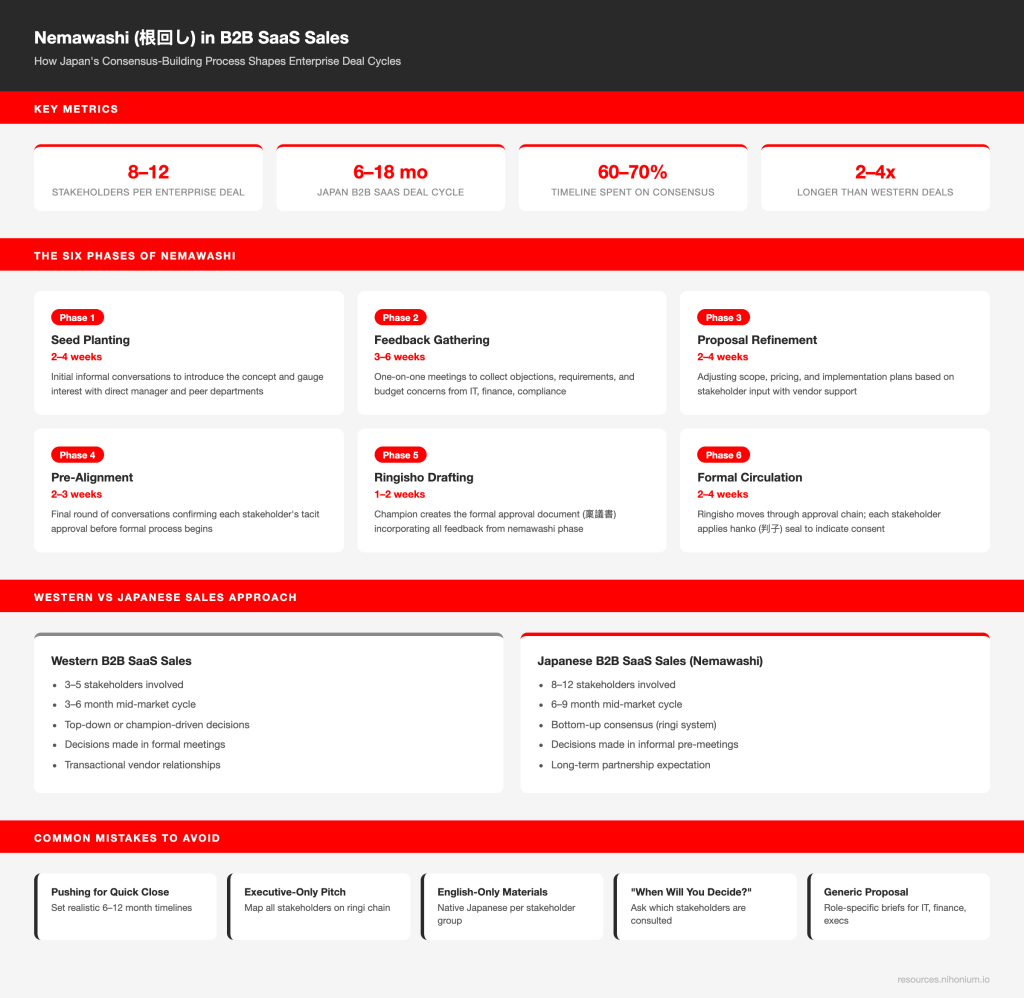
Nemawashi runs through a sequence of one-on-one stakeholder conversations that build consensus layer by layer before the formal ringi document ever circulates.
In a Western sale, a champion often pushes a proposal through procurement with an executive sponsor. A Japanese organization needs broad horizontal and vertical alignment before any written proposal moves. The process unfolds in phases, each requiring patience and cultural fluency from the seller.
It usually begins when an internal champion, often a department manager (buchō, 部長) or section chief (kachō, 課長), sees value in a SaaS product. Rather than drafting a formal proposal at once, the champion starts a series of private conversations with every stakeholder who will later need to approve the ringisho (稟議書, the formal approval document). These conversations do three things: test receptivity, surface objections early, and fold feedback into the proposal before it becomes official.
Expect each key stakeholder to be consulted more than once. A first conversation introduces the idea, a later one refines it with that person’s feedback, and a final one confirms their tacit agreement. Only when this signals broad alignment does the champion draft the ringisho and circulate it for formal hanko (判子, personal seal) approval.
| Nemawashi Phase | Activities | Stakeholders Involved | What Sets the Pace |
|---|---|---|---|
| Seed Planting | Initial informal conversations to introduce the concept and gauge interest | Direct manager, one or two peer departments | The champion’s standing and how urgent the problem is |
| Feedback Gathering | One-on-one meetings to collect objections, requirements, and budget concerns | IT department, finance, compliance, end users | The number of departments and how quickly the vendor answers questions |
| Proposal Refinement | Adjusting scope, pricing, and implementation plans based on stakeholder input | Champion and vendor (external SaaS team) | How fast the vendor can adapt scope, pricing, and documentation in Japanese |
| Pre-Alignment | Final round of conversations confirming each stakeholder’s tacit approval | All approvers on the ringi chain | The slowest or most skeptical approver |
| Ringisho Drafting | Champion writes the formal approval document incorporating all feedback | Champion with vendor-supplied materials | Whether the vendor’s materials can be reused directly |
| Formal Circulation | Ringisho moves through the approval chain; each stakeholder applies a hanko or approves in an electronic workflow | All signatories, from junior to senior management | The length of the chain and the company’s budget calendar |
Nemawashi vs. Western B2B Sales: Why Timelines Diverge
Japanese enterprise SaaS deals involve more stakeholders and more rounds of consultation than comparable Western deals, so they take longer.
The structural differences between nemawashi-driven procurement and Western sales explain why foreign SaaS companies so often underestimate Japan deal timelines. In Western B2B SaaS, a single economic buyer or a small buying committee often drives the decision. In Japan, most of the elapsed time goes into consensus-building before anything formal happens, and the formal step largely confirms what has already been agreed: the EU-Japan Centre for Industrial Cooperation describes the decision reaching the top as “confirmed (rather than made)”.
| Dimension | Western B2B SaaS Sales | Japanese B2B SaaS Sales (with Nemawashi) |
|---|---|---|
| Deal cycle (mid-market) | Shorter; often set by the buyer’s quarter | Longer; plan on two to three quarters |
| Deal cycle (enterprise) | Several months | Plan on nine months to a year or more |
| Number of stakeholders involved | A small buying committee | Every manager affected by the decision, across departments |
| Decision-making style | Top-down or champion-driven | Bottom-up consensus (ringi system) |
| Where decisions are actually made | In formal meetings and review calls | In informal pre-meeting conversations (nemawashi) |
| Role of formal meetings | Debate, negotiate, and decide | Confirm what has already been informally agreed |
| Post-decision commitment level | Variable; churn risk in the first year | High; consensus creates durable organizational buy-in |
| Relationship expectation | Transactional; a vendor can be replaced at renewal | Long-term partnership; several trust-building meetings before the deal moves |
The longer timeline is not wasted time. The consensus built through nemawashi means the organization has bought into the solution before the contract is signed, and the implementation that follows approval tends to be swift and rarely questioned (EU-Japan Centre).
How Global SaaS Companies Can Navigate Nemawashi
Success requires equipping your internal champion with the right materials, mapping every stakeholder on the ringi chain, and planning the timeline around that chain rather than around your own quarter.
A foreign vendor does not run the buyer’s internal nemawashi. You will not be in the room when your champion makes the case to colleagues, although you can support the process from outside, including meetings with individual stakeholders when the champion arranges them. That makes champion enablement the most important variable in your Japan go-to-market execution.
Identify and Map the Full Stakeholder Chain
Before your first formal presentation, work with your champion to map everyone who will need to approve or consent to the purchase. In Japanese enterprises this usually spans the requesting department, IT security and compliance, the finance or budget office, and at least one layer of executive management. Build your timeline from that map: each additional department adds its own round of conversations, and a buffer for reorganizations or extra consultations is prudent.
Arm Your Champion for Internal Conversations
Your champion needs department-specific value propositions, not a single generic pitch deck. Prepare separate one-page briefs for IT (security, integration, data residency), finance (TCO, ROI timeline, billing flexibility), end users (ease of adoption, Japanese-language UI), and executives (strategic alignment, competitive positioning). All materials should be in native-level Japanese; machine-translated documents undermine credibility immediately.
Respect the Process and Track Progress Indirectly
Asking “When will you make a decision?” signals that you do not understand the process and can damage trust. Ask instead “Which stakeholders have you been able to speak with so far?” or “Is there any additional information that would help your internal discussions?” These questions respect the process while giving you visibility into the deal.
| Common Mistake | Why It Fails in Japan | Recommended Alternative |
|---|---|---|
| Pushing for a quick close | Undermines the consensus process and signals impatience | Plan the timeline around the approval chain and resource accordingly |
| Presenting only to the executive sponsor | Skips the bottom-up consensus required by the ringi system | Map and prepare materials for every stakeholder on the approval chain |
| Using English-only sales materials | Creates friction in every nemawashi conversation your champion has | Provide native Japanese materials tailored to each stakeholder group |
| Asking “When will you decide?” | Seen as pressure and culturally tone-deaf | Ask which stakeholders have been consulted and what information they need |
| Sending a single generic proposal | Fails to address department-specific concerns surfaced during nemawashi | Create role-specific one-pagers for IT, finance, end users, and executives |
| Treating the deal as closed after verbal agreement | Verbal agreement comes before the formal ringi circulation, which takes time of its own | Keep supporting your champion through the ringisho approval phase |
Key Takeaways
Five lessons for SaaS companies navigating nemawashi in Japan.
- Nemawashi is where deals are won or lost. In Japanese enterprise sales, formal meetings confirm decisions already made through informal consensus-building.
- Plan for longer deal cycles. As a planning assumption, give mid-market deals two to three quarters and enterprise deals nine months to a year or more; no reliable public statistic exists, so test these against your own pipeline.
- Your champion enablement strategy is your sales strategy. The vendor does not run the buyer’s internal nemawashi. Success depends on equipping your champion with native-language, stakeholder-specific materials.
- Longer timelines produce stronger outcomes. The consensus achieved through nemawashi means the organization has bought into the solution before the contract is signed.
- Local market expertise prevents the most common failures. The mistakes that kill Japan deals come from applying Western sales playbooks in a consensus-driven market. For the definition and origins of the practice, see our nemawashi glossary entry.
Working with Nihonium. We are a Japan go-to-market partner for B2B SaaS companies: Japan go-to-market strategy. Talk to us about your Japan entry.
Sources
- Sagi, S. “Ringi System”: The Decision Making Process in Japanese Management Systems: An Overview. International Journal of Management and Humanities, Vol. 1, Issue 7, April 2015.
- EU-Japan Centre for Industrial Cooperation. From Understanding to Navigating Japanese Business Culture (Martin Glisby). January 2018.
- Research Nester. Japan Software as a Service (SaaS) Market Size and Growth Outlook 2035.
- Kotobank. 根回し (nemawashi). Dictionary entries.
- GLOBIS Europe. The Invisible Hand: How Nemawashi Shapes Every Decision in Japan. 2025.
Frequently Asked Questions
What is the difference between nemawashi and ringi?
Nemawashi is the informal, behind-the-scenes consensus-building in which stakeholders are consulted one by one and their support secured. Ringi is the formal approval mechanism that follows: a written proposal, the ringisho, circulates through the organization and each approver affixes a hanko (or approves electronically) to indicate consent.
How long does a typical B2B SaaS deal take to close in Japan?
No reliable public statistic exists, so plan with assumptions you can test: two to three quarters from first meaningful contact to signed contract for mid-market deals, and nine months to a year or more for enterprise deals. The difference from Western markets comes from the time Japanese organizations spend on consensus-building before the formal ringi starts.
Can a foreign SaaS company participate directly in nemawashi?
Not in the buyer’s internal nemawashi, which happens between colleagues. You can still shape it: identify and equip an internal champion with stakeholder-specific materials, ROI data, and answers to likely objections in native-level Japanese, and meet individual stakeholders when the champion arranges it. The EU-Japan Centre’s advice to outsiders is to ask key stakeholders directly how nemawashi for the proposal should be done and what data the ringi will need.
Is nemawashi still relevant for smaller Japanese companies and startups?
The formal ringi process is most common in large enterprises, but the instinct toward consensus persists across most Japanese organizations. Even at startups and SMBs, decision-makers consult key colleagues informally before committing to a SaaS purchase, though deal cycles are usually shorter than in enterprise.