

If you sell SaaS in Japan, the deal is often decided before formal approval starts. In many enterprise deals, nemawashi comes first, then ringi follows. That helps explain why sales cycles often run 6 to 12 months, why a champion’s “yes” does not mean budget is set, and why deals can still stall late.
Here’s the short version:
- Nemawashi = private internal alignment across teams
- Ringi = formal written approval through the company chain
- Most vendor influence is earlier, during private internal talks
- Most delay risk shows up later, when the proposal is routed for approval
- Japanese buying groups may involve 8 to 12 stakeholders
- Formal approval may need 5 to 15 sign-offs
- Formal circulation alone can take 2 to 4 months
If I were running a Japan pipeline, I’d read deals this way: champion support matters, but internal alignment matters more. I’d also give the buyer two sets of materials: short Japanese-language internal share-outs for nemawashi, and formal proposal, pricing, ROI, and security files for ringi.
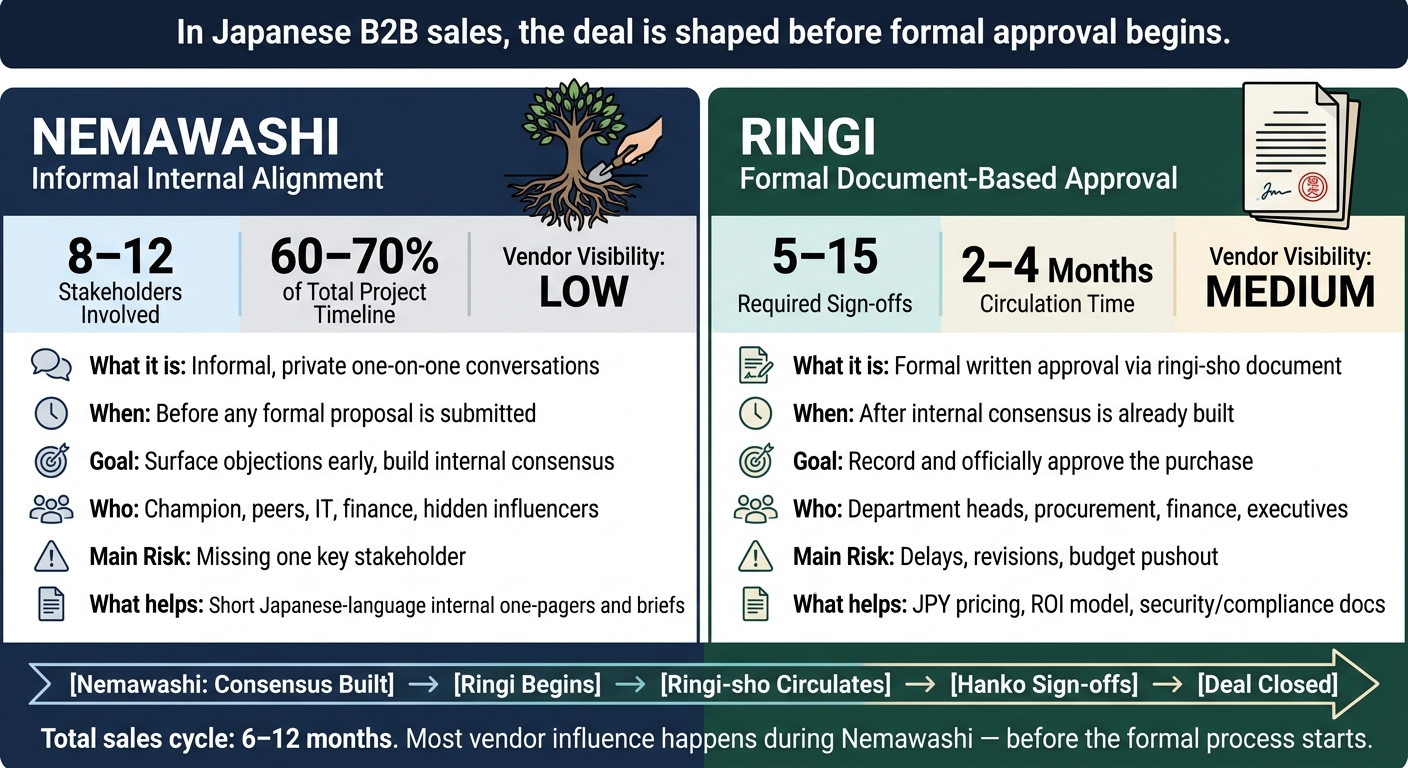
Nemawashi vs. Ringi: Japan B2B Deal Stages Explained
Quick Comparison
| Area | Nemawashi | Ringi |
|---|---|---|
| What it is | Informal internal alignment | Formal approval process |
| When it happens | Before a formal request | After internal support is built |
| Main goal | Surface concerns early | Record and approve the purchase |
| Who is involved | Champion, peers, IT, finance, hidden influencers | Department heads, procurement, finance, executives |
| Vendor visibility | Low | Medium |
| Main risk | Missing one key person | Delays, revisions, budget pushout |
| What helps most | Short internal-facing Japanese materials | Proposal docs, ¥ pricing, ROI, security answers |
Bottom line: I’d treat nemawashi as the point where the deal is shaped, and ringi as the point where weak spots get exposed. The practical move is simple: help your champion carry the deal through both stages with the right materials, timing, and expectations.
sbb-itb-a752276
Nemawashi: Informal Alignment Before Formal Approval
Nemawashi literally means "preparing the roots" before transplanting a tree. In a business setting, it means getting people aligned before a proposal goes in for formal approval.
In plain English, nemawashi is a string of private one-on-one conversations. These talks are often led by an internal champion, like a section chief or department manager, to surface concerns and build support early. For vendors, this is often where deal control is shaped behind the scenes, because internal backing starts to form before the formal approval process even begins.
"Nemawashi literally means going around the roots, a gardening term for preparing soil before transplanting a tree. In business, it refers to informally consulting all key stakeholders before making a formal proposal, ensuring no one is surprised." – Yuga Koda, Co-Founder, Nihonium
By the time a proposal reaches an official review, much of the result has already been shaped through nemawashi. The meeting often just confirms what those earlier conversations already settled. Once that alignment is in place, the proposal moves into ringi.
How Nemawashi Works Inside Enterprise Buying Groups
In a typical SaaS deal, B2B buying patterns in Japan involve nemawashi with business owners, IT, security, finance, and executive management. Each group looks at the purchase from its own angle, so the champion works through concerns one by one. This usually happens in separate, low-pressure conversations, not in one big meeting.
Nemawashi often includes 8 to 12 stakeholders, which is far more than in many Western deals. The aim is broad alignment before anyone makes a public commitment.
This is also where things get hard for vendors. Hidden influencers can matter just as much as formal approvers. A long-tenured senior manager or a trusted internal advisor may not show up on any org chart, but that person can still shape whether the proposal feels safe or risky. Strong nemawashi takes these people into account, even when they are hard to spot from the outside.
What Vendors Can and Cannot See During Nemawashi
Most of nemawashi happens out of sight. Internal objections, scope changes, and pricing adjustments usually stay inside the buyer’s organization. At this stage, vendors help from the sidelines by giving internal champions the material they need to share across teams.
Some common signals show up again and again:
- Requests for Japanese-language material for different departments
- Role-specific questions from stakeholders the vendor has not met
- Repeated delays in scheduling a formal decision meeting
"Nemawashi is where deals are won or lost." – Yuga Koda, Co-Founder, Nihonium
If one key stakeholder was left out, the proposal may need to be revised before it can move into ringi.
Ringi: Formal Approval Through the Ringi-sho
Once nemawashi has done its job, the deal moves into ringi – the formal, document-based approval stage.
At the center of this process is the ringi-sho (稟議書), an internal written proposal that routes the purchase request through the company’s approval chain. Each reviewer – usually from the requesting department, IT, finance, procurement, or executive leadership – adds their hanko (personal seal) to show approval. If someone objects, the document goes back for revision and resubmission.
The key point is simple: the ringi-sho is not where the decision happens. It’s where the decision gets written down. Ringi turns earlier alignment into a formal paper trail.
What Goes Into a Ringi-sho for a SaaS Purchase
Because approval runs through documents, the vendor’s job is to give the internal champion material they can actually use.
A ringi-sho for a SaaS purchase usually follows a standard internal template. It covers the solution description, total cost and budget impact, implementation scope and timeline, security and compliance details, and expected ROI or productivity gains.
For global SaaS vendors, that means sending draft-ready inputs that are easy to drop into the template. In practice, that usually includes:
- A clean JPY pricing summary by license type and user count
- A simple ROI model with conservative assumptions that finance can verify
- A short Japanese vendor summary the champion can paste into the template
It also helps to send editable files – PowerPoint, Excel, and Word – so the champion can fit them to the company’s format and language.
Security and compliance documents need extra care. Japanese enterprises often ask for data residency details, access control mechanisms, certifications like ISO 27001 or SOC 2, and confirmation of compliance with Japan’s Act on the Protection of Personal Information (APPI).
A dedicated Japanese-language security overview, mapped to common IT review questions, can help keep the ringi-sho from getting stuck at the compliance stage.
Why Ringi Is More Visible but Still Not Fully in Vendor Control
Ringi is usually the first point where vendors get clear signs that a deal is moving through formal approval.
The customer starts asking for procurement documents: official quotations, vendor registration forms, Japanese-language quotations, vendor forms, and security questionnaires. They may mention "稟議" directly or say the document needs to circulate before the end of the fiscal year. Those are strong signs the deal has moved beyond informal alignment and into a structured purchasing process.
But visibility doesn’t mean control.
The circulation order, internal comments, and approval timing all stay inside the customer’s organization. A SaaS ringi-sho may require 5 to 15 approvals, and each review can take one to two weeks. The formal circulation alone can last two to four months, even after consensus has already been built.
"In reality, the proposal may be actively circulating through the ringi process with no external visibility to the vendor." – Yuga Koda, Co-Founder, Nihonium
New questions can show up at any point. Finance may ask for a multi-year total cost of ownership breakdown. IT may flag a data residency issue. Procurement may ask for extra competitive quotes.
When that happens, the ringi-sho goes back to the champion for revision. Once ringi starts, the vendor is dealing with objections, not steering the outcome. That handoff is where informal consensus turns into formal approval risk.
Nemawashi vs. Ringi: Purpose, Timing, and Deal Control
Nemawashi builds informal consensus. Ringi turns that work into a formal decision.
Put them side by side, and the shift in vendor influence becomes pretty clear:
| Aspect | Nemawashi | Ringi |
|---|---|---|
| Purpose | Build informal consensus and surface objections privately | Formalize the decision and assign accountability |
| Timing | Early to middle stages; often accounts for 60–70% of the total project timeline | Final stage; timing varies by approver chain |
| Stakeholders | Champion, peer departments, IT, finance, legal, informal influencers | Formal approvers from department head to executive |
| Communication style | Informal, one-on-one, often off-the-record | Formal, document-driven, sequential sign-off |
| Documentation | Informal briefs, one-pagers, internal slide decks | Ringi-sho and internal sign-offs |
| Vendor visibility | Low – much of the discussion happens behind closed doors | Medium – customers may reference internal approval or fiscal deadlines |
| Common risks | Missing a key stakeholder; misreading silent opposition | Stalling due to approvers encountering unexpected objections |
| Effect on deal timing | Determines whether the deal is viable internally at all | Finalizes the legal and financial commitment |
Why Ringi Usually Fails Without Successful Nemawashi
Once nemawashi sets the baseline, ringi tends to reveal what was missed. It usually doesn’t create buy-in from scratch.
In large Japanese enterprises, one executive sponsor usually can’t push a deal through ringi by force, which is a common challenge when entering the Japanese SaaS market. Approvers tend to assume the proposal has already been vetted quietly. If that work didn’t happen, they often won’t reject the deal head-on. Instead, they delay it, ask for more analysis, or push it into the next budget cycle.
That’s the painful part. If IT security, finance, or a skeptical division head wasn’t brought in during nemawashi, those objections often show up during ringi at the worst time. Then the ringi-sho goes back to the champion for changes, and the deal can lose months.
"Attempting to bypass informal consensus-building by going directly to the final decision-maker typically backfires and damages the relationship with the champion." – Yuga Koda, Co-Founder, Nihonium
How Each Stage Affects Forecast Confidence
For pipeline control, separate excitement from internal readiness.
Forecast confidence should reflect how many stakeholders are aligned, not how busy or optimistic the champion seems. Confidence only starts to move up when the ringi-sho is drafted, the approval path is clear, and a fiscal deadline is in sight.
How SaaS Vendors Should Support Both Stages in Japan
Once you understand that nemawashi comes before ringi, the vendor’s role gets a lot clearer. Your job is not to jump around the process. It’s to help the internal champion move through it.
Global SaaS teams usually don’t close Japanese enterprise deals on their own. Internal champions do. So the smart move is simple: give that champion what they need at each step of consensus-building, across both nemawashi and ringi.
Materials That Help During Nemawashi and Ringi
The materials that help during nemawashi are different from the ones needed for ringi. Send the wrong asset at the wrong time, and you make the champion’s job harder.
During nemawashi, champions need conversational, targeted content they can pass along in small, informal discussions. A short Japanese-language product overview, a one-page brief that addresses IT concerns, and a simple before-and-after workflow visual usually help far more than a generic sales deck. The point is to let each stakeholder understand the proposal in terms that make sense to them, without needing the vendor in the room. In many cases, messaging around reducing operational burden and fitting into existing workflows lands better than bold performance claims.
Once the deal moves from private alignment to formal approval, the format shifts. For ringi, champions need formal, structured documents that can be attached to or cited in the ringi-sho. That includes a Japanese-language proposal template with background, cost and contract terms in JPY, an implementation timeline, risk mitigation, and ROI logic. It also means having security and compliance materials ready for the checks buyers ask for, so IT and legal approvers don’t have to chase the vendor for answers in the middle of the process. Even a short approval chain can stall if key documents are missing.
One practical pricing note: default to annual contracts. Monthly billing can make budgeting harder and can signal less commitment.
Where Nihonium Fits in the Process
This is the point where localization matters most. Direct English-to-Japanese translation usually falls flat in both nemawashi and ringi. Nihonium tackles this by tying its support to the role vendors play at each stage, without trying to take control of the process.
For nemawashi, Nihonium localizes product overviews, internal summary decks, and targeted one-pagers into natural Japanese. That goes beyond language alone. It also covers framing, examples, and emphasis so the material fits Japanese business norms. For ringi, Nihonium helps prepare Japan-specific proposal templates and compliance collateral that match how ringi-sho documents are usually structured inside companies.
Beyond materials, Nihonium also offers fractional sales support. That means local experts can help co-strategize deals, advise on timing, and steer vendors away from pressure tactics that disrupt the customer’s internal process. Fractional support gives teams a way to localize materials and handle timing issues without building a full local team.
Conclusion: Informal Consensus First, Formal Approval Second
Nemawashi and ringi are not two versions of the same step. They happen in sequence, and that order does not change. Nemawashi decides whether internal buy-in exists in the first place. Ringi records and approves what people have already agreed on. If you skip nemawashi or try to rush past it, the deal usually slows down instead of speeding up. Objections that weren’t handled quietly tend to show up later, in the formal stage, when they’re harder to fix.
For global SaaS vendors, success in Japan comes down to one discipline: support the customer’s internal process instead of trying to swap in a Western sales motion. Equip your champion, localize your materials, and set timeline expectations around how Japanese enterprise buying actually works. In Japan, deals close when the internal groundwork is done, not when the pitch is loud.
FAQs
How can I tell if nemawashi is actually happening?
Because nemawashi happens behind the scenes, you usually won’t see it happen in plain view. But you can spot the clues. Your champion may ask for specific materials, ROI data, or clear answers to questions from IT, legal, or finance.
If you’re not sure where things stand, ask which stakeholders they’ve spoken with so far instead of pressing for a decision date. Silence – or "we will study this carefully" – often means the team is still building internal agreement.
Who usually owns the ringi-sho in a Japanese company?
Usually, an internal champion owns and drafts the ringi-sho. In most cases, that’s a department manager or section chief.
That person spots the need, collects input during nemawashi, puts together the proposal with ROI and rollout details, and then moves it through the approval process.
What should I send first to support a Japan SaaS deal?
First, create polished Japanese materials your internal champion can use to build support inside the company. That should include a master security questionnaire that covers:
- Data residency
- Encryption
- APPI compliance
Also include one-page Japanese briefs tailored to IT, finance, and executive stakeholders. Each brief should cover ROI, rollout timelines, and case studies that fit the audience.
Make sure the materials are professionally translated, business-ready, and easy to circulate for internal review and approval.
Related Blog Posts
- Nemawashi: Building Consensus in Japan
- Cultural Factors in Japanese Decision-Making
- Nemawashi vs. Ringi: Decision-Making Tools in Japan
- Checklist for Navigating Japanese Decision-Making
 English
 Japanese