
The review and comparison sites that matter most for B2B SaaS in Japan are BOXIL and ITreview: BOXIL lists more than 4,000 services and is built around lead generation, and ITreview carries about 166,000 user reviews of some 16,000 products and offers a free vendor listing.
Japanese B2B buyers do not evaluate software the way Western buyers do. Before they talk to a vendor, many IT managers and procurement teams compare products on Japanese-language comparison and review sites, read peer reviews and build internal confidence that the vendor is credible in Japan, not just globally. In a March 2026 survey of 300 people involved in IT purchases, run by ITreview’s operator, 37.7% of those who answered had found candidate products on IT comparison or review sites (web search: 47.3%), and 79.7% of those asked said they always or usually check user reviews when choosing an IT tool. For a foreign SaaS company entering Japan, a listing on the right sites is not a nice-to-have; it is part of the distribution channel.
How Japanese B2B SaaS Review Sites Work
Japanese review and comparison platforms are buyer-driven research environments where business users compare software, read peer reviews and request documents or demos, all in Japanese.
The sites differ in their business models, and the model shapes what a listing does for you. BOXIL and ITトレンド (IT Trend) are built around document requests (shiryō seikyū, 資料請求): a buyer asks for a product’s materials, and the vendor pays for the lead. ITreview, run in partnership with G2 since 2018, is built around user reviews and quarterly Grid Awards; a product appears on its Grid once it has more than three reviews, and paid plans add lead capture and buyer intent data. In both cases results depend on active management: review collection, complete Japanese product information and fast follow-up, not just a listing.
The platforms act as a trust layer between foreign vendors and Japanese buyers: a maintained Japanese listing with recent reviews signals commitment, language investment and peer validation.
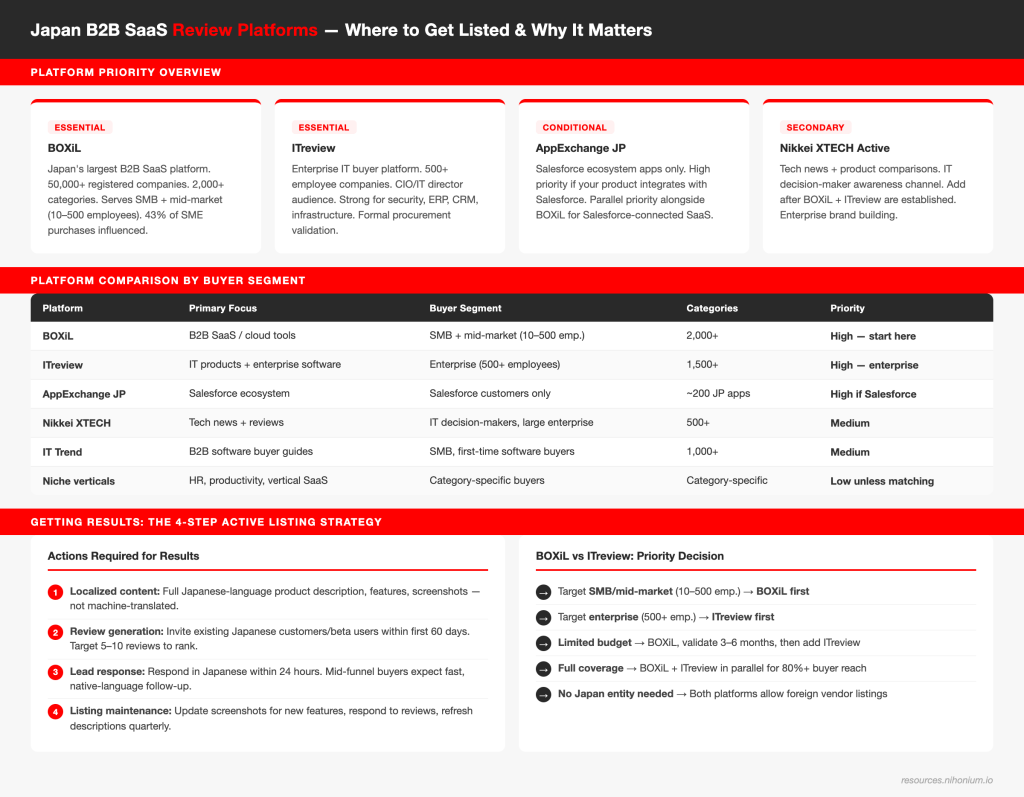
Japan SaaS Review Platform Comparison
Each platform serves a different part of Japan’s B2B software buying process. Knowing the differences tells you where to put limited localization and listing-management resources. Figures are the operators’ own, as published in 2025 and 2026.
| Platform | Primary Focus | Buyer Segment | Products Listed | Listing Priority |
|---|---|---|---|---|
| BOXIL | SaaS comparison and review site with document requests (SmartCamp) | Business users researching SaaS; 200,000+ members (November 2025) | 4,000+ services (November 2025) | High for inbound leads; paid only |
| ITreview | Software and cloud review site (ITcrowd, a joint venture of SB C&S and ITmedia; G2 partner) | IT and business users; about 210,000 users | About 16,000 products, 166,000 reviews, 944 categories | High, review credibility; free basic listing |
| Nikkei XTECH Active | Nikkei BP’s product information site, with white paper downloads | Decision-makers in IT, manufacturing and construction | Not published | Medium, awareness channel |
| AppExchange JP (Salesforce) | Salesforce ecosystem apps (now branded AgentExchange) | Salesforce customers only | No Japan count published | High, if Salesforce-integrated |
| IT Trend | B2B IT products with document requests (Innovation & Co., Innovation Inc. group) | Business users comparing IT products | 8,400+ products (2026) | Medium, secondary coverage |
| Niche vertical platforms | Vertical-specific (HR, productivity) | Category-specific buyers | Category-specific | Low unless matching vertical |
For most SaaS companies entering Japan, the order follows cost and readiness: open a free ITreview listing early and start collecting reviews, add BOXIL once you can answer document requests in Japanese within a day, then consider Nikkei XTECH Active for awareness with larger companies as budget permits. Products in the Salesforce ecosystem should treat the Japanese AppExchange storefront as a parallel priority.
BOXIL vs ITreview: The Priority Decision
BOXIL and ITreview cover the broadest part of Japan’s B2B SaaS buyer market, but they do different jobs. Which comes first depends on whether you need leads now or credibility first.
BOXIL, operated by SmartCamp, describes itself as one of Japan’s largest SaaS comparison and review sites. It lists more than 4,000 services, has more than 200,000 members, and more than 1,200 companies have used it as a marketing channel (all as of November 2025). Vendors pay a base fee of JPY 50,000 a month, with a minimum one-year term, plus a fee per document-request lead that varies by category; there is no free plan. BOXIL leads are mid-funnel: buyers who request materials have already compared products. Response time and Japanese-language follow-up decide how many of them convert.
ITreview, operated by ITcrowd (a joint venture of SoftBank group company SB C&S and ITmedia), launched in 2018 in a business partnership with G2 and works much like G2: user reviews, category grids and quarterly Grid Awards. Its live counter shows about 16,000 products, 166,000 reviews and 210,000 users. A free listing carries product information and collects reviews; paid plans (annual contracts, from JPY 150,000 a month plus a JPY 100,000 initial fee) add lead capture, intent data and use of review content. Reviews on ITreview are what IT teams find when they check a vendor during a formal evaluation, and a product with no reviews there has a credibility gap.
| Decision Factor | Prioritize BOXIL | Prioritize ITreview |
|---|---|---|
| Target company size | SMB and mid-market buyers who request materials online | Larger companies whose IT teams check reviews in formal evaluations |
| Sales motion | Inbound lead generation, product-led | Enterprise sales, formal evaluation |
| Category | General SaaS: CRM, HR, PM, marketing | IT security, infrastructure, ERP, GRC |
| Review priority | Enough Japanese reviews to support the listing | Review count and quality (more than three reviews to appear on the Grid) |
| Budget timing | Paid from day one: base fee plus per-lead fees | Free listing first; paid plan when you want leads and intent data |
| Ideal ICP match | Companies ready to follow up leads in Japanese | Companies building credibility before or alongside enterprise sales |
| Expected lead volume | Lead flow is the product you pay for | Leads only on paid plans; value is mainly credibility |
The most effective Japan review site strategy uses both platforms. BOXIL generates pipeline from buyers who are already comparing products, while ITreview builds credibility and supports procurement due diligence. Companies with limited resources can start with the free ITreview listing, then commit to BOXIL’s annual contract once they can handle Japanese leads and have judged lead quality against their own conversion data.
How to Get Listed and Generate Results
Creating a listing is the starting point; generating leads from Japanese review sites takes work in four areas: localized content, review collection, lead response and ongoing listing maintenance.
Localized listing content. Everything a buyer sees on BOXIL and ITreview should be in natural Japanese, not machine-translated English: the product description, feature list, use cases, screenshots and pricing overview. Buyers read the quality of the Japanese as a proxy for the vendor’s commitment.
Review generation. Reviews are what buyers look for: in ITreview’s March 2026 survey, 87.4% of those asked said that too few reviews had led them to drop a product or lower its priority. Invite existing Japanese customers, pilot users and beta testers to write reviews in Japanese, and get past ITreview’s three-review threshold for its Grid as early as you can.
Lead response speed and language. Leads from these sites are mid-funnel: buyers who have already compared products and want the next step. Answer within a business day, in Japanese. Companies without Japan-based staff should set up a Japanese lead-handling process before they create listings, not after.
Listing maintenance. Update screenshots and descriptions and reply to reviews; a stale listing undermines the credibility it was meant to create.
Key Takeaways
- BOXIL and ITreview are the two essential listings: BOXIL (4,000+ services, 200,000+ members) is paid lead generation; ITreview (about 16,000 products and 166,000 reviews) is the review and credibility platform with a free basic listing.
- Japanese buyers check reviews: In ITreview’s March 2026 survey of people involved in IT purchases, 79.7% of those asked always or usually check user reviews, and 37.7% had found candidate products on comparison or review sites.
- Japanese-language content is mandatory for results: Listings with machine-translated or English content lose out to competitors with native Japanese descriptions and screenshots.
- Reviews drive visibility: ITreview places a product on its Grid only from three reviews, and most buyers who check reviews will pass over a product without them. Active review collection from Japanese customers is the main lever.
- Start free, then pay for leads: Open the free ITreview listing early to collect reviews; add BOXIL’s paid lead generation once you can follow up in Japanese within a day.
Working with Nihonium. We are a Japan go-to-market partner for B2B SaaS companies: sales and marketing funnel (awareness, SEO, local leads). Talk to us about your Japan entry.
Sources
- SmartCamp, BOXIL service page (updated 10 November 2026): 4,000+ services, 200,000+ members and 1,200+ vendor companies as of November 2025; pricing.
- ITcrowd, ITreview (live counter, 18 November 2026) and ITreview for vendors: free and paid listings; G2 partnership; Grid threshold of three reviews.
- ITcrowd, IT product selection white paper (survey of 300 people involved in IT purchases, March 2026).
- Innovation Inc., ITトレンド press release (26 June 2026): 8,400+ products.
- Nikkei BP, Nikkei XTECH Active; Salesforce, AppExchange Japan.
Frequently Asked Questions
Do I need a Japan entity to get listed on BOXIL or ITreview?
Neither platform’s vendor pages state that a Japanese entity is required; what a listing does require is the ability to manage inquiries, reviews and contracts in Japanese. Confirm the contracting and billing terms with each platform before you sign, and set up Japanese lead follow-up first, so the listing can produce results before you have an entity in Japan.
How many reviews does my listing need before it generates leads?
On ITreview a product appears on the category Grid once it has three reviews, and the free plan’s lead button also needs completed product information and three reviews. Beyond that there is no published threshold, and crowded categories such as CRM or HR need more. Start collecting reviews early, before launch, by inviting pilot users and beta customers to review your product during onboarding.
Should I list on Japanese review sites before or after localizing my product?
After at least the core experience is localized. A listing drives traffic to your product, but if the product is not in Japanese, inquiries convert poorly and reviews may be negative. A sensible order is: localize the sign-up flow and core UI, create Japanese listings, collect the first reviews, then pay for lead generation or placement.
Is there a free version of BOXIL for foreign SaaS companies?
No. BOXIL lists no free plan and no free trial: vendors pay a base fee of JPY 50,000 a month on a minimum one-year term plus a fee per lead that varies by category. ITreview does have a free listing with a product page and review collection; its paid plans add lead capture, intent data and use of review content, so most companies start there and judge lead quality before paying for placement.