
SaaS localization for Japan adapts your product’s UI, content, documentation and UX for Japanese users. It goes beyond translation because Japanese buyers judge a product by whether it reads and behaves like a local one.
Japan is the world’s fourth-largest economy by nominal GDP (IMF, October 2026), and Grand View Research puts its SaaS market at USD 12.3 billion in 2025, growing about 12% a year to 2033. It is also one of the markets where language matters most. In CSA Research’s 2020 “Can’t Read, Won’t Buy” survey of 8,709 consumers in 29 countries, 90% of Japanese respondents, given two similar products, chose the one with information in their own language. And when a strong global brand competes with a product that offers local-language information, only 50% of Japanese respondents chose the global brand, against 69% across all countries: the lowest share of any nationality. These are consumer findings, but they match what we see with business buyers: a product that has not been localized starts every Japanese evaluation at a disadvantage.
Nihonium’s SaaS localization service adapts the whole product experience (in-app UI, onboarding flows, marketing content, help documentation and legal pages) so the product reads as if it was built in Japan. The work is done by people who sell and support SaaS in Japan, not by a general translation agency.
Key Capabilities
SaaS localization for Japan covers every layer a user touches, from interface design to the Japanese text of your legal pages.
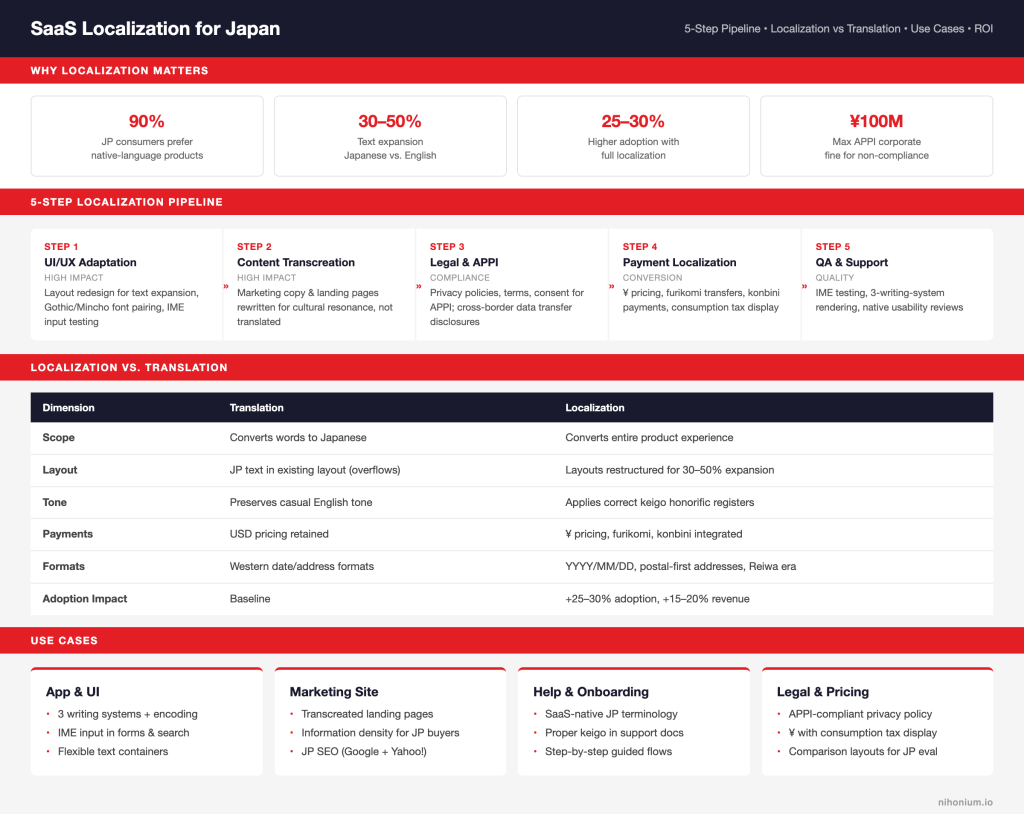
Localization Features
| Capability | What It Does | Benefit |
|---|---|---|
| UI/UX Localization | Adapts layouts, navigation and visual hierarchy for Japanese strings, which do not fit English layouts one for one (character width, line breaking and font metrics all change), and for Japanese typography, including the pairing of Gothic and Mincho typefaces. | Eliminates broken layouts and truncated text that erode trust on first impression. |
| Content Transcreation | Rewrites marketing copy, landing pages and product messaging so they work in Japanese, rather than translating word for word. | Produces messaging that sounds native, in a market where nine in ten consumers prefer information in Japanese (CSA Research, 2020). |
| Documentation Translation | Translates help centers, knowledge bases, API docs and onboarding guides with SaaS terminology and the right level of keigo (敬語, polite language). | Reduces support tickets and supports self-service, which suits Japanese users’ preference for detailed written information. |
| Cultural Adaptation | Adjusts tone, imagery, color choices and information density to Japanese UX expectations and trust-building design patterns. | Builds credibility with enterprise buyers who expect thorough product information and careful presentation. |
| Payment Localization | Sets out the payment methods and billing documents Japanese buyers expect: credit cards, bank transfer (furikomi, 振込), convenience store payment (konbini, コンビニ) for smaller customers, invoices and yen pricing, and localizes the checkout and billing copy. The integration itself is done by your engineers or your payment provider. | Removes purchase friction: buyers expect local payment options and transparent yen pricing. |
| Legal and APPI Compliance | Produces natural Japanese versions of privacy policies, terms of service and consent screens, including the information APPI requires before personal data goes to a third party abroad. Your Japanese counsel confirms the legal content. | Supports compliance (APPI fines for a company that breaches a PPC order reach JPY 100 million) and builds trust through clear Japanese legal text. |
| Date, Number, and Format Localization | Converts dates (YYYY/MM/DD), currency (¥), addresses (postal code first, prefecture to detail) and number formatting to Japanese standards. Supports the era calendar (Reiwa) where required. | Prevents confusion and data entry errors that cause users to abandon forms and workflows. |
| Honorific System Adaptation | Applies the correct politeness level (teineigo 丁寧語, sonkeigo 尊敬語, kenjōgo 謙譲語) across all user-facing text based on context and audience. | Avoids messaging that sounds rude or too casual, in a market where register matters. |
| SEO Localization | Conducts Japanese keyword research, optimizes metadata and structures content for Google and Yahoo! JAPAN search. | Drives organic discovery where search behavior and keyword patterns differ from English-language markets. |
| QA and Localization Testing | Tests Japanese input methods (IME), validates rendering across all three writing systems (hiragana, katakana, kanji) and runs native-speaker usability reviews. | Catches truncation, encoding issues and cultural missteps before launch. |
How It Works
Nihonium runs localization in six phases, so the surfaces that decide adoption are ready first.
-
Audit Your Current Product
We review every user-facing surface (UI strings, marketing pages, help docs, emails, legal pages, onboarding flows) for text volume, hardcoded strings, layout flexibility and IME compatibility. The output is a gap analysis that shows what needs to change and where the highest-impact work is.
-
Prioritize Localization Scope
We define a phased roadmap based on user journey impact. The sign-up flow, core product UI, pricing page and primary help articles come first; secondary content follows, so you reach the market sooner without cutting quality where it matters most.
-
UI/UX Adaptation
We adapt the interface for Japanese: layouts that tolerate different string lengths, appropriate typefaces, a visual hierarchy that does not rely on italics or capitalization (neither exists in Japanese), and IME input that works in every form field and search box.
-
Content Transcreation
Native Japanese writers who know SaaS rewrite headlines, CTAs, feature descriptions and value propositions for Japanese business readers: the right honorific register, adapted idioms, the right information density, and the katakana or English loanwords that Japanese users actually use for technical terms.
-
QA and Cultural Review
Every surface gets two reviews: functional QA (layout, encoding, IME, input validation) and a cultural review by native Japanese SaaS professionals across devices and browsers. We check tone consistency, honorific use and cultural accuracy, because in Japan a single awkward phrase can undermine an otherwise strong product.
-
Launch and Iterate
We support the launch and keep improving the Japanese experience from user feedback and engagement data. As you ship new features and campaigns, each update gets the same treatment.
Use Cases
Each product surface has its own localization problems and needs its own approach.
| Use Case | Challenge | Localization Approach |
|---|---|---|
| App Localization | Japanese strings break buttons, menus and dialogs designed around English. Three writing systems add encoding complexity. IME causes form and search issues. | Restructure layouts for flexible text containers, validate rendering across writing systems, and test every input with a Japanese IME. |
| Marketing Site | Direct translation sounds unnatural and fails to build trust with buyers who expect detailed product information before engaging. | Native writers transcreate landing pages, feature descriptions and CTAs with appropriate information density and formality. |
| Help Documentation | Japanese users rely on self-service support and expect comprehensive documentation. Poor translations increase support costs and churn. | Restructure knowledge bases with SaaS terminology, proper keigo and an information architecture that matches how Japanese users search. |
| Onboarding Flows | Western-style onboarding can feel too informal and too fast for Japanese users who prefer detailed, step-by-step guidance. | Redesign onboarding copy and flow structure for thoroughness, adding contextual guidance so users build confidence. |
| Email Campaigns | Casual tone and aggressive CTAs underperform in Japan, where business communication follows formal conventions. | Transcreate emails with appropriate honorifics, subject lines written for Japanese inboxes, and CTAs that suit consensus-driven decisions. |
| Legal Pages | Privacy policies and terms must meet APPI, including the information required for transfers of personal data abroad, in natural Japanese. | Produce clear Japanese versions of the legal documents for your Japanese counsel to confirm. |
| Pricing Pages | USD-only pricing and unfamiliar plan structures create friction. Buyers expect yen pricing and clear comparisons; prices shown to consumers must include consumption tax under the NTA’s total-price display rule. | Localize pricing with yen formatting, a clear consumption tax display and comparison layouts that match how Japanese buyers evaluate plans. |
Localization vs Translation
Translation converts words. Localization converts the experience. For SaaS products entering Japan, the difference decides whether users adopt the product or drop it.
Translation produces a Japanese equivalent of your English text. Localization makes the whole product experience feel Japanese. The distinction matters because software is interactive: every button, error message and onboarding step shapes the user’s view of its quality.
Translation gives you Japanese words in your existing layout, but those words may overflow buttons and break navigation, because Japanese strings do not map one for one onto English ones. Translation keeps your casual tone, but Japanese business users expect specific honorific registers. Translation converts date formats; localization also restructures address fields, displays yen pricing with consumption tax and offers local payment methods.
Japanese uses three writing systems (hiragana, katakana and kanji), often within the same sentence. A translation can use correct characters in unnatural patterns, which tells native speakers immediately that the product was not built for them.
No public study we could verify measures the revenue difference between localized and merely translated SaaS products in Japan, so measure it in your own numbers: trial-to-paid conversion, activation and support tickets before and after the Japanese release. The language preference itself is well documented: 90% of Japanese consumers in CSA Research’s survey chose the product with information in Japanese.
Key Takeaways
The essential points for SaaS companies considering Japanese localization.
- Japan demands localization, not just translation. In CSA Research’s 2020 survey, 90% of Japanese consumers chose the product with information in Japanese, and only 50% would pick a global brand over a local-language competitor, the lowest share of any nationality.
- SaaS localization spans far beyond text. It covers UI adaptation, cultural tone, payment methods, the Japanese text of APPI notices, formatting and honorifics: every surface a user touches.
- Measure the return in your own funnel. There is no reliable public benchmark for the uplift; conversion, activation and support data before and after the Japanese release will show it.
- Japanese language complexity requires native expertise. Three writing systems, several politeness levels and subject-object-verb word order make unreviewed machine translation risky for user-facing SaaS text.
- Localization is ongoing, not one-time. Keeping every feature release and campaign update at native quality is what sustains trust and retention.
Working with Nihonium. We are a Japan go-to-market partner for B2B SaaS companies: localization by SaaS experts. Talk to us about your Japan entry.
Sources
Data and research referenced on this page.
- CSA Research, “Consumers Prefer their Own Language” (7 July 2020), results of “Can’t Read, Won’t Buy” (B2C), a survey of 8,709 consumers in 29 countries.
- Nihonium, “Common Localization Challenges in Japan and Solutions”, background reading on the practical problems, not a data source.
- Grand View Research, “Japan Software as a Service (SaaS) Market Outlook, 2033”: USD 12.3 billion in 2025, USD 31.3 billion forecast for 2033, about 12% a year.
- National Tax Agency, total-price display rule (No. 6902): prices displayed to consumers must include consumption tax.
- Act on the Protection of Personal Information, English text (Japanese Law Translation): fines of up to JPY 100 million for a company that breaches a PPC order.
- IMF, World Economic Outlook, October 2026: Japan’s rank by nominal GDP.
Frequently Asked Questions
Common questions from SaaS companies planning Japanese localization.
How long does SaaS localization for Japan typically take?
It depends on string volume, how much text is hardcoded, and how many surfaces you launch with. A first phase covering the core UI, sign-up flow, pricing page and primary help articles is much shorter than full localization of the marketing site, email campaigns, documentation and legal pages. Nihonium plans the work in phases so the highest-impact surfaces launch first, and agrees the timeline after the audit.
Do we need to localize our entire product before launching in Japan?
No. Japanese users accept a partially localized product if the core experience (sign-up, primary workflows, pricing and key help content) feels native. What they do not accept is a half-translated product where buttons stay in English, error messages switch languages, or the tone shifts between formal and casual. Nihonium helps you define the minimum scope that earns trust, then expand coverage over time.
Why can’t we use machine translation for our Japanese localization?
You can use it as a first draft, but not as the final text on user-facing surfaces. Japanese mixes three writing systems with context-dependent choices, the honorific system (keigo) depends on social relationships a machine cannot see, and which SaaS terms are written in katakana, kanji or English follows conventions that vary by product category. Machine output works for low-visibility content; everything a buyer or user reads needs native expert review.
How does Nihonium handle ongoing localization as we release new features?
Nihonium works inside your release workflow, receiving string files, design mockups and content drafts as part of your sprint cycle. Continuous localization stops Japanese users from meeting untranslated strings or inconsistent terminology after an update, which erodes trust and tells buyers the market is not a priority.