

Expanding into Japan’s SaaS market requires more than just translation – it demands a tailored approach to content localization. Here’s what you need to know upfront:
- Localization is key: Japanese buyers value trust, precision, and culturally relevant messaging. Translation alone won’t cut it.
- SEO differences: Japanese search behaviors rely on three scripts (Kanji, Hiragana, Katakana), long-tail keywords, and the search engine market in Japan, including Yahoo! Japan.
- Trust-building: Social proof, polite language, and detailed content resonate with Japanese audiences.
- Technical adjustments: UTF-8 encoding, proper hreflang tags, and mobile-friendly designs are essential for Japanese SEO.
Localization done right can boost adoption rates by 25–30% and grow revenue by 15–20% in Japan. Let’s break down the seven critical steps to get there.
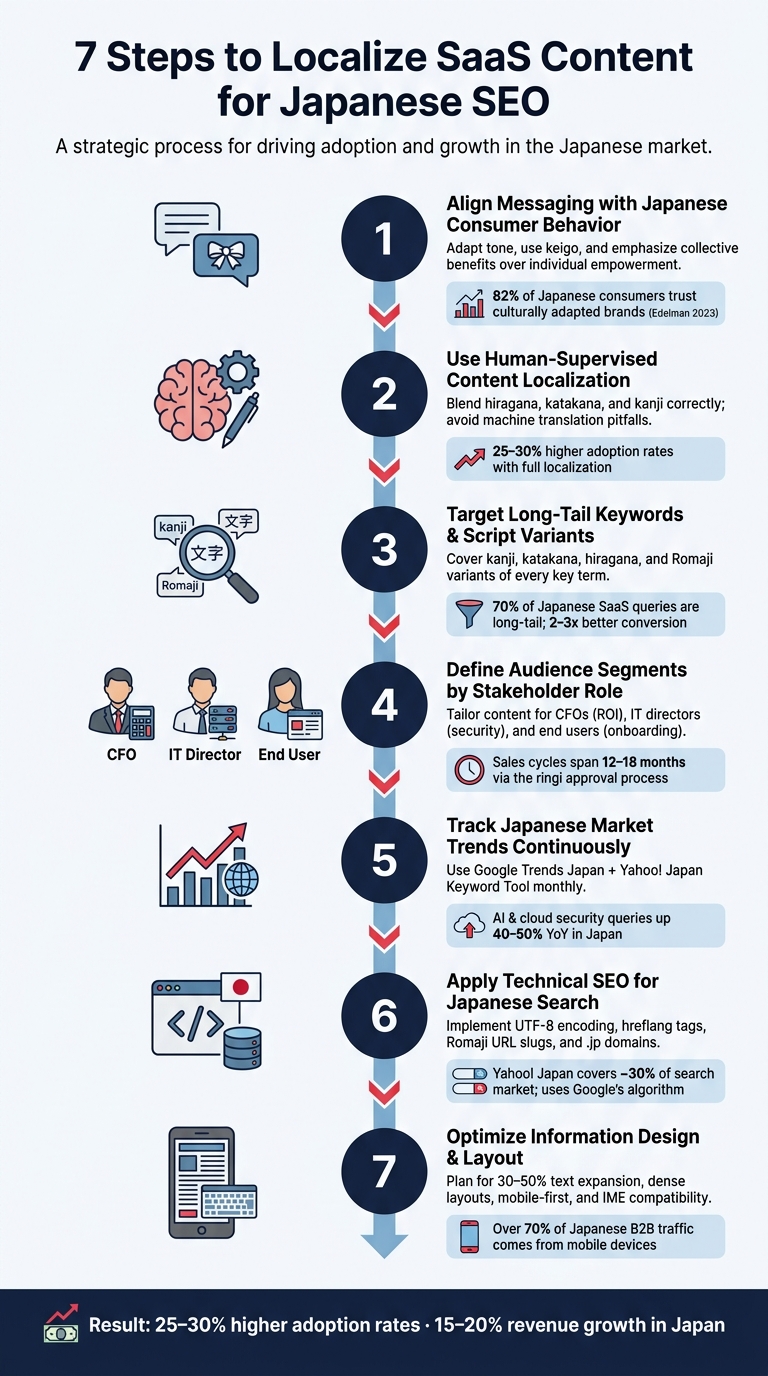
7 Steps to Localize SaaS Content for Japanese SEO
1. Align Content Messaging with Japanese Consumer Behavior
Japanese users spend three times longer researching SaaS tools compared to the global average. This means your content needs to go beyond simply explaining features – it should build trust, reduce perceived risks, and support a collective decision-making process that often involves multiple stakeholders.
The tone of your messaging is just as important as the content itself. Urgency-driven phrases like "Buy now!" that work in Western markets often fall flat in Japan. A softer, more thoughtful approach – such as "Discover how our tool may support your team’s efficiency" – resonates better with the cultural preference for keigo (formal, polite language) and indirect communication styles. According to the 2023 Edelman Trust Barometer, 82% of Japanese consumers trust brands that adapt their messaging to align with local cultural norms.
Social proof plays a major role in Japanese SaaS adoption, influencing 65% of decisions more than feature lists [Forrester Japan 2023]. Local testimonials are critical. For example, Slack saw a 45% increase in Japanese sign-ups over six months by incorporating keigo, group-oriented visuals, and testimonials from well-known local companies like Recruit Holdings [Slack Japan Case Study, 2022].
Cultural communication nuances also matter. Japan’s high-context communication style relies heavily on implied meaning and context rather than direct statements. Incorporating familiar concepts like kaizen (continuous improvement) or omotenashi (hospitality-driven service) into your content demonstrates a deeper understanding of the audience. This cultural fluency doesn’t just enhance trust – it also improves SEO performance. Behavior-matched, localized content generates 2.5x more featured snippets in Japanese search results compared to untranslated material.
To adapt effectively, audit your existing messaging for Western-centric assumptions. Phrases focusing on individual empowerment (e.g., "empower yourself") should be reframed to emphasize collective benefits (e.g., "support your team"). Highlight reliability and provide detailed information rather than making bold claims. Most importantly, feature Japanese social proof early in the buyer’s journey to build credibility.
sbb-itb-a752276
2. Use High-Quality, Human-Supervised Content Localization
While machine translation might seem like a budget-friendly option, in Japan, it can actually harm both your SEO efforts and your credibility. This highlights why human oversight is so crucial.
The challenge lies in the complexity of the Japanese language. Japanese blends three writing systems – hiragana, katakana, and kanji – often within a single sentence. Machine translation tools frequently misuse these characters and struggle with keigo (formal language), leading to awkward phrasing and unclear messaging. For Japanese enterprise buyers, this can come across as careless or even disrespectful. These subtleties require skilled human oversight to truly connect with Japanese users.
"In Japan, a single awkward phrase can undermine an otherwise strong product."
- Yuga Koda, Co-Founder, Nihonium
Search engines like Google Japan and Yahoo! Japan are increasingly penalizing machine-translated content, labeling it as low quality. This directly impacts SEO rankings. In contrast, content localized under human supervision aligns better with local search intent. For example, even choosing the right word for "sushi" can depend on factors like regional usage and audience demographics.
The benefits of proper localization are clear: SaaS products fully localized for Japan see adoption rates increase by 25–30% and revenue grow by 15–20% compared to non-localized versions. A smart approach is to focus human review on high-impact areas first – like sign-up flows, core user interfaces, and pricing pages – before tackling secondary content. Developing a localization style guide can also help by standardizing terminology, honorifics, and identifying elements that should remain untranslated.
"Machine translation remains unreliable for Japanese SaaS localization… all user-facing content requires native expert review."
- Yuga Koda, Co-Founder, Nihonium
Companies like Nihonium use transcreation to adapt marketing content for cultural relevance, moving away from a simple "translate and ship" approach to a more comprehensive localization strategy. This ensures the content not only makes sense but also resonates deeply with the target audience.
3. Target Long-Tail Keywords and Keyword Variants
Broad terms like "プロジェクト管理" are highly competitive and often fail to convert effectively. Instead, aim for long-tail keywords – phrases such as "中小企業 CRM 導入事例" – that attract users with specific intent. According to SEMrush, 70% of Japanese SaaS search queries are long-tail, and Ahrefs data reveals these terms convert 2–3 times better than broader terms because they align closely with user intent. To succeed, you’ll need precise targeting supported by robust tools.
Japanese long-tail keywords come with unique challenges due to the language’s writing system. A single concept can appear in kanji, katakana, hiragana, or even Romaji, depending on the searcher’s preference or context. For instance, users might look for a SaaS tool as "顧客管理ツール" (kanji), "カスタマーマネジメント" (katakana loanword), or "CRM ソフトウェア" (Romaji blend). To drive qualified traffic, you must account for these script variations.
"Choosing the wrong script or mixing scripts inappropriately immediately signals a foreign product." – Nihonium
Once you’ve identified your keywords, the next step is handling these script variations. Tools like Google Keyword Planner (Japan), Yahoo! Japan Keyword Suggest, and Ahrefs (set to Japanese) are invaluable. Start with a seed keyword and expand using autocomplete suggestions and related searches. Focus on keywords with at least 50 searches per month and a Keyword Difficulty (KD) score below 30. Native speakers should review your selections to ensure they align with local B2B buying patterns, as this step is critical for maintaining cultural relevance and effective localization.
A practical example of this strategy comes from HubSpot Japan. In Q1 2024, they targeted the long-tail keyword "初心者向けCRMツール 比較" (beginner CRM tool comparison) in 15 localized blog posts. Within three months, they achieved a #1 ranking on Google.co.jp and saw qualified leads jump from 400 to 1,400 per month – a 250% increase. This success stemmed from targeting a specific stage in the buyer’s journey rather than using a generalized approach.
After pinpointing your primary long-tail keywords, incorporate semantic variants – like "最適化" versus "改善" – naturally throughout your content. Google Japan rewards in-depth topical coverage, and using keyword variants in non-English search results can boost rankings by 15–20%. Place your main keyword in the H1 header and within the first 100 words, but let variants flow organically through subheadings and body text to maintain readability and relevance.
4. Define Your Target Audience Demographics and Segments
Defining your audience goes beyond just language and keyword targeting – it’s about truly understanding who you’re speaking to. For the Japanese market, this is especially important. Out of over 125 million residents, only about 10% are fluent in English. Fully localizing your content not only helps with communication but also builds trust, a recurring theme in this guide.
When it comes to Japanese B2B buyers, the ringi system plays a pivotal role. This consensus-driven, multi-level approval process can stretch SaaS sales cycles to anywhere between 12 and 18 months. To succeed, your content must address the specific needs of IT managers, finance teams, and top executives.
"Japanese business buyers often require extensive consensus among multiple stakeholders, leading to longer deal cycles and greater scrutiny of product claims. Localization, therefore, also means understanding how to navigate group dynamics and the formal approval processes in enterprise sales." – Yuga Koda, CEO, Nihonium
Tailoring your message by stakeholder role is key. For instance:
- An ROI calculator is perfect for a CFO looking to justify expenses.
- A security-focused whitepaper speaks directly to an IT director’s concerns.
- A detailed onboarding guide reassures end users and builds their confidence.
Japanese customers also place high value on collectivism. Messaging that frames your product as the trusted choice among leading companies tends to perform better than claims of being disruptive or different. To strengthen this approach, include social proof like endorsements from well-known Japanese brands, official certifications, and case studies. As Naoki Togawa from Nikkei Business Publications explains, "It’s easy to tell which vendors know what they are doing and are really committed to the market just through the quality of their materials."
5. Track Japanese Market Trends and Run Local Market Analysis
The Japanese SaaS market changes quickly, with content becoming outdated in just a few months. For example, search queries for terms like "AI導入" (AI implementation) and "クラウドセキュリティ" (cloud security) have increased by 40–50% year-over-year, showing a rising interest among enterprises in AI tools and data security.
To stay ahead, use a combination of Google Trends Japan and the Yahoo! Japan Keyword Tool. Since Yahoo! Japan accounts for about 30% of the search market and is a popular business resource, relying solely on Google could leave gaps in your strategy. By leveraging both tools, you can uncover a more complete view of what Japanese buyers are searching for, including niche terms like "クラウドERP" (cloud ERP), which might not have a direct English equivalent. These insights also help set the foundation for analyzing competitor content.
Competitor analysis plays a key role in Japanese SEO. Reviewing the content published by domestic competitors and identifying their rankings can highlight untapped opportunities. Additionally, platforms like ITmedia and Boxil are essential to monitor since many Japanese enterprise buyers rely on them to research and compare vendors.
Consistency is critical when tracking trends. Monitor keywords monthly and conduct in-depth competitor and audience sentiment analysis every quarter. For instance, if searches for a specific use case rise by 25% quarter-over-quarter, aim to create or update related content within four to six weeks to stay relevant.
Nihonium offers tailored market entry strategies, including detailed market analysis, to help businesses identify competitive opportunities quickly and effectively.
6. Apply Technical SEO Best Practices for Japanese Search Engines
After crafting a localized content strategy, it’s equally important to ensure your site’s technical setup aligns with Japanese language requirements. Many SaaS companies falter not because of their content, but due to the technical foundation supporting it.
Start with character encoding. Your databases, APIs, and interfaces must support UTF-8 to properly display Hiragana, Katakana, and Kanji. If this isn’t configured correctly, users will see garbled symbols instead of readable text – instantly damaging your credibility. As Yuga Koda, Co-Founder of Nihonium, explains:
"Unicode support is fundamental. Ensure your databases, APIs, and interfaces use UTF-8 or similar standards, safeguarding against data corruption or display errors."
When it comes to structure, there are several key points to address. Use Romaji for URL slugs (e.g., example.com/jp/service) to avoid messy percent-encoding in search results. For meta tags, keep titles between 28–32 full-width characters and descriptions within 80–100 full-width characters to prevent truncation in Japanese search results. A .jp or .co.jp domain can also boost trust with local users, with .co.jp being particularly reliable since it’s reserved for registered Japanese corporations.
Don’t overlook hreflang tags. Proper implementation ensures your site aligns with nearly 95% of the Japanese search market since Yahoo! Japan relies on Google’s algorithm. This is a practical advantage for smaller teams working on localization.
Finally, remember that Japanese text often expands by 30–50% compared to English. This can affect UI elements like table headers and form fields. Test your layouts using actual Japanese content to avoid issues with spacing or alignment. These technical adjustments are essential for creating a seamless experience for Japanese users.
7. Plan for Information Design and Layout Differences
Even if your content is perfectly translated, the design of your website or app can face challenges when switching from English to Japanese. Japanese text tends to expand by 30–50% compared to English. This can throw off button labels, table headers, and navigation menus, making the layout look misaligned or cluttered. To avoid this, you’ll need to rethink your design approach to suit Japanese users.
Japanese writing combines three scripts – Hiragana, Katakana, and Kanji – which adds another layer of complexity. These scripts often require 10–15% more line height than Latin characters to maintain readability. Yuga Koda, Co-Founder of Nihonium, highlights another key difference:
"Japanese text does not word-wrap in the same way as English – line breaks can occur between any two characters… and hyphenation rules differ entirely."
Another critical factor is the visual style that Japanese users prefer. Unlike Western designs that lean toward minimalism and lots of whitespace, Japanese audiences often favor information-dense layouts. This means detailed navigation menus, granular settings, and comprehensive tooltips are not just appreciated – they’re expected. A design that feels sleek and modern in the U.S. might seem incomplete or even unreliable to Japanese users, who value thoroughness and clarity.
Mobile optimization is equally important, especially since over 70% of Japanese B2B traffic comes from mobile devices. To cater to this, focus on vertical, thumb-friendly designs with sticky call-to-action buttons, modular content sections, and visible trust signals.
Lastly, don’t overlook the importance of IME (Input Method Editor) compatibility. Japanese users type phonetically and then convert their input into characters. If your forms activate actions on every keystroke, it can disrupt this process, leading to frustrating user experiences and potentially higher bounce rates. Be sure to test your forms with native Japanese input methods before launching.
Conclusion
The seven tips outlined here are not standalone tactics – they’re part of a cohesive system designed to work together. It all starts with aligning your message to Japanese consumer behavior, setting the stage for everything else. From there, human-supervised localization ensures your tone and level of formality resonate appropriately. Effective keyword research – spanning Hiragana, Katakana, and Kanji – boosts visibility. When combined with audience segmentation, market trend analysis, SEO and SEM in Japan, and thoughtful information design, these strategies help turn visibility into tangible results.
At the heart of this approach lies one critical principle: shinrai, or trust. Japanese B2B buyers are known for their cautious, consensus-driven decision-making process, often spanning 12–18 months. Every detail of your localization strategy – whether it’s the level of politeness in your messaging or the structure of your product pages – either strengthens or erodes that trust.
For companies willing to invest fully in localization, the rewards are clear: 25–30% higher adoption rates and 15–20% revenue growth in the Japanese market. These numbers highlight the competitive advantage that comes with a well-executed strategy.
But localization isn’t a one-and-done effort. As Yuga Koda, Co-Founder of Nihonium, emphasizes:
"Localization is not ‘set-and-forget’; it requires ongoing refinement to meet evolving market needs."
To maintain momentum, regular updates are essential. Quarterly audits, A/B testing, and monitoring market shifts ensure your strategy evolves alongside your audience. By continuously fine-tuning each element, you preserve the trust that underpins success in the Japanese market. Together, these strategies offer a clear path to effectively localizing SaaS content for long-term growth in Japan.
FAQs
How do I choose the right Japanese keyword script (Kanji/Hiragana/Katakana/Romaji)?
To choose the right Japanese keyword script, think about your content’s purpose and who you’re trying to reach. Kanji works well for native terms and formal contexts, while Hiragana is better for simpler, more casual language. Katakana is commonly used for foreign words or technical terms. Meanwhile, Romaji – though less popular – might be appropriate for non-native speakers. Look into your target audience and study competitor keywords to find the script that matches how locals search online.
What should I localize first to build trust with Japanese B2B buyers?
To connect effectively with Japanese B2B buyers, it’s essential to tailor your product’s content and communication to reflect their business values. Emphasize reliability, integrity, and long-term relationships in your messaging. These principles resonate deeply within Japanese business culture, where trust and mutual respect play a key role in decision-making.
Which technical SEO fixes matter most for Japanese pages?
When working on technical SEO for Japanese pages, there are a few key adjustments to focus on:
- Optimize the text display area: Japanese characters can take up more space than Latin characters, so ensure your layout accommodates text expansion without breaking the design.
- Use the correct writing systems: Japanese uses a mix of kanji, hiragana, katakana, and sometimes romaji. Make sure you’re using the appropriate system for your audience and content type.
- Tailor content for keyword searches: Japanese keyword searches often differ from English ones in structure and intent. Research and adapt your content to match how users search in Japanese.
These steps not only help improve your site’s search rankings but also create a smoother experience for users navigating your pages.
Related Blog Posts
- Translation vs. Localization: What Works for Japan
- How Japanese Culture Shapes SaaS Messaging
- Ultimate Guide to Japanese Keyword Strategy
- 5 Content Tips for Japanese SaaS Audiences
 English
  Japanese