

We know of no public benchmark for how long a SaaS company takes to earn back a Japan entry, so treat every timeline as a planning assumption: plan on six to twelve months to first revenue from direct sales in the mid-market, twelve to eighteen months to meaningful enterprise revenue, and judge break-even on a two- to three-year horizon. Partners can bring first revenue forward, but building the partnership takes time of its own, and localization pays back over years, not quarters.
Realistic Revenue Timelines
Setting realistic expectations is what keeps headquarters aligned and the Japan budget in place. Too many SaaS companies enter Japan with revenue expectations calibrated to their home market and lose heart when those expectations are not met in the first two or three quarters. The result is withdrawal or budget cuts at the moment early work is starting to pay off.
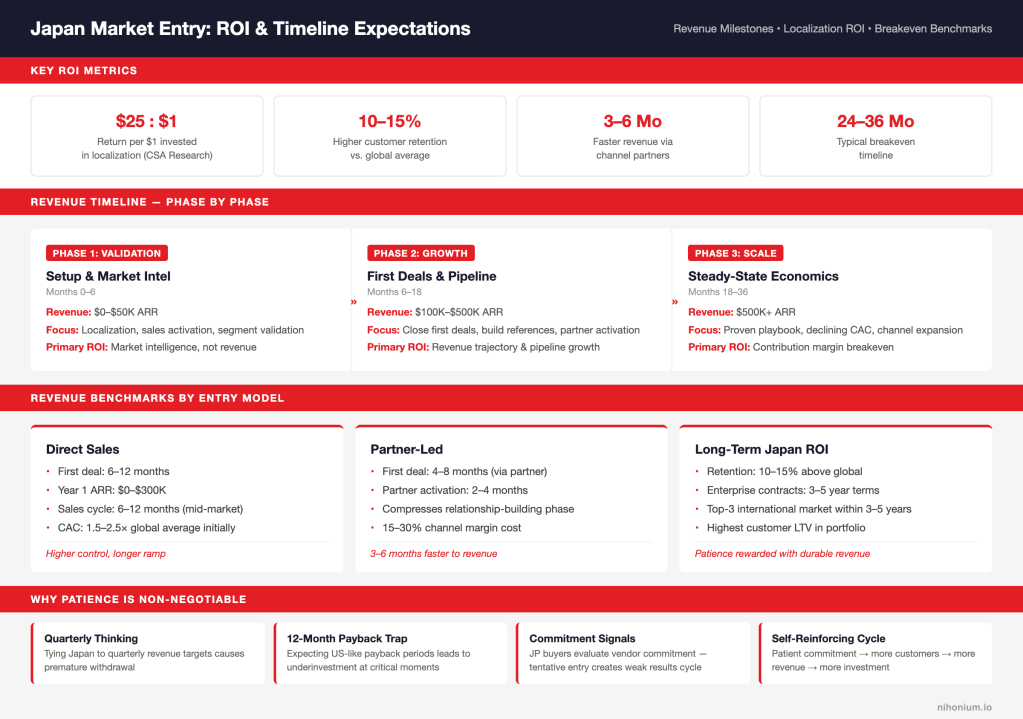
For direct sales to mid-market Japanese customers (companies with 100 to 1,000 employees), a workable planning frame looks like this. The first months go on setup: product localization, local sales capability (a direct hire or a fractional team), first pipeline, and outreach to target accounts. Next come prospecting, discovery meetings, demos, and the early rounds of nemawashi (根回し, informal consensus-building) inside the prospect. After that, proposals enter ringi (稟議, the formal approval process). On this frame, first closed deals arrive between months six and twelve.
Enterprise accounts (more than 1,000 employees) take longer. Plan on nine to twelve months from first meeting to signed contract, and more for deals with regulatory review, deep integration, or several departments. A company targeting enterprise should therefore not count on meaningful enterprise revenue until twelve to eighteen months after starting its Japan entry. These ranges are planning assumptions to test against your own pipeline, not statistics.
Partner-Led Revenue Acceleration
Channel partners are one of the most effective ways to shorten the time to revenue in Japan. Japanese companies rely heavily on outside IT vendors: about 72% of Japan’s ICT professionals work at IT vendors, against about 35% in the US (MIC White Paper 2018). Zoom shows what that means for sales: about 90% of its US revenue came from direct sales, while about 70% of its Japan sales came through partners (Firstlight Capital). That is one company’s figure, not a market average, but partners such as systems integrators (SIers), value-added resellers (VARs), and consulting firms bring existing customer relationships, established trust, and a detailed understanding of their clients’ systems and purchasing processes.
A well-aligned partner can shorten the sales cycle by making warm introductions to qualified prospects, lending its own reputation, guiding the vendor through the customer’s nemawashi and ringi, and bundling the SaaS product with implementation services that answer buyers’ concerns about deployment.
Once a partner is active, its deals can close sooner than a direct team’s first deals. But recruiting and enabling the partner takes months of its own: the partner runs its own internal approvals before committing, and the vendor has to provide enablement training, co-marketing materials, and agreed commercial terms. Count that time when you compare the partner route with direct sales.
Companies that combine direct sales with partners create several paths to revenue, which reduces dependence on any one channel and raises the chance of early revenue.
The Localization Return
Localization is where Japan’s payback starts, and it is often justified with a single headline multiple. We could not trace the widely quoted “$25 for every $1” to any study, so we do not use it. The return is real but has to be measured in your own numbers: conversion on Japanese pages and trials, deal sizes, support tickets, and the share of opportunities that reach procurement.
In Japan the return comes mainly from eligibility. Enterprise buyers evaluate in Japanese, and the people who sign the ringi, from IT security to the finance office, read the documentation, the security answers, and the contract terms in Japanese. A product without Japanese documentation and support is often dropped before the comparison starts, so localization decides whether you compete at all.
The return is not immediate. Translation, cultural adaptation, and technical localization are paid up front, while the returns build up as the localized product wins deals, gains reviews, and earns references. Plan for localization to pay back over the same multi-year horizon as the Japan entry itself.
Phase-by-Phase ROI Expectations
ROI expectations follow the phases of the entry. In the validation phase (roughly the first six months), the main return is not revenue but market intelligence: which segments respond, which features resonate and which need adapting, how the product positions against local competitors, and what prices the market will bear. This knowledge shapes every later investment decision and is often worth more than early revenue.
In the growth phase (roughly months six to eighteen), first revenue arrives. First deals close, early customers become references, and the team develops a repeatable sales playbook for Japan. Revenue in this phase is usually modest; judge it by trajectory and pipeline growth rather than absolute numbers.
In the scale phase (roughly months eighteen to thirty-six), the Japan operation approaches steady-state economics. The sales team has a proven playbook, partners generate consistent pipeline, references and reviews strengthen credibility, and acquisition costs fall as awareness and inbound demand grow. On this frame, contribution-margin break-even lands somewhere in years two to three; whether it does depends on deal size and how steadily the company keeps investing.
Why Patience Is Non-Negotiable
The most common failure mode for SaaS companies in Japan is impatience. Companies that enter with a twelve-month payback target, or tie Japan budgets to quarterly revenue, tend to underinvest at critical moments or withdraw too early.
Japan rewards long-term commitment. Japanese buyers evaluate the vendor’s commitment to the market as well as the product. They ask: does the company have a dedicated Japan team? Does the roadmap respond to Japanese customers? Will the company still support the Japanese market in five years? Buyers who sense that a vendor treats Japan as an experiment will hesitate to spend their own credibility on the ringi needed to approve the purchase.
This creates a self-reinforcing cycle. Companies that show patient commitment attract more customers, which brings more revenue, which justifies more investment. Companies that enter tentatively, demand fast returns, and cut investment at the first sign of slow progress create the opposite cycle: weak commitment leads to weak results, which leads to further cuts.
Benchmarking Your Japan ROI
Benchmark Japan against your own comparable launches, not against your home market. Useful comparisons are your time to first revenue and first enterprise deal in another non-English market, your customer acquisition cost in Japan against your global average (expect it to be higher at first and to fall as references accumulate), retention and expansion of Japanese customers against your global base, and the months to break-even for the Japan operation as a whole.
Set the cost side against real numbers too. If the plan includes a local subsidiary, JETRO’s Tokyo model case puts the first-year set-up of a two-person subsidiary at about USD 264,000 to 289,000, including JPY 30 million of paid-in capital and before salaries (JETRO). Starting with partners or a fractional sales team before incorporating keeps that commitment until the market has been validated.
Companies that enter Japan with realistic expectations, committed investment, and the patience to let the market develop can build a durable revenue stream in the world’s fourth-largest economy by nominal GDP (IMF). The ROI from Japan is real, but the commitment horizon is measured in years, not quarters.
Key Takeaways
- Judge break-even on a two- to three-year horizon: No public benchmark exists, but the phases of an entry (validation, growth, scale) make break-even inside the first eighteen months unlikely, with enterprise-focused companies at the longer end.
- Year 1 is an investment year: Expect little revenue in the first twelve months while you validate product-market fit, build pipeline, and establish partner relationships; planning for this avoids premature strategy changes.
- Enterprise deals are slow to win and well supported once won: The nemawashi and ringi that stretch enterprise deals also commit the whole organization, and implementation after approval tends to be swift (EU-Japan Centre for Industrial Cooperation).
- Phased investment reduces risk: Partners or a fractional sales team let you validate the market before committing to a subsidiary, which JETRO’s model case prices at about USD 264,000 to 289,000 for two people in Tokyo in the first year.
- Measure the return in your own numbers: Track time to first revenue, acquisition cost, and retention in Japan against your other markets rather than against headline multiples.
Working with Nihonium. We are a Japan go-to-market partner for B2B SaaS companies: localization by SaaS experts. Talk to us about your Japan entry.
Sources
- Firstlight Capital, System Integrators: the Key to Success for SaaS in Japan. Zoom’s direct and partner sales shares in the US and Japan.
- Ministry of Internal Affairs and Communications, Information and Communications White Paper 2018. Share of ICT professionals at IT vendors.
- JETRO, Model case: costs of setting up a business in Tokyo. Filing and first-year set-up costs for a two-person subsidiary.
- EU-Japan Centre for Industrial Cooperation, From Understanding to Navigating Japanese Business Culture (Martin Glisby, January 2018). Nemawashi, ringi, and implementation after approval.
- IMF, World Economic Outlook (October 2026). Japan’s rank by nominal GDP.
Frequently Asked Questions
What is a realistic revenue target for Year 1 in Japan?
There is no reliable public benchmark, and much depends on entry strategy and deal size. A fractional team with existing relationships can close first deals within the year; a newly hired direct team often closes its first deal late in the year, which leaves little Year 1 revenue. Set the Year 1 target on validated pipeline rather than closed revenue, because an aggressive revenue target pushes teams into strategic mistakes.
How does Japan ROI compare to other international markets?
Japan usually costs more to enter than markets where you can sell in English, because localization and local sales capability come first. The long-term case rests on retention: Japanese enterprise customers are slow to choose a vendor and, once the ringi is approved, slow to switch. Compare your own retention and expansion in Japan against your other markets before drawing conclusions.
What are the key milestones to track during the first 24 months?
As a planning frame: in months 1 to 6, complete product localization and launch a Japanese marketing presence. In months 6 to 12, sign first partner agreements and build a set of qualified enterprise opportunities. In months 12 to 18, close first enterprise deals and expand the partner portfolio. In months 18 to 24, show repeatable deal patterns and enough pipeline velocity to justify scaling. Use these milestones for go or no-go decisions at each phase.
When should a company abandon its Japan market entry effort?
Consider pausing or restructuring after twelve to eighteen months if validation shows weak buyer relevance, no partner has shown active interest, or compliance would require architectural changes you cannot fund. Abandoning too early is more common than persisting too long, though. Before withdrawing, make sure the problem is market fit and not execution: thin localization, the wrong partner strategy, or too little sales coverage.