

What Japan market entry costs a SaaS company depends mostly on whether it sets up its own subsidiary and hires its own team. JETRO’s Tokyo model case puts the filings for a stock company (KK) at about USD 6,200 and the set-up of a two-person subsidiary at USD 264,000 to 289,000, including JPY 30 million of paid-in capital and before any salaries. Salaries come on top: Robert Walters’ 2026 survey puts a software country manager in Japan at JPY 30 to 60 million in base pay. Localization, marketing and travel vary with scope and have no public benchmark. A phased or fractional start lets a company test demand before it commits to the entity and the payroll.
Entity Establishment: The KK Setup
Foreign SaaS companies that set up a legal presence in Japan most often choose the kabushiki kaisha (株式会社, KK), the Japanese stock company. The statutory fees are modest. A KK pays a registration license tax of 0.7% of its capital, with a JPY 150,000 minimum, plus a notary fee for certifying the articles of incorporation and, if the articles are on paper, stamp duty, so the fees come to about JPY 180,000 to 240,000 at the minimum tax. A godo kaisha (合同会社, GK) pays JPY 60,000 to 100,000. Professional fees for a judicial scrivener (司法書士, shihō shoshi) or corporate services provider, and the registered address, come on top and vary by provider.
The statutory minimum capital for a KK is one yen, but the practical floor is set by other rules. A foreign founder who needs a Business Manager visa to run the company from Japan must show JPY 30 million of capital (the rule since October 2025), and a new company with JPY 10 million or more of capital pays consumption tax from its first year. After formation, the company files corporate tax returns, consumption tax returns once it is liable, and registrations of any change; most foreign-owned subsidiaries pay a Japanese tax accountant (税理士, zeirishi) and a bookkeeping service for this.
JETRO’s model case for Tokyo is the most useful public reference for the total. It estimates about USD 6,200 (USD 6,156) for the filings, and USD 264,000 to 289,000 to set up a two-person subsidiary. That total covers the paid-in capital of JPY 30 million, visas, office set-up, a recruiting fee and housing, and it excludes salaries and social insurance. Leadership time is a cost too: opening a corporate bank account and completing the registrations takes months of management attention before the entity can trade.
Localization Investment
Product localization is one of the most variable parts of the budget. The total depends on the volume of UI text and documentation, how far workflows must change (approval flows, Japanese date formats, invoices), and how much marketing content the company needs in Japanese. There is no public benchmark for the cost. Translation vendors quote by word or character volume, so the reliable way to budget is to count the strings and pages, get two or three quotes, and add a recurring line for every release that changes the UI.
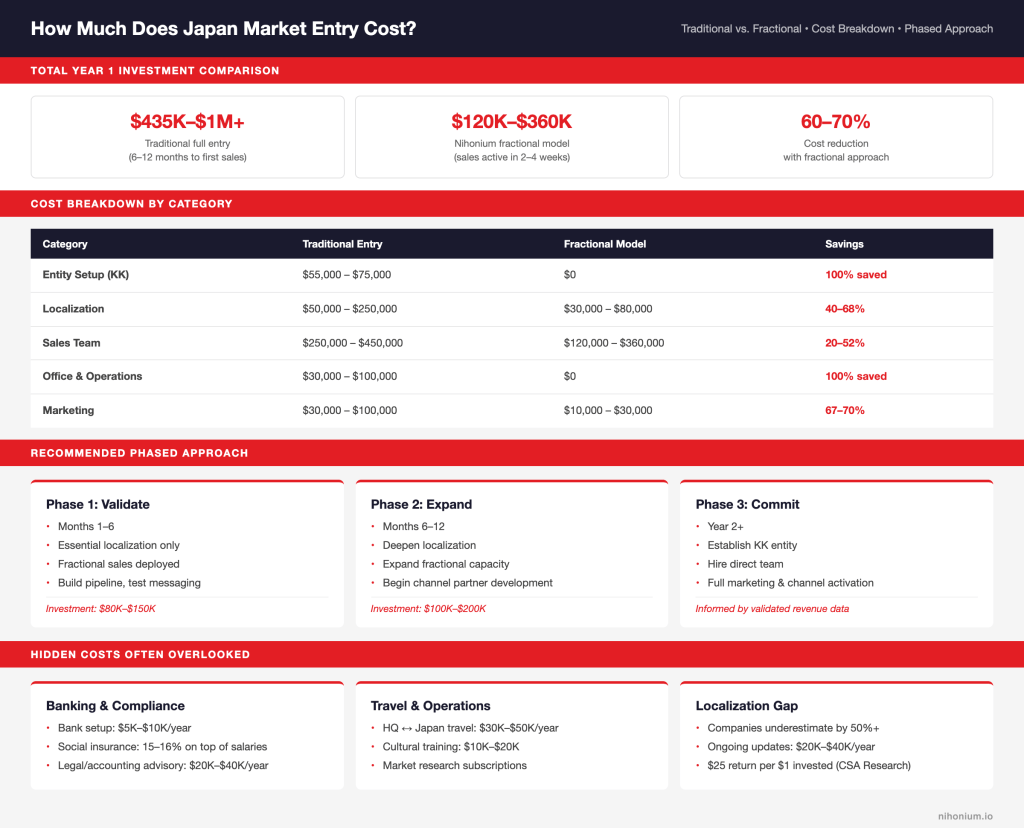
A useful way to scope localization is by layer: the product UI and error messages; help center content and technical documentation; the marketing website and landing pages; sales collateral such as case studies, white papers and the presentation deck; and ongoing maintenance as the product ships updates. Each layer can be phased. Many companies localize the UI, the onboarding flow and the sales deck first, and add the full help center once paying customers need it. SaaS localization for Japan covers the layers in more detail.
The case for spending here rests on buyer behaviour rather than on a return figure. In CSA Research’s survey of business software buyers, every Japanese respondent preferred to buy in Japanese. A Japanese buyer who cannot evaluate the product, the contract and the support in Japanese has an easy reason to choose a domestic alternative.
Local Team Costs
Hiring local staff is the largest recurring commitment. Robert Walters’ Japan Salary Survey 2026 gives these base salary ranges for IT software roles in Japan, before bonuses and benefits:
- Country manager: JPY 30 to 60 million
- Sales manager: JPY 15 to 25 million
- Sales account manager: JPY 10 to 20 million
- Sales development representative: JPY 7 to 15 million
- Customer success manager: JPY 10 to 20 million
- Marketing manager: JPY 10 to 15 million
- Pre-sales engineer (technology roles): JPY 10 to 18 million
Beyond base pay, the employer pays its share of social insurance: about 15% of salary in Tokyo in fiscal 2026 (pension 9.15%, health insurance 4.925% at the Kyokai Kenpo Tokyo rate, employment insurance 0.85%), plus workers’ accident insurance, a little more from age 40, and capped on high salaries. A commuting allowance is common practice. Japanese law also protects employees from dismissal: under Article 16 of the Labor Contracts Act, a dismissal that lacks objectively reasonable grounds and is not appropriate in general social terms is invalid. That makes an early hire hard to reverse if the market does not respond.
A minimal local team of two or three people, for example a country manager and one or two account managers, therefore means two or three salaries in the ranges above plus about 15% in social insurance, recruiting fees and several months before the team is productive. Office space, technology and travel come on top. Employing staff directly also usually requires the entity described above.
The Full First-Year Budget
A first-year budget for a direct entry has six lines: the entity (filings, professional fees, capital); localization; the local team (salaries, social insurance, recruiting); office and operations; marketing and demand generation; and travel between headquarters and Japan. Only the first and third have public reference points: the JETRO model case for the entity and the Robert Walters ranges for salaries. The others depend on scope, and any total quoted without that scope is a guess.
Two features of the budget matter more than the total. First, the largest items, capital and salaries, are committed before any Japanese revenue arrives. Second, revenue arrives late: as a planning assumption, not a benchmark, allow 6 to 12 months to first mid-market revenue and 12 to 18 months to meaningful enterprise revenue, with break-even judged over two to three years. Growth-stage SaaS companies that plan for both find the full-commitment model a heavy bet on an unproven market.
The Fractional Alternative
A fractional sales team is one way to lower the upfront commitment. Instead of setting up an entity and hiring, the company contracts experienced Japanese-speaking sales people for part of their time, and they work the market under a services contract. No entity is needed to start selling software to Japanese customers from abroad, though how contracts and invoices are issued should be settled with a tax adviser.
There is no public benchmark for what fractional teams cost: fees depend on the scope of work and the number of people, so compare proposals on what is included. The main difference from direct entry is the shape of the commitment. Fees can be scaled up or down as the market responds, and nothing has to be unwound if the company decides Japan is not the right market yet.
The fractional approach can also start sooner. Entity set-up and hiring take months before the first sales meeting; a fractional team that is already in place can begin once positioning and Japanese materials are ready. That means the company starts receiving market feedback, building pipeline and testing pricing earlier than it would under a traditional approach.
The Phased Approach
For SaaS companies that want a full in-market presence eventually but see the risk of a large upfront commitment, a phased approach splits the decision. The first phase is market validation: the company localizes what buyers see first, deploys fractional sales resources and starts building pipeline and holding customer conversations. Its cost is driven by the localization scope and the sales capacity chosen.
The second phase expands on validated signals. If early results are promising, the company deepens its localization, adds sales capacity, starts channel partner conversations and begins planning the entity. The third phase, usually not before year two, moves to full commitment if the second phase supports it: the KK, the first direct hires (sometimes people who already know the accounts), more marketing and active channel partners.
This approach reduces cumulative risk by tying each investment to results from the previous phase. Companies that do proceed to a full presence start with customer relationships, partner conversations and market knowledge already in place, rather than from scratch. How long Japan market entry takes to show ROI covers the timing in more detail.
Key Takeaways
- The entity is cheap to form but expensive to run: KK statutory fees are about JPY 180,000 to 240,000 at the minimum tax, but JETRO’s Tokyo model case puts the set-up of a two-person subsidiary at USD 264,000 to 289,000, including JPY 30 million of capital and before salaries.
- A GK is cheaper to form: JPY 60,000 to 100,000 in statutory fees; ongoing tax filings and accounting apply to either form.
- Localization has no public price list: budget it by layer (UI, documentation, website, sales collateral, maintenance) from vendor quotes, because Japanese buyers expect to evaluate and buy in Japanese.
- Hiring is the largest recurring expense: a software country manager earns JPY 30 to 60 million and an account manager JPY 10 to 20 million in base pay (Robert Walters 2026), plus about 15% employer social insurance.
- Revenue comes later than the costs: as a planning assumption, allow 6 to 12 months to first mid-market revenue and judge break-even over two to three years; a phased or fractional start limits what is committed before then.
Working with Nihonium. We are a Japan go-to-market partner for B2B SaaS companies: localization by SaaS experts. Talk to us about your Japan entry.
Sources
- Japan External Trade Organization (JETRO), Setting up a business in Tokyo: model case (filings and set-up of a two-person subsidiary).
- Robert Walters, Japan Salary Survey 2026 (base salaries, IT software).
- CSA Research, Businesses prefer local-language purchasing (2008 survey of business software buyers).
- Japanese Law Translation, Labor Contracts Act, Article 16.
- KK and GK fees, the Business Manager visa capital and the first-year consumption tax rule: see kabushiki kaisha and godo kaisha, which cite the Ministry of Justice, the National Tax Agency and the Japan Notary Association. Social insurance rates: Japan Pension Service, Kyokai Kenpo (Tokyo) and the Ministry of Health, Labour and Welfare, fiscal 2026.
Frequently Asked Questions
What is the minimum viable budget for Japan market entry?
There is no fixed minimum, because the largest costs, an entity and local salaries, are optional at the start. A lean entry pays for localization of what buyers see first, a fractional or contracted sales capacity and Japanese marketing materials, with no entity. If validation succeeds, budget for the entity later, using the JETRO model case as the reference.
How much should we budget for product localization?
Count your UI strings, documentation pages and marketing assets, and get quotes from two or three specialist vendors; there is no reliable market average. Budget a recurring amount for every release that changes the UI, because untranslated new features are what Japanese users notice first.
What are the hidden costs of Japan market entry?
The ones most often missed are employer social insurance (about 15% of salary in Tokyo), recruiting fees, a tax accountant and bookkeeping for the entity, corporate bank account set-up time, and travel between headquarters and Japan. Leadership time during formation is also a real cost, even if it never appears in the budget.
Can we reduce costs by operating remotely without a Japan presence?
Selling software from abroad without an entity is possible, but a team that is never in Japan struggles with the relationship-building that nemawashi (根回し, informal consensus-building before a decision) and partner development require. A Japanese-speaking team on the ground, full-time or fractional, is the usual compromise between cost control and access to buyers.