
A Godo Kaisha (GK, 合同会社, literally “joint company”) is Japan’s limited liability company (LLC) form, introduced in 2006 by the Companies Act as a simpler and more flexible alternative to the Kabushiki Kaisha (KK, 株式会社) stock company.
A GK can be formed with capital of one yen and a single member, and it needs no board of directors and no annual general meeting. Its statutory formation costs are a registration and license tax of 0.7% of capital with a JPY 60,000 minimum, plus JPY 40,000 of stamp duty if the articles of incorporation are on paper: JPY 60,000 to 100,000 for most subsidiaries. A KK pays a JPY 150,000 minimum registration tax, a notary fee of JPY 30,000 to 50,000 for certifying its articles, and the same stamp duty on paper: about JPY 180,000 to 240,000. These differences have made the GK a common choice for foreign companies setting up Japanese subsidiaries; Apple Japan, Google and Amazon Japan all operate as godo kaisha.
GK Structure and How It Works
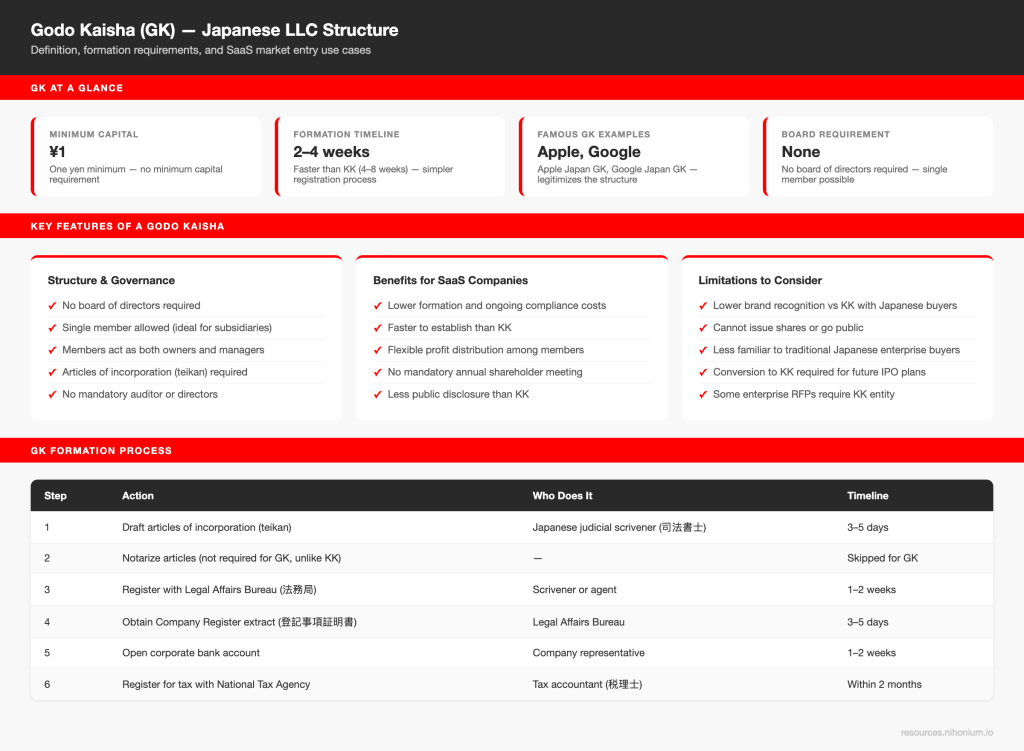
The GK is run by its members, the equivalent of LLC members in Western jurisdictions. Members are both owners and managers unless the articles name managing members, so there is no separate board of directors. How profits are shared among members can be set freely in the articles of incorporation, whereas a KK distributes dividends in proportion to shareholdings unless it issues different classes of shares.
The GK’s articles of incorporation (teikan, 定款) are filed with the Legal Affairs Bureau with the registration, but unlike a KK’s they do not need notarization, which saves both cost and time. A GK can have a single member, so a foreign parent company can be the sole member of a wholly owned Japanese subsidiary. A corporate member appoints an individual to perform its duties as member (shokumu shikkōsha, 職務執行者), who acts for the GK much as a representative director acts for a KK.
GK vs KK: Key Structural Differences
| Attribute | GK (Godo Kaisha) | KK (Kabushiki Kaisha) |
|---|---|---|
| Legal type | Limited liability company (LLC) | Stock company (corporation) |
| Minimum capital | 1 yen | 1 yen (a founder who needs a Business Manager visa must show JPY 30 million, whichever form is used) |
| Formation timeline | Shorter: no notarization step before filing | Adds notarization of the articles before filing |
| Formation cost (fees) | 60,000 to 100,000 yen | About 180,000 to 240,000 yen (at the minimum registration tax) |
| Board of directors | Not required | Not required for a private KK; at least 1 director |
| Annual shareholder meeting | Not required | Required annually |
| Public financial disclosure | No obligation to publish financial results | Must publish its balance sheet every year (a large company also its income statement) |
| Can issue shares | No | Yes |
| Can raise VC or list on exchange | No | Yes (Tokyo Stock Exchange eligible) |
| Brand recognition with Japanese buyers | Moderate | High |
| Famous foreign company examples | Apple Japan, Google, Amazon Japan | Most large Japanese companies |
When SaaS Companies Should Choose a GK
The GK suits foreign SaaS companies in the market validation or lean entry phase. It gives the legal presence needed to sign contracts, hire Japanese staff and hold bank accounts, while keeping the administrative burden and the cost of a Japanese legal entity low.
Choose a GK if: You are entering Japan to test product-market fit before committing to a full local operation. Your target customers are SMBs or mid-market companies rather than Tier 1 enterprise buyers. You are running a lean headcount and want minimal compliance overhead. You want to evaluate the market before deciding whether to convert to a KK.
Choose a KK instead if: Your primary targets are large Japanese enterprises for whom entity type is a formal procurement criterion. You intend to raise capital from Japanese investors. You are building toward a Tokyo Stock Exchange listing. Your channel partners or SIers require a KK as a contractual condition.
How to Form a Godo Kaisha
GK formation runs in six steps and is usually handled by a judicial scrivener (shihō shoshi, 司法書士), with a tax accountant (zeirishi, 税理士) for the tax notifications.
| Step | Action | Who Handles It | Timeline |
|---|---|---|---|
| 1 | Draft articles of incorporation (teikan) | Judicial scrivener or agent | Depends on how quickly the members agree the terms and sign |
| 2 | Notarization (not required for GK) | Skipped for GK | N/A |
| 3 | Register with Legal Affairs Bureau | Scrivener or agent | The filing date becomes the date of incorporation; the bureau then processes the registration |
| 4 | Obtain company register extract | Legal Affairs Bureau | Once the registration is complete |
| 5 | Open corporate bank account | Company representative | Depends on the bank’s review |
| 6 | File the corporation establishment notification with the tax office (National Tax Agency) | Tax accountant (zeirishi) | Within 2 months of formation |
The scrivener, the Legal Affairs Bureau and the bank each set part of the timetable, so ask your scrivener for a current estimate. Bank account opening for a new foreign-owned company is often the slowest step.
Converting a GK to a KK
A GK can convert into a KK (an organizational change, soshiki henkō, 組織変更) if the company’s needs change. The conversion requires the consent of all members, a creditor protection procedure in which creditors are given at least one month to object, and new registrations: the KK’s registration and license tax is 0.15% of capital with a JPY 30,000 minimum, plus a registration closing the GK. The one-month creditor period means the conversion takes at least a month.
Some foreign SaaS companies plan a two-stage approach: enter Japan as a GK to validate the market with lower overhead, then convert to a KK once revenue justifies the extra compliance and the enterprise credibility. Apple Japan, Google and Amazon Japan show the other side: large operations can run as a GK indefinitely, so conversion is a choice driven by fundraising, listing or buyer expectations, not by size.
Key Takeaways
- GK is Japan’s LLC equivalent: It can be formed with one yen of capital and a single member, for JPY 60,000 to 100,000 in statutory fees, making it the most accessible Japanese company form for foreign SaaS companies.
- Apple Japan, Google and Amazon Japan all use GK structures: These examples legitimize the GK for foreign subsidiaries and answer concerns about brand credibility with Japanese buyers.
- No board or annual meetings required: The GK’s simpler governance reduces ongoing compliance overhead compared to a KK, and it has no duty to publish its financial results, so lean teams can focus on market development rather than corporate administration.
- GK cannot issue shares: Companies that intend to raise Japanese VC funding or list on the Tokyo Stock Exchange need a KK. Pair a GK with a clear conversion plan if equity fundraising is likely.
- GK suits the market validation stage: Series A to growth-stage SaaS companies testing Japan product-market fit before committing to a full Japan operation benefit most from the GK. A judicial scrivener handles the formation itself.
Working with Nihonium. We are a Japan go-to-market partner for B2B SaaS companies: Japan go-to-market strategy, fractional sales team (Japanese-speaking sales, first email to closing to account management) and localization by SaaS experts, so the go-to-market plan behind the entity decision is in place. Talk to us about your Japan entry.
Sources and Further Reading
- Companies Act (Act No. 86 of July 26, 2005), English text (Japanese Law Translation): GK and KK governance, public notice of financial statements, organizational change and creditor objection.
- National Tax Agency, registration and license tax rates (No. 7191) and stamp duty on articles of incorporation (No. 7141).
- Japan National Notaries Association, notary fees: certification of a KK’s articles of incorporation.
- JETRO, Setting Up Business in Japan: establishing a business entity.
- Ministry of Justice, commercial registration for foreign nationals and overseas residents: representative residency rule withdrawn on 16 March 2015.
Frequently Asked Questions
Does a Godo Kaisha have less credibility than a Kabushiki Kaisha with Japanese enterprise buyers?
Often, yes. Japanese enterprise buyers (especially government, financial services and large manufacturers) are more familiar with the KK and may read a GK as a smaller or less established entity. The large foreign companies that operate as GKs (Apple Japan, Google, Amazon Japan) have made the form familiar, and for SMB and mid-market SaaS targets a GK is unlikely to be a significant barrier to sales.
Can a GK hire Japanese employees?
Yes. A Godo Kaisha hires under the same labour law as a KK, and its employees have the same social insurance, paid leave and employment protections. Like any corporation that pays remuneration, a GK enrols in health insurance and employees’ pension (shakai hoken, 社会保険), and it registers for labour insurance (rōdō hoken, 労働保険) when it hires its first employee.
Can a foreign company be the sole member of a GK?
Yes. A foreign corporation can be the sole member of a Japanese GK, which is a common structure for Japanese subsidiaries of foreign companies. The parent is named as the member in the articles of incorporation and appoints an individual to perform its duties. In March 2015 the Ministry of Justice withdrew its old practice of requiring at least one representative director of a Japanese company to have an address in Japan; the notice is written for stock companies, so ask your judicial scrivener how the registry treats a GK whose representative lives abroad. Banks set their own requirements for opening an account, and some still ask for a resident representative.
Is there a minimum staffing requirement for a GK?
No. A GK can have no employees and be run by its member. Some foreign SaaS companies set up a GK first as a contracting entity, using it to engage local contractors, sign partnership agreements and give Japanese customers a domestic counterparty while they recruit their first local hire, or while a fractional sales team runs the early sales work.