

If you sell enterprise SaaS in Japan the same way you sell in the U.S. or Western Europe, deals often slow down. In Japan, buying groups are larger, approvals take longer, and trust is built through formality, patience, and careful follow-up. In the West, teams usually expect direct communication, fewer approvers, and faster movement.
Here’s the short version:
- Japan is more formal
- The West is more direct
- Japan leans on group approval
- The West often moves with a smaller buying group
- Japanese sales cycles often run 90 to 180+ days
- Western sales cycles often run 30 to 90 days
- Silence in Japan often means reflection
- Silence in the U.S. often reads as hesitation or disengagement
- Localized materials matter in Japan
- Pushy follow-up can hurt trust in Japanese accounts
I’d boil the article down to this: match your sales behavior to the market. If I’m selling in Japan, I need formal emails, patient follow-up, Japanese-language materials, and support for internal consensus. If I’m selling in the U.S. or Western Europe, I can usually be more direct, move faster, and focus more on one champion.
Quick Comparison
| Area | Japan | West (U.S./Western Europe) |
|---|---|---|
| Formality | More formal | More informal |
| Communication | Indirect, context-heavy | Direct, plainspoken |
| Decision-making | group consensus, nemawashi and the ringi process | Champion-led or smaller group |
| Stakeholders | 5+ in many enterprise deals | 2–3 on average |
| Sales cycle | 90 to 180+ days | 30 to 90 days |
| Meetings | Prepared, hierarchical, less open debate | More open debate, decision-focused |
| Email style | Polite, detailed, framed with context | Short, action-focused |
| Follow-up | Light and patient | Faster and more direct |
| Localization | Often needed early | Less often a blocker |
One stat stands out: 78% of Japanese enterprise buyers reject English-only products at the first screening stage. So if I want deals to move, I can’t just translate my pitch style. I need to change my process too.
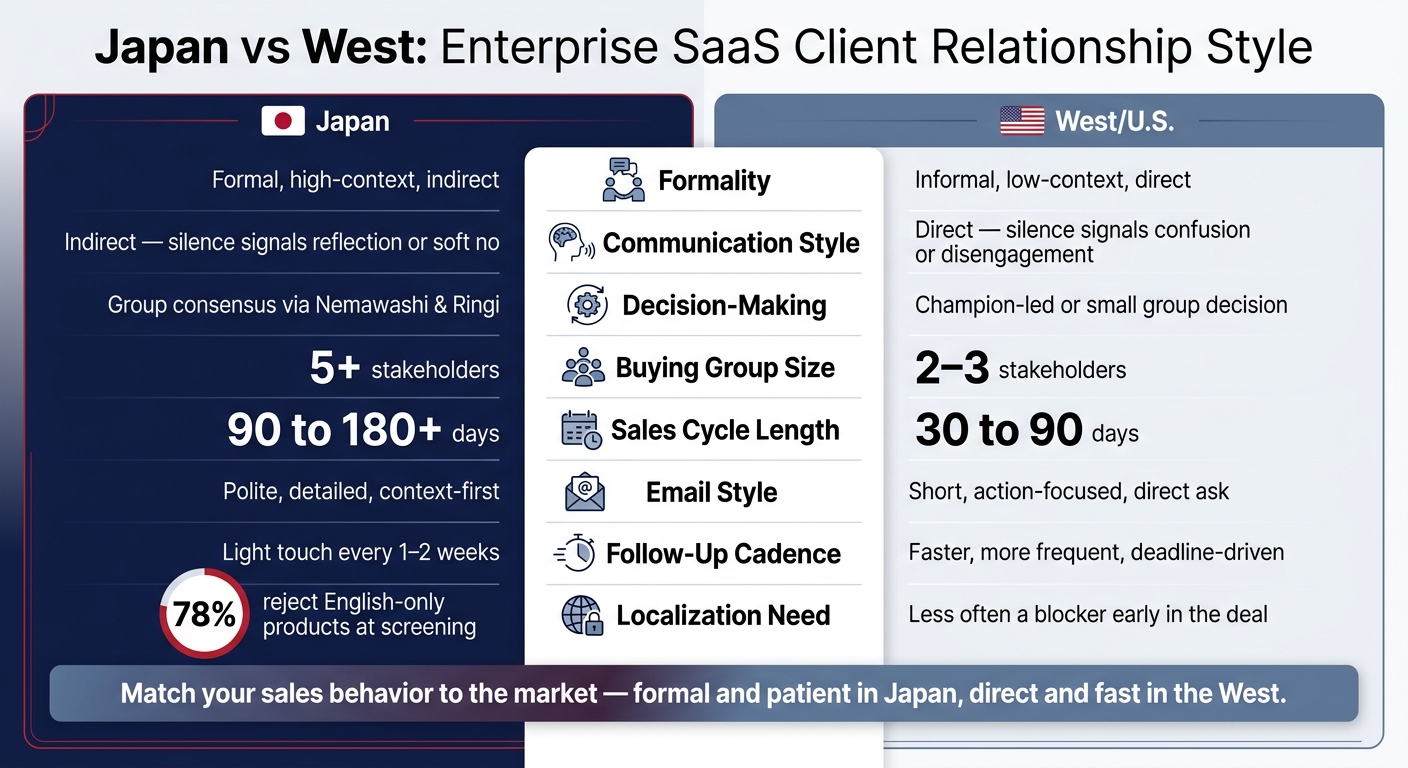
Japan vs West: Enterprise SaaS Sales Differences at a Glance
Client Relationship Norms in Japanese Enterprise SaaS
Japanese enterprise relationships are built on Shinrai (信頼). That means trust earned over time through steady behavior and mutual obligation, not just a signed contract.
Formality, Email Tone, and Respect Signals
In day-to-day communication, formality matters. In Japan, it signals trust. Business communication is high-context, so what you imply can matter just as much as what you say outright. Use honorifics, keep your language respectful and indirect, and send detailed written follow-ups that answer likely questions before the client has to ask.
Longer Sales Cycles and Group Approval
At the approval stage, Japanese enterprise SaaS deals usually move through a risk-reduction process with two steps.
Nemawashi is the informal stage. Here, your internal champion quietly checks in with IT, Finance, Legal, and the right executives to surface concerns in private before any formal proposal appears. This stage alone can take 4 to 8 weeks.
After that alignment is in place, the deal moves into ringi. This is the formal written approval process, where a ringisho document circulates in sequence through 3 to 7 approvers, often adding another 2 to 4 weeks.
Trying to skip either stage to move faster can backfire. More often than not, it weakens trust with the internal champion.
Meeting Behavior: Hierarchy, Preparation, and Silence
Japanese meetings often confirm agreement that was built in advance, not argue it out from zero. Punctuality is treated as a basic sign of respect for the group’s time. And if you send a junior rep to an important QBR, the client may read that as a sign they are not a priority.
A few signals matter a lot here:
- Send a formal agenda ahead of time
- Share a localized slide deck in advance
- Match the seniority of the room when the meeting is important
Silence also means something different. A long pause usually signals reflection or indirect hesitation, not confusion or disengagement.
These norms are quite different from Western enterprise SaaS (and how they compare to Japanese SaaS companies), where communication is often more informal, debate is more direct, and decisions tend to move faster.
sbb-itb-a752276
Client Relationship Norms in Western Enterprise SaaS
By contrast, Western enterprise SaaS tends to reward directness, speed, and smaller decision groups. Trust is often tied to performance: if you deliver against clear expectations, the relationship gets stronger.
Informal Rapport and Direct Communication
U.S. buyers often move to a first-name basis fast. Communication is direct. People usually say what they mean, and clarity matters more than subtle hints. Emails are short, plain, and focused on action.
The aim is simple:
- get to the point
- confirm the next step
- keep things moving
That style can also shorten the path to a decision.
Faster Deal Motion and Smaller Buying Groups
Western teams usually push for faster demos, faster closes, and smaller buying groups. With fewer people involved, one internal champion can often move the deal ahead more easily, especially when an executive is backing it.
In this setup, ROI projections and product reviews do much of the work. Pre-sale relationship-building still has a place, but it usually carries less weight.
Meetings Built Around Debate and Decisions
Western meetings are often built for decisions. Disagreement is expected, and in many cases, welcomed. It’s part of how teams test ideas, challenge assumptions, and get aligned fast. Interruptions are common too, and they usually don’t mean disrespect. The point is to leave with either a decision or a clear next step.
Silence means something very different here than it does in Japan. In a U.S. meeting, a long pause often signals confusion, hesitation, or disengagement – not reflection. When someone goes quiet, the usual move is to ask a direct question and pull them back in. That gap in interpretation is a common source of friction for teams selling across both markets.
Those differences show up most clearly in formality, pace, meeting behavior, and email tone.
Japan vs. the West: 5 SaaS Relationship Differences
Here’s the practical side-by-side view for sales teams. This isn’t just about tone or manners. It changes how reps should read buyer signals, pace follow-up, and decide when to pull in other people.
The relationship style that works best depends on the market: formal and patient in Japan, direct and fast in the West.
Formality and Communication Style
In Japan, indirect language often means a soft no. Western buyers, especially in the U.S., are more likely to say no plainly.
That changes how reps should respond. If a prospect says "we will study it", treat that as a sign to pause and reassess. It’s not a green light to push harder. In many cases, pushing at that point can hurt trust and make the conversation stall.
Decision-Making and Sales Pace
Japanese enterprise deals often involve 5 or more stakeholders and move through nemawashi and ringi, which can add 6 to 12 weeks to the sales cycle. In Western markets, buying groups usually involve 2 to 3 stakeholders, and one champion or executive can often move the deal ahead on their own.
This is where a lot of reps misread the room. In U.S. SaaS sales, deadline pressure is common. In Japan, that same pressure can backfire. If you compress the timeline too much, buyers may not have room to check with their teams. Worse, it can put them in a bad spot inside their company.
Those approval gaps become most visible in meetings and email.
Meeting and Email Behavior
Japanese meetings tend to be structured and aware of hierarchy. Major objections often come up in private, not during the meeting itself. U.S. meetings are usually more open, and buyers are more willing to voice concerns on the spot.
Email follows the same pattern. Japanese emails usually start with context and polite framing. U.S. emails tend to go straight to the ask. For reps, that means the format and timing of outreach should shift based on the market, not just the account.
The table below shows how these patterns show up across common SaaS touchpoints.
| Dimension | Japan | West (U.S.) |
|---|---|---|
| Communication style | High-context, indirect | Low-context, direct |
| Decision-making | Consensus-driven (nemawashi & ringi) | Champion-led or individually owned |
| Buying group size | 5+ stakeholders | 2–3 stakeholders |
| Sales cycle | 3–6 months | 1–2 months |
| Email style | Formal, polite, context-heavy | Short, direct, action-oriented |
How SaaS Teams Can Reduce Friction Across Both Markets
Once you know where the gap is, the next step is simple: fix the way you execute. That means adjusting your tone, follow-up rhythm, stakeholder map, and the materials you put in front of buyers.
Adjust Tone, Follow-Up Cadence, and Stakeholder Mapping
Use a market-specific cadence, tone, and stakeholder plan.
For Japanese enterprise accounts, formality is a trust signal. After a first meeting or trade show, send a personalized thank-you within 24 hours. During ringi, follow up lightly every 1–2 weeks. Pushy closing emails can damage trust.
Your internal champion also needs the right materials in Japanese, based on who they need to persuade:
- Security documentation for IT
- ROI models for finance
- Workflow context for end users
That gives the champion something they can use to move nemawashi inside the company.
The Western playbook works almost the opposite way. Keep communication short and decision-focused. Put your energy into the individual champion, move fast, and make it easy for one person to approve the deal. Your account plan should reflect these different approval paths from day one, not after the deal slows down.
Use Localization and Local Sales Support to Build Trust in Japan
In Japan, internal approval depends on materials people can share around the company, not just a strong sales call.
78% of Japanese enterprise buyers reject English-only products at the first screening stage. So the practical place to start is a staged rollout: a Japanese landing page, a localized product deck, and pricing in yen. Proposals should be priced in JPY and include Japan Consumption Tax (JCT).
You don’t need to localize the full UI right away. That can come after you’ve tested the market with 3–5 customers. Even a one-page Japanese summary can help a lot if your champion can drop it straight into the ringi-sho approval brief. It removes a real blocker to internal progress.
These changes turn a market difference into a sales process your team can actually use.
For teams without a Japan presence, Nihonium provides localized collateral, fractional sales support, and stakeholder navigation through nemawashi and ringi processes that are often hard for outside teams to read.
Conclusion: Match Relationship Style to Market Reality
Relationship style changes how deals move, not just how people behave. Match your tone, follow-up timing, stakeholder map, and documentation to the market, and the relationship starts doing more of the sales work for you.
FAQs
How do I know if a Japanese prospect is actually interested?
Look for real engagement, not polite affirmations. When someone says they’ll consider your proposal, that often means a soft no. Actual interest tends to show up in specific questions about implementation, pricing at scale, timelines, or technical documentation.
Pay attention to what happens between meetings too. If attendance drops, the people joining are less senior, or replies start coming in slower, the deal may be losing steam. A much better signal is when they assign action items, set deadlines, and name internal owners.
What should I localize first for Japan?
Start with full Japanese-language support across the UI, documentation, and customer support. Many enterprise buyers in Japan will reject a product before a formal review even starts if that support isn’t in place.
You should also prepare APPI privacy documentation and security questionnaires early. These are central parts of Japanese enterprise procurement, not side tasks to handle later. Nihonium can help line up this work with what local buyers expect.
When should I adapt my sales process for Japan?
Start adjusting right away when you enter the Japanese market. In Japanese enterprise SaaS, sales teams usually put long-term relationships ahead of deal speed.
Sales cycles are often 2–3 times longer than in Western markets, usually 6–12 months. That means you should reset expectations, pipeline forecasts, and reporting early. If you rush demos or skip formal etiquette, you can create friction and hurt trust.
Related Blog Posts
- Japanese B2B Sales: Key Differences from Western Markets
- B2B SaaS Buying Behavior in Japan
- Long-Term Perspective in Japan: Lessons for SaaS
- Hierarchy in Japanese SaaS Companies
 English
 Japanese