

To handle APPI compliance for a SaaS product in Japan, map the personal information you hold, publish a Japanese privacy policy that states each purpose of use, choose a lawful route for any transfer of data abroad, and have a breach-reporting workflow ready before your first Japanese customer goes live. Japan’s Act on the Protection of Personal Information (個人情報保護法, APPI) is enforced by the Personal Information Protection Commission (PPC). It reaches foreign companies: under Article 171, the law applies to an overseas business that handles the personal information of people in Japan in connection with supplying goods or services to them. Since April 2022 the PPC can also issue orders to foreign operators. In practice your obligations start with the first email address you collect from a prospect in Tokyo, and enterprise buyers will test them long before a regulator does.
Key APPI Requirements for Foreign SaaS Companies
Eight obligations do most of the work for a SaaS company, from defining purposes of use to reporting breaches on a fixed timeline.
The amendments in force since April 2022 made breach reporting mandatory, widened individual rights (including electronic disclosure), added the “pseudonymously processed information” category and tightened the information you must give before a transfer abroad. Enforcement is steady: in fiscal 2025 the PPC processed 17,139 breach reports from private businesses and issued 455 instances of guidance and advice, 2 recommendations and 1 order. A further amendment was enacted in July 2026 and will take effect by July 2028; it adds administrative surcharges for serious violations (see the FAQ below).
| Requirement | APPI Article | Obligation Details | SaaS Impact |
|---|---|---|---|
| Purpose Specification | Art. 17, 21 | Specify the purpose of use as concretely as possible, and publish it or notify the individual. Use beyond that purpose needs consent. | Privacy policy must state each data-use case (analytics, billing, support, product improvement) explicitly. |
| Consent for Sensitive Data | Art. 20(2) | Obtain prior consent before acquiring “special care-required personal information” (race, creed, social status, medical history, criminal record, disability and similar). | HR-tech or health-tech SaaS must implement consent flows before data ingestion. |
| Security Control Measures | Art. 23–25 | Take organizational, human, physical and technical security measures, supervise employees and supervise any contractor you entrust personal data to. | Requires documented security policies, access controls, encryption, employee training and contracts with sub-processors. |
| Third-Party Provision | Art. 27 | Obtain prior consent before providing personal data to a third party, with exceptions (legal obligation, protection of life or property, public health and others). Entrusting data to a contractor for your own purposes is not third-party provision. | A sub-processor working only for you is an entrustee; a vendor using the data for its own purposes is a third party. |
| Cross-Border Transfers | Art. 28 | Before providing personal data to a recipient abroad: obtain consent after telling the individual the destination country, its data protection system and the recipient’s measures, or transfer to a country the PPC has designated (the EU and the UK), or confirm the recipient has a system meeting PPC standards (contract, group rules or APEC CBPR certification). | Applies even to entrustment: overseas sub-processors and group companies need a route. |
| Breach Notification | Art. 26 | For reportable breaches (sensitive data, risk of financial loss, wrongful purpose such as unauthorized access, or more than 1,000 people), file a preliminary report to the PPC promptly (about 3–5 days after you learn of it) and a final report within 30 days (60 days for wrongful-purpose cases); notify affected individuals promptly. | SaaS operators need an incident-response plan with Japanese-language notification templates. |
| Data Subject Rights | Art. 32–39 | Publish key information about retained personal data; respond to requests for disclosure (including in electronic form), correction or deletion, cessation of use and cessation of third-party provision. | Data-export and deletion tooling, or a documented manual process, must be available for Japanese users. |
| Record-Keeping | Art. 29–30 | Keep records when you provide personal data to, or receive it from, a third party. The retention period is one or three years depending on how the record is made. | Logs of data sharing via APIs, webhooks or integrations must be retained and retrievable. Entrustment to a sub-processor is outside this duty. |
SaaS-Specific Compliance Considerations
SaaS platforms face particular APPI questions around sub-processor chains, API data flows and the fact that Japanese law has no “processor” role in the GDPR sense.
The APPI does not divide the world into controllers and processors. Anyone who uses a personal information database for business is a “business operator handling personal information” with the full set of duties. What it does have is entrustment (委託, itaku): when your Japanese customer hands personal data to your SaaS platform so that you process it for them, that is entrustment, not third-party provision, so no individual consent is needed. The customer must supervise you (Article 25), and you keep your own obligations as a business operator; you cannot contract out of them. The July 2026 amendment will add an express duty for entrustees not to use entrusted data beyond the entrusted work.
Commercially, Japanese enterprise buyers send detailed data-handling questionnaires before signing and usually ask where data is stored. A Japan-region hosting option and Japanese-language answers shorten that stage.
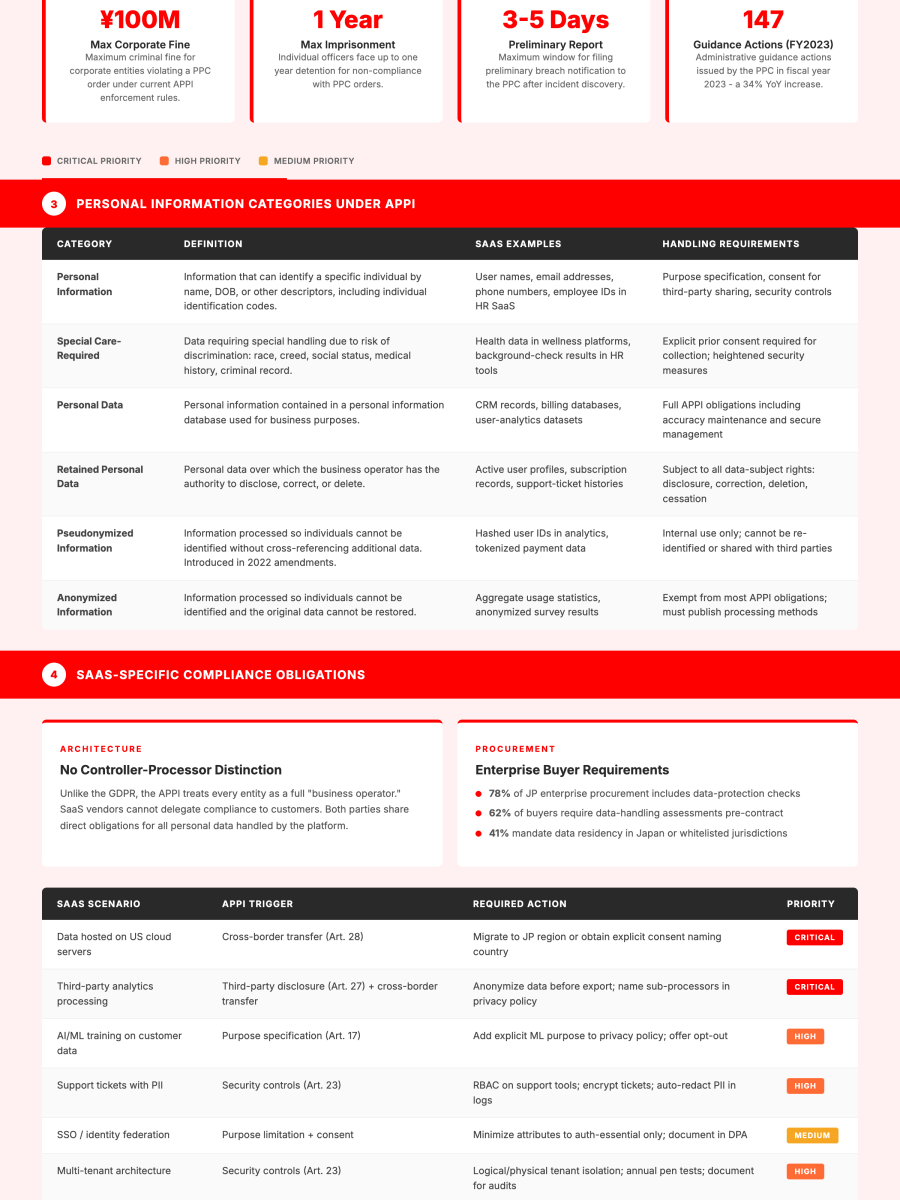
| SaaS Scenario | APPI Obligation | Recommended Action |
|---|---|---|
| Customer data stored on US-based cloud (AWS us-east-1) | If the cloud provider does not handle the data (contract excludes it and access is controlled), this is not a provision to a foreign third party; you must still understand the foreign country’s rules and disclose the country as part of your security measures (Art. 23, 32) | Confirm the provider’s contract terms, name the country in your privacy notice, or offer AWS Tokyo (ap-northeast-1) for customers who require Japan residency. |
| Third-party analytics (Mixpanel, Amplitude) processing user events | Entrustment if the vendor works only for you; third-party provision (Art. 27) if it uses the data for its own purposes; Art. 28 applies where the vendor is abroad. Cookie and device data may also fall under “individually referable information” (Art. 31) and the Telecommunications Business Act’s external transmission rule | Pseudonymize event data before export; name analytics tools and their countries in your privacy policy. |
| AI/ML model training on customer data | Purpose specification (Art. 17); training must fall within the published purpose of use. The 2026 amendment will relax consent for statistics and AI development, once in force | Add an explicit “product improvement and machine learning” purpose to the privacy policy; agree the position with enterprise customers in the contract; offer an opt-out. |
| Customer support tickets containing personal information | Security control measures (Art. 23); access limited to necessary personnel | Implement role-based access controls on support platforms; encrypt ticket contents; auto-redact personal data in logs. |
| SSO / identity federation with customer IdP | Purpose limitation and data minimization for authentication data | Collect only the attributes authentication needs; document data flows in the data processing agreement. |
| Multi-tenant data architecture | Security control measures (Art. 23); prevent cross-tenant data leakage | Implement logical or physical tenant isolation; conduct regular penetration tests; document the architecture for customer audits. |
Cross-Border Transfer Mechanisms
Article 28 gives three routes for providing personal data to a recipient outside Japan. The PPC has designated only the EU and the UK as having equivalent protection, under the mutual adequacy arrangement with the EU that took effect on 23 January 2019 and was continued after Brexit for the UK. The United States, Canada, Australia and Singapore are not designated. For recipients there, use informed consent or a recipient system that meets PPC standards (contract, intra-group rules or APEC CBPR certification), and keep monitoring it. Storing data on a foreign provider’s servers is not a “provision” at all if the provider does not handle the data.
APPI Compliance Checklist for SaaS Companies
Work through these 12 steps before launching your SaaS in Japan.
The common failures are vague purposes of use, overseas transfers with no lawful route, and breach response that is too slow or only in English.
| Step | Action Item | Priority | Details |
|---|---|---|---|
| 1 | Conduct a personal-information audit | Critical | Map every data field collected from Japanese users: names, emails, IP addresses, device IDs, cookies. Classify each as personal information, special care-required information, individually referable information, or pseudonymized or anonymized data. |
| 2 | Draft a Japanese-language privacy policy | Critical | Specify every purpose of use; state your company name, address and representative’s name; describe security measures, including the countries where data is held; explain how to make disclosure and other requests. |
| 3 | Implement consent-management infrastructure | Critical | Build consent flows where the law requires them: sensitive data, use beyond the stated purpose, third-party provision and consent-based transfers abroad. Check whether the Telecommunications Business Act’s external transmission rule applies to your tracking tags. Record consent timestamps and versions. |
| 4 | Establish cross-border transfer safeguards | Critical | For recipients outside the EU and UK: obtain informed consent naming the destination, or sign data-protection agreements that bring the recipient up to the PPC’s standards, and check them periodically. |
| 5 | Document sub-processor relationships | High | List all vendors that access personal data (hosting, analytics, support tools, payment processors), whether each is an entrustee or a third party, and its country. Put entrustment contracts in place. |
| 6 | Implement security control measures | High | As good practice: encrypt data at rest and in transit (TLS 1.2 or later), enforce MFA for internal access, run regular vulnerability scans and annual penetration tests. |
| 7 | Build a breach-notification workflow | High | Create runbooks for PPC reporting (preliminary report in about 3–5 days, final report within 30 or 60 days). Prepare Japanese-language notification templates for affected individuals. |
| 8 | Enable data-subject rights fulfillment | High | Build self-service tools or documented processes for disclosure, correction, deletion and cessation requests. The law requires a response without delay; set an internal target such as 14 days. |
| 9 | Name a privacy contact for Japan | Medium | The APPI does not require a local representative or DPO, but Japanese customers, users and the PPC need a reachable, Japanese-speaking point of contact. This can be an employee or an external partner. |
| 10 | Train employees on APPI obligations | Medium | Train everyone who accesses Japanese customer data, at least annually. Document completion and content. |
| 11 | Implement record-keeping systems | Medium | Log third-party provisions and receipts of personal data and keep the records for one or three years, depending on the recording method. Ensure audit-trail integrity. |
| 12 | Schedule annual compliance reviews | Medium | Review privacy policies, consent mechanisms, sub-processor lists and security measures annually. The APPI is reviewed every three years; the 2026 amendment’s rules and guidelines are being drafted now. |
Key Takeaways
APPI compliance is manageable for a foreign SaaS company that plans for it, and an easy reason for a Japanese enterprise to say no if you do not.
- Extraterritorial reach is real: The APPI applies to a foreign SaaS company handling personal information of people in Japan in connection with services to them, even without a local entity, and the PPC can issue orders to overseas operators.
- No processor safe harbor: Entrustment removes the need for consent when a customer hands you data, but you keep your own obligations as a business operator. You cannot contract them away.
- Cross-border transfers need a route: Only the EU and the UK are designated. For the US and elsewhere, rely on informed consent or a recipient system that meets PPC standards, and check whether your cloud setup is a “provision” at all.
- Breach reporting runs on a clock: A preliminary report to the PPC is expected about 3–5 days after you learn of a reportable breach, and a final report within 30 days (60 for wrongful-purpose cases). Prepare Japanese-language templates in advance.
- Compliance is a sales enabler: Japanese enterprise procurement checks data handling closely. Documented APPI compliance shortens security review.
Working with Nihonium. We are a Japan go-to-market partner for B2B SaaS companies: Japan go-to-market strategy. Talk to us about your Japan entry.
Sources
- Act on the Protection of Personal Information, English translation (Japanese Law Translation, Ministry of Justice)
- PPC: APPI Guidelines (General Rules), including breach reporting timelines (Japanese)
- PPC Q&A 12-3: storing personal data on servers outside Japan (Japanese)
- PPC: Guidelines on confirmation and record-keeping for third-party provision (Japanese)
- PPC: EU-Japan mutual adequacy framework (Japanese)
- PPC: overview of the 2026 amendment to the APPI, July 2026 (Japanese)
- ScanNetSecurity: PPC annual report for fiscal 2025 (Japanese)
Frequently Asked Questions
Does APPI apply to my SaaS if I don’t have a legal entity in Japan?
Yes. Article 171 applies the APPI to a foreign business that handles the personal information of people in Japan in connection with supplying goods or services to them, wherever the company is incorporated. If your SaaS collects email addresses, usage data or other identifiable information from Japanese users, you are covered. Since April 2022 the PPC can require reports from foreign operators and issue them recommendations and orders. You do not need a Japanese subsidiary to comply, but you do need someone who can deal with Japanese users and the PPC in Japanese.
How does APPI differ from the GDPR for SaaS companies?
The biggest structural difference is that the APPI has no system of legal bases. The GDPR requires one of six lawful bases for each processing activity; the APPI instead requires you to specify and publish your purposes of use, and asks for consent mainly for use beyond those purposes, for sensitive data, for third-party provision and as one route for transfers abroad. Nor does it have a GDPR-style processor role: a SaaS vendor processing customer data is an entrustee with its own duties. On breaches, the APPI’s preliminary report is expected in about 3–5 days, a little longer than the GDPR’s 72 hours, with a final report within 30 or 60 days.
What happens if my SaaS product is found non-compliant with APPI?
Enforcement is graduated. The PPC usually starts with a request for a report, guidance or advice, then a recommendation, and if that is ignored, a binding order. Violating an order is a crime: up to one year of imprisonment or a fine of up to JPY 1 million for the individual responsible, and a fine of up to JPY 100 million for the company. The amendment enacted in July 2026 adds an administrative surcharge for serious violations, such as unlawful third-party provision or improper acquisition affecting 1,000 or more people, equal to the financial gain from the violation. It takes effect by July 2028 at the latest. A publicized violation usually costs more in lost enterprise deals than in fines.
Can I store Japanese customer data on servers outside Japan?
Yes. First check whether a transfer is happening at all: if you store data on a foreign cloud provider’s servers and the provider does not handle the data (its contract excludes access and access is controlled), the PPC does not treat it as a provision to a third party abroad. You must still understand that country’s rules and tell users where the data is. If a recipient abroad will handle the data, Article 28 requires one of three routes: the recipient is in the EU or the UK; the individual consents after being told the country, its rules and the recipient’s measures; or the recipient has a system that meets PPC standards, usually set up by contract. Many SaaS companies also offer a Japan-region instance (such as AWS ap-northeast-1 or Azure Japan East) because enterprise buyers ask for it.