
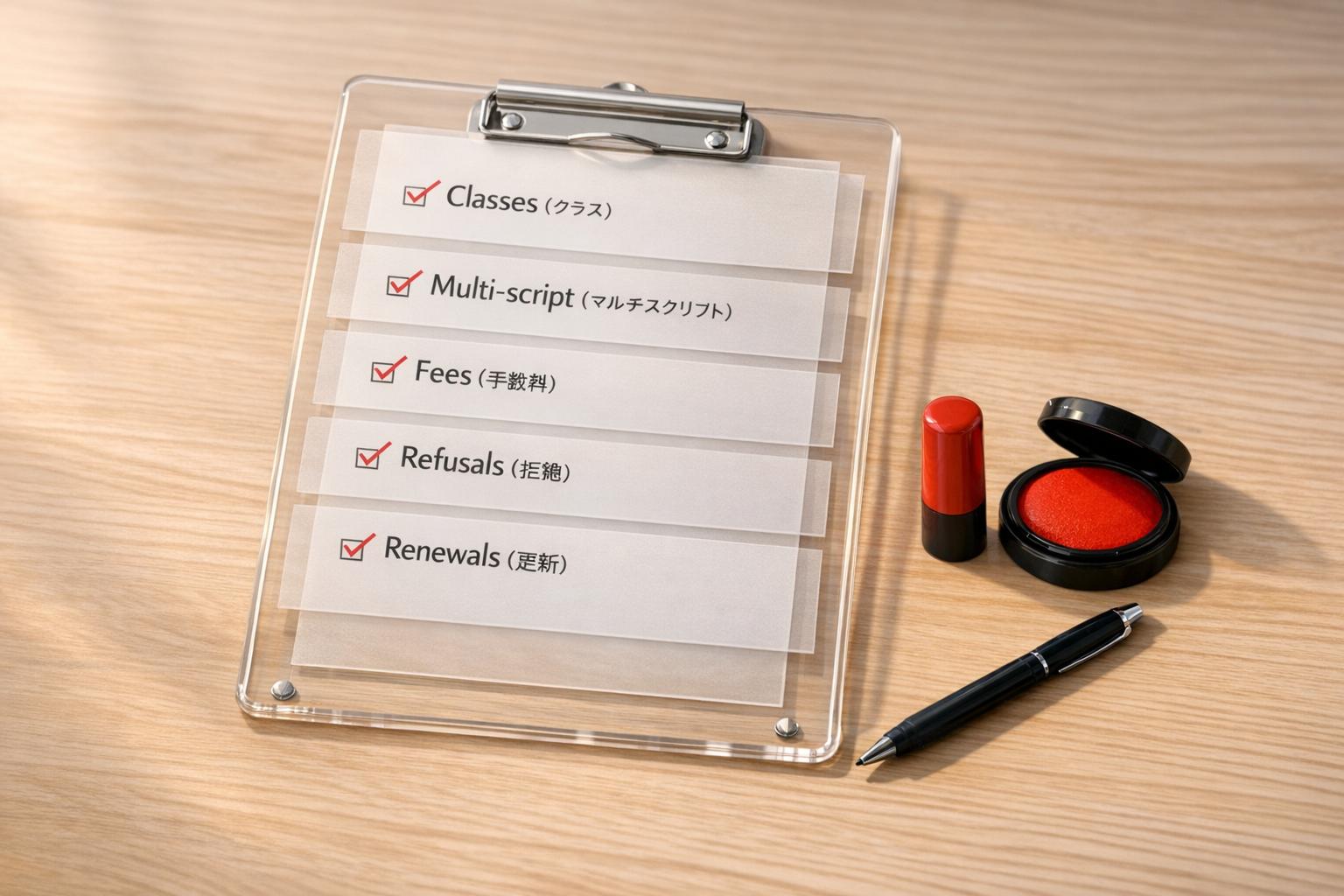
Want to protect your SaaS brand in Japan? Start with trademark registration.
Japan’s first-to-file system means the first person to register a trademark gets exclusive rights, even if you’re already using the brand elsewhere. For SaaS companies entering Japan’s growing market – projected to reach $13.4 billion by 2027 – this makes early registration essential.
Here’s what you need to know:
- Register in multiple scripts (English, Katakana, Kanji) to cover all variations of your brand. This is a critical part of localizing your SaaS product for the Japanese market.
- Search for existing trademarks using J-PlatPat to avoid conflicts.
- Choose the right classes: Class 42 for cloud-based services, Class 9 for downloadable software.
- Plan costs: Filing fees start at ¥12,000 (~$90 USD), with total costs under $2,000 for most cases.
- Act fast: Delays can lead to rebranding or costly disputes.
Trademark registration also enables enforcement, protects against misuse, and builds trust with Japanese customers. Start early, file correctly, and keep your brand secure in this competitive market.
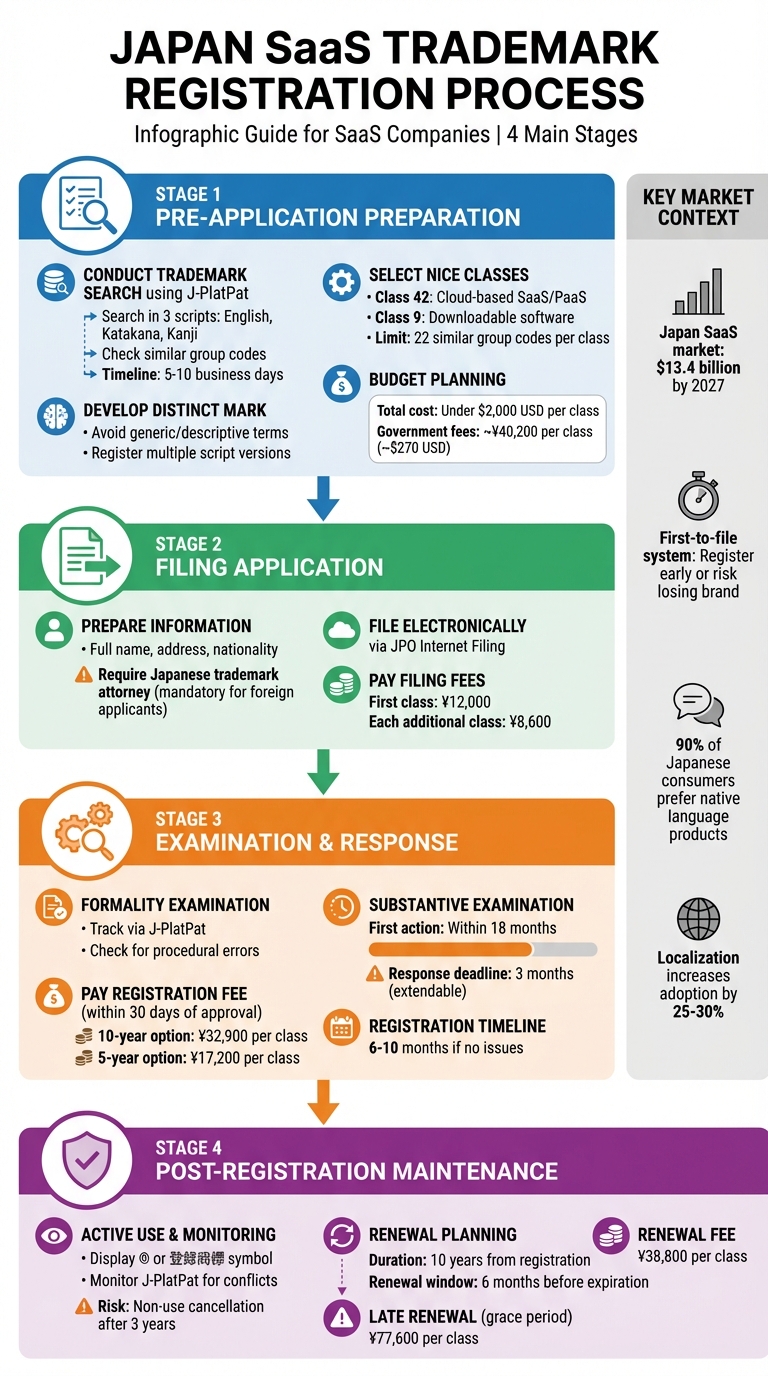
Japan SaaS Trademark Registration Process: 4-Stage Checklist
Pre-Application Preparation
Conduct a Trademark Clearance Search
To begin, use J-PlatPat, the Japan Platform for Patent Information. This free tool helps you search for existing trademarks, including those that are identical or similar. Be sure to search for your brand across multiple scripts – its English version, Katakana transliteration, and any Kanji translations. This is important because Japanese consumers often recognize foreign brands by their phonetic sound. This phonetic recognition is a key factor when designing SaaS landing pages in Japan to build trust with local users.
"For a broader and stronger protection in Japan, we recommend registering your trademark in local characters." – Marcaria
Pay close attention to similar group codes. These codes, unique to the Japan Patent Office (JPO), are used to determine similarity. Goods or services sharing the same code are automatically considered similar, regardless of their classification under the Nice system. Expand your search to include phonetic and visual similarities that could lead to rejection. Typically, a professional word mark search takes about five business days, while logo searches may take up to ten.
If you find similar marks that haven’t been used for three consecutive years, they may be eligible for a non-use cancellation trial. This could clear the way for your application. It’s also crucial to file before announcing your product. Japan follows a strict first-to-file rule, meaning someone else could register your brand if you delay. These multi-script considerations will also come into play when addressing distinctiveness later.
Once your clearance is confirmed, the next step is selecting the proper Nice Classification classes.
Select the Right Nice Classification Classes
For SaaS businesses, protection under both Class 9 and Class 42 is typically required. Class 42 covers SaaS and PaaS offerings – cloud-based tools that don’t require installation. Class 9, on the other hand, applies to software or mobile apps that users download and install.
Starting January 1, 2026, the 13th edition of the Nice Classification (NCL 13-2026) includes "Artificial Intelligence as a Service (AI-as-a-Service)" in Class 42. If your SaaS product uses AI, make sure to use this updated terminology to align with current standards.
Keep your specification within 22 or fewer similar group codes per class. Exceeding 22 could result in a provisional refusal from the JPO. Japan also allows multi-class applications, which makes managing your trademark portfolio easier.
| Fee Type | First Class | Each Additional Class |
|---|---|---|
| Application Fee | ¥12,000 | ¥8,600 |
| 10-Year Registration | ¥32,900 | ¥32,900 |
| 5-Year Registration | ¥17,200 | ¥17,200 |
Develop a Distinct Trademark
Your trademark must stand out. Generic or descriptive names, as well as misleading ones, are likely to be rejected. To improve your chances, consider enhancing generic terms with unique design elements like stylized logos, colors, or even sounds.
For example, McDonald’s secured its brand identity in Japan by registering "Makudonarudo" (マクドナルド), and Coca-Cola did the same with "Kōkakōra" (コカ・コーラ). Starting April 1, 2024, the JPO may allow trademarks similar to existing ones if the prior owner consents and there’s no risk of customer confusion.
Avoid using three-dimensional marks that merely reflect a product’s function. These are hard to register unless they’ve gained distinctiveness through long-term use. Also, always use your trademark as an adjective followed by a noun (e.g., "SaaS Platform") rather than as a noun or verb. This helps prevent it from becoming generic.
Calculate Costs and Set Your Budget
Government fees for filing and registration total about ¥40,200 per class (around $270 USD at current exchange rates). This includes ¥12,000 for the first class application fee and ¥32,900 for a 10-year registration. Filing additional classes costs ¥8,600 each, with the same ¥32,900 registration fee per class.
A full professional search and registration for a single class usually costs under $2,000 USD, covering both government and professional fees. If your SaaS product requires protection under both Class 9 and Class 42, plan for two classes. If your application faces a refusal, appeal fees are ¥55,000 for the first class and ¥40,000 for each additional class.
The JPO typically issues its first examination action within 18 months, and registration is often granted within 6 to 10 months if no issues arise.
With your budget set, ensure your service descriptions meet JPO standards.
Match Your SaaS Services to JPO Standards
The JPO prefers clear and widely accepted terms for products and services. Vague descriptions like "technology services" are often rejected and may require revision. To avoid delays, use terms already approved in the JPO’s classification database.
Be specific about how your service is delivered. For instance, software installed on a device falls under Class 9, while cloud-based services belong to Class 42. A project management tool installed on a PC would be Class 9, while its web-based counterpart would be Class 42.
Unlike the USPTO, the JPO doesn’t require proof of use when filing. However, you must show "intent to use" the trademark in Japan, even if your product hasn’t launched yet. Note that a use requirement kicks in three years after registration.
sbb-itb-a752276
Filing the Trademark Application
Prepare Applicant Information
When filing your trademark application, you’ll need to provide the applicant’s full name, address, and nationality. Represent your trademark clearly using approved formats, which can include words, figures, symbols, 3D shapes, colors, sounds, or holograms.
Make sure to list your goods and services according to the Nice Classification system. However, avoid designating 23 or more similar group codes in a single class, as this could lead to a provisional refusal. If you’re claiming priority based on a foreign application filed within the last six months, you’ll need to submit a certified copy of that application within three months of filing in Japan.
For foreign applicants, working through a registered Japanese trademark attorney is mandatory. While you won’t need a Power of Attorney for the initial filing, it will be required for tasks like appeals or transferring ownership later on.
Once you’ve gathered all necessary details, it’s time to choose a filing method.
Select a Filing Method
The Japan Patent Office (JPO) offers electronic submissions through Internet Filing, which is the primary method. This approach provides immediate confirmation and an assigned application number. Your Japanese attorney will handle the online filing process, ensuring everything proceeds smoothly.
If your trademark strategy involves expanding into multiple countries, you might consider filing through the Madrid Protocol. Japan’s membership in the protocol allows you to file a single international application that can cover various jurisdictions. However, keep in mind that the JPO will examine Madrid Protocol applications within 18 months. For faster results, a direct domestic filing in Japan is often quicker, with registration typically taking 6 to 10 months if there are no complications.
Calculate and Pay Filing Fees
Japan uses a two-stage payment system for trademark fees. The first payment is the filing fee, due when you submit your application, and the second is the registration fee, payable only if your trademark is approved.
- Filing fees are ¥12,000 for the first class and ¥8,600 for each additional class.
- After your application is allowed, you’ll have 30 days to pay the registration fee. Choose between ¥32,900 per class for a 10-year registration or ¥17,200 per class for a 5-year registration.
Your attorney will handle these payments, which can be made via wire transfer, credit card, or PayPal. Since filing fees are non-refundable – even if your application is rejected – conducting a thorough clearance search beforehand is crucial to avoid unnecessary expenses. This ties back to the budgeting steps you should have completed during the pre-application phase.
Responding to Examination Outcomes
Track the Formality Examination
Once you submit your application, the Japan Patent Office (JPO) assigns it an application number. Make sure to save this confirmation – it’s your key to tracking your filing through J-PlatPat.
The formality examination is the first step in the process. Here, the JPO reviews your application for any missing documents or procedural mistakes before moving on to the substantive review stage. You can keep tabs on your application’s progress using J-PlatPat, the Japan Platform for Patent Information, which serves as the main online tool for tracking applications. Additionally, your local trademark attorney can access the JPO’s systems directly, interpreting updates and alerting you to any issues that might need attention. Staying on top of these updates is essential to address any problems that could arise during the substantive examination phase.
Address Substantive Examination Refusals
After the formality stage, the next milestone is the substantive examination. Within about 18 months of your application date, the JPO will issue its first action, which could be an approval or a refusal notice. If you receive a refusal, non-resident applicants have three months to respond, with the option to request a one-month extension, followed by an additional two-month extension if necessary.
Refusals often stem from issues such as conflicts with existing trademarks, lack of distinctiveness, or exceeding 22 similar group codes in one class. If a prior conflicting mark is cited, you can submit arguments to demonstrate your mark’s distinctiveness. Alternatively, if the cited mark hasn’t been used in Japan for at least three consecutive years, consider filing a non-use cancellation trial. For marks deemed too generic, providing evidence of acquired distinctiveness through use in Japan can strengthen your case. If the refusal only affects certain SaaS services, filing a divisional application allows the undisputed services to move forward independently. Once all issues are resolved, you can proceed to finalize your registration by paying the required fees on time.
Pay the Registration Fee
Once your trademark is approved, it’s time to pay the registration fee. This must be done within 30 days, though a one-time 30-day extension is available. Your trademark rights only take effect after this payment is processed.
"Upon payment, the trademark is registered and the trademark right comes into effect." – FUJIMarks Japan P.C.
The fee structure offers two options: ¥32,900 per class for a 10-year registration or ¥17,200 per class for a 5-year term. While the 10-year option is more economical over time, the 5-year term provides flexibility if you’re testing your SaaS product’s market fit through localization or navigating short-term financial constraints. Your attorney will ensure the payment is made promptly to prevent your application from lapsing. A few weeks after payment, you’ll receive your official certificate of trademark registration.
Post-Registration Maintenance
Use and Monitor Your Trademark
Once your trademark is registered, maintaining and actively using it is key to protecting its value over time. Start by displaying the ® or 登録商標 (tōroku shōhyō) symbol to indicate its registered status.
To safeguard your trademark, use private SDI services and regularly monitor J-PlatPat for conflicting filings. This is especially important as brokers often submit bulk applications – one broker filed over 17,000 applications in 2020, surpassing major companies like Sanrio and Shiseido.
If you come across a suspicious application, submit evidence like catalogs, transaction records, or publications directly to the Japan Patent Office (JPO) examiner. This approach works: about 60% of such applications are eventually rejected when third-party evidence is provided. For SaaS brands, it’s also vital to keep an eye on Japanese e-commerce platforms for unauthorized use of your logo or brand name. When you spot infringement, you can request removal through the platform provider or send a formal warning via certified mail.
Plan for Trademark Renewals
Trademark rights in Japan last for 10 years from the registration date, but they can be renewed indefinitely. Missing the renewal deadline, however, means losing your rights entirely, forcing you to file a new application – which could face challenges from newer filings.
To avoid this, file your renewal within the 6 months leading up to your expiration date. The renewal fee is ¥38,800 per class for another 10 years. If you miss this window, you’ll have a 6-month grace period after expiration, but the fee doubles to ¥77,600 per class. Avoid this costly mistake by setting up a tracking system now – whether through your attorney’s watch service or an internal calendar. Keep in mind that trademarks not actively used for three years are vulnerable to Non-Use Cancellation.
Incorporate the Trademark into Your Market Strategy
Your trademark isn’t just a legal asset – it’s a branding tool that can help you connect with Japanese buyers. In Japan, trademarks signal stability and commitment, which are highly valued by buyers (shinrai). This is particularly important in a market where only 34% of small and medium enterprises (SMEs) use SaaS solutions, and the average company uses just 35 apps compared to a global average of 93.
Leverage your trademark in localized sales materials, especially case studies.
"Case studies are the most important sales collateral in Japan. There was a survey a little while back and it was the most requested document. Even above the company deck itself"
Adjust your marketing approach to better suit Japanese buyers’ preferences. For example, replace direct calls-to-action like "Book a Demo" with softer options like "Download Documents", as Japanese buyers often prefer to conduct thorough internal research before engaging with vendors. Also, ensure your brand uses appropriate honorific language (keigo) and avoids overly casual or pushy sales tactics, which can erode trust.
For SaaS companies entering the Japanese market, your trademark lays the groundwork for building trust and credibility. Consider working with localization experts like Nihonium (https://nihonium.io), who specialize in product localization, marketing funnel development, and tailored market entry strategies for Japan. Align your branding with local payment preferences, such as bank transfers (furikomi) and monthly invoicing, and optimize for popular platforms like LINE and Yahoo! Japan. With the Japanese SaaS market projected to hit ¥2 trillion by 2027, growing at a 25% annual rate, your trademark can be a key asset for capturing this expanding opportunity.
Conclusion
Securing trademark protection in Japan requires careful planning, timely filing, and ongoing upkeep. Japan operates under a first-to-file system, which means registering your trademark early is essential to avoid the risk of costly rebranding or losing your foothold in the market.
To safeguard your brand fully, register your mark in English, Katakana, and Kanji. This prevents others from exploiting variations in script. Additionally, avoid overly broad service descriptions to reduce the risk of non-use cancellation. Once registered, your trademark becomes a powerful tool for enforcement, both within Japan and internationally.
However, registration is just the beginning. Continued use and enforcement are equally important. Trademarks in Japan can be canceled if they remain unused for three consecutive years, so it’s crucial to keep detailed records, such as invoices and advertisements, to demonstrate ongoing use. With 90% of Japanese consumers favoring products in their native language and localized efforts increasing adoption rates by 25–30%, your trademark doesn’t just protect your brand – it builds trust and strengthens your presence in the Japanese market.
FAQs
Do I need to trademark my SaaS name in Katakana too?
Yes, it’s a good idea to trademark your SaaS name in Katakana if you’re operating in Japan. Katakana is commonly used for foreign brand names and trademarks, making it easier for your brand to be recognized and protected in the Japanese market. This step ensures your name aligns with local linguistic norms while offering stronger legal safeguards.
Should I file in Class 9, Class 42, or both?
If your SaaS software falls under both categories, make sure to file in Class 9 (which covers software products and digital content) and Class 42 (which includes technological services and software development). Filing in both classes ensures your software and its related services are well-protected.
What can I do if my trademark is refused in Japan?
If the Japan Patent Office (JPO) refuses your trademark application, you still have options to address the situation. You can respond by either amending your application or requesting an appeal or trial to challenge the decision. Start by carefully examining the Office Action to understand the specific reasons for the refusal. Then, prepare and submit any necessary amendments or arguments to address the issues raised.
For a smoother process, consider working with a local trademark attorney. Their expertise can help you navigate the complexities of the JPO’s procedures and increase your chances of a favorable outcome.
 English
  Japanese