
A fractional go-to-market service that helps global FinTech and payments SaaS companies enter Japan without first establishing a full local entity.
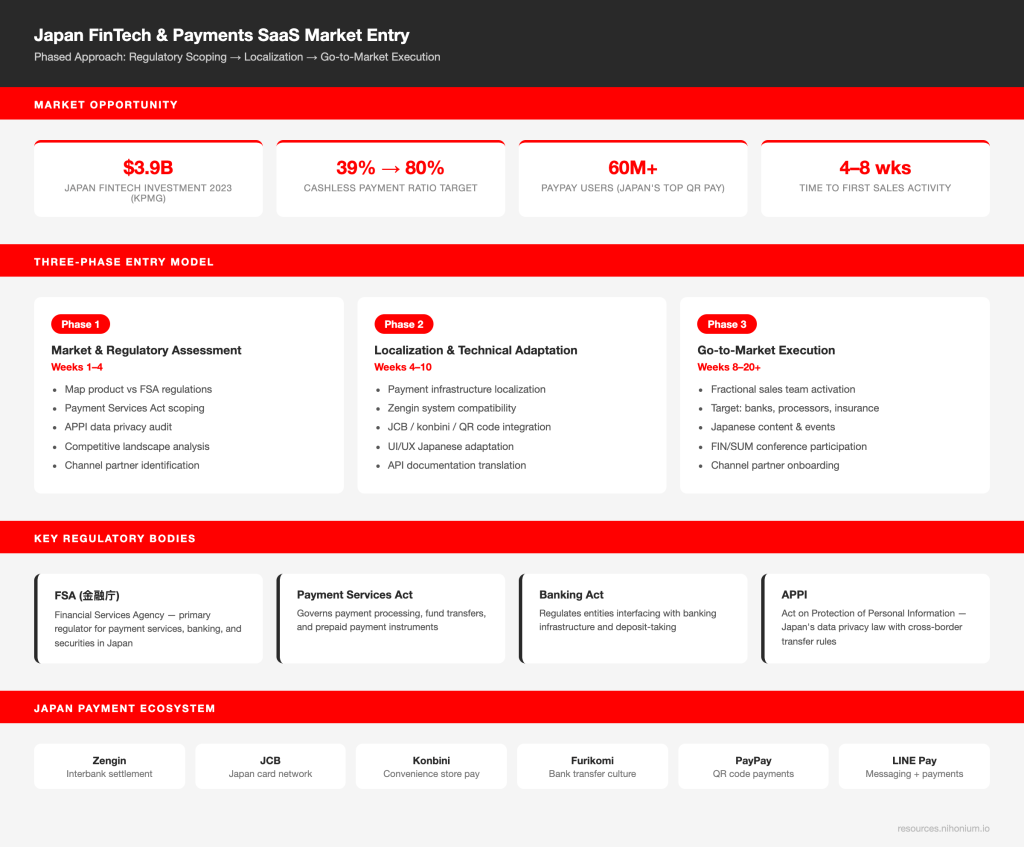
Japan’s payments market is shifting. The Ministry of Economy, Trade and Industry (METI) put the cashless share of consumer payments at 39.3% in 2023 and 42.8% in 2024, passing the 40% target for 2025 set in its 2018 Cashless Vision; 80% remains the long-term goal. PayPay, the largest QR code payment app, passed 75 million registered users in August 2026. Venture investment into Japanese fintech is modest by comparison (KPMG: USD 204.5 million across 37 deals in the first half of 2026), so the opportunity for a global vendor lies in selling to Japan’s financial institutions and finance teams. Entry is demanding: payment and banking businesses register with the Financial Services Agency (FSA), card payments fall under METI’s Installment Sales Act, and the domestic ecosystem, spanning the Zengin interbank network, JCB, konbini (コンビニ, convenience store) payments, furikomi (振込, bank transfer) and QR code apps, has no direct Western equivalent.
Nihonium provides a fractional Japan go-to-market model for Series A to growth-stage FinTech and payments SaaS companies. Instead of a subsidiary before the market is proven, you get strategy, localization, a sales and marketing funnel and a fractional Japanese-speaking sales team as one service.
Key Capabilities
Service modules covering Japan FinTech market entry, from the entry plan through pipeline generation.
Service Features
| Capability | What It Does | Benefit |
|---|---|---|
| Regulatory Readiness in the Entry Plan | Lists the licensing questions your Japanese counsel must confirm and builds the answers into the plan | No sales motion that runs ahead of the licence position |
| APPI Materials in Japanese | Japanese privacy and data-handling materials under the Act on the Protection of Personal Information, for counsel to confirm | Answers buyers’ data questions in their language |
| Payment Experience Localization | Localizes product copy, documentation and checkout or invoice flows for Japanese methods (furikomi, konbini, JCB, QR payments); integration stays with your engineers or payment provider | Product reads and works the way Japanese finance teams expect |
| SaaS UI/UX Localization | Translates and restructures product interfaces, documentation, and onboarding flows for Japanese enterprise buyers | Reduces friction in sales demos and pilot deployments |
| Japan GTM Strategy | Develops positioning, pricing structure, and channel strategy tailored to the Japanese B2B fintech buying cycle | Replaces guesswork with a validated market approach |
| Fractional Sales Team | Japanese-speaking sales professionals who prospect, qualify, and advance deals from first email to closing | Generates pipeline without the fixed cost of a local hire |
| Channel Strategy | Selects target channel partners (banks, payment processors, system integrators) and builds the partner pitch | Distribution through networks buyers already trust |
| Japan Marketing Funnel | Builds demand generation assets targeting financial services decision-makers | Creates inbound pipeline alongside outbound sales |
How It Works
A phased approach that moves from regulatory clarity to commercial traction in the Japanese fintech market.
Phase 1: Market and Regulatory Assessment. We start with market and regulatory scoping. The Payment Services Act covers funds transfer, prepaid payment instruments and electronic payment instruments such as stablecoins; the Banking Act covers banking and, since 1 June 2018, electronic payment agency providers that connect to bank APIs; the Financial Instruments and Exchange Act covers investment advice; METI’s Installment Sales Act covers card payments. We map which of your product’s functions touch which framework, so your Japanese counsel can confirm which registrations, notifications or exemptions apply before you invest in localization and sales.
Phase 2: Localization. For FinTech and payments SaaS, localization goes beyond language: Japanese financial institutions expect products to fit domestic settlement through the Zengin System and local data formats. We localize the interface, API documentation and the materials buyers’ security teams review.
Phase 3: Go-to-Market Execution. While localization finishes, the fractional sales team prospects target accounts (regional banks, payment processors, insurers, enterprise finance departments) and the marketing funnel runs Japanese content, webinars and events such as FIN/SUM (co-hosted by Nikkei and the FSA) and the FSA’s Japan Fintech Week.
FinTech and Payments Industry Applications
Japan-specific entry challenges by use case, and the go-to-market approach for each.
| Use Case | Challenge | Go-to-Market Approach |
|---|---|---|
| Payment Orchestration Platforms | Japan’s landscape includes JCB, konbini, furikomi, and multiple QR code networks with no Western equivalent | Positions coverage of domestic methods in Japanese and targets merchants and payment providers that need it |
| Compliance and RegTech SaaS | The FSA’s AML/CFT guidelines and Japan’s KYC rules differ from FinCEN or FCA frameworks | Positions the product against FSA expectations in Japanese and reaches compliance teams at banks and payment firms |
| Banking Middleware and Open Banking | Japan’s open banking runs on bank APIs under the Banking Act’s electronic payment agency registration, not PSD2 | Targets banks and registered providers active in API connections; localizes API documentation |
| Fraud Detection and Risk Scoring | Japanese transaction patterns and APPI rules on personal data require model retraining and data handling adjustments | Localizes data-handling materials for buyers’ security reviews and targets risk teams at issuers and payment providers |
| Embedded Finance and BaaS | Offering banking or payment services can require registration under the Banking Act or Payment Services Act | Targets banks open to BaaS partnerships, with the licensing model confirmed by Japanese counsel |
| Invoice and B2B Payment Automation | Japanese B2B payments rely heavily on furikomi and month-end settlement, and invoices must fit the qualified invoice system in force since October 2023 | Localizes payment flow design and invoice copy for Japanese accounts payable workflows |
Japan FinTech Market Entry vs Traditional Approach
Establishing a Japanese entity compared with Nihonium’s fractional model.
| Dimension | Direct Entity (K.K. / G.K.) | Fractional Model |
|---|---|---|
| Setup Cost | JETRO’s Tokyo model case: about USD 6,200 of filings; USD 264,000 to 289,000 to set up a two-person subsidiary, including JPY 30 million of capital, before salaries | No entity formation required to start selling software |
| Time to First Sales Activity | After formation, the bank account and the first hire | Once positioning and Japanese materials are ready |
| Regulatory Navigation | Requires hiring local legal counsel independently | Japanese counsel still advises; regulatory questions built into the entry plan |
| Local Sales Capability | Requires recruiting and managing Japanese sales professionals | Fractional Japanese-speaking sales team from the start |
| Payment Infrastructure Knowledge | Must be developed internally | Zengin, JCB, konbini and QR payments reflected in positioning and localization |
| Channel Partner Access | Cold-start relationship building | Channel strategy and partner targeting from the start |
| Risk Profile | High fixed cost before market validation | Variable cost that scales with traction |
Key Takeaways
Five points for FinTech and payments SaaS companies.
- Japan’s payments market is moving: The cashless share reached 42.8% in 2024, past the government’s 40% target, with 80% as the long-term goal, and PayPay has more than 75 million registered users.
- Regulation is the primary barrier: Each law attaches to specific activities; map product functions to them, and have Japanese counsel confirm the position, before selling.
- Card data rules are concrete: Since 1 June 2018 the Installment Sales Act requires merchants to protect card numbers. The Credit Card Security Guidelines (version 6.1, March 2026), which METI treats as the practical standard, call for non-retention or PCI DSS for merchants and PCI DSS for payment service providers.
- The fractional model defers entity overhead: A fractional team can start pipeline work before a subsidiary exists; a regulated payment business still needs its own registration and presence in Japan.
- Channel partnerships matter: Financial institutions buy through consensus and trusted networks. As a planning assumption, not a promise, expect two to three quarters for mid-market deals and nine months to a year or more for enterprise deals.
Sources
- KPMG, Pulse of Fintech H1’26 (August 2026).
- METI, cashless payment ratio releases (29 March 2024, 31 March 2025) and “Cashless Vision” (April 2018).
- PayPay Corporation, registered users pass 75 million (10 August 2026).
- Payment Services Act (Act No. 59 of 2009), English text; FSA, registers of licensed and registered businesses and electronic payment agency registration.
- Credit Transaction Security Council, Credit Card Security Guidelines, version 6.1 (March 2026); METI, outline of the 2016 Installment Sales Act amendment.
- Zengin-Net, Zengin System opened to funds transfer service providers (7 October 2022).
- FISC, Security Guidelines on Computer Systems for Financial Institutions, 14th edition.
- JETRO, Tokyo model case for set-up costs.
Frequently Asked Questions
Does our FinTech SaaS product need FSA registration to operate in Japan?
It depends on what the product does. Registration attaches to activities: funds transfer and third-party prepaid instruments under the Payment Services Act, electronic payment agency services under the Banking Act, investment advice under the Financial Instruments and Exchange Act, and acquiring or payment facilitation for cards with METI under the Installment Sales Act. Selling software to a licensed institution differs from performing the activity yourself, so have Japanese counsel confirm your position; our entry plan raises these questions early.
How long does it take to start generating pipeline in Japan’s fintech market?
Outbound activity starts once positioning and Japanese materials are ready. Deals take longer: as a planning assumption, not a statistic or a promise, allow 6 to 12 months to first mid-market revenue and 12 to 18 months to enterprise revenue, with financial institutions usually at the long end.
Do we need to integrate with Japan’s Zengin system directly?
Usually not. The Zengin System is the interbank network that relays domestic credit transfers between banks; participation was limited to deposit-taking institutions until October 2022, when Zengin-Net opened it to funds transfer service providers, and the first one connected in November 2025. Most FinTech SaaS products reach bank transfers through bank APIs or a licensed payment partner.
Can we sell to Japanese financial institutions without a local entity?
For software, often yes. Banks prefer a visible local presence, which a team meeting in Japanese during Japanese business hours largely provides, and they review vendor security against the FISC Security Guidelines, so prepare Japanese answers. If your product performs a regulated activity such as funds transfer, a foreign company needs a business office in Japan and a representative domiciled in Japan to register (Payment Services Act, Article 40). Talk to us about your situation.