

Entering Japan’s SaaS market requires understanding its unique decision-making culture. Unlike Western markets, Japan emphasizes group consensus, which impacts sales cycles, stakeholder engagement, and localization efforts. Here’s a quick breakdown of the key factors:
- Nemawashi: Informal groundwork with stakeholders before formal proposals.
- Ringi System: A bottom-up approval process involving detailed proposals and multiple reviews.
- Risk Sharing: Group decision-making spreads accountability among stakeholders.
- Localization Feedback: Continuous improvement of products and materials based on user input.
- Harmony Principles: Indirect, relationship-focused sales tactics align with Japanese business norms.
These practices result in longer sales cycles but build trust and loyalty when executed effectively. Companies like HubSpot have succeeded by investing in local presence and aligning with these processes. Ignoring these norms can lead to stalled deals, while respecting them can unlock Japan’s $10.5–$11.8 billion SaaS market.
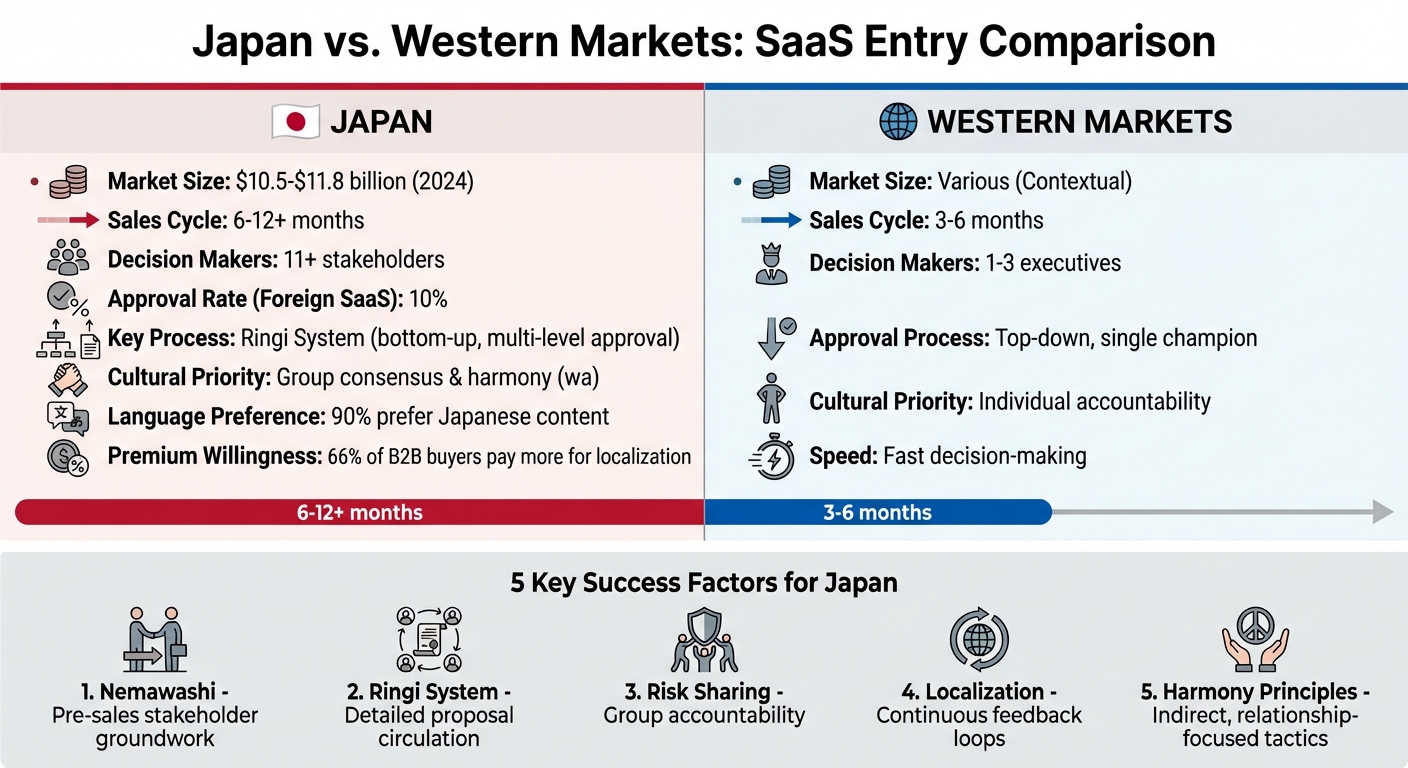
Japan vs Western SaaS Market Entry: Sales Cycles and Decision-Making Comparison
1. Nemawashi Demands Pre-Sales Stakeholder Discussions
Nemawashi, a concept rooted in Japan’s culture of harmony and conflict avoidance, refers to the process of laying the groundwork with key stakeholders before presenting a formal proposal. By the time a formal meeting takes place, all parties are typically aligned, turning the meeting into a formality to confirm the consensus already reached.
When done poorly, nemawashi can lead to silent opposition or embarrassment for stakeholders, which can derail potential deals. This challenge is even more pronounced in Japanese enterprise SaaS purchases, which often involve 11 or more decision-makers across various functions.
To navigate this, global SaaS companies must go beyond formal titles to identify and engage key influencers. This involves discreet, one-on-one discussions often held in informal settings. These conversations are essential for understanding unspoken concerns and building trust.
Another critical element is the quality of materials. High-quality, idiomatic Japanese content is a must. As Naoki Togawa emphasizes:
Everything should be in high-quality, idiomatic Japanese. There’s nothing worse than bad translation. It’s easy to tell which vendors know what they are doing and are really committed to the market just through the quality of their materials and programs.
Poorly translated materials can signal a lack of commitment to the Japanese market, undermining trust. Stakeholders rely on these documents to build internal consensus, making their quality non-negotiable.
Timing also plays a pivotal role. Reaching out too early or too late can disrupt the process, so aligning communication with the Japanese fiscal year is crucial. Without effective nemawashi, the ringisho – a formalized proposal – faces a high risk of rejection or indefinite delays.
For SaaS companies entering the Japanese market, partnering with experts like Nihonium, who specialize in tailored localization and go-to-market strategies, can make a significant difference. Mastering nemawashi is essential for navigating the broader consensus-building practices that define the Japanese SaaS market.
sbb-itb-a752276
2. Ringi System Extends SaaS Approval Timelines
The ringi system (ringi-seido) is a traditional, bottom-up decision-making process in Japan. It begins when a team member drafts a formal proposal, called a ringisho, which then circulates through various departments – such as Finance, IT, and Legal – and moves up through multiple management levels before reaching top executives. At each stage, the proposal is reviewed, feedback is added, and approval is marked with a hanko (personal seal).
This method of building consensus can significantly slow down SaaS approval timelines compared to Western markets. For example, in Japan, the B2B SaaS sales cycle often stretches to 6–12 months or even longer, whereas in the U.S., it usually takes 3–6 months. The delay stems from the need to gain approval from numerous hierarchical levels, rather than relying on a single decision-maker. To navigate this process successfully, proposals must be exceptionally detailed and well-prepared to secure approval at each step.
As Yuga Koda, CEO of Nihonium, puts it:
Japanese companies also don’t want to and have the luxury to go through the Ringi process over and over, as it’s a highly time-consuming process.
To effectively navigate the ringi system, it’s essential to create a comprehensive ringisho. This document should include a clear problem statement, a detailed solution, a risk assessment, a cost–benefit analysis with ROI projections, an implementation timeline, and relevant case studies – all written in precise Japanese. Since many stakeholders reviewing the proposal may not be end-users of the software, the document must be entirely self-explanatory, eliminating the need for vendor input during the review process.
Including materials like a "Download Documents" option is crucial, as these often become attachments to internal ringisho proposals. Among the most requested sales materials are ROI metrics and case studies, which help risk-averse Japanese companies justify investments across departments. On the other hand, poorly prepared documentation can signal a lack of commitment to the Japanese market and cause delays in the approval process.
To adapt to these extended timelines, global SaaS companies should develop "ringi-ready" sales kits. These should include localized company introduction decks, detailed technical specifications, and compliance documentation tailored to Japan’s Act on the Protection of Personal Information (APPI). Partnering with Nihonium can also provide fractional sales support and customized strategies for market entry, making it easier to craft proposals and engage with stakeholders effectively.
3. Consensus Spreads Risk Across SaaS Adoption Decisions
In Japanese companies, decision-making often involves a group effort rather than a single individual taking full responsibility. This approach minimizes the risk for any one person if a SaaS solution doesn’t work out. It’s a stark contrast to many Western markets, where a single executive might champion a purchase and take ownership of the outcome. In Japan, this shared accountability pushes stakeholders to demand solid evidence of a product’s reliability.
With this collective decision-making process, multiple stakeholders – many of whom might not even be the end users – evaluate proposals. Their focus? Ensuring vendor stability, smooth implementation, and reliable support. As Yuga Koda, CEO of Nihonium, puts it:
Since other companies are using the product, the potential buyer feels safe moving forward with their decision.
This emphasis on shared accountability is bolstered by the use of proof-based materials like case studies. A survey of 208 Japanese companies found that case studies are the most persuasive sales tools because they provide social proof – showing that other respected companies have successfully adopted the solution. This kind of validation helps groups feel more secure in making decisions. Without it, hesitation often prevails.
To address these unique concerns, SaaS providers need to create materials tailored to the needs of different departments. For instance:
- IT teams often seek evidence of data sovereignty and compliance with Japan’s APPI regulations.
- Procurement teams prioritize local invoicing options and proof of vendor stability.
- Business unit leaders want clear ROI metrics and efficiency improvements.
Meeting these diverse needs is essential for overcoming the high scrutiny that foreign SaaS providers face in Japan. Local distributors report an approval rate of just 10% for foreign SaaS products, highlighting the challenges involved.
Take HubSpot as an example. The company established a local office in Japan, offering on-site support and building trust through personal relationships. This localized approach demonstrates how understanding Japan’s consensus-driven decision-making can help SaaS providers reduce perceived risks and speed up market entry. For companies looking to enter the Japanese market, working with specialists like Nihonium – who offer fractional sales support and tailored market entry strategies – can be a smart way to navigate these complex processes and address stakeholder concerns effectively.
4. Feedback Loops Drive SaaS Localization Improvements
Localization in Japan is a continuous journey, shaped and refined by feedback from customers, partners, and frontline staff. Japanese users bring unique expectations to the table – whether it’s workflows, data presentation, or business processes – and these often differ significantly from Western norms. This is where structured feedback loops come into play, helping to identify and address gaps early in the process.
The numbers make it clear: localization is non-negotiable in the Japanese market. For instance, 90% of Japanese consumers prefer products with information in their own language (compared to 76% globally). Meanwhile, only 50% would choose a major global brand over a product presented in Japanese (versus 69% globally). Additionally, 66% of B2B buyers in Japan are willing to pay more for localized products. Naoki Togawa from Nikkei Business Publications highlights this necessity:
There’s no question that companies have to adapt their product to local business processes. Global providers need to get their product right before anything.
Feedback loops also reveal nuances in decision-making processes. In Japan, where frameworks like Ringi involve multiple stakeholders who may not be direct users of the product, it’s not just about localizing the interface. Companies must also adapt supporting materials – sales decks, documentation, case studies, and ROI calculators – to meet the needs of decision-makers. As Yuga Koda from Nihonium advises:
Establish regular feedback loops: Solicit structured feedback from Japanese clients and frontline staff to surface pain points early.
Localization needs can vary widely depending on the product and its audience. For example, with technical tools like developer software, users might accept English interfaces but still expect detailed Japanese documentation. On the other hand, for non-technical B2B products, a fully localized user interface is critical to prevent user drop-off. Tools like A/B testing and user interviews are essential for refining localization efforts, as poorly executed translations can erode trust. Yuga Koda underscores this point:
If the localization is awkward or poorly executed, the English version is preferred.
Given Japan’s consensus-driven approach to decision-making, working with localization specialists can make a big difference. Nihonium’s services go beyond basic translation, offering iterative refinements based on real user feedback. This ensures that SaaS products align with the nuances of Japanese business culture and truly resonate with their audience.
5. Harmony Principles Prevent Direct Confrontations
In Japanese business culture, the principle of wa – or harmony – plays a central role, prioritizing group cohesion over individual assertiveness. This cultural emphasis means direct confrontations and aggressive tactics are typically avoided. Instead, businesses rely on diplomatic and indirect methods, a mindset global SaaS providers should adopt when entering the Japanese market.
In practice, Japanese companies often address challenges through subtle suggestions rather than overt demands. For instance, instead of using pushy sales techniques, a more effective approach is to employ gentle, respectful language while steadily building trust over time.
Adopting strategies rooted in consensus-building can greatly enhance market engagement. Establishing a local presence, for example, helps build credibility in a business environment that values long-term, relationship-driven interactions. Many successful sales efforts in Japan focus on hosting regular technical workshops and providing clear, transparent proposals – methods that foster trust without creating pressure for immediate decisions.
It’s also essential to train sales teams in proper etiquette. Native staff who are fluent in keigo (polite Japanese) and understand the intricacies of hierarchical communication are far better equipped to navigate sensitive negotiations. They can also interpret indirect feedback more effectively, avoiding missteps like high-pressure tactics or public disagreements, which could damage long-term relationships. Aligning sales strategies with these cultural norms ensures smoother interactions and strengthens partnerships.
For global SaaS companies looking to enter Japan, Nihonium offers fractional sales support and tailored market entry strategies. Their local expertise helps businesses manage diplomatic negotiations and adapt their sales tactics to meet cultural expectations, ultimately fostering the trust needed for success in this unique market.
Conclusion
Breaking into Japan’s SaaS market requires more than just a business strategy; it demands a deep understanding of the country’s cultural and professional norms. Practices like nemawashi (informal groundwork), ringi (consensus approvals), risk-sharing, feedback loops, and a focus on harmony create a business climate that values collaboration and patience over aggressive tactics. Ignoring these principles can lead to failure, but respecting and embracing them opens doors to opportunities in the world’s second-largest enterprise software market.
The potential here is immense. Japan’s SaaS market is projected to be worth Japan’s SaaS market is projected to be worth $10.5–$11.8 billion by 20240.5–Japan’s SaaS market is projected to be worth $10.5–$11.8 billion by 20241.8 billion by 2024, with small and medium-sized enterprises (SMEs) offering untapped growth potential. Companies like HubSpot illustrate the impact of investing in local presence and relationship-building. By transitioning from remote operations to establishing a physical office early on, HubSpot successfully gained traction in the market, proving that local engagement matters.
Mastering the nuances of Japan’s business culture is crucial, and local expertise plays a vital role. From using keigo (polite Japanese) to creating culturally relevant materials, native professionals bring insights that foreign teams often lack. As Naoki Togawa, Manager at Nikkei Business Publications, puts it:
Everything should be in high-quality, idiomatic Japanese. There’s nothing worse than bad translation. It’s easy to tell which vendors know what they are doing and are really committed to the market just through the quality of their materials and programs.
For global SaaS companies, navigating these challenges can be daunting, but specialized local support can make all the difference. Nihonium offers a practical solution, providing fractional sales support and tailored localization services. Acting as an outsourced Japan team, Nihonium helps companies build the trust – or shinrai – needed to succeed in nemawashi discussions, secure ringi approvals, and manage harmony-focused negotiations.
The Japanese market rewards businesses that show genuine commitment through careful localization, long-term relationship-building, and respect for consensus-driven processes. With the right partner and a realistic approach to timelines, SaaS companies can turn Japan’s cultural complexities into a strategic advantage.
FAQs
What is nemawashi, and how does it influence SaaS market entry in Japan?
In Japan, nemawashi is the practice of laying the groundwork for consensus among stakeholders before formal decisions are made. It involves informal discussions, gathering input, and securing preliminary support, which helps ensure smoother approvals during official meetings or proposals.
For SaaS companies looking to enter the Japanese market, understanding nemawashi is essential. Japanese businesses place a strong emphasis on group consensus rather than individual decision-making. This often means longer sales cycles, as it requires multiple meetings and consistent communication to build trust and alignment. To navigate this process successfully, companies need to invest in localized materials, bilingual communication, and cultivating strong relationships.
Incorporating nemawashi into their strategy allows SaaS businesses to align with Japan’s collaborative business culture, gaining stakeholder support and improving their chances of achieving long-term success.
How does the ringi system affect SaaS approval timelines in Japan?
The ringi system plays a central role in how decisions are made within Japanese companies. It works by circulating a formal proposal, known as a ringisho, among relevant stakeholders for review and approval. Each department or individual involved adds their seal of approval, symbolizing agreement. This approach prioritizes collective agreement rather than individual authority.
When it comes to adopting SaaS solutions, the ringi system can significantly lengthen the approval process. Proposals often go through several rounds of review to address risk, budget considerations, and legal compliance. As a result, final decisions can take weeks – or even months. To work effectively within this framework, SaaS providers should anticipate extended sales cycles and focus on building strong relationships while aligning with key stakeholders early in the process. This can help ease the path toward approval.
Although the ringi system may slow decision-making, it ensures that decisions have broad support across the organization and reduces potential risks. This makes it an essential aspect of conducting business in Japan.
Why is localization essential for SaaS companies entering the Japanese market?
Localization plays a crucial role in achieving SaaS success in Japan. Japanese customers expect a smooth, native experience that feels tailor-made for them. In fact, 72% of Japanese buyers prefer all communications – such as marketing materials, customer support, and legal documents – to be in Japanese. Without local language support, many potential users may simply turn away. But it’s not just about language – cultural elements like the use of honorifics, familiar imagery, and interfaces designed with local preferences in mind are just as important to capture their interest.
Japanese users also set a high bar when it comes to product reliability, regulatory compliance, and responsive customer support. Offering a localized product signals respect for Japan’s distinct business customs and helps foster the trust essential for their consensus-driven decision-making process. Even small details, like pricing in yen (¥), using metric measurements, or formatting dates as December 31, 2025, show a level of care that deeply resonates with Japanese stakeholders. By focusing on these localization efforts, companies can align with Japan’s standards and earn the trust of their audience.
 English
  Japanese