

SaaS Entering Japan: Limited to Large Enterprises?
Introduction
Whether it’s creating a new revenue channel through focusing on a new territory or seeing demand from increased leads or customers, going after global revenue is a consideration for most businesses. There are tradeoffs to going after global revenue. Many parts need to be worked on which may distract teams from going after their core market.
To go after global revenue, teams have to internationalize their website and product. Internationalization is a technical project that is often underestimated in how long it takes to complete. On top of internationalization, there are a whole lot of go-to-market-related initiatives that need to be done. The initial efforts, including localization, which is key to to gain the trust of the local market, may seem like more of a cost than opportunity.
When Should SaaS Businesses Go Global?
The tradeoff of going global may seem big. There are always immediate fires that need to be put out. There are initiatives in the core market that may have higher priority. Going global seems like a mammoth-sized project, but if going global is done successfully, the rewards are great. Companies open up completely new channels. Companies that have nailed global expansion get up to 50% of their revenues from international markets:

So when should companies start considering global expansion? As early as possible!
Starting early does not mean to immediately start marketing in global markets. Starting early is creating an environment that allows companies to move quickly when the opportunity arises. One aspect of this is internationalization. Many companies don’t have internationalization in mind and have to rework and newly implement an internationalization-compatible environment. As for localization, SaaStr’s Jason Lemkin says that localizing early is a strategic weapon. Localization (i.e., translations and more) will need to happen. The longer you wait, the harder it gets, as the infrastructure gets more complex. Having awareness of internationalization and localization from the start will simplify the process when (not if) localization is needed. Localization is also important as buyers have a strong preference tools and platforms in their native language.
Japan Entry Lagging
Japan is highly opportunistic, as SaaS adoption is growing and is at the beginning stages, but Japan entry to date has been limited to large enterprises that have already had success in their core markets. As a result, the software available in Japan ends up lagging. Companies in the US that are established make it to Japan. Innovative companies that challenge the incumbent don’t make it to Japan until they become ubiquitous tools. That being said, there are limited domestic solutions to fill the gap, creating a lag in Japan’s software market.
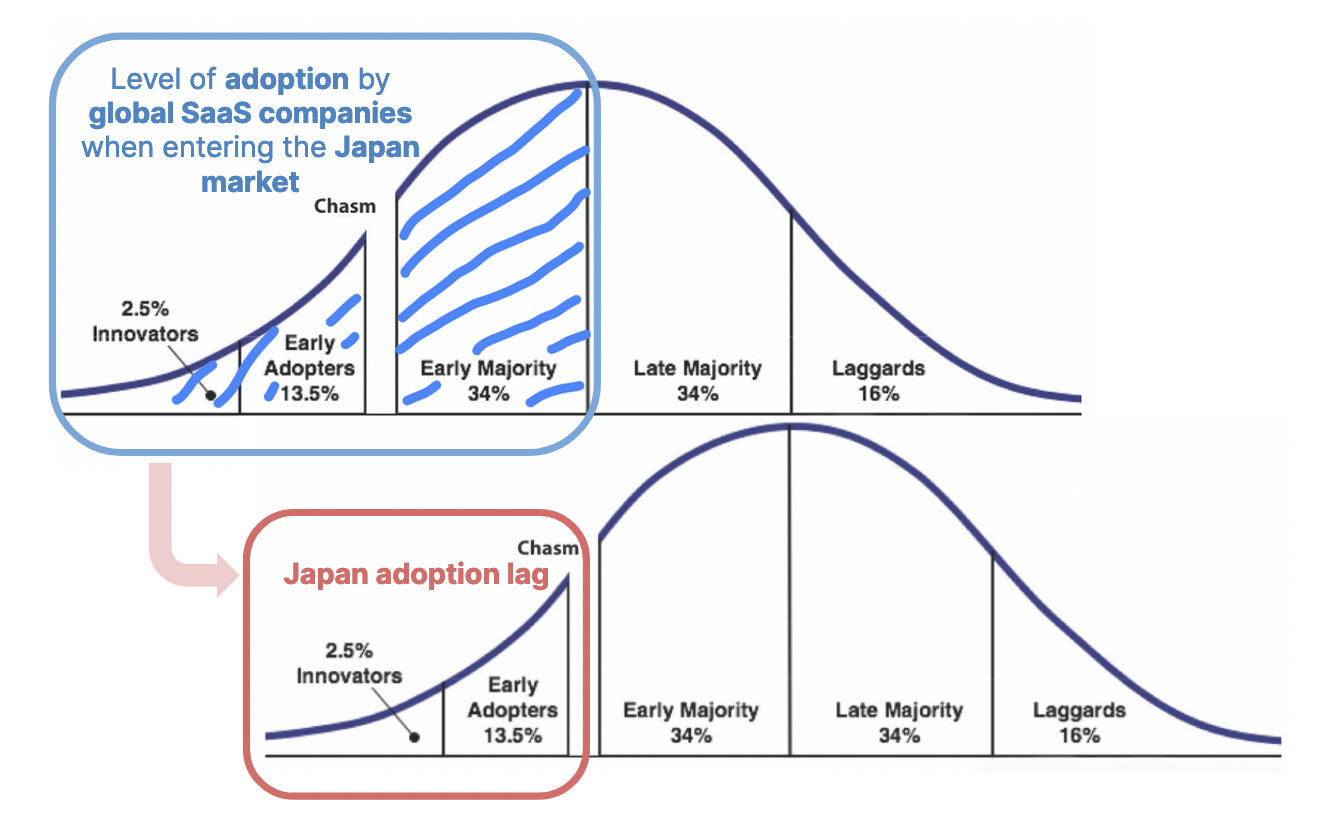 Part of the issue is that there are limited ways for SMB SaaS businesses to enter Japan. All the existing options are limited to large enterprises. There is a lot of opportunity for SMB SaaS businesses, as there is a lot of whitespace up for grabs. If these companies can navigate through the nuances unique to the Japanese market, these companies can be thought leaders in markets that are more saturated in other global markets.
Conclusion
SaaS businesses should go global as early as possible. Setting up a local entity is not the first step in going after a specific territory. Localization, sales, and marketing can all be done without a local entity. That being said, deals are much more likely to close with a local presence, including local support, which can also be done without a local entity.
The opportunity is great for SMB SaaS companies in Japan. SaaS companies that enter Japan are large enterprises that have proven product market fit in their core market. These companies have $100m+ in revenues. As a result, there is a lag software available in the Japanese market, as SMB SaaS companies that challenge the incumbent have limited options for Japan entry. The whitespace that’s up for grabs is a huge opportunity for SMB SaaS companies, if they are able to validate and enter the Japanese market in a low risk way. If you’d like to discuss Japan entry, book a consultation here!
 English
  Japanese