

SaaS Sales in Japan: Importance of Partners, Resellers, and Distributors
Introduction
Selling in Japan is pretty unique which manifests in ways like a unique CTA and the Ringisho process. The initial growth motion may start out with product-led growth, but those who have exposure to sales in Japan may know the growth strategy evolves with the company. Overtime working with partners, resellers, and distributors becomes essential to long-term success. Partners, resellers, and distributors sell a product on behalf of the service provider and take a cut of the revenue. They are crucial to sales in Japan, but that doesn’t necessarily translate to guaranteed success in Japan. There is a lot of work that goes into acquiring partners and maintaining the relationship.
How much do partners, resellers, and distributors sell?
The Japanese government’s Small and Medium Enterprise Agency compiled data in 2019 and found that for small and medium-sized businesses, 24% of their IT purchasing comes from direct sales. 43% comes from “IT-related Media” and “Local IT Vendors.” 4% to 26% comes from “Supporting Organizations” (banks, accounting firms, legal firms, trade organizations, etc.) and “Large Enterprises.” The remaining 7% comes from consulting firms, venture capital firms, freelance workers, and IT coordinators.
How Cloud Service Providers Reach SMEs
 Source: Recreated in English based on The Small and Medium Enterprise Agency’s SME IT purchasing report
It’s unclear what the breakdown of the 43% of IT-related media and local IT vendors is, this is the largest channel. Being listed on review sites and working with local IT vendors is the probable way to the SMEs in Japan. Direct sales is the second largest channel and as a result, many SaaS companies in Japan have two separate sales teams for partner sales and direct sales. Some SaaS companies in Japan have such robust partner sales teams that partnerships contribute more than 50% of their revenues. Overall, 18 of the top 20 public SaaS companies, in terms of ARR, have partnership programs.
When do Japanese companies implement a partner sales strategy?
Direct sales are great to bring on the “innovators” and the “early adopters.” These are the people who help validate product-market fit (PMF). Once PMF is validated, resellers, partners, and distributors can help you cross the chasm into the “early majority.” Resellers will help companies that have found some level of PMF and will sell into the “early majority” and “late majority”
Reseller and Distributor’s Focus Based on Product Maturity
 Source: PartnerSuccess’s whitepaper on reseller strategy
Engaging resellers, partners, and distributors become effective once there’s PMF. Given that resellers primarily sell into the “early majority” and “late majority,” a combined 68% of buyers, it makes sense that they have a high portion of overall sales. Resellers, partners, and distributors are effective in helping products cross the “chasm.”
If we look at the companies partners, resellers, and distributors work with from a different angle, they only work with companies that have found PMF. This makes perfect sense since the partners, resellers, and distributors make money on commission and revenue share. If the product they’re selling doesn’t have solid PMF, the return decreases.
Myths of Partner Sales
There are many myths and assumptions about partner sales in Japan. Here are a few of the most common ones.
You chose the partners, resellers, and distributors
The probability of a distributor selecting a company is about 10%. Partners, resellers, and distributors will sell what is most likely going to sell and generate revenue. The solution being sold needs to have strong potential. The level of PMF is one way to measure the potential return — If there is no PMF, partners, resellers, and distributors will likely pass on a company’s request to work with them.
Partners, resellers, and distributors will also have to see how the product matches their product catalog and their overall sales strategy. Ultimately, the decision comes down to incentives aligning between the service provider and the partner.
Leads and revenue will come right away
Incentives, again, are a key part of the eventual leads and revenue that may come from a partnership. Unless the revenue and collaboration incentives align, the partner will not be inclined to sell the product. You are taking the backseat and sales are strictly driven by the partners, resellers, and distributors. The salespeople will be the ones deciding when and how to sell your product.
Closing the partnership is the hard part
Assuming that the incentives are aligned, there is a ton of work that goes into a successful partnership. Especially for technical products, partners will ask the service provider to join demos. Educating and ramping up the partners’ team requires regular cadences. The partners, resellers, and distributors regularly ask for specific collateral and information. On top of the business needs, companies also have to maintain the relationship to be on good terms with the partners.
You can start a partner sales process right away
Partner sales should be treated like any sales pipeline. It’s very unlikely to collaborate with a partner, reseller, or distributor right away. It takes time to build and nurture the pipeline. The reseller, partner, and distributor must also consider how a specific product fits into their process. It can take 2 to 3 years to have a fully built-out partner sales motion.
It’s almost impossible to partner with large enterprises
Large Japanese distributors are said to be difficult to partner with. This is the case for most companies, but as long as the incentives are aligned, large distributors will consider smaller companies that are in the process of finding PMF. The alignment large distributors are looking for would be synergistic opportunities (the service supplements products that are already being sold) on top of financial incentives.
Keys to being selected as a partner
Incentives, Incentives, Incentives
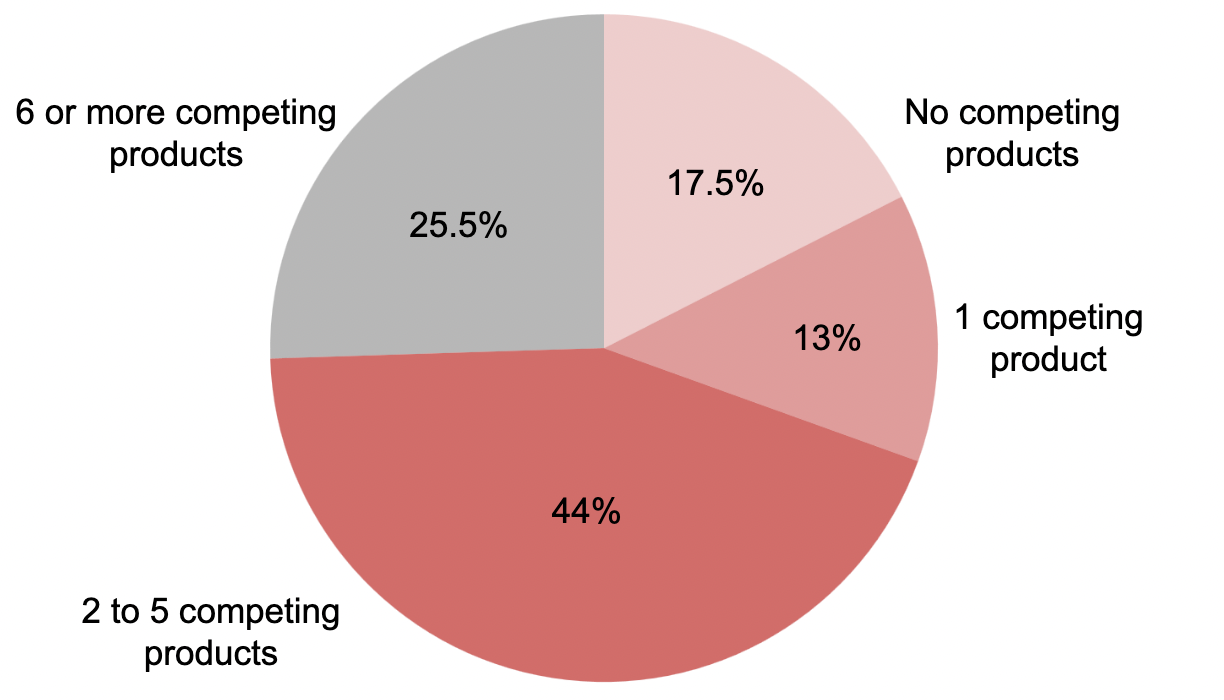
Given that the company engaging resellers, partners, and distributors will not be driving the sales, the incentives must be aligned. The resellers have to be especially financially incentivized to sell the product because they usually sell multiple products in the same space. 82.5% of the resellers sell competing products within a specific category. 44% have 2 to 5 competitors. Only 17.5% of resellers will have a single product in a specific category, so the reseller has to be more incentivized to sell one specific product.
Number of Competing Products Handled by Partners (n=200)
Source: Sairu’s research report on partner businesses
Given that the majority of resellers have multiple products within a category if the incentives are even slightly misaligned, they may be inclined to sell a competing product.
Synergies
Synergies are another way to stand out. By being synergistic with other products in the catalog, resellers may find a specific product easier to sell. Having synergies is a way to stand out compared to competitors in the space. This could be achieved through direct integrations or having a clear value proposition as a supplementing tool. Being synergistic and financially aligning incentives is the ideal way to partner.
How Nihonium Can Help
To get on the radar of resellers, partners, and distributors having a local presence is necessary. Having a localized website, documentation, and product is key to validating the local presence. This is especially important for Japan, as Japanese buyers tend to prefer locally optimized solutions. Having content beyond documentation is the next step to show that a company is active in the market. The last necessary aspect to be considered by local resellers, partners, and distributors is having a local representative with whom they can work. As part of Nihonium’s value proposition of being a fractional Japan team, we would be able to liaise with any sales and support questions and manage the relationship with the resellers, partners, and distributors. Nihonium has a track record of formalizing engagements on behalf of clients. If you’d like to learn more about Nihonium’s approach, please book a consultation here.
Conclusion
Engaging resellers, partners, and distributors may seem simple, but the process is as complex as any other sales process. Hence Japanese companies usually have teams dedicated to partnerships. Being a viable option for resellers, partners, and distributors is only part of the challenge, as they primarily work with companies that have companies that have found PMF. Once the relationship with the reseller is established, it is important to work towards a win-win relationship to get the best results.
Global companies that have yet to find PMF in Japan tend to be disappointed when entering Japan through resellers, partners, and distributors. They rely solely on these channels and set high revenue expectations on a short timeline. They may have found product market fit globally, but still need to validate the Japanese market. Nihonium’s goal is to help validate the Japanese market and translate the existing PMF into the Japanese market.
The opportunity to enter Japan is great. SaaS is only at the beginning based on investment trends and companies hitting major milestones. That being said, entering the Japanese market should be done in a measured and low-risk way.
 English
  Japanese