
What Is Gaishi-kei (外資系)?
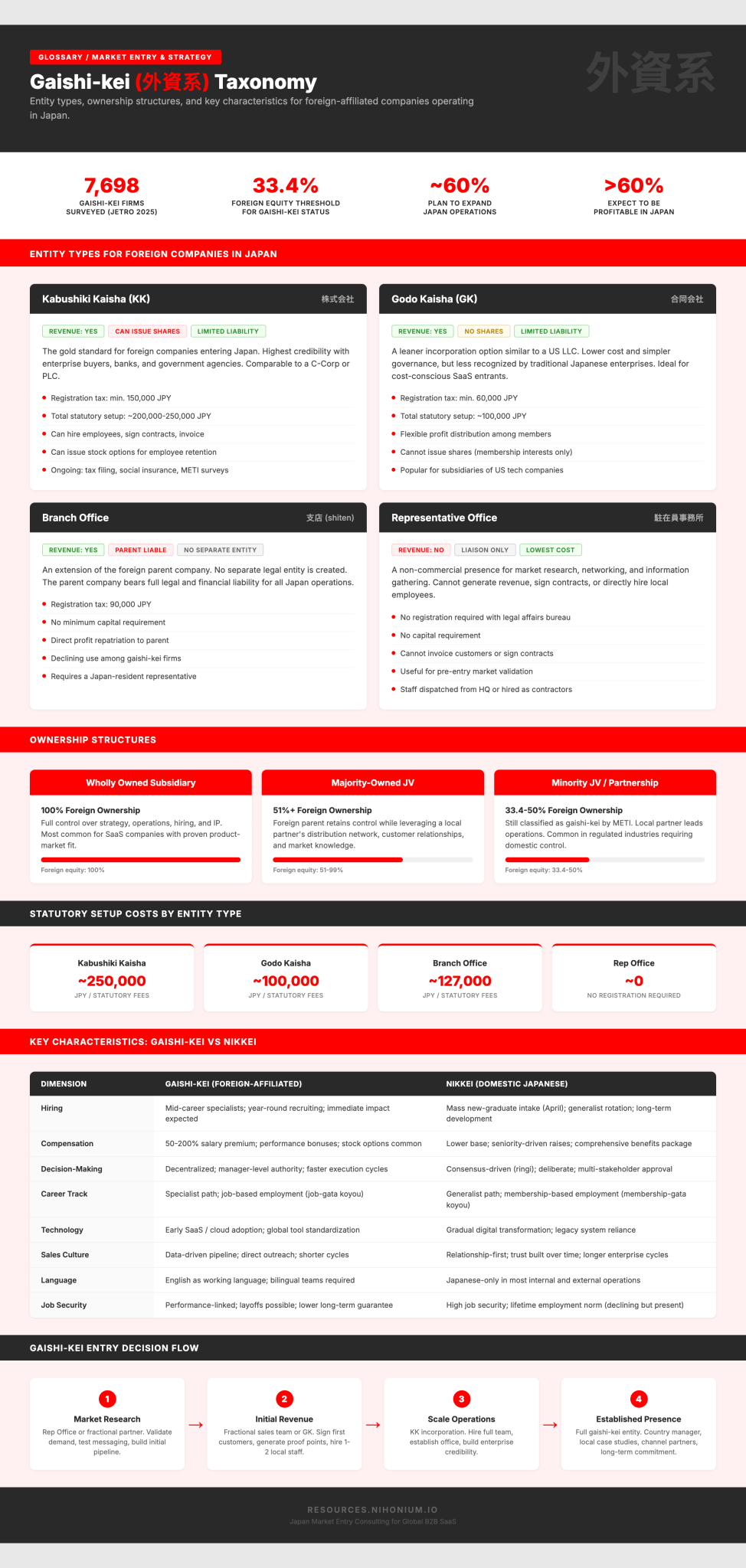
Gaishi-kei (外資系) means a foreign-affiliated company in Japan: a company in which a foreign parent or foreign investors hold a substantial share of the capital. There is no single legal threshold; government surveys have used more than one-third (METI) and 25% or more (JETRO).
The term is built from three kanji: gai (外, outside), shi (資, capital) and kei (系, affiliated or related). In everyday Japanese business language, the full phrase gaishi-kei kigyō (外資系企業) describes any enterprise whose ownership, management or strategic direction is shaped by a foreign parent. For statistics, the Ministry of Economy, Trade and Industry (METI) counted a company as foreign-affiliated in its Survey of Trends in Business Activities of Foreign Affiliates (外資系企業動向調査) when foreign investors held more than one-third of its shares and the largest foreign investor held at least 10%; METI ran that survey until fiscal 2020. JETRO’s annual survey of foreign-affiliated companies uses a lower bar: a foreign ownership ratio of 25% or more, plus companies identified as Japanese subsidiaries of foreign companies.
The term carries weight beyond any definition. In Japan’s job market, gaishi-kei signals a distinct set of workplace norms: performance-based pay, faster promotion and, often, English as a working language. Job seekers search for gaishi-kei roles by name. The foreign corporate presence is large enough for JETRO to survey every year: for its 2025 survey, JETRO sent questionnaires to 7,698 foreign-affiliated companies in Japan and received 1,520 valid responses.
How Gaishi-kei Companies Operate in Japan
Foreign-affiliated companies in Japan combine a local legal presence with global reporting lines, adapting their management practices to Japan’s relationship-driven market.
Operating as a gaishi-kei company in Japan means working through a sequence of decisions that balances headquarters objectives with local regulatory and cultural requirements. The lifecycle usually follows a recognizable pattern.
Step 1: Choosing a Legal Structure
The first decision is the entity type. Options range from a representative office, which may not engage in sales, to a Kabushiki Kaisha (KK), the structure most familiar to Japanese enterprise buyers. Each structure carries different cost, liability and tax implications. Incorporating a KK costs a registration and license tax of 0.7% of capital, with a minimum of JPY 150,000, plus a notary fee of JPY 30,000 to 50,000 for certifying the articles of incorporation and JPY 40,000 of stamp duty if the articles are on paper. Registering a foreign company’s branch office costs JPY 90,000 in registration and license tax (National Tax Agency; Japan National Notaries Association; JETRO).
Step 2: Establishing Local Operations
Once the entity is registered, the company needs an office, a corporate bank account, and registrations with the tax office and the social and labour insurance offices; JETRO’s model case also budgets for Bank of Japan filings on the inward investment. Japanese banks look closely at thinly capitalized foreign entities, which makes the initial capital decision strategically important. Foreign executives who need a Business Manager visa now face stricter requirements: for applications from 16 October 2025, the Immigration Services Agency requires JPY 30 million of capital, at least one full-time employee who is a Japanese national or permanent resident (or holds a similar status), Japanese ability at about CEFR B2 for the applicant or an employee, three years of management experience or a relevant master’s degree, and a business plan checked by an expert.
Step 3: Hiring and Building the Team
Unlike domestic Japanese firms, which centre on shinsotsu ikkatsu saiyō (新卒一括採用, hiring new graduates as a cohort each April), gaishi-kei companies typically recruit experienced mid-career professionals who can deliver results immediately. Hiring is hard. In JETRO’s 2025 survey, 56.2% of foreign-affiliated companies were recruiting and about 80% of those found positions difficult to fill: 44.5% of all respondents. Sales roles were the hardest, named by 60.2% of the companies struggling to hire, far ahead of non-IT technical roles (28.3%).
Step 4: Go-to-Market Execution
Gaishi-kei firms selling B2B SaaS in Japan must localize the sales process as well as the language. Japanese enterprise procurement is consensus-driven and often runs through ringi (稟議), a written approval workflow that adds months to an enterprise deal. Successful gaishi-kei operations layer global product positioning onto local proof points: case studies from Japanese customers and Japanese-language documentation.
Step 5: Ongoing Compliance and Reporting
Foreign-affiliated companies file corporation tax returns with the National Tax Agency and local tax returns with the prefecture and the municipality. They must also comply with Japan’s Companies Act, including the annual public notice of financial statements that applies to a KK, the Financial Instruments and Exchange Act if they are listed, and the Bank of Japan reporting that follows foreign direct investment. The burden is manageable: in JETRO’s 2025 survey, about 60% of foreign-affiliated companies said they intend to strengthen or expand their operations in Japan.
Types of Gaishi-kei Structures
Foreign companies entering Japan can choose from eight structures, each with distinct trade-offs in credibility, cost, liability and operational flexibility.
The structure determines whether the company can sign contracts, invoice customers, hire employees and build long-term credibility with Japanese buyers. The following table summarizes the options.
| Structure | Japanese Name | Ownership Model | Can Generate Revenue | Advantages | Disadvantages |
|---|---|---|---|---|---|
| Kabushiki Kaisha (KK) | 株式会社 | 100% foreign-owned subsidiary; can issue shares | Yes | Most familiar to enterprise buyers; limited liability; can issue stock options | Higher setup cost (about JPY 180,000 to 240,000 in statutory fees at the minimum registration tax); annual general meeting and public notice of financial statements |
| Godo Kaisha (GK) | 合同会社 | 100% foreign-owned subsidiary; membership interests only | Yes | Lower setup cost (JPY 60,000 minimum registration tax, plus JPY 40,000 stamp duty on paper articles; no notarization); flexible governance; limited liability; no obligation to publish financial results | Less familiar to traditional Japanese enterprises; cannot issue shares |
| Branch Office | 支店 (shiten) | Extension of foreign parent; no separate legal entity | Yes | No capital to pay in; JPY 90,000 registration tax; profits belong directly to the parent | Parent company bears full liability; not expected to make independent decisions |
| Representative Office | 駐在員事務所 | Liaison function of foreign parent; no legal entity | No | Lowest cost; no registration required; suited to market research, information gathering and advertising | No sales activity; cannot ordinarily open bank accounts or lease property in its own name |
| Joint Venture (KK or GK) | 合弁会社 | Shared ownership between foreign and Japanese partner | Yes | Access to partner’s distribution network, customer base and local knowledge | Shared control; potential for strategic misalignment; complex exit terms |
| Limited Liability Partnership (LLP) | 有限責任事業組合 | Partnership between two or more partners; no corporate tax at entity level | Yes | Pass-through taxation; flexible profit sharing; good for R&D collaborations | Not a company; limited use for commercial SaaS operations |
| Tokumei Kumiai (TK) | 匿名組合 | Silent partnership; investor provides capital, operator manages | Yes (operator only) | Investor not publicly named; pass-through income treatment; used in fund structures | Investor has no management rights; not suitable for operating companies |
| Fractional / Outsourced Model | N/A (contractual) | Foreign company contracts with a local partner to sell or act on its behalf | Via partner | No entity required; fastest route to first customer conversations; lowest upfront cost | Less direct control; brand must be managed through partner agreements |
For SaaS companies from Series A to growth stage, the choice often comes down to a KK for credibility, a GK for cost and simplicity, or a fractional sales model to test the market before committing to an entity.
Gaishi-kei vs Domestic Japanese Companies
Gaishi-kei and domestic Japanese (nikkei, 日系) firms differ across most dimensions of operations, from hiring philosophy to decision-making speed.
These differences matter for SaaS companies entering Japan, because your gaishi-kei identity shapes how candidates, customers and partners see your organization. The table below sets out the usual contrasts; they are tendencies, and many companies on both sides are exceptions.
| Dimension | Gaishi-kei (Foreign-Affiliated) | Nikkei (Domestic Japanese) |
|---|---|---|
| Hiring Model | Mid-career recruitment; specialists valued; year-round hiring | New-graduate intake each April; generalist rotation programs |
| Compensation | Often higher base pay; performance bonuses; stock compensation common, including USD-based grants | Lower base salary; seniority-driven raises; broad benefits (housing, company facilities, allowances) |
| Promotion Criteria | Performance-based; faster advancement | Seniority-weighted (nenkō joretsu, 年功序列); group consensus considered |
| Decision-Making | Decentralized; manager-level authority; faster execution | Consensus-driven (ringi approval); deliberate; multiple stakeholders |
| Work-Life Balance | Flexible hours; remote work options; generous leave policies | Improving, but traditionally longer hours; nomikai (飲み会, after-work drinks) as a social obligation |
| Technology Adoption | Early adoption of SaaS, automation and cloud tools | Gradual digital transformation; reliance on legacy systems common |
| Career Development | Specialist track; role-specific skill building; job-based employment (job-gata koyō, ジョブ型雇用) | Generalist track; cross-departmental rotation; membership-based employment (membership-gata koyō, メンバーシップ型雇用) |
| Sales Culture | Direct outreach; data-driven pipeline management; faster internal approvals | Relationship-first; trust built over time; longer enterprise cycles |
| Language | English as a working language (often required); bilingual teams | Japanese in most internal and external communication |
| Job Security | Performance-linked; lower long-term guarantee | High job security; long-term employment norm (declining but still influential) |
For SaaS companies entering Japan, gaishi-kei status cuts both ways. It attracts ambitious, English-capable talent but can make risk-averse enterprise buyers hesitant until you demonstrate long-term commitment.
Benefits and Challenges for SaaS Companies
Gaishi-kei status gives SaaS companies advantages in talent and technology adoption, but it adds friction in enterprise sales and compliance.
Benefits
- Access to bilingual talent: Specialized recruiters (Robert Half, Robert Walters, Michael Page, Hays) run active gaishi-kei candidate pools, and the pay and stock compensation on offer attract professionals that domestic firms struggle to keep.
- Faster technology adoption: Gaishi-kei companies typically run on global SaaS stacks, avoiding legacy integration problems. That also makes other gaishi-kei firms a natural first buyer segment for SaaS vendors.
- Global brand recognition: A strong international brand gives immediate credibility with buyers in finance, pharmaceuticals and technology, where global standards matter.
- Positive market trajectory: In JETRO’s 2025 survey, about half of foreign-affiliated companies expected revenue growth, and 61.6% expected a profit for the current fiscal year.
- Stability as a draw: Japan’s rating for “social and economic stability/geopolitical stability” rose 24.3 points from the previous JETRO survey, making it the most highly rated item since the survey began.
Challenges
- Enterprise sales cycles are long and consensus-driven: Japanese procurement runs through ringi approval, so plan enterprise cycles in quarters, not weeks.
- Talent is the hardest resource: In JETRO’s 2025 survey, 44.5% of foreign-affiliated companies had difficulty securing the people they need, sales roles most of all, and securing personnel topped the list of areas companies want improved.
- Perception of impermanence: Some Japanese buyers worry that a gaishi-kei company will leave the market. Building trust takes a local presence, Japanese-speaking leadership and domestic case studies.
- Regulatory and compliance work: National and local tax filings, Companies Act duties and investment reporting to the Bank of Japan add up to a real, if manageable, burden.
- Cultural adaptation costs: Localization goes beyond translation: UX patterns, payment methods (invoice-based billing remains common) and support hours all need adapting.
- Tighter immigration rules: The October 2025 Business Manager visa reform raised the capital requirement to JPY 30 million and added employment, language, experience and business plan requirements.
Key Takeaways
Five essential points for SaaS companies evaluating a gaishi-kei market entry in Japan.
- Gaishi-kei is a market identity, not just a classification: Surveys draw the line at different points (more than one-third for METI, 25% for JETRO), but in practice the label shapes how candidates, customers and partners see your company in every interaction.
- Entity structure determines credibility and cost: A KK is the most familiar structure for enterprise buyers but costs more to establish and maintain. A fractional model offers the fastest path to market validation without the overhead of an entity.
- Talent is the primary bottleneck: In JETRO’s 2025 survey of foreign-affiliated companies, 44.5% struggled to hire, and sales roles were the hardest to fill. Plan your hiring strategy alongside your go-to-market strategy.
- The Japan market rewards long-term commitment: About 60% of foreign-affiliated companies plan to strengthen or expand their Japan operations, and 61.6% expect a profit this fiscal year (JETRO, 2025 survey).
- Fractional models reduce entry risk: SaaS companies can test product-market fit in Japan through fractional sales teams and localization partners, and defer the cost of a legal entity until revenue justifies it.
Working with Nihonium. We are a Japan go-to-market partner for B2B SaaS companies: Japan go-to-market strategy. Talk to us about your Japan entry.
Sources and Further Reading
- JETRO, “JETRO Publishes 2025 Survey on Business Operations of Foreign-affiliated Companies in Japan” (26 February 2026) and the full survey report (PDF): definition, sample, outlook, hiring difficulty.
- METI, Survey of Trends in Business Activities of Foreign Affiliates (外資系企業動向調査): definition of a foreign affiliate (METI’s survey outline; METI blocks automated access, confirmed via search); last run for fiscal 2020 (JETRO, Invest Japan Report 2021).
- JETRO, “Establishing a Business Entity in Japan”: representative offices, branches, KK and GK; and the Tokyo set-up model case, including the Bank of Japan investment filings.
- National Tax Agency, registration and license tax rates (No. 7191); JETRO, sample branch registration form (JPY 90,000 per branch); Japan National Notaries Association, notary fees (articles of incorporation, stamp duty).
- Immigration Services Agency of Japan, revision of the Business Manager status of residence criteria, in force 16 October 2025.
- Robert Walters, Japan Salary Survey 2026: pay and stock compensation trends in tech sales.
Frequently Asked Questions
What percentage of foreign ownership makes a company gaishi-kei?
There is no single legal threshold. METI’s survey of foreign affiliates, run until fiscal 2020, counted companies in which foreign investors held more than one-third of the shares and the largest foreign investor at least 10%. JETRO’s annual survey uses 25% or more. In everyday use, a company is also called gaishi-kei when its management direction clearly comes from overseas.
Do gaishi-kei companies need to incorporate in Japan to do business?
Not necessarily. A foreign company that carries on transactions in Japan continuously must register there, and a branch office (shiten) is the simplest way to do it; the parent bears full liability. A representative office supports market research but cannot engage in sales. A fractional model through a local partner gives market access with no entity at all. Many SaaS companies still incorporate a KK or GK for serious enterprise sales, because Japanese buyers read a local entity as long-term commitment.
How are salaries different at gaishi-kei companies compared to Japanese firms?
No official statistic compares pay at gaishi-kei and domestic firms directly. Recruiter surveys, such as Robert Walters’ 2026 salary survey, describe foreign firms competing with higher salaries and stock compensation, often USD-based, while domestic firms rely more on seniority-based raises and broader non-salary benefits such as housing support and company facilities.
Is being a gaishi-kei company an advantage or disadvantage when selling B2B SaaS in Japan?
It depends on the buyer segment. Gaishi-kei status helps when selling to other foreign-affiliated companies and technology-forward domestic firms. It can be a disadvantage with traditional enterprises that prioritize long-standing vendor relationships. Successful gaishi-kei SaaS companies counter this by hiring Japanese country managers, building local case studies, and showing the commitment the wider community shows: about 60% of foreign-affiliated companies in JETRO’s 2025 survey plan to strengthen or expand in Japan.