
Japan’s DX initiative is a government-backed push to modernize enterprise IT, and it is the main reason Japanese buyers are now open to cloud software from abroad. DX, short for digital transformation, is the term Japanese companies and ministries use for replacing legacy on-premise systems with cloud-based ones and reorganizing work around data. The push traces back to the Ministry of Economy, Trade and Industry (METI) “DX Report” of September 2018, which introduced the “2025 Digital Cliff”: the warning that Japan could lose up to JPY 12 trillion a year from 2025 onward if companies did not modernize their aging core systems. For a foreign SaaS company, DX matters less as a policy than as a change in who is willing to buy what.
That change is in buyer behavior. Decision-makers who once defaulted to a domestic vendor and a custom on-premise build now evaluate cloud-native, API-first products, many of them built outside Japan. The market is still demanding, but the default answer to “can we use a foreign SaaS product?” has moved from no to maybe.
The Origins and Policy Framework Behind Japan’s DX Push
Japan’s DX movement rests on a METI report, a certification program written into law, and a Digital Agency created in 2021.
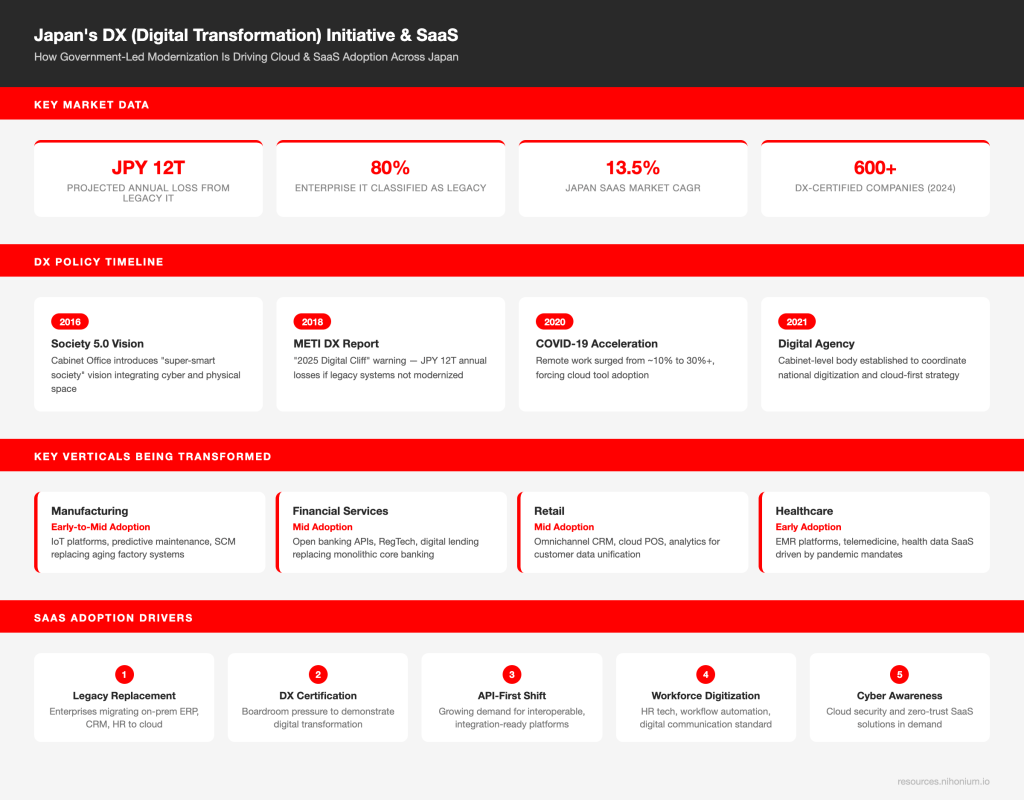
The 2018 DX Report was the catalyst. Drawing on a 2017 survey, it found that about 80% of Japanese companies were running “legacy” systems: overly complex, heavily customized and siloed, so that data could not be used across the business. Some 70% said those systems were holding back their digital plans. METI’s point was that these systems would keep absorbing maintenance budgets and engineers while making companies slower than their global competitors, and it put the cost of inaction at up to JPY 12 trillion a year from 2025.
The government then built several programs around that warning. The DX Certification (DX認定, DX nintei) recognizes companies that publish a digital strategy, governance and a plan approved at board level. It is granted by METI under the Act on Promotion of Information Processing, with the review handled by the Information-technology Promotion Agency (IPA), and must be renewed every two years. Certification has become a signal to investors and partners, which is what pushes DX onto board agendas. Behind it sits the broader Society 5.0 vision from the Cabinet Office’s Fifth Science and Technology Basic Plan (2016), which frames digital technology as the base of a “super-smart society” joining cyberspace and physical space.
The institutional step came on 1 September 2021, when the Digital Agency (デジタル庁) opened under the Cabinet. It coordinates the digitization of central and local government, standardizes data and systems across agencies and is reforming how government buys IT. Public-sector procurement norms tend to cascade into private-sector purchasing, so a cloud-first government makes cloud-first purchasing easier to defend inside a Japanese enterprise.
How DX Is Reshaping Japan’s SaaS Landscape
Japan’s SaaS market is growing at about 12% a year, and the cloud market as a whole faster still, with legacy replacement as a main driver.
| DX Driver | Impact on SaaS Adoption | Key Metric |
|---|---|---|
| Legacy system replacement | Enterprises migrating from on-premise ERP, CRM and HR systems to cloud alternatives | About 80% of companies running legacy systems (METI DX Report, 2018) |
| COVID-19 acceleration | Rapid adoption of remote work tools, e-signature platforms and cloud collaboration | Telework among full-time employees rose from 13.2% in March 2020 to 27.9% in April 2020 (Persol Research and Consulting) |
| DX Certification program | Board-level pressure to adopt modern digital tools and show progress | 1,170 certified businesses as of 1 September 2024 (METI survey of certified firms) |
| Digital Agency formation | Government procurement modernization normalizing cloud-first purchasing | Established 1 September 2021 |
| API-first architecture shift | Growing demand for interoperable, integration-ready SaaS platforms | Public cloud services market of JPY 4.14 trillion in 2024, forecast JPY 8.82 trillion by 2029 (IDC Japan) |
| Workforce digitization | HR tech, workflow automation and digital communication tools becoming standard | SaaS market forecast to grow about 12% a year to 2033 (Grand View Research) |
| Data utilization initiatives | Analytics, BI and data platform SaaS gaining traction across industries | A common DX priority; no reliable market-wide figure |
| Cybersecurity awareness | Cloud security and zero-trust SaaS solutions in high demand | Security market forecast to grow from about USD 10.3 billion (2025) to about USD 18.8 billion (2031) (Mordor Intelligence) |
Together these drivers have moved many Japanese enterprises from tolerating SaaS to looking for it. The pandemic was the sharpest accelerant. Before 2020, many companies resisted remote work and cloud workflows because of in-person habits and paper-based processes, including the hanko (personal seal) needed to approve documents. The first state of emergency in April 2020 roughly doubled telework in a month and forced quick adoption of video conferencing, electronic signatures and cloud document management. Much of that emergency adoption has since become permanent, and companies are now budgeting for SaaS as long-term infrastructure rather than a stopgap.
Key Verticals Being Transformed by DX
Manufacturing, financial services, retail and healthcare are the four sectors where DX is reshaping software buying most deeply.
DX does not affect every industry equally. Verticals with deep legacy dependencies and large operations offer the biggest openings for a SaaS company entering Japan.
Manufacturing is Japan’s economic backbone and the place where legacy debt runs deepest. Factory automation, supply chain and quality systems built decades ago are being supplemented or replaced by cloud IoT platforms, predictive maintenance SaaS and digital twin tools. METI treats manufacturing DX as a national priority.
Financial services institutions, from the megabanks to regional banks, are under pressure to digitize customer-facing services and back-office work. Open banking APIs, digital lending platforms and RegTech tools are the main openings.
Retail is being reshaped by omnichannel commerce, cashless payments and data-driven customer engagement. Retailers are investing in cloud POS, inventory management and CRM.
Healthcare digitization picked up with the pandemic and the government’s medical DX program, which covers electronic prescriptions, shared medical records and telemedicine.
| Vertical | Primary DX Pain Point | SaaS Opportunity Areas | Adoption Stage |
|---|---|---|---|
| Manufacturing | Aging factory and supply chain systems | IoT platforms, predictive maintenance, SCM | Early-to-mid adoption |
| Financial Services | Monolithic core banking infrastructure | Open banking APIs, RegTech, digital lending | Mid adoption |
| Retail | Siloed customer data and offline-first operations | Omnichannel CRM, cloud POS, analytics | Mid adoption |
| Healthcare | Paper-based records and fragmented systems | EMR platforms, telemedicine, health data SaaS | Early adoption |
| Logistics | Manual routing and warehouse management | WMS, fleet management, delivery optimization | Early adoption |
| Government/Public Sector | Bureaucratic paper processes and fragmented IT | Workflow automation, citizen services platforms | Early adoption |
Vertical focus is where foreign SaaS companies win or lose. A horizontal, one-size-fits-all pitch rarely lands in Japan. A company that ties its messaging, integrations and sales approach to the DX pain point of one target vertical, for example replacing a manufacturer’s spreadsheet-based quality records, gets a hearing that a generic “digital transformation platform” does not.
Key Takeaways
DX has changed how Japanese enterprises evaluate and buy software, and the change is still under way.
- Government-driven urgency: METI’s “2025 Digital Cliff” warning and the DX Certification program have put legacy modernization and cloud adoption on board agendas.
- The market is growing: Japan’s SaaS market is forecast to grow about 12% a year, and IDC Japan expects the public cloud market to roughly double between 2024 and 2029, to about JPY 8.8 trillion.
- COVID-19 made adoption stick: Telework roughly doubled in a month in April 2020, and the shift to e-signatures and cloud collaboration has largely held.
- Vertical strategies win: Manufacturing, financial services, retail and healthcare each have distinct DX pain points, and SaaS companies that sell to one of them get further than those that sell to everyone.
- Openness still requires localization: DX has made Japanese enterprises more receptive to foreign SaaS, but success still depends on Japanese-language product and support, answers on data residency, and a sales approach built for consensus-driven procurement.
Working with Nihonium. We are a Japan go-to-market partner for B2B SaaS companies: Japan go-to-market strategy. Talk to us about your Japan entry.
Sources
- IPA: DX Certification program (DX認定制度)
- Digital Agency: organizational information
- IDC Japan: Japan public cloud services market forecast, February 2025 (Japanese)
- MIC Information and Communications White Paper 2021: telework rates (Japanese)
- Grand View Research: Japan SaaS market outlook
- Mordor Intelligence: Japan cybersecurity market
- ITmedia: METI’s 2025 report on legacy systems (Japanese)
Frequently Asked Questions
What is the “2025 Digital Cliff” and is it still relevant?
The “2025 Digital Cliff” is the term METI’s 2018 DX Report used for the economic loss of up to JPY 12 trillion a year that Japan could face from 2025 if companies did not replace their legacy core systems. 2025 has come and gone, and the problem has not: a METI report published in May 2025 found that about three quarters of the companies surveyed still ran legacy systems. The warning did its main job, which was to make modernization a board-level topic. Today the cliff is better read as a risk that grows the longer old systems stay in place than as a fixed deadline.
How does the DX Certification program work?
Companies apply to METI, and IPA reviews the application against criteria based on METI’s Digital Governance Code: a published digital strategy, the organization and systems to carry it out, indicators for measuring progress, and executive commitment. Certification is valid for two years, and IPA aims to issue a decision within 60 business days of accepting an application. METI counted 1,170 certified businesses on 1 September 2024, and the number has grown each year since the program began in 2020, driven mostly by small and mid-sized companies. For a SaaS vendor, a prospect’s certification is a useful signal that it has a modernization budget and an executive sponsor.
Is Japan’s SaaS market large enough to justify a dedicated market entry effort?
Japan is the world’s fourth-largest economy by nominal GDP in the IMF’s October 2026 projections. Grand View Research estimates its SaaS market at USD 12.3 billion in 2025, growing to USD 31.3 billion by 2033, and IDC Japan forecasts the public cloud market will roughly double between 2024 and 2029. For a SaaS company with product-market fit in North America or Europe, Japan is often one of the largest markets it has not yet addressed. Localization and local go-to-market work take real investment, but in the DX-driven verticals the return can justify it.
What role does Japan’s Digital Agency play in SaaS adoption?
The Digital Agency, launched on 1 September 2021, is the government’s “control tower” for digitization. It coordinates national digital strategy, modernizes government IT procurement, standardizes data and systems across public services, and works to remove rules that block cloud adoption. Its influence on SaaS is both direct and indirect. Directly, it opens public-sector opportunities, usually through registered cloud services and local partners. Indirectly, its cloud-first and open-API standards set norms that Japanese enterprises follow, which makes the whole market more receptive to modern SaaS.