
Omotenashi is the Japanese philosophy of wholehearted, anticipatory hospitality applied to SaaS customer success, where service teams proactively address customer needs before they are expressed.
Rooted in Japanese traditions from the tea ceremony to ryokan innkeeping, omotenashi (おもてなし) represents a different approach to service than most Western SaaS companies practice. The word is often translated as “hospitality,” but that undersells it. Omotenashi implies wholehearted dedication to the guest’s experience, with no expectation of anything in return. In SaaS customer success it shows up as a way of working built on anticipation rather than reaction, thoroughness rather than speed alone, and long-term relationships rather than transactional support.
For global SaaS companies entering the Japanese market, understanding omotenashi is not optional: it is the baseline Japanese enterprise customers measure you against, because their domestic vendors already work this way. The gap between Western-standard customer success and what Japanese customers expect is a common reason foreign products fail to renew. Language is part of it. In a 2008 survey of business software buyers in eight countries, CSA Research found that every Japanese respondent preferred to buy in Japanese, and that buyers were 4.5 times more likely to buy when marketing, documentation and post-sales technical support were in their own language. No study we could find measures the churn difference itself, so measure it on your own Japanese accounts.
How Omotenashi-Style Customer Success Works
Omotenashi-style CS operates on a proactive, anticipatory service model where customer success managers identify and resolve issues before the customer becomes aware of them.
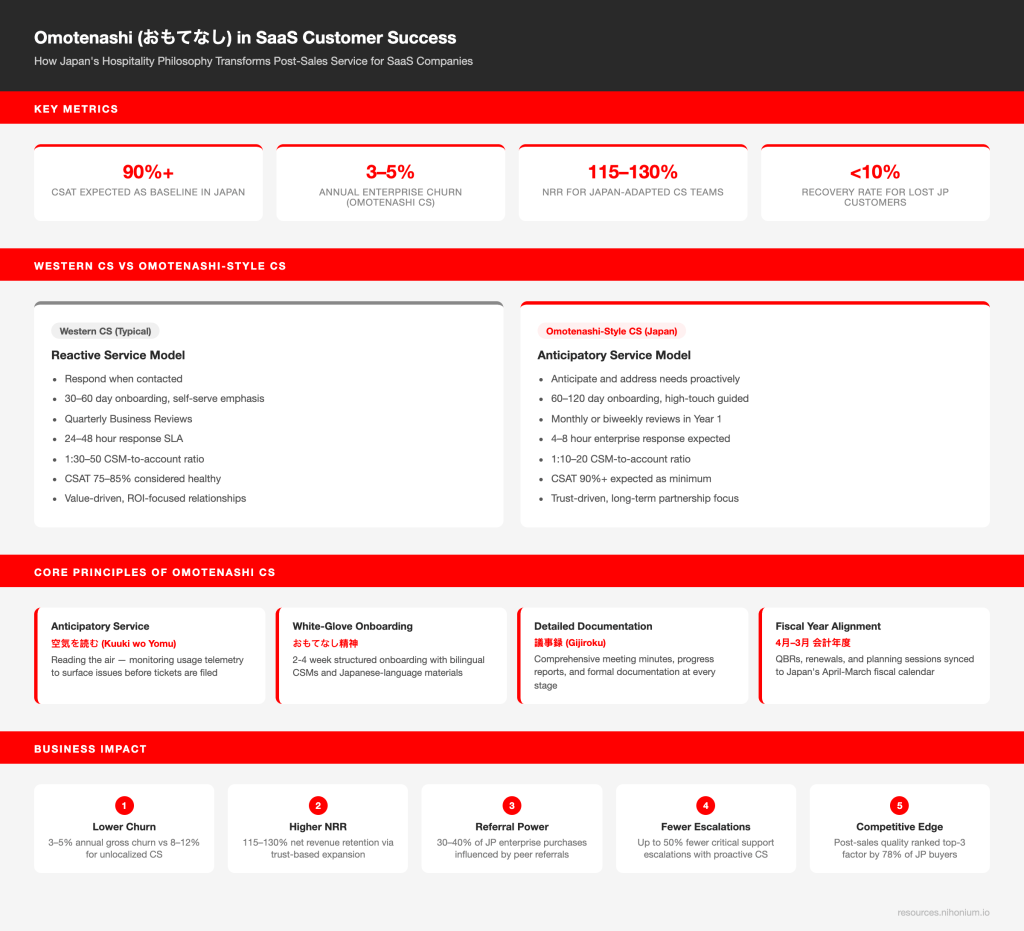
In practice, omotenashi-driven customer success differs from conventional Western CS at every stage of the customer lifecycle. It is not simply “better” service; it is a different operating model that needs its own processes, staffing and cultural competence.
The methodology rests on several interconnected principles:
1. Anticipatory Needs Assessment (Kuuki wo Yomu, 空気を読む)
Literally “reading the air,” kuuki wo yomu is the practice of perceiving unspoken needs, concerns and sentiments. In SaaS customer success, it means CSMs who watch product usage, organizational changes at the client and seasonal business pressures, and raise potential issues before any support ticket is filed. A CSM practicing omotenashi does not wait for a customer to report a problem; they reach out when login frequency drops, when a key feature goes unused, or when a stakeholder change suggests a renewal risk.
2. White-Glove Onboarding
Japanese enterprise customers expect a structured, carefully documented onboarding process. This typically includes a dedicated Japanese-speaking CSM, Japanese-language training materials, step-by-step implementation guides, and frequent touchpoints in the first months. Written Japanese materials matter more than video or English resources: the buyer’s team often works through them on its own, and passes them around internally. Our guide to onboarding localization covers what to translate first.
3. Regular, Structured Check-Ins
Where Western CS teams might schedule quarterly business reviews, omotenashi-style CS often calls for monthly touchpoints during the first year. These check-ins are not superficial: they include usage reports, ROI analyses, roadmap previews and recommendations tailored to the customer’s business.
4. Detailed Documentation and Reporting
Japanese business culture places great value on thoroughness and precision in written communication. Customer success teams are expected to provide meeting minutes (gijiroku, 議事録), progress reports and formal documentation at every stage. What might seem excessive to a Western team is standard practice in Japan.
5. Alignment with the Japanese Fiscal Calendar
The national government and most large Japanese companies run an April to March fiscal year. Omotenashi-style CS aligns business reviews, renewal conversations and planning sessions with this calendar, not the January to December cycle many Western SaaS companies default to. IT budgets for the next fiscal year are usually settled between January and March, so expansion and renewal conversations need to happen before that window closes. Check each customer’s own year-end.
Western Customer Success vs. Omotenashi-Style Customer Success
Omotenashi-style CS differs from Western CS in philosophy, cadence, staffing, and customer expectations across every major operational dimension. The table describes tendencies, not benchmarks: we found no published Japanese data on onboarding length, response times or CSM ratios.
| Dimension | Western CS (Typical) | Omotenashi-Style CS (Japan) |
|---|---|---|
| Service Philosophy | Reactive, respond when contacted | Proactive, anticipate and address needs before they arise |
| Onboarding Duration | Shorter, self-serve emphasis | Longer, high-touch and guided, with written Japanese materials |
| Check-In Cadence | Quarterly Business Reviews | Monthly reviews common in Year 1 |
| Documentation | Knowledge base articles, FAQs | Detailed Japanese-language guides, formal meeting minutes, custom reports |
| Response Time Expectation | Set by the SLA tier | Prompt acknowledgment within Japanese business hours expected, especially for enterprise accounts |
| CSM-to-Account Ratio | Set by ARR tier; larger books of accounts | Smaller books for enterprise accounts, sized from the committed review cadence |
| Satisfaction Baseline | Satisfaction scores tracked as a health metric | High expectations, often unspoken; silence is not a sign of satisfaction |
| Escalation Handling | Tiered support system | Named senior contact, direct executive access for key accounts |
| Language | English-first | Japanese-first, bilingual team required |
| Relationship Orientation | Value-driven, ROI-focused | Trust-driven, long-term partnership emphasis |
Benefits of Omotenashi-Style Customer Success for SaaS Companies
SaaS companies that adopt omotenashi-style CS in Japan put themselves in a stronger position on retention, expansion and referrals than those applying Western-standard practices.
The investment in omotenashi-style customer success pays back across several dimensions:
- Lower Churn: Japanese enterprise customers tend to stay with a vendor once their expectations are met, and the reverse also holds: customers who experience poor service often leave quietly at renewal and are hard to win back. Track gross churn on your Japanese accounts separately from the global figure so you can see the effect.
- Expansion Revenue: Trust built through consistent, high-quality service creates natural expansion paths: more seats, more departments, and group companies that hear about you from the first customer.
- Stronger Referral Networks: Japanese enterprise buyers rely on peer referrals, trusted introductions and other users’ experience. In ITreview’s March 2026 survey of 300 people involved in IT purchasing, 87.4% of those asked said too few reviews had led them to drop a product or give it lower priority. A satisfied customer who has experienced genuine omotenashi becomes an advocate, in conversation and in reviews.
- Competitive Differentiation: Domestic SaaS vendors already work this way, so foreign entrants who match or exceed these expectations stand apart from competitors who treat Japan as “just another region.”
- Fewer Support Escalations: Proactive CS catches issues before they become escalations, which protects both the account and the CSM’s time.
Omotenashi-Style CS by SaaS Industry Vertical
The specific application of omotenashi principles varies by industry vertical, with each sector carrying distinct expectations for service depth and communication cadence.
| SaaS Vertical | Key Omotenashi Application | Critical Expectation |
|---|---|---|
| Enterprise CRM/Sales | Dedicated Japanese-speaking CSM, custom workflow configuration | Monthly usage optimization reviews, Japanese fiscal year alignment |
| HR Tech | Updates on Japanese rule changes that affect the product, localized employee portals | Proactive notice before regulatory changes (e.g., labor law revisions) |
| FinTech/Accounting | Meticulous data accuracy, Japanese GAAP alignment | Zero-tolerance error handling, same-day issue resolution during close periods |
| Marketing Automation | Japan-market campaign playbooks, local channel expertise | Seasonal campaign support (e.g., Obon, Oshogatsu, fiscal year-end) |
| DevOps/Infrastructure | Japanese-language incident support, detailed post-mortems | Proactive capacity planning, pre-scheduled maintenance communication |
| Cybersecurity | Japan-specific threat intelligence, compliance documentation | Immediate Japanese-language incident response, executive briefings |
Across verticals, support in the customer’s language carries weight beyond the support desk. In CSA Research’s 2020 survey of 8,709 consumers in 29 countries, 75% said they were more likely to buy the same brand again if customer care was in their language. Business buyers in Japan apply the same test at renewal.
Key Takeaways
Omotenashi-style customer success is the foundational requirement for SaaS retention and growth in the Japanese enterprise market.
- Anticipation over reaction: Omotenashi-style CS means identifying and addressing customer needs before they are voiced, shifting the CS model from reactive to anticipatory.
- Higher investment, measured returns: Omotenashi-style CS needs smaller books of accounts per CSM and more structured touchpoints; track churn and expansion on your Japanese accounts to see what it returns.
- Language and cultural fluency are non-negotiable: Japanese-language support, Japanese-speaking CSMs and cultural competence, including kuuki wo yomu and the Japanese fiscal year, are baseline expectations, not differentiators.
- Expectations are high and often unspoken: Dissatisfied Japanese customers rarely complain before they leave, and lost customers are hard to recover, so consistent quality is a commercial necessity.
- Trust drives expansion: The trust built through omotenashi creates upsell and referral paths, and reviews from satisfied users weigh in the next buyer’s shortlist.
Working with Nihonium. We are a Japan go-to-market partner for B2B SaaS companies: Japan go-to-market strategy. Talk to us about your Japan entry.
Sources and Further Reading
- CSA Research, “Businesses Prefer Local Language Purchasing”: September 2008 survey of 351 business software buyers in eight countries.
- CSA Research, “Consumers Prefer their Own Language” (7 July 2020): “Can’t Read, Won’t Buy” survey of 8,709 consumers in 29 countries.
- ITreview, survey of 300 people involved in SaaS selection (March 2026).
- Nihonium, customer success and retention in Japan: further reading.
Frequently Asked Questions
How does omotenashi differ from standard high-touch customer success?
Omotenashi goes beyond high-touch CS by making anticipation the core operating principle rather than simply increasing the number of interactions. In standard high-touch models, CSMs respond quickly and thoroughly to requests; in omotenashi-style CS, they are expected to identify needs and deliver solutions before the customer raises them, by watching usage for early friction and knowing the customer’s internal calendar. It is the difference between excellent responsiveness and genuine foresight.
What staffing model supports omotenashi-style CS for SaaS in Japan?
Size the team from the cadence you commit to (monthly reviews, minutes after every meeting, Japanese-language reports) rather than from a Western accounts-per-CSM ratio; we found no published Japanese benchmark. CSMs need native or near-native Japanese, deep product knowledge and fluency in Japanese business communication. Many foreign SaaS companies start with a small Japanese-speaking team, sometimes the same fractional team that sells and manages the account, and hire in-house CSMs as the customer base grows.
Can omotenashi-style CS be scaled without unsustainable costs?
Yes, but it takes deliberate process design rather than simply more headcount. Successful companies keep people for the strategic moments (onboarding, reviews, renewal discussions) and automate routine touchpoints such as usage reports, product update notices and satisfaction surveys. The automated layer has to meet Japanese standards of quality too: machine-translated or generic English content will not do.
Why is customer recovery so difficult in Japan compared to Western markets?
Japanese business culture places a high value on trust, and once trust is broken the damage reaches beyond the individual account. A dissatisfied Japanese enterprise customer is unlikely to complain directly; it will quietly decline to renew and may share the experience through the informal networks that influence purchasing. That makes preventive, omotenashi-style CS a risk management practice as much as a service philosophy.