
Japanese customer success strategy is the discipline of retaining and expanding SaaS revenue in Japan through culturally adapted, anticipatory service built on trust and long-term relationship management.
For global SaaS companies entering Japan, customer success is not a post-sale afterthought: it decides whether the first Japanese customers renew and whether they become the references the next buyers ask for. Language is the first test. In CSA Research’s 2008 survey of business software buyers in eight countries, every Japanese respondent preferred to buy in Japanese, and buyers overall were 4.5 times more likely to buy when marketing, documentation and post-sales technical support were in their own language. The second test is how dissatisfaction shows up. Japanese enterprise customers rarely complain before they leave; they decline to renew, and an account lost that way is hard to win back. No public study we could find measures churn or net revenue retention for foreign SaaS products in Japan, so track both on your own Japanese accounts, separately from the global figures.
The core problem is straightforward: Western customer success playbooks need adapting for Japan. The cadence, communication style, onboarding expectations and expansion motion all differ from what works in North America or Europe. Japanese buyers expect service in the spirit of omotenashi (おもてなし, wholehearted, anticipatory hospitality): proactive, thorough and attentive to needs before they are voiced. Companies that miss this expectation tend to see stalled expansion, quiet disengagement and non-renewal with little warning. This page sets out what a Japan customer success program needs and how to build one without a full in-country CS organization from day one.
Key Capabilities
A Japan customer success program is a retention and expansion engine adapted to how Japanese enterprises buy, use and renew software.
Customer Success & Retention Features
| Capability | What It Does | Benefit |
|---|---|---|
| Japanese-Speaking CSMs | Native or near-native Japanese-speaking customer success managers who work as an extension of your team and stay with the account | Removes the language barrier and builds trust through fluent, culturally aware communication; continuity signals commitment |
| Structured Onboarding Programs | Guided onboarding with complete written Japanese documentation, training sessions and stakeholder alignment meetings | Meets Japanese enterprise expectations for thorough implementation; IT teams often review documentation quality before they sign |
| Japan-Adapted Health Scoring | Monitors engagement, support ticket patterns, stakeholder relationship depth and indirect sentiment signals | Detects churn risk early in customers who rarely escalate |
| Business Reviews | Reviews aligned with the customer’s fiscal year (April to March for most large companies), with a Japanese-language deck shared in advance | Reinforces value at the cadence Japanese enterprises expect and lands before budgets are set |
| Executive Sponsor Relationships | Establishes and maintains senior-level relationships between your leadership and the customer’s decision-makers | Creates organizational trust that survives individual personnel changes, including Japan’s regular staff rotations |
| Japanese-Language Support | Support in Japanese during Japan Standard Time (JST) business hours, with detailed localized documentation | Meets the responsiveness enterprise buyers check during vendor qualification |
| Trust-Based Expansion Revenue | Grows accounts through the customer’s ringi (稟議, written approval circulated through the organization) process rather than aggressive upsell | Expansion that fits how Japanese organizations approve new spending |
| Proactive Renewal Management | Starts the renewal conversation well before the customer’s budget for the next fiscal year is settled, usually between January and March | Prevents surprise non-renewals by engaging decision-makers before budgets lock |
| Indirect Feedback Interpretation | Runs scheduled check-ins designed to surface concerns that Japanese stakeholders will not volunteer directly | Addresses issues before they escalate, by practicing kuuki wo yomu (空気を読む, reading the air) |
How It Works
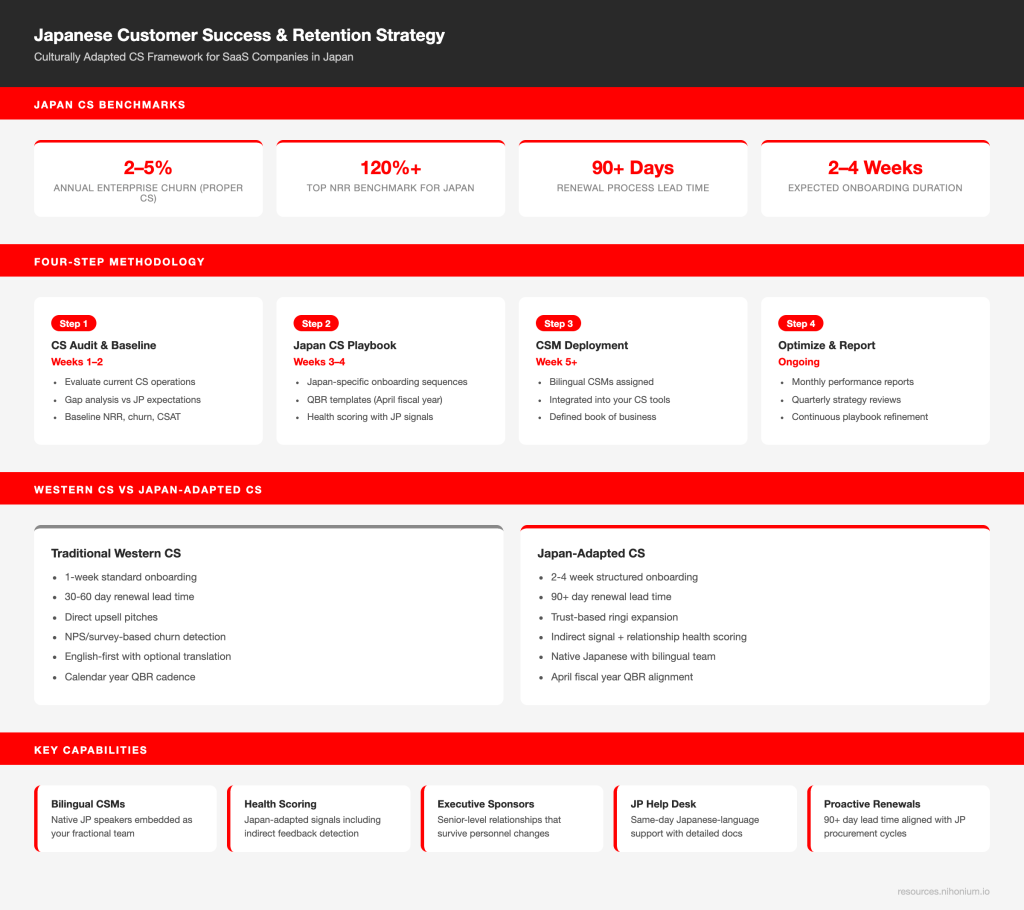
Building customer success for Japan usually follows four steps, designed to work inside your existing CS platform while adapting each touchpoint for Japanese customers. Our guide to onboarding and customer success localization covers the documentation side in more detail.
Step 1: CS Audit & Baseline Assessment
Start with an audit of your current customer success operations as they apply to Japanese accounts: onboarding flows, health scoring criteria, support response times, review cadence and renewal process, compared with what Japanese enterprise customers expect. The output is a gap analysis that shows where the current approach falls short. Record a baseline for your Japan book of business (gross and net retention, expansion revenue, onboarding completion and satisfaction), because there is no public Japanese benchmark to compare against.
Step 2: Japan CS Playbook Design
From the audit, design a Japan-specific playbook: guided onboarding with Japanese documentation for each user role, business review templates aligned with each customer’s fiscal year, health scoring that includes Japanese engagement signals, and escalation protocols that account for indirect communication. The playbook should be an operating manual rather than a theory document, with scripts, templates and workflows in both Japanese and English, written in natural Japanese with the right level of polite language (keigo, 敬語).
Step 3: Japanese-Speaking CSM Coverage
Put Japanese-speaking customer success managers on the accounts, working inside your existing CS tools and reporting structures and keeping regular syncs with headquarters CS leadership. With only a handful of Japan accounts, a part-time or fractional Japanese-speaking CSM, or the account manager who sold the deal, can cover the work; size the team from the cadence you commit to (monthly check-ins, quarterly reviews, minutes after every meeting) rather than from a Western accounts-per-CSM ratio. Keep the same person on an account through the contract where you can.
Step 4: Ongoing Optimization & Reporting
Track gross and net retention, expansion revenue, onboarding completion, health score trends and satisfaction across your Japanese accounts. Monthly reports give visibility into account health, and quarterly reviews with your CS leadership refine the playbook. Set your own targets in advance; we know of no published NRR benchmark for Japan.
The choice between hiring a local CS team and relying on headquarters-based CSMs is not all or nothing. A fractional or shared model gives Japanese-speaking coverage without committing to full-time hires during the early years of market entry. Customer success is not a separate Nihonium service: as listed on our services page, our fractional sales team runs Japanese-speaking sales from the first email to closing and account management, and our localization by SaaS experts covers the Japanese documentation and in-product text onboarding depends on.
Use Cases
Customer success challenges in Japan vary by company stage, product complexity and customer segment. These are the most common situations where a Japan-adapted approach matters.
| Use Case | Challenge | How Japan CS Strategy Solves It |
|---|---|---|
| Post-Launch Retention | First Japanese customers do not renew because onboarding and support fall below expectations | Guided onboarding with a Japanese-speaking CSM and Japanese documentation from day one |
| Stalled Expansion Revenue | Existing customers stay but never expand because upsell attempts feel too aggressive | Expansion through the customer’s ringi process, building trust before proposing more seats or products |
| Silent Churn Risk | Japanese customers disengage quietly without raising complaints, so churn looks sudden | Health scoring that watches indirect signals, plus scheduled check-ins that surface hidden concerns |
| Renewal Surprise Losses | Renewal conversations start too late, after budgets and procurement decisions are made | Renewal conversations that start before the customer’s budget for the next fiscal year is settled |
| Support Ticket Escalations | English-only support or out-of-hours responses damage satisfaction and erode trust | Japanese-language support in JST business hours with detailed documentation |
| Executive Relationship Gaps | No senior-level sponsor, so the account is exposed when the day-to-day champion changes role | Executive sponsor connections that anchor the relationship at the organizational level |
| Fiscal Year Misalignment | Reviews and success metrics follow a January calendar year and miss the April fiscal year most large customers budget on | Reviews, planning and reporting aligned with each customer’s fiscal year |
Japanese Customer Success vs Traditional Approach
The gap between standard Western customer success practice and what Japanese customers expect shows up across seven dimensions. The table describes tendencies, not benchmarks: we found no published Japanese data on onboarding length, renewal lead times or churn by approach.
| Dimension | Traditional Western CS | Japan-Adapted CS |
|---|---|---|
| Onboarding Duration | Shorter, self-serve emphasis | Longer, guided, with written Japanese materials and stakeholder alignment |
| Renewal Lead Time | Shortly before contract end | Before the customer’s budget for the next fiscal year is settled |
| Expansion Sales Motion | Direct upsell pitches based on usage data | Trust-based expansion through ringi consensus building |
| Churn Detection | Usage drops and survey responses | Indirect sentiment signals, relationship depth and scheduled check-ins |
| Communication Style | Direct feedback expected and encouraged | Indirect; requires kuuki wo yomu and structured prompting |
| Support Language | English with optional translation | Native Japanese with detailed Japanese-language documentation |
| Business Review Cadence | Calendar-year quarters | Aligned with the customer’s fiscal year, often April to March |
The bottom line: companies that adapt customer success for Japan give themselves the best chance at renewal, and companies that run a Western playbook unchanged tend to learn about problems only when the customer declines to renew. Referrals raise the stakes. In ITreview’s March 2026 survey of 300 people involved in IT purchasing, 87.4% of those asked said too few reviews had led them to drop a product or give it lower priority, so satisfied customers who write reviews help the next sale. Our article on omotenashi in SaaS customer success covers the service philosophy behind these differences.
Key Takeaways
- Japanese churn is quiet and hard to reverse: Dissatisfied Japanese enterprise customers rarely complain before they leave, and a customer lost at renewal is hard to win back. No public benchmark exists, so measure churn and net retention on your Japanese accounts separately.
- Onboarding sets the trajectory: Japanese enterprises expect guided onboarding with complete written Japanese materials and stakeholder alignment; a short self-serve onboarding can read as a lack of commitment.
- Expansion revenue requires trust, not tactics: Accounts grow through the ringi approval process, after business reviews have shown value, rather than through aggressive upsell motions.
- Churn signals are indirect: Health scoring for Japan must watch engagement patterns, support ticket sentiment and stakeholder relationship depth, and renewal talks must start before the customer’s budget is set.
- A fractional model can bridge the gap: A part-time Japanese-speaking CSM, or the account manager on a fractional sales team, can cover the first Japan accounts before a full in-country CS team is justified.
Sources
- CSA Research, “Businesses Prefer Local Language Purchasing”: September 2008 survey of 351 business software buyers in eight countries, including Japan.
- ITreview, survey of 300 people involved in SaaS selection (March 2026).
- Further reading on nihonium.io: onboarding and customer success localization, omotenashi in SaaS customer success and fractional sales teams in Japan.
Frequently Asked Questions
What does a fractional customer success team for Japan look like in practice?
Usually one or more Japanese-speaking people assigned to your Japanese accounts part-time, working inside your existing CS tools, attending your internal syncs and appearing to customers as members of your team. The difference from a full-time hire is flexibility: coverage grows with your Japan book of business without fixed headcount in the early years. At Nihonium, account management is part of our fractional sales team, so the person who sold the deal can stay with the customer after signature.
How does the Japan-adapted health scoring model differ from standard approaches?
Standard health scores lean on product usage, survey responses and direct feedback, which say little in Japan because customers rarely express dissatisfaction directly. A Japan-adapted score adds indirect signals: the depth and breadth of stakeholder relationships, changes in meeting attendance, the tone and frequency of support tickets, and the CSM’s own observations. It should also weight executive sponsor relationships heavily, since accounts anchored by senior-level trust withstand day-to-day friction better.
How long does it take to see measurable improvement in Japan NRR?
There is no public benchmark, so set your own milestones. Leading indicators such as onboarding completion, support satisfaction and health score trends move first; net retention only shows the effect at renewal, which for annual contracts means at least a year, and expansion often waits for the customer’s next fiscal-year budget. Judge the program over several renewal cycles rather than one quarter.
Can this approach work inside our existing customer success platform?
Yes. A Japan program does not need a separate technology stack: set up Japanese accounts as their own segment in the CS platform and CRM you already use, add the Japan-specific health signals and playbooks there, and keep Japanese-language templates for reviews and reports alongside the English ones. Headquarters CS leadership then sees Japan account health in the same system, without reconciling data across tools.