

Japan’s productivity and collaboration software market is one of the larger SaaS opportunities in Asia, shaped by the government’s Work Style Reform (働き方改革, hatarakikata kaikaku), the jump in remote work during the COVID-19 period, and a broad push toward digital transformation (DX) in Japanese enterprises.
Productivity tools sit inside a growing SaaS market: Grand View Research puts Japan’s SaaS market at USD 12.3 billion in 2025, rising about 12% a year to USD 31.3 billion in 2033. Japanese companies also use fewer apps than their peers: 53 per company against 98 globally in Okta’s Businesses at Work 2026 report, which leaves room to grow and makes every new tool a considered decision. Local competition is strong. Chatwork had 8.23 million registered IDs at the end of June 2026, and 97% of its paying users are small and mid-sized companies; Backlog by Nulab is a widely used Japanese project management tool; and LINE WORKS builds on the familiarity of the LINE consumer app. Foreign SaaS companies entering this space need a Japan-specific localization strategy, a clear difference from local tools, and an understanding of how Japanese teams actually work together.
Key Capabilities for Productivity & Collaboration Market Entry
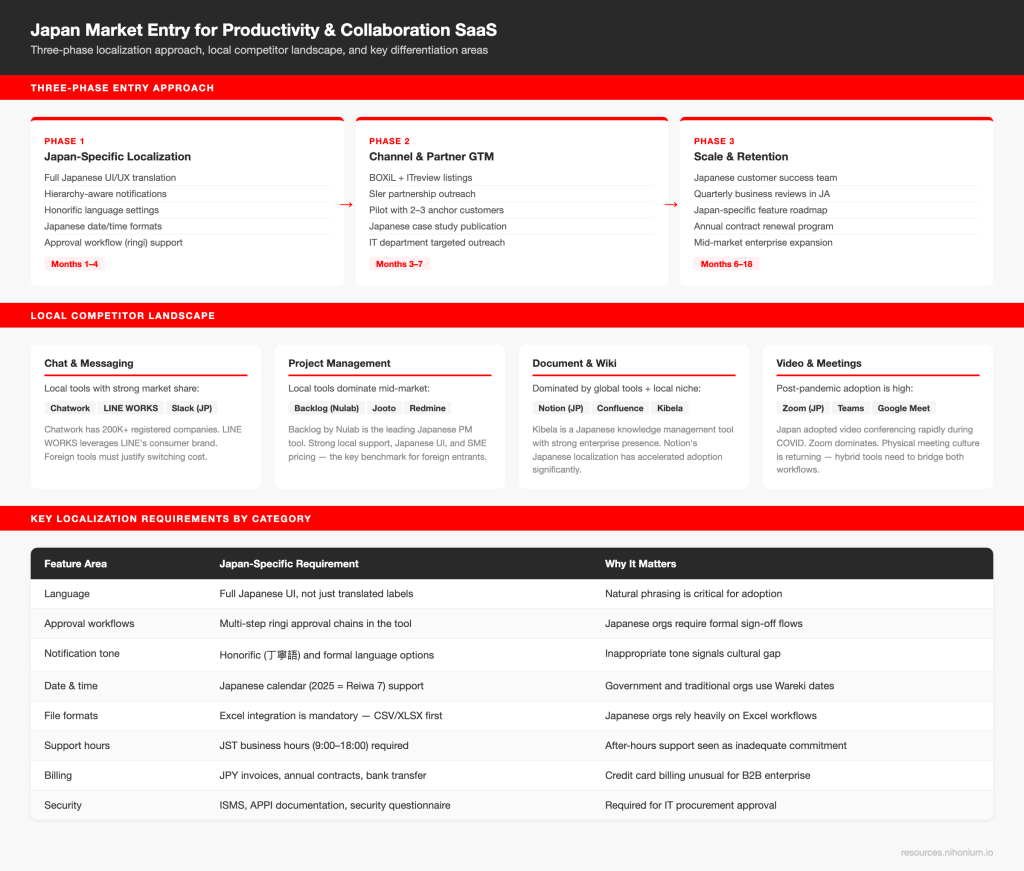
Japan Productivity SaaS Entry Capabilities
| Capability | What It Does | Benefit |
|---|---|---|
| Full Japanese UI/UX localization | Localizes all product interfaces into natural Japanese, not literal translation | The product feels native, not foreign |
| Ringi workflow fit | Supports multi-step approval chains that match Japanese organizational hierarchies | Helps the tool pass IT department approval |
| Honorific language settings | Adapts notification and interface language to Japanese business formality levels | Avoids cultural friction in enterprise rollouts |
| Excel and file format support | Works smoothly with Excel-heavy Japanese workflows | Removes a common objection in Japanese organizations |
| Japanese customer success | Japanese-speaking support and account management in JST business hours | Supports renewals and expansion |
| SIer and IT partner GTM | Identifies channel partners with enterprise customer bases and builds the partner pitch | Reaches enterprise buyers through relationships they already trust |
How Nihonium’s Productivity & Collaboration Entry Program Works
Nihonium’s entry program for productivity and collaboration SaaS runs in three overlapping phases, from localization to account management, using our localization, sales and marketing funnel and fractional sales services.
Phase 1: Japan-Specific Localization. Nihonium localizes beyond translation. For productivity tools this means notification language in the appropriate honorific register (keigo, 敬語) for business communication, approval workflows that support the ringi (稟議, written approval) chain, Japanese date formats including the Japanese era calendar (wareki, 和暦) that many public bodies use, and copy that fits Excel-centric work processes. Engineering changes stay with your team. These are not cosmetic changes; they decide whether Japanese teams adopt the product and keep using it after the first rollout.
Phase 2: Channel and Partner GTM. Nihonium sets up your BOXIL and ITreview listings as part of the marketing funnel and runs targeted outreach to IT departments and SIers. Review sites matter here: in ITreview’s March 2026 survey of IT product buyers, 37.7% found candidates on comparison or review sites. The fractional sales team also looks for the first pilot customers willing to become public references, because Japanese case studies are what later buyers ask for.
Phase 3: Scale and Retention. Nihonium’s fractional sales team handles account management in Japanese: regular business reviews, renewals and expansion within existing accounts. Japanese enterprise accounts expect support and reviews in their own language, and accounts managed only from overseas are harder to renew and expand.
Local Competitor Landscape
Knowing Japan’s local competitors is essential for positioning a foreign productivity tool. The market divides into four functional areas, each with entrenched local and global players.
Chat and messaging. Chatwork, run by kubell, which reports the most monthly users of any business chat in Japan (Nielsen, July 2025), had 8.23 million registered IDs at the end of June 2026, with paying users concentrated in small and mid-sized companies. LINE WORKS builds on the familiarity of the LINE consumer app. Slack launched its Japanese version in November 2017 and is used by many technology companies and international organizations in Japan. Foreign tools entering this space need a clear reason to switch from Chatwork.
Project management. Backlog by Nulab is a widely used Japanese project management tool, popular with development teams, creative agencies and IT departments. Its Japanese-native UX, pricing and local support make it the benchmark for any foreign PM tool entering Japan. Jooto and Redmine also hold positions in specific segments. Foreign tools need a genuine capability advantage, often in AI features or coordination across international teams, to justify switching costs.
Document and wiki. Notion opened a Japanese beta in October 2021 and launched officially in Japanese in November 2022. Kibela, a Japanese knowledge management tool, has enterprise users. Confluence holds its position in organizations that already run Atlassian tools, which Atlassian sells in Japan through partners. This segment is more open to foreign tools than chat or project management, partly because local alternatives are less dominant.
Video and meetings. Zoom and Microsoft Teams are widely used in Japanese companies, Teams especially among Microsoft 365 users, and Google Meet has a smaller presence. This segment is the most open to global tools, because Japanese buyers had few local alternatives when remote work jumped in 2020: among full-time employees it rose from 13.2% in March 2020 to 27.9% in April 2020 (Persol, via the MIC White Paper 2021).
Key Localization Requirements by Feature Area
| Feature Area | Japan-Specific Requirement | Why It Matters |
|---|---|---|
| Language | Full Japanese UI with natural phrasing | Literal translation fails; requires professional localization |
| Approval workflows | Multi-step ringi chains with sequential sign-off | Japanese organizations use formal approval flows |
| Notification tone | Honorific (keigo) language options for business context | Inappropriate tone signals a cultural gap to users |
| Date and time | Japanese era calendar (Reiwa, since May 2019) support for public-sector buyers | Many official documents use wareki dates |
| File formats | Smooth Excel import and export | Many Japanese organizations run workflows in Excel |
| Support hours | Japanese-language support in JST business hours | English-only support outside Japanese hours signals a vendor that is not committed |
| Billing | JPY invoices, annual contracts, bank transfer (furikomi, 振込) | Enterprise procurement typically pays by invoice and bank transfer |
| Security | ISMS (ISO/IEC 27001) certification, APPI documentation, security check sheet (セキュリティチェックシート) | Asked for in IT procurement reviews at most enterprises |
Key Takeaways
- Productivity tools sit in a growing SaaS market: Grand View Research puts Japan’s SaaS market at USD 12.3 billion in 2025, growing about 12% a year, but foreign tools need Japan-specific localization and a clear difference from strong local players.
- Ringi workflow support matters: Japanese organizations use multi-step approval chains for adopting tools and for daily work. Products that cannot accommodate them meet resistance at the IT department.
- Local competitors require genuine differentiation: Chatwork (chat), Backlog (project management) and Kibela (wiki) have strong local positions. Foreign tools need clear advantages, typically in AI features, international collaboration or integrations, to justify switching.
- Japanese account management drives retention: enterprise accounts expect Japanese-language support in Japanese business hours, so build customer success into the Japan budget from the start.
- Nihonium’s part: Japan go-to-market strategy, localization by SaaS experts, a sales and marketing funnel, a fractional Japanese-speaking sales team from the first email to closing and account management, and local thought leadership. Talk to us about your Japan market entry.
Sources
- Grand View Research, Japan Software as a Service Market Size and Outlook.
- kubell, Results presentation, second quarter of fiscal 2026 (14 August 2026, in Japanese): Chatwork registered IDs and paying users.
- ITreview, IT product selection white paper (survey of March 2026, in Japanese).
- Ministry of Health, Labour and Welfare, Work Style Reform (in Japanese).
- Also relied on: Okta, Businesses at Work 2026; MIC, Information and Communications White Paper 2021 (Persol telework survey); Slack and Notion Japanese launch announcements; Cabinet Office, AI Promotion Act (2025).
Frequently Asked Questions
How does Japanese work culture affect productivity tool adoption?
Japanese work culture emphasizes hierarchy, formality in communication and consensus-based decisions. That affects adoption in three ways: notifications and messaging should support appropriate formality; approval features should accommodate the ringi sign-off chain; and visible activity tracking can meet resistance from employees who read monitoring as a lack of trust. Tools that support these norms rather than challenge them are adopted more easily.
Is there a market for AI-powered productivity tools in Japan?
Yes. The government promotes AI adoption, most recently through the AI Promotion Act, fully in force since September 2025, and the AI Basic Plan the Cabinet approved in December 2025, and enterprises are open to AI features in productivity tools. The requirement is that they work well in Japanese: copilot or summarization features that work only in English will see limited use among Japanese-speaking teams.
How long does it take for a foreign productivity tool to gain traction in Japan?
There is no public benchmark. As a planning assumption, allow 6 to 12 months to first mid-market revenue and 12 to 18 months to meaningful enterprise revenue; large enterprise rollouts usually come after reference customers and SIer partnerships are in place. Tools that skip localization or rely on English-language marketing take longer.
Should a productivity SaaS use direct sales or partner-led sales in Japan?
Both work, for different segments. Direct sales, fed by review-site leads from BOXIL and ITreview and by outbound, suits small and mid-sized customers. Partner-led sales through SIers and IT resellers suits large enterprises, where the SIer’s existing relationship and approved-vendor status reduce friction, so many foreign productivity tools use both.