
A Japan SaaS market entry agency is the outside partner that helps a global SaaS company validate, localize, build channels and sell in Japan, a market worth about USD 12 to 14 billion (Grand View Research: USD 12.3 billion in 2025; Research Nester: USD 13.8 billion in 2026). The right Japan SaaS market entry agency speeds up entry by combining localization, channel development and sales execution, which a single hire or a generic consultant rarely covers. This guide covers how to identify the type of agency you need, what a full engagement includes, how to score prospective partners, and which firms work in this space.
The most common mistake global SaaS companies make is not whether to enter Japan. It is choosing the wrong type of partner to help them do it, and finding out only after months of fees and lost time.
This buyer’s guide brings together what is usually spread across many pages: a taxonomy of agency types, the scope of a full engagement, a structured evaluation scorecard, and a short directory of firms. Most articles explain why to enter Japan. This one answers who helps you do it, what a real engagement includes, and how to compare agencies side by side.
Why Japan’s SaaS Market Demands a Specialist Partner
Japan is the fourth-largest economy by nominal GDP (IMF World Economic Outlook, October 2026), but it has its own data protection rules, a trust-based procurement culture and a deep dependence on legacy systems, all of which make self-directed entry slow. A specialist Japan go-to-market partner shortens the learning curve compared with building an in-house Japan capability from scratch, and costs less than a full local office in the first year.
The market keeps growing. Grand View Research forecasts the Japanese SaaS market to grow about 12% a year to USD 31.3 billion in 2033; Research Nester forecasts 13.5% a year to USD 38.1 billion by 2035. OpenAI chose Tokyo for its first office in Asia, announced in April 2024, a sign of how seriously global technology companies take the market. The opportunity is real. So are the barriers.
The Structural Barriers That Make Japan Entry Non-Trivial
Three friction points hit SaaS companies in month one, not month twelve.
Compliance and regulatory environment. Japan’s Act on the Protection of Personal Information (APPI) has cross-border transfer rules many teams do not expect: since the 2020 amendment took full effect in April 2022, a transfer abroad based on consent requires telling the person about the destination country’s data protection system, and a further amendment passed in July 2026 comes into force by July 2028. Expect enterprise prospects to ask how your product handles Japanese personal data before the first demo. Sector rules in fintech, healthcare and government add further layers, and Japan’s Digital Agency and DX agenda raise both demand for SaaS and the security expectations placed on vendors.
Legacy-system integration complexity. In the survey behind METI’s 2018 DX Report, about 80% of companies were running legacy systems, and METI warned of losses of up to JPY 12 trillion a year from 2025 if they were not modernized. Your product does not just need to work; it needs to fit next to on-premises systems that Japanese enterprises have run for decades. That takes local knowledge of the SIer (systems integrator) ecosystem and of how Japanese enterprises actually deploy software.
Trust-based procurement culture. In CSA Research’s 2008 survey of business software buyers, every Japanese respondent preferred to buy in Japanese. Language is only the surface. Decisions are built through nemawashi (根回し, informal consensus-building) and ringi (稟議, formal written approval), which makes B2B sales cycles long and puts weight on relationships with the senior people who approve purchases. A great demo does not shortcut this.
Why a Local Office Isn’t Always the First Move
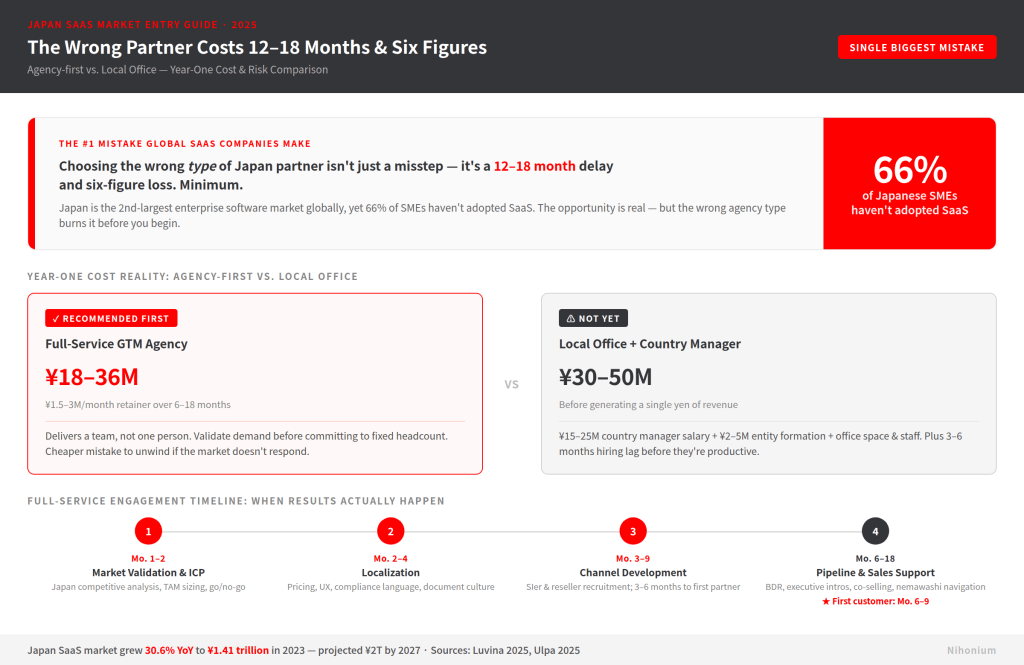
“Can’t we just hire a Japanese employee or open a local office?” Most SaaS leaders considering Japan ask this. The answer is not no; it is not yet.
Setting up a K.K. (kabushiki kaisha) or GK (godo kaisha) is the cheap part: JETRO’s Tokyo model case puts the filings at about USD 6,200. The full set-up of a two-person subsidiary comes to USD 264,000 to 289,000, including JPY 30 million of paid-in capital and before salaries. A credible country manager costs JPY 30 to 60 million a year in base salary in IT software (Robert Walters 2026 salary survey), and the employer adds social insurance on top. And the hiring itself is slow: in JETRO’s 2025 survey of foreign-affiliated companies, 44.5% said they struggle to hire, with sales roles the hardest to fill.
An agency-first approach changes the order. You validate the market, build initial pipeline and prove demand before committing to fixed headcount. The best agencies work as your fractional Japan team: they carry the execution while you keep strategic control. Once revenue is repeatable, you hire in-country and move the agency to a supporting role. Signing an office lease before that point is the sequencing mistake to avoid.
Is Japan Viable for Mid-Market SaaS, Not Just Enterprise?
Yes, with conditions.
Adoption is uneven by company size. In MIC’s 2025 survey, 83.5% of companies with 100 or more employees used cloud services at least in part, and companies in Japan used 53 apps on average against 98 globally (Okta Businesses at Work 2026). Smaller and mid-sized companies are where much of the remaining room sits. Three categories where mid-market SaaS has clear demand drivers in Japan:
- HR tech: Japan’s labour shortage and workforce rules create demand for workforce management, payroll and talent tools, including at companies with 50 to 500 employees.
- Project management and collaboration: The pandemic changed Japanese work habits, and mid-market companies look for tools that bridge remote and in-office work.
- Cybersecurity and GRC: APPI and sector rules drive demand across company sizes, not just in large enterprises.
The conditions: a vertical focus (horizontal SaaS is harder to position in Japan without brand awareness), existing APAC revenue that shows regional demand, and a product mature enough to localize without a rebuild. If you meet those, the mid-market opportunity is real.
Types of Japan SaaS Market Entry Agencies: A Taxonomy
Japan market entry agencies for SaaS companies fall into four main categories: localization-only firms, full-service go-to-market partners, channel partner network operators, and market entry consultancies. Confusing these four types is the most common, and most costly, sourcing mistake global SaaS teams make. Aren’t most of these just translation firms dressed up as GTM consultants? Some are. But the types are genuinely different, and knowing the difference saves you from paying for the wrong scope.
| Agency Type | Core Services | Best Fit Stage | Typical Engagement Length | Budget Range Signal | Key Limitation |
|---|---|---|---|---|---|
| Localization-Only | Translation, cultural adaptation, UI/UX localization | Post-validation; product ready for Japan | Project-based, per deliverable | $ | No pipeline accountability; no channel access |
| Full-Service GTM Partner | Validation, localization, channel development, pipeline and sales support | Pre-revenue to early traction in Japan | Ongoing, usually long enough to cover at least one full sales cycle | $$$ | Higher cost; requires strategic alignment from HQ |
| Channel Partner Network Operator | Reseller recruitment, partner enablement, co-sell programs | Product localized; scaling distribution | Ongoing, tied to partner programmes | $$ | Assumes product and messaging are already Japan-ready |
| Market Entry Consultancy | Market research, strategy, introductions | Pre-commitment; exploring viability | Short project | $ to $$ | Advisory-only; hands off before execution begins |
The budget signals are relative, not prices: we found no public benchmark for agency fees in Japan, so compare proposals on what they include.
Localization-Only Agencies
These firms handle translation, cultural adaptation and UI/UX localization. They are the right fit if you already have Japan channel relationships and need content support: your product is ready, and it needs to speak Japanese. (See Localization vs Translation for SaaS for the difference between these scopes.)
The ceiling: localization-only agencies produce assets, not pipeline. They will not recruit channel partners, run sales meetings or own revenue outcomes. Hire a localization firm expecting go-to-market execution and you get well-translated materials and no customers, because nobody is there to put them in front of buyers.
Full-Service Go-to-Market Partners
Full-service GTM partners cover the whole arc from market validation to active sales. They are the highest-leverage option for companies entering Japan without local infrastructure, and the most expensive.
Engagements are usually structured as a monthly retainer, a hybrid with a lower retainer plus revenue-based fees, or a project scope with milestone payments. The best full-service partners act as your Japan fractional sales team and strategic layer combined. They localize the ideal customer profile (ICP), build the channel relationships and sit in the sales meetings. That is what you are paying for.
Channel Partner Network Operators
These firms specialize in recruiting resellers, enabling partners and building co-sell programmes within Japan’s IT distribution ecosystem. In our experience, channel partners in Japan act as collaborators: they handle customer engagement, local support, contract negotiation and sometimes product adaptation, well beyond distribution. Distributors focus on logistics and broad reach through reseller networks, which suits standardized, scalable products better. For a deeper comparison, see Japan Channel Partner Development.
Ideal fit: your product is already localized, you have initial Japan traction, and you need to scale distribution without building a direct sales force. The limitation is that these operators assume your product and messaging are Japan-ready. If they are not, you will burn partner goodwill fast.
Japan Market Entry Consultancies
Consultancies deliver market research, competitive analysis, entry strategy and introductions. They are valuable at the pre-commitment stage, when you are deciding whether to enter Japan, not how to execute.
The key limitation: advisory-only firms hand off before execution. You get a strategy deck and a list of introductions; you do not get someone who will sit in a sales meeting with a prospect in Osaka. Some firms present as full-service but work as consultancies: they use execution language in proposals but lack the team, the channel relationships or the sales capacity to deliver beyond the strategy phase. This distinction comes back in the red flags section below.
What a Full-Service Japan SaaS Market Entry Engagement Includes
A credible full-service Japan SaaS market entry engagement covers four overlapping phases: market validation and ICP localization, product and content localization, channel and partnership development, and active sales pipeline support. It needs to run long enough to see real sales cycles. As a planning assumption, not a benchmark, allow 6 to 12 months to first mid-market revenue and 12 to 18 months to meaningful enterprise revenue. Legitimate firms can set out the deliverables and success measures for each phase before the contract is signed.
Phase 1: Market Validation and Japan ICP Definition
Deliverables in this phase include a Japan-specific competitive analysis, ICP localization (your US ideal customer profile does not map one-to-one to Japan), sizing for your specific category, and a go/no-go recommendation with enough evidence to defend it internally. This phase takes weeks, not quarters.
Here is what separates a strong agency from a weak one in Phase 1. A weak output is a long deck of macro market data you could have found yourself in an afternoon: good charts, no insight about your category. A strong output is shorter and specific: it names your main competitors in Japan, identifies segments where they are weak and you are strong, and includes notes from interviews with potential Japanese buyers. The second is worth many times the first.
A good Phase 1 output tells you who to sell to in Japan and why they would buy. It does not just tell you Japan is a big market. You already know that.
Phase 2: Localization, Beyond Translation
Surface localization covers language: UI strings, documentation, website and marketing collateral. That is the minimum. Deep localization, the work that moves deals, includes pricing model adaptation (many Japanese buyers prefer annual contracts and invoices that meet the Invoice System requirements), compliance language, UX patterns that match Japanese workflows, and document culture (Japanese enterprises expect formal proposals, detailed specifications and extensive Q&A documents before purchase).
The categories that need the most adaptation are those touching HR processes, financial workflows or compliance reporting. SaaS localization for Japan in these categories is not a translation project; it is a product adaptation project. This is where translation-only agencies fall short: they can make your product speak Japanese, but they cannot make it work the way a Japanese team works.
Phase 3: Channel and Partnership Development
Partner recruitment in Japan is relationship-first. You do not cold-email a SIer or IT reseller and sign a deal. You get introduced, you meet, you build trust across several conversations, and then, maybe, you discuss terms. Plan for the first signed partner to take months, not weeks.
The Japanese IT reseller ecosystem is structured differently from the US. About 72% of Japan’s ICT professionals work at IT vendors rather than at user companies (MIC White Paper 2018), so large SIers such as Fujitsu, Hitachi, NEC and NTT Data, the leading IT services vendors in IDC Japan’s 2024 ranking, hold many enterprise relationships, while mid-tier resellers serve smaller and mid-market companies. Whether you need a co-sell model (your agency sells alongside the partner) or a referral model (the partner identifies opportunities, you close) is a decision your agency should help you make based on product complexity and deal size. For products that need ongoing onboarding and customer success, we would choose channel partners over distributors.
Phase 4: Pipeline Development and Sales Support
“How do I know the agency will actually deliver pipeline, not just strategy decks?” This is the right question, and it is where agency relationships succeed or fail.
Sales support in practice means a business development (BDR) function prospecting into your Japan ICP, introductions through the agency’s network, proposal localization (not just translation, but restructuring proposals to fit Japanese procurement evaluation), and negotiation support through Japan’s long decision-making cycles, where the senior people who approve the purchase have to be won over too.
Contractual success measures should look like this: qualified meetings set per month, pipeline value generated, and revenue milestones tied to engagement renewal. If your agency contract has no pipeline commitment at all, not even a directional one such as a monthly floor of qualified meetings in Phase 4, you do not have a GTM partner. You have a consultant.
Cost Signals: What a Full-Service Engagement Should Cost
Agency fees in Japan are not published in any benchmark we could find, which leaves buyers negotiating blind. What you can do is compare like with like. (For the wider cost picture, see How Much Does Japan Market Entry Cost for a SaaS Company?)
- Localization-only project: Usually a fixed fee per scope (UI, documentation, marketing site). Ask for the price per deliverable and what review by a native SaaS specialist is included.
- Market entry consultancy: Usually a fixed-fee strategy project. You get a report and recommendations; ask what happens after it.
- Full-service GTM retainer: Usually a monthly fee, sometimes with success-based components. Ask how many people work on your account, for how many hours, and on which activities.
- Success-share hybrid: A lower monthly retainer plus a share of closed revenue or per-deal fees. It aligns incentives, but the agency needs confidence in your product-market fit to accept it.
The comparison that matters is with the direct route. A Japan country manager costs JPY 30 to 60 million a year in base salary (Robert Walters 2026), before social insurance, office, travel, a local marketing budget and the months before they are productive, and usually an entity costing USD 264,000 to 289,000 to set up with two people (JETRO). An agency engagement delivers a team, not a single person, and is easier to unwind if the market does not respond. The agency path is not cheap. It is the cheaper mistake to reverse.
How to Evaluate Japan SaaS Market Entry Agencies: A Practical Scorecard
Score each prospective firm across five dimensions: SaaS-specific track record, depth of local network, localization capabilities beyond translation, sales execution accountability, and the cultural fluency of the delivery team, not just the sales team. Generic Japan consultancies often score high on network and low on SaaS execution. That gap is where deals stall.
| Evaluation Dimension | What Strong Looks Like | What Weak Looks Like | Red Flag Signal |
|---|---|---|---|
| SaaS-Specific Track Record | Named B2B SaaS clients with outcomes; case studies showing pipeline, not just “market entry” | Generic technology clients; outcomes described as “market research completed” or “introductions made” | Cannot name a single B2B SaaS client by company and category |
| Depth of Local Network | Named channel partners and references you can contact; active relationships with SIers and IT resellers in your vertical | Claims of an “extensive network” without specifics; references available “upon request” but never delivered | No named partners; the network appears to be the founder’s personal contacts |
| Localization Capabilities | Full scope: pricing, UX, compliance language, documentation culture, not just translation | Translation-focused; outsources localization to vendors with no SaaS context | Describes localization as “translation and cultural adaptation” only |
| Sales Execution Accountability | Pipeline commitments in the contract; BDR function; co-sells with you in meetings | Scope ends at “introductions”; no pipeline metrics; engagement structured as advisory | Contract has no pipeline or revenue-linked deliverables |
| Cultural Fluency of Delivery Team | Delivery team (not just the sales team) is bilingual with SaaS sales or partnerships backgrounds and has closed deals in Japan | Sales team is fluent; delivery team is junior or lacks SaaS experience | You meet the senior partner during the pitch, then get handed to a team you have never met |
The Five Evaluation Dimensions
SaaS-specific track record. This is non-negotiable. Japan market expertise alone does not mean a firm can sell your SaaS product. A long list of Japanese enterprise references can hide the fact that few of them are software companies, and none in your category. A team can know Japan well and still not understand usage-based pricing, churn metrics, or how to position a SaaS product against an incumbent on-premises system.
Depth of local network. Ask for names. A strong agency will name the SIers, IT resellers and industry associations it works with, and let you talk to them. A weak one talks about “deep connections” and never produces a contact. The network is either real and verifiable, or it is not.
Localization capabilities. This goes well beyond language. A strong partner will push back on your US pricing model, tell you why your onboarding flow will not work for Japanese users, and know which billing structures Japanese buyers expect. A weak one translates your English content and calls it done.
Sales execution accountability. This is the dividing line between a GTM partner and a consultant. Does the agency share responsibility for pipeline? Will it sit in sales meetings and help close deals? Or does the engagement end when the “strategy phase” wraps up? Get it in writing.
Cultural fluency of the delivery team. Meet the people who will do the work, not only the partners who pitch you. The delivery team needs to be native, or near-native, in both Japanese business culture and SaaS sales. One without the other leaves a gap your prospects will notice.
Questions to Ask Any Prospective Japan GTM Agency
Use these in your first call. They are designed to separate real GTM partners from advisory-only firms:
- “Name three B2B SaaS clients you took from zero Japan revenue to their first meaningful revenue, and can I speak to their Japan lead?”
- “Which SIers or IT resellers have you activated as channel partners in the last 12 months? Can you provide a reference from one?”
- “What does your team do in a first sales meeting with a Japanese enterprise prospect? Who attends from your side and what do they do?”
- “Show me a Phase 1 deliverable, redacted. What does a real output look like?”
- “What pipeline or revenue measures are you willing to commit to in the contract for Phase 4?”
- “Who on your delivery team has closed a B2B SaaS deal in Japan in the last 24 months? What was their role?”
- “How do you handle the nemawashi process with enterprise prospects? Give me a specific example.”
- “If we sign and the engagement isn’t producing qualified pipeline by month six, what happens? What is your remediation process?”
- “What’s your view on direct entry versus partner-led entry for our product category? Why?”
- “Which Japanese review platforms should our product be listed on, and will you handle those listings?”
If the agency cannot answer questions 1, 2 and 5 with specifics, it is not a full-service GTM partner, whatever its proposal says.
Red Flags That Signal a Misfit
Watch for these warning signs during the evaluation:
- No SaaS-specific case studies. If every reference is a manufacturer, a consumer brand or a “confidential technology client,” the agency has not done this work for SaaS.
- Scope that ends at “introductions.” Real GTM partners do not hand you a list of names and wish you luck. They co-sell.
- A bilingual team that knows neither SaaS nor enterprise sales. Language fluency is not business fluency. Your agency needs people who understand ARR, churn and product-led growth, in Japanese.
- Promises of meaningful revenue in 90 days. Japan’s sales cycles are long. A firm promising quick results for B2B SaaS is either selling consulting, not execution, or overpromising.
- Inability to name actual channel partners in your vertical. “We have relationships with major SIers” means nothing without names.
- Bait-and-switch on the delivery team. You meet senior partners during the sale; the work is done by a junior team you have never met. Ask to meet the delivery team before signing.
- No contractual pipeline measures. An agency that will not commit to any pipeline outcome is protecting itself from accountability.
- Too much market size, too little of your category. An agency that spends its pitch on how big the Japanese SaaS market is, without addressing your competitive position in Japan, is selling the market, not your entry into it.
Choosing a Firm Type, and Where Nihonium Fits
Firms that help SaaS companies enter Japan include go-to-market partners such as Nihonium, localization and language firms, management and market entry consultancies, marketing agencies, and channel specialists. They differ in scope, team and industry focus. Map your current stage, pre-revenue in Japan or scaling from initial traction, to the right type of firm before shortlisting names.
Nihonium: Japan Go-to-Market for Global SaaS
Nihonium is a Japan go-to-market partner for B2B SaaS companies. Its five services, listed on its services page, are Japan go-to-market strategy (including market evaluation and channel strategy), localization by SaaS experts, a sales and marketing funnel (awareness, SEO, local leads), a fractional sales team that runs Japanese-speaking sales from the first email to closing and account management, and local thought leadership.
Nihonium works with global SaaS companies at the pre-revenue to early-traction stage in Japan, and publishes entry guides for verticals such as cybersecurity, HR tech, fintech and DevOps. The model is built around SaaS: the same partner carries the work from strategy through localization to the sales conversations, rather than handing off after the strategy phase.
Matching Your Stage to the Right Firm Type
The most common mistake is not choosing a bad agency. It is choosing the right agency at the wrong stage. Use this framework to match your position to the right type of firm:
| Your Stage | What You Need | Recommended Agency Type | Example Fit |
|---|---|---|---|
| Pre-revenue in Japan, exploring viability, no local presence | Market validation, ICP definition, go/no-go decision | Full-service GTM partner or market entry consultancy | A GTM partner that also sells, or a consultancy for the decision followed by an execution partner |
| Early traction, product localized, first customers, no scalable channel | Channel partner recruitment, pipeline development, sales support | Full-service GTM partner or channel partner network operator | A partner whose contract includes pipeline measures and named channel partners |
| Scaling, established Japan revenue, need to expand distribution or verticals | Expanded channel network, vertical-specific partnerships, marketing acceleration | Channel partner network operator plus a localization or marketing agency | A channel specialist working alongside a B2B marketing agency |
The key point: if you are pre-revenue in Japan, a localization-only firm or a marketing agency cannot get you to first customers alone. You need either a full-service partner, or a consultancy that validates the market followed by an execution partner. If you are already scaling, you do not need another strategy deck; you need channel reach and marketing capacity. Match the scope to the stage and you avoid the most expensive mismatch in Asia-Pacific expansion. For more on this sequencing decision, see Phased Market Entry vs Full Launch in Japan.
Key Takeaways
Japan’s SaaS market is worth about USD 12 to 14 billion and forecast to grow 12 to 13.5% a year (Grand View Research, Research Nester), and the opportunity is real for mid-market and enterprise sellers alike. The essential points from this guide:
- Four distinct agency types exist: localization-only, full-service GTM, channel network operators and consultancies. Choosing the wrong one is the most common and costly entry mistake.
- A full-service Japan SaaS engagement covers four phases: validation, localization, channel development and pipeline support. It needs to run long enough to see real sales cycles.
- Evaluate agencies on five dimensions: SaaS-specific track record, named local network, localization depth, pipeline accountability, and the cultural fluency of the delivery team.
- Red flags include advisory-only scope, no SaaS case studies, promises of quick results and inability to name channel partners in your vertical.
- An agency-first approach costs less than a local office in year one: a two-person subsidiary costs USD 264,000 to 289,000 to set up before salaries (JETRO), and an agency lets you validate demand before committing to fixed headcount.
- Mid-market SaaS companies can succeed in Japan, particularly in HR tech, cybersecurity and productivity, if they have a vertical focus, existing APAC traction and a mature product.
- Nihonium is a Japan go-to-market partner for global SaaS, covering strategy and market evaluation, localization, the sales and marketing funnel, fractional sales and local thought leadership.
- Match your stage to your agency type. Pre-revenue companies need validation and execution. Scaling companies need channel expansion and marketing. Don’t hire a consultant when you need a co-seller.
Sources
Primary Sources
- Grand View Research, Japan Software as a Service Market Outlook; Research Nester, Japan Software as a Service (SaaS) Market.
- JETRO, Tokyo set-up model case; JETRO survey of foreign-affiliated companies (2025); Robert Walters, Japan Salary Survey 2026.
- Personal Information Protection Commission, guidelines on provision to third parties in foreign countries; see also our APPI compliance checklist for SaaS.
- CSA Research, business software buyers prefer to buy in their own language (2008).
Cited-Within Sources
- IMF, World Economic Outlook (October 2026); METI, DX Report (September 2018); MIC, Information and Communications White Paper 2018 and 2025 communications usage survey; Okta, Businesses at Work 2026; IDC Japan, 2024 IT services vendor ranking; OpenAI, “Introducing OpenAI Japan” (April 2024).
Frequently Asked Questions
What does a Japan SaaS market entry agency actually do?
A Japan SaaS market entry agency performs four core functions: market validation (sizing your opportunity and defining your Japan ICP), localization (adapting your product, pricing and content for Japanese buyers), channel development (recruiting and enabling local resellers and SIers) and pipeline support (outreach, introductions and co-selling). This differs from a translation firm, which handles language only, and from a general Japan consultant, which delivers strategy without execution. A full-service agency shares responsibility for outcomes, not just deliverables.
How long does it take to enter the Japanese SaaS market with an agency?
Validation takes weeks; localization, channel development and pipeline work then overlap for as long as the sales cycle requires. As a planning assumption rather than a benchmark, allow 6 to 12 months to first mid-market revenue and 12 to 18 months to meaningful enterprise revenue, with enterprise deal cycles of nine to twelve months or more. “Entry” (your first paying Japan customer) and “scale” (repeatable pipeline producing predictable revenue) are different milestones. For more detail, see How Long Does It Take to See ROI from Japan Market Entry?
What is the difference between a channel partner and a distributor in Japan?
Channel partners act as collaborators: they handle customer engagement, local support, contract negotiation and sometimes product adaptation, beyond distribution. Distributors focus on logistics and broad reach through reseller networks, which suits standardized, scalable products. For SaaS products that need ongoing customer success and localization, we would choose channel partners. For high-volume, low-touch SaaS with little customization, distributors can work. See the full comparison at Japan Channel Partner Development.
Do I need to localize my SaaS product before entering Japan?
Yes, in stages. Minimum viable localization (a Japanese UI, core documentation and a localized pricing model) comes before any serious sales effort: in CSA Research’s 2008 survey, every Japanese business software buyer preferred to buy in Japanese. Deep localization (workflow adaptation, compliance language for APPI, Japanese-style proposal documents and sector-specific UX) is needed for enterprise deals. Do the minimum first to test the market, and deepen it once you have traction and customer feedback. See Localization vs Translation for SaaS for the full distinction.
Is Japan a viable market for mid-market SaaS companies, not just enterprise?
Yes, with conditions. Cloud use is high among larger companies (83.5% of companies with 100 or more employees in MIC’s 2025 survey), and smaller and mid-sized companies are where much of the remaining room sits. Categories with clear mid-market demand include HR tech, project management and collaboration tools and cybersecurity. Mid-market entry makes sense with a vertical focus, existing APAC revenue that shows regional demand, and a product mature enough to localize without a rebuild. Generic horizontal SaaS without a clear vertical wedge is harder below enterprise.
What compliance requirements should my SaaS product meet before entering Japan?
Start with the Act on the Protection of Personal Information (APPI), which governs data handling, including transfers abroad; see APPI vs GDPR for how it differs from European rules. Vendors selling to government agencies meet the security expectations set through the Digital Agency and ISMAP, and enterprise buyers often ask for similar evidence. Sector rules apply in fintech, healthcare and legal/RegTech. Japanese counsel owns the legal position; a specialist agency should raise these questions in Phase 1. For details, see Key Regulatory Requirements for SaaS Companies in Japan.
How do I know if a Japan market entry agency is truly SaaS-specialized?
Apply a three-question test. (1) Can they name B2B SaaS clients by company and product category? Not “a leading technology company”; actual names. (2) Do their case studies show pipeline and revenue outcomes, not just “completed market entry” or “delivered market research”? (3) Does their delivery team include former SaaS sales or partnerships people who understand ARR, churn, expansion revenue and product-led growth, or is it made up of Japan-market generalists? If the answer to any of these is no, you are evaluating a Japan consultancy, not a SaaS GTM partner.
What should a Japan SaaS market entry agency contract include?
Your contract should include phase-based deliverables with specific outputs per phase (not vague “strategic advisory”), success measures tied to pipeline (qualified meetings, pipeline value, revenue milestones, not just effort measures such as hours worked), IP and data ownership clauses confirming that you own the market intelligence, partner relationships and customer data generated during the engagement, exit provisions with notice periods and transition duties, and underperformance remediation: what happens if Phase 4 does not produce pipeline. A contract that bills monthly for “advisory and support” with no quantitative accountability is the one to avoid. Have Japanese counsel review it before you sign.