

Japan market entry is the process by which a foreign company starts selling to customers in Japan: deciding how it will reach them (directly, through partners or both), adapting its product and materials to the market, and deciding whether and when to set up a legal presence there. For a SaaS company it usually starts with selling, not with a company registration.
This primer explains what the term covers, the entry options and the vocabulary you will meet. For what a full program involves, from strategy and localization to partners, regulation, the entity and hiring, see our guide to Japan market entry services for SaaS.
Why Japan Matters for SaaS Companies
Japan is the fourth-largest economy by nominal GDP in the IMF’s October 2026 projections. Grand View Research puts the Japanese SaaS market at USD 12.3 billion in 2025 and expects it to reach USD 31.3 billion by 2033, growth of about 12% a year. Japanese companies also still use fewer applications than their peers: 53 per company in Japan against 98 globally, in Okta’s Businesses at Work 2026 report.
The market is broad as well as large. Japan had 3.365 million small and medium-sized enterprises in 2021, 99.7% of all enterprises, according to the Small and Medium Enterprise Agency, alongside large companies with substantial IT budgets. It is also demanding: procurement is consensus-driven, trust is built through local presence, and buyers expect high standards of product quality and support in Japanese.
What Market Entry Covers
“Market entry” is used loosely. For a SaaS company it usually means six pieces of work, which overlap in time:
- Go-to-market strategy: which customers to target first, how to position the product against what they use today, and which sales channels to use. Our overview of Japan go-to-market strategy covers it.
- Localization: a Japanese interface, documentation, support and marketing, adapted rather than translated; see SaaS localization for Japan.
- Sales and marketing: the Japanese-language funnel and the people who hold sales conversations in Japanese.
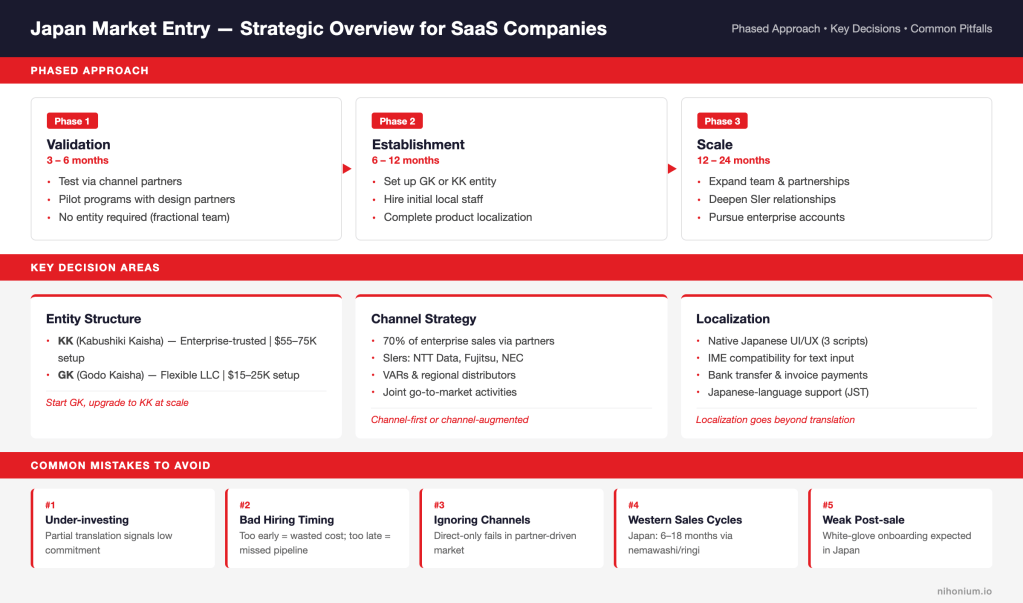
- Partners: resellers, distributors and systems integrators (SIers), which carry more weight in Japan than in most markets: about 72% of Japan’s ICT professionals work at IT vendors rather than at user companies (MIC White Paper 2018).
- Regulatory preparation: knowing which Japanese rules apply. The Act on the Protection of Personal Information (APPI) applies to foreign businesses that handle the personal information of people in Japan in connection with supplying goods or services to them; our overview of SaaS regulatory requirements in Japan covers the rest, and Japanese counsel confirms the position for a given product.
- Legal presence and hiring: whether to set up an entity, and when to make the first local hires.
The Entry Options
There are four broad ways to reach Japanese customers. They are not exclusive, and many companies move from one to another as the business grows.
| Option | What it means | Japanese entity needed? | Usual fit |
|---|---|---|---|
| Sell from abroad | The home entity contracts with Japanese customers, with Japanese-speaking sales and support from its own staff or a fractional sales team | No | Testing demand, self-serve and mid-market products |
| Through partners | Agents, resellers, distributors or SIers sell the product, often with their own services | No | Enterprise accounts that buy through their IT vendors |
| Direct with a local entity | A Japanese subsidiary or branch employs the team and contracts with customers | Yes | Committed, larger-scale operations |
| Hybrid | Partners for some segments or regions, a direct team for others | Usually, once the direct team grows | The model many companies end up with |
Choosing between direct and partner-led entry is the subject of our comparison of direct entry vs the partner model in Japan.
Entity or None
A legal presence is a decision you can take later. JETRO describes three forms. A representative office needs no registration but may only do preparatory and supporting work such as market research and publicity: it cannot sell. A branch office must be registered, and at least one of its representatives must live in Japan. A subsidiary is a Japanese company, usually a kabushiki kaisha (KK) or a godo kaisha (GK); our comparison of KK vs GK for SaaS explains the choice.
The filing fees are small, but running a subsidiary is not. JETRO’s Tokyo model case puts the registration and filing costs at about USD 6,200, and setting up a two-person subsidiary at USD 264,000 to 289,000, including JPY 30 million of paid-in capital, before salaries and social insurance. That is why many SaaS companies sell from their home entity or through a partner first, and form an entity once the pipeline justifies it. The registration itself is work for a judicial scrivener (司法書士, shihō shoshi) or a corporate services provider.
How Entry Usually Unfolds
Most entries run in phases rather than as one large investment. A validation phase tests demand through customer interviews, partners and pilots, usually without an entity; market validation decides whether to continue and what to adapt. An establishment phase completes localization, builds a pipeline and settles the entity and first hires. A scale phase adds people, partners and enterprise accounts. Our comparison of phased entry vs a full launch sets out when each approach fits.
Japan Market Entry Vocabulary
| Term | Meaning |
|---|---|
| Go-to-market (GTM) strategy | The plan for which customers to sell to, with what positioning, through which channels and at what price |
| Kabushiki kaisha (KK, 株式会社) | A Japanese stock company, the most recognized entity type with enterprise buyers |
| Godo kaisha (GK, 合同会社) | A Japanese limited liability company, similar to a US LLC, with simpler governance |
| Representative office (駐在員事務所, chūzai-in jimusho) | An unregistered office for market research and publicity; it cannot sell |
| Branch office (支店, shiten) | A registered office of the foreign company itself, with no separate legal personality |
| SIer (エスアイヤー) | A Japanese systems integrator, often the outsourced IT department of its enterprise clients |
| Sales agent or distributor (販売代理店, hanbai dairiten) | A company that sells your product to its customers, on commission or by reselling it |
| Gaishi-kei (外資系) | A foreign-affiliated company; see our gaishi-kei guide |
| Nemawashi (根回し) | Informal consensus-building before a decision; see nemawashi |
| Ringi (稟議) | The formal written proposal circulated for approval inside a Japanese company; see ringi decision-making |
| Eigyō (営業) | The Japanese word for the sales function, and in B2B a relationship-driven way of selling; see eigyō |
| Shiryō seikyū (資料請求) | A request for a product’s materials, one of the first steps a Japanese buyer takes on a vendor or comparison site |
| Furikomi (振込) | Payment by bank transfer against an invoice, which many Japanese companies prefer to card payment |
| Meishi (名刺) | The business card, exchanged at every first meeting |
| APPI | The Act on the Protection of Personal Information, Japan’s data protection law, overseen by the Personal Information Protection Commission |
| JETRO | The Japan External Trade Organization, the government agency that supports foreign companies investing in Japan |
| Business Manager visa (経営・管理, keiei-kanri) | The residence status for a foreign founder running a company in Japan; since 16 October 2025 it requires JPY 30 million of capital among other conditions |
Common Misconceptions
- “Entering Japan means setting up a company.” Selling can start from the home entity or through partners; the entity follows the pipeline.
- “Translation is enough.” Japanese buyers judge the whole experience in Japanese: the interface, the documentation, the sales materials and the support.
- “A partner will do the selling for us.” Partners sell what they are trained and equipped to sell; enabling them is your work.
- “Japanese buyers will work in English.” Japan ranks 86th of 117 countries in the EF English Proficiency Index 2026, so English-only sales and support reach a narrow set of buyers.
Key Takeaways
- Market entry is broader than incorporation: it covers strategy, localization, sales and marketing, partners, regulation, and only then the entity and hiring.
- There are four broad options: sell from abroad, sell through partners, sell direct through a local entity, or combine them.
- The entity can wait: filings cost about USD 6,200 in JETRO’s model case, but a two-person subsidiary costs USD 264,000 to 289,000 including capital, before salaries.
- Partners matter more than elsewhere: about 72% of Japan’s ICT professionals work at IT vendors, so many enterprises buy through their SIer.
- The full program is set out in our guide to Japan market entry services.
Working with Nihonium. We are a Japan go-to-market partner for B2B SaaS companies: Japan go-to-market strategy and localization by SaaS experts. Talk to us about your Japan entry.
Sources
- JETRO, Setting up a business in Tokyo: model case (filing and set-up costs) and forms of business (representative office, branch, subsidiary).
- Grand View Research, Japan SaaS market outlook.
- Ministry of Internal Affairs and Communications (MIC), Information and Communications White Paper 2018 (ICT professionals at IT vendors).
- Okta, Businesses at Work 2026 (apps per company).
- Also relied on, cited in plain text: IMF World Economic Outlook (October 2026); SME Agency (2021); APPI (Japanese Law Translation); EF English Proficiency Index 2026; Immigration Services Agency rules for the Business Manager status (from 16 October 2025).
Frequently Asked Questions
What is the first step in entering the Japanese market?
Start with structured market validation, not entity formation or hiring. Interview Japanese prospects in your target segment (15 to 25 is a common rule of thumb; stop when the themes repeat) to test pain points, feature fit and the competition. The findings decide whether to proceed, what to adapt and which entry option fits.
How long does Japan market entry take?
No public benchmark exists, so plan with assumptions you can test: 6 to 12 months to first mid-market revenue, 12 to 18 months to meaningful enterprise revenue, and break-even judged over two to three years. Enterprise deal cycles alone often run nine to twelve months or more. Our article on the Japan market entry ROI timeline explains how to set milestones.
Do we need to speak Japanese to enter the Japan market?
Company leadership does not, but the Japan-facing team must include native Japanese speakers for sales, marketing and customer support. A bilingual person who bridges headquarters and the Japan team saves a great deal of lost context in both directions.
How important is physical presence in Japan?
Presence helps credibility with enterprise buyers, and regular in-person visits matter for relationship building, particularly during nemawashi on major deals. A permanent office is not required from day one; a new KK or GK needs a registered head office address in Japan, which some companies meet with a serviced office before the team grows.