
When a SaaS company sets up a legal entity in Japan, it usually chooses between two company forms: the Kabushiki Kaisha (KK, 株式会社), Japan’s stock company and the equivalent of a corporation, and the Godo Kaisha (GK, 合同会社), Japan’s limited liability company (LLC).
The choice affects formation cost, governance and disclosure, how buyers read the company, and whether it can raise equity or list. The KK is by far the more common form: in the National Tax Agency’s company sample survey for fiscal 2024, 89.7% of active corporations were KKs and 7.2% were GKs. The GK is nonetheless well known among foreign subsidiaries: Apple Japan, Google and Amazon Japan all operate as godo kaisha. Neither form is better in general; the right one depends on what the Japan entity has to do in its first years.
Comparison Overview
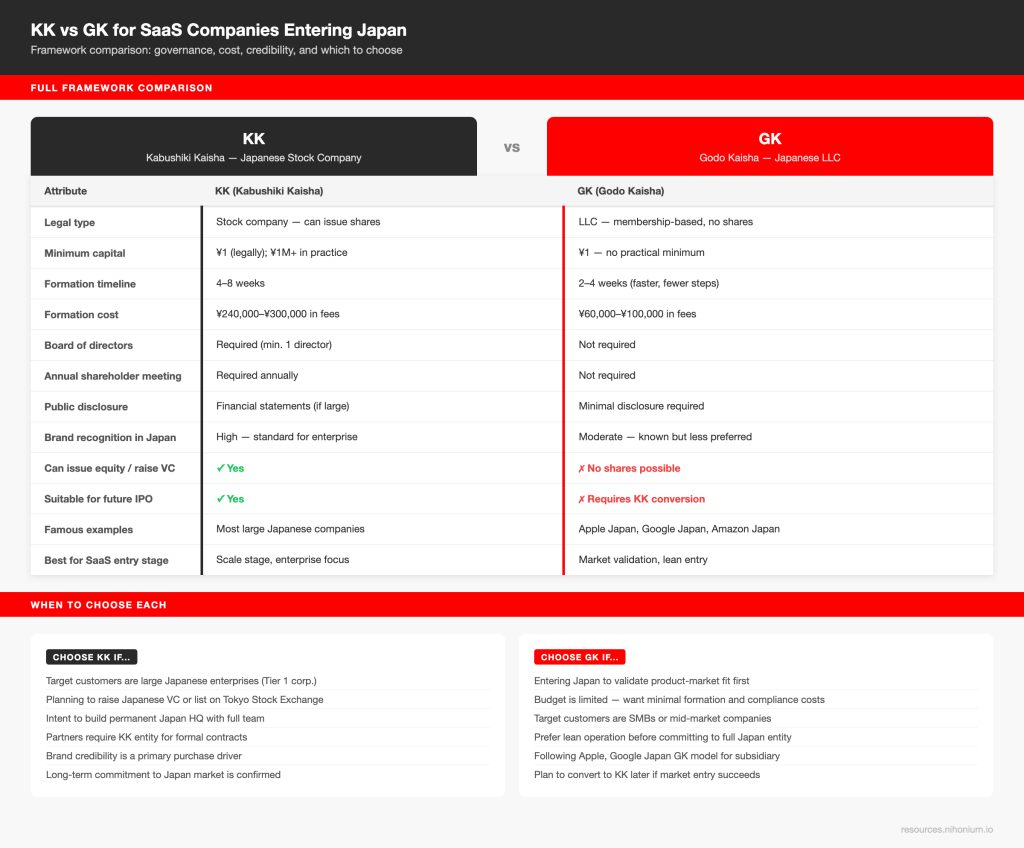
KK vs GK at a Glance
| Attribute | KK (Kabushiki Kaisha) | GK (Godo Kaisha) |
|---|---|---|
| Legal type | Stock company (corporation) | Limited liability company (LLC) |
| Minimum capital | 1 yen (a founder who needs a Business Manager visa must show JPY 30 million, whichever form is used) | 1 yen (same visa rule) |
| Formation timeline | Adds notarization of the articles before filing | Shorter: no notarization step before filing |
| Formation cost (statutory fees) | About 180,000 to 240,000 yen at the minimum registration tax | 60,000 to 100,000 yen |
| Board of directors | Not required for a private KK; at least 1 director | Not required; run by its members |
| Annual shareholder meeting | Required annually | Not required |
| Public disclosure | Must publish its balance sheet every year (a large company also its income statement) | No obligation to publish financial results |
| Brand recognition | High, the standard form for enterprise buyers | Moderate, known but less familiar to traditional buyers |
| Can issue equity/raise VC | Yes | No shares possible |
| Suitable for Japan IPO | Yes | Requires conversion to KK |
| Profit distribution flexibility | In proportion to shareholdings, unless it issues different classes of shares | Flexible, as set in the articles of incorporation |
| Famous examples | Most large Japanese companies | Apple Japan, Google, Amazon Japan |
Core Distinction: Governance and Capital
The KK and the GK differ on two dimensions: governance and access to capital. A KK is owned by shareholders and run by directors they elect; it must hold an annual shareholders meeting and publish its balance sheet every year. A GK is owned and run by its members (shain, 社員), with no board, no annual general meeting and no duty to publish its financial results.
On capital the difference is decisive. A KK can issue shares, take equity from Japanese or foreign investors and list on the Tokyo Stock Exchange. A GK has no shares, so it cannot raise venture capital in the usual way, and it has to convert to a KK before any equity round or listing.
For a subsidiary wholly owned by its foreign parent, raising capital in Japan is rarely an early priority, so the GK’s lighter governance often wins in the first phase. The trade-off is perception: some enterprise buyers read a GK as smaller or less established.
Formation Requirements Compared
Forming a KK takes one more step and costs more. A notary must certify the KK’s articles of incorporation (teikan, 定款), for a fee of JPY 30,000, 40,000 or 50,000 depending on the capital. A GK’s articles need no notarization, so that step and its fee disappear.
Both forms register with the Legal Affairs Bureau and pay registration and license tax of 0.7% of capital, with a minimum of JPY 150,000 for a KK and JPY 60,000 for a GK. Articles prepared on paper carry JPY 40,000 of stamp duty; electronic articles carry none. At the minimum tax, statutory fees come to about JPY 180,000 to 240,000 for a KK and JPY 60,000 to 100,000 for a GK, a difference of about JPY 120,000 to 140,000 before professional fees. A judicial scrivener (shihō shoshi, 司法書士) usually files for either form.
Residency is no longer a hurdle for the company itself: since 16 March 2015 the Ministry of Justice has registered stock companies whose representative directors all live abroad (ask your scrivener how this applies to a GK). Banks set their own rules, and some still ask for a representative in Japan. A founder who moves to Japan on a Business Manager visa must, since 16 October 2025, show JPY 30 million of capital and employ at least one full-time staff member, whichever form the company takes.
When to Choose Each
Best Fit by Scenario
| Scenario | Best Fit | Why |
|---|---|---|
| Market validation phase, first Japan entity | GK | Lower fees and overhead while you test the market |
| Target customers are Japanese SMBs and mid-market | GK | Entity type is less likely to come up in smaller deals |
| Target customers are Tier 1 enterprise (banks, manufacturers) | KK | Enterprise procurement teams know the KK best, and some prefer it |
| Planning to raise Japanese VC funding | KK | Shares required; GK cannot issue equity |
| Subsidiary of a large foreign parent company | GK | Follows the Apple Japan, Google and Amazon Japan model |
| Building toward Tokyo Stock Exchange listing | KK | Only a stock company has shares to list |
| Lean headcount, minimal compliance burden preferred | GK | No board, annual meeting or duty to publish accounts |
| SIer or channel partner contracts require KK | KK | Some partner agreements specify entity type |
Can You Convert From GK to KK?
Yes. A GK can become a KK through an organizational change (soshiki henkō, 組織変更). The conversion needs the consent of all members and a creditor protection procedure that gives creditors at least one month to object, so it takes at least a month. The articles are rewritten for a share-based company, directors are appointed, and two registrations are filed: the new KK’s registration and license tax is 0.15% of capital with a JPY 30,000 minimum, plus a registration closing the GK.
Some foreign SaaS companies plan two stages: a GK during market validation, then a KK once enterprise sales or fundraising becomes the priority. Apple Japan, Google and Amazon Japan show that large operations can run as a GK indefinitely, so conversion is driven by fundraising, listing or buyer expectations, not by size.
The company keeps its legal identity through the conversion, but its name changes (合同会社 becomes 株式会社), so documents and registrations that show the old name need updating.
Key Takeaways
- GK is cheaper and simpler to form: Statutory fees are JPY 60,000 to 100,000, against about JPY 180,000 to 240,000 for a KK, with no notarization step.
- KK offers greater brand credibility with enterprise buyers: The KK is 89.7% of active corporations (NTA, fiscal 2024), and procurement teams in financial services, government and large manufacturing know it best. SMB and mid-market buyers are less likely to ask about entity type.
- GK cannot raise equity funding: The GK has no shares. Companies planning to raise Japanese VC funding or list on the Tokyo Stock Exchange must use or convert to a KK.
- Apple Japan, Google and Amazon Japan use GK structures: They have made the GK familiar, although entity type can still come up in large enterprise deals.
- Start GK, convert to KK when justified: Conversion takes at least a month because of the creditor objection period. A judicial scrivener handles the formation and the conversion; your Japan go-to-market strategy should decide the timing. For the detail on each form, see our guides to the Kabushiki Kaisha and the Godo Kaisha.
Working with Nihonium. We are a Japan go-to-market partner for B2B SaaS companies: Japan go-to-market strategy. Talk to us about your Japan entry.
Sources
- Companies Act (Act No. 86 of July 26, 2005), English text (Japanese Law Translation).
- National Tax Agency, registration and license tax rates (No. 7191), stamp duty on articles of incorporation (No. 7141), company sample survey, fiscal 2024 (corporations by type), and consumption tax for new corporations (No. 6503).
- Japan National Notaries Association, notary fees.
- Ministry of Justice, commercial registration for foreign nationals and overseas residents.
- Immigration Services Agency, Business Manager status of residence: revised criteria from 16 October 2025.
- Ministry of Finance, corporate tax rates and the effective corporate tax rate.
- JETRO, Setting Up Business in Japan: establishing a business entity.
- US Treasury Regulations, 26 CFR 301.7701-2(b)(8): list of foreign entities treated as corporations, which includes the Japanese Kabushiki Kaisha.
Frequently Asked Questions
Does choosing a GK instead of a KK affect tax treatment in Japan?
Not in Japan. A KK and a GK are both ordinary corporations for Japanese tax: the same corporate tax, local taxes and consumption tax apply, and the Ministry of Finance puts the combined effective rate at 29.74% (30.64% where the defense special corporate tax applies). Consumption tax applies once taxable sales in the base period exceed JPY 10 million, or from the first year for a new company with JPY 10 million or more of capital. The difference can arise at the parent: US tax rules treat a KK as a corporation automatically, while a GK can elect its US classification, one reason US groups often choose the GK. Ask your tax advisers.
How long does it take to open a bank account for a new GK in Japan?
There is no fixed timeline: each bank runs its own review, and for a foreign-owned company the account is often the slowest step of the set-up. Banks typically ask for the register extract, the parent’s registration documents, the representative’s identification and the business plan, and some want to meet the representative. Online banks can be quicker for smaller operations.
Can I establish a GK remotely without visiting Japan?
Often, yes. A judicial scrivener can file the registration under a power of attorney, so nobody needs to be in Japan for the filing. Two things are harder from abroad: the bank account, where banks may ask for a representative in Japan or a visit, and the head office, which must be an address in Japan. A virtual office can provide the address but does not solve the bank requirement.
If I start with a GK, do all my contracts need to be rewritten when I convert to KK?
Not necessarily. The company keeps its legal identity; only its form and name change. Existing contracts remain valid, but documents that show the GK name should be updated by notice or addendum, and licences and registrations need the change reported. A judicial scrivener handles the registrations; a Japanese lawyer can review contracts.