

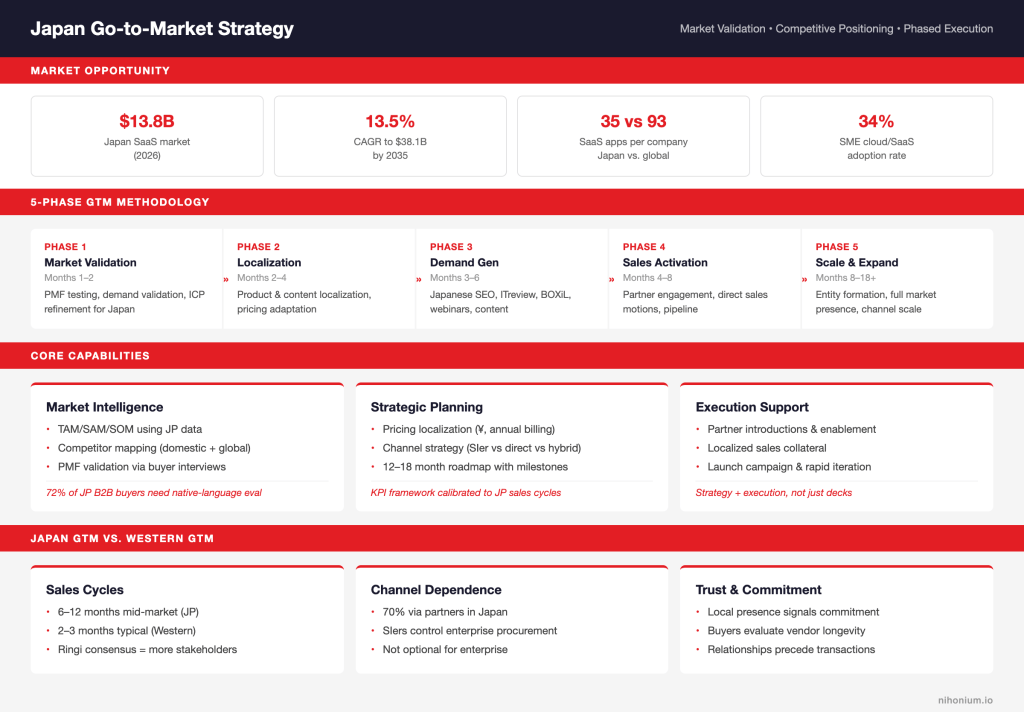
A Japan go-to-market (GTM) strategy is the set of decisions a SaaS company makes before it commits money to Japan: which buyers to target first, how to position the product for them, which channels and partners reach them, how to price and localize, who sells in Japanese, and how to judge progress. This page is the short overview of what the strategy contains; our complete guide to Japan SaaS go-to-market strategy works through each step in depth.
The market is large enough to justify the work, although estimates differ by publisher: Grand View Research puts Japan’s SaaS market at USD 12.3 billion in 2025, rising to USD 31.3 billion by 2033 (about 12% a year), and Research Nester at USD 13.8 billion in 2026, growing about 13.5% a year to 2035. Adoption is uneven. Okta’s Businesses at Work 2026 counts 53 apps per company in Japan against 98 globally, and digital transformation is concentrated in large companies: about 90% of companies with more than 1,000 employees work on DX, against about 30% of those with 100 or fewer (IPA, DX Trend 2024, as reported by JETRO).
What the Strategy Decides
A complete Japan GTM strategy settles about ten questions. Each has a Japan-specific factor that a global plan tends to miss.
| Decision | What it settles | The Japan-specific factor |
|---|---|---|
| Target segment | Which companies, sizes, industries and departments to approach first | Buying groups grow with deal size, and DX work is concentrated in large companies |
| Positioning | Why a Japanese buyer should choose you over the domestic product they already know | 85% of B2B buyers had narrowed their choice before the first sales meeting (One Marketing, 2025) |
| Channels | How buyers will find you: Japanese search, review sites, events, outbound, partners | 37.7% of people involved in IT purchases found candidates on comparison or review sites (ITreview, March 2026) |
| Partners | Whether system integrators, resellers or distributors carry the product | About 72% of Japan’s ICT professionals work at IT vendors (MIC White Paper 2018) |
| Pricing and billing | Price model, currency, contract length, invoicing | Buyers expect yen pricing, and many prefer annual contracts |
| Localization scope | What is translated first: website, sales materials, product, documentation, support | Japanese buyers expect to evaluate in Japanese |
| Sales motion and team | Who sells in Japanese: a direct hire, a partner or a fractional team | Enterprise decisions are made by consensus and take longer |
| Entity timing | Whether to sell cross-border, through a partner or through a local company, and when | JETRO’s Tokyo model case: about USD 6,200 of filings; USD 264,000 to 289,000 to set up a two-person subsidiary, including JPY 30 million of capital, before salaries |
| Regulation and data | Which rules apply to the product and its data | APPI (Japan’s data protection law) and sector rules; Japanese counsel owns the legal position |
| Roadmap and KPIs | Milestones, budget, decision gates and how progress is judged | No public benchmark for time to revenue; targets are planning assumptions |
Each decision has a page of its own for depth: the target segment and buying group in step 1 of the complete guide, channels in its step 2, direct entry vs the partner model, localizing SaaS pricing for Japan, the review platforms in our overview of Japanese SaaS review sites, and timelines in Japan market entry ROI timelines.
The Order of Work
The decisions depend on each other, so the order matters more than the format of the document.
- Validate demand. Interview Japanese buyers in the target segment, map the domestic products they use today, and test whether the problem you solve is felt the same way in Japan.
- Decide. Settle the segment, positioning, channels, partner criteria and pricing on the evidence from step 1.
- Plan. Turn the decisions into a roadmap with a budget, KPIs set for longer sales cycles, and decision gates for the big commitments: hiring in Japan, setting up an entity, full product localization.
- Launch and learn. Put the Japanese materials in place, start the first sales conversations, and feed what buyers say back into the plan.
The complete guide sets out a month-by-month launch sequence for the first year.
Why a Western Playbook Needs Changing
- Decisions are made by groups. Enterprise purchases go through ringi (稟議, the formal approval process), usually after informal consensus-building known as nemawashi (根回し). How that changes the entry plan is covered in 5 ways consensus shapes SaaS market entry in Japan.
- Partners carry much enterprise buying. System integrators advise many large Japanese companies on IT, so a strategy without a partner view misses a main route to enterprise buyers.
- Localization is a product requirement. Buyers expect a Japanese interface, Japanese documentation, yen pricing and Japanese support, not a translated landing page.
- Trust comes before transactions. Buyers judge whether a foreign vendor will stay: a local presence, a credible partner, Japanese references and consistent follow-up all count.
- Timelines are longer. There is no public benchmark, so plan with assumptions you can test: 6 to 12 months to first mid-market revenue and 12 to 18 months to meaningful enterprise revenue.
Where Nihonium’s Strategy Service Fits
Nihonium’s strategy service builds a custom Japan go-to-market strategy for your product: we evaluate the market to set the product’s positioning and recommend the channels that resonate with Japanese buyers. Our other services carry the plan into the market: localization by SaaS experts, a sales and marketing funnel, a fractional sales team and local thought leadership. Legal and data protection questions sit with Japanese counsel, and company formation with a judicial scrivener or a corporate services provider.
Key Takeaways
- A Japan GTM strategy is a set of decisions: segment, positioning, channels, partners, pricing, localization, sales team, entity timing, regulation and KPIs.
- Each decision has a Japan-specific factor: group decisions, the weight of system integrators, Japanese-language evaluation and yen pricing.
- Work in order: validate demand, decide, plan with decision gates, then launch and learn.
- Treat timelines as assumptions: no public benchmark exists for time to revenue in Japan.
- Go deeper in the complete guide: it covers each step, the buying center, localization stages and a first-year launch sequence.
Sources
- Grand View Research, Japan Software as a Service Market Outlook. USD 12.3 billion in 2025, USD 31.3 billion by 2033.
- Research Nester, Japan Software as a Service (SaaS) Market. USD 13.8 billion in 2026, 13.5% CAGR (2026 to 2035).
- Okta, Businesses at Work 2026 (30 April 2026). 53 apps per company in Japan, 98 globally.
- JETRO, Digital Technology sector overview. DX engagement by company size (from IPA, DX Trend 2024).
- Ministry of Internal Affairs and Communications, Information and Communications White Paper 2018. About 72% of ICT professionals at IT vendors.
- JETRO, Setting up a business in Tokyo: model case. Filing costs and the cost of a two-person subsidiary.
- One Marketing, BtoB購買プロセス白書2025 (B2B Purchasing Process White Paper 2025), PR TIMES, 11 November 2025. Survey of 600 people involved in B2B purchases.
- ITcrowd, IT product selection white paper (survey of 300 people involved in IT purchases, March 2026).
Frequently Asked Questions
How long does it take to execute a Japan go-to-market strategy?
Building the strategy depends on how much research already exists; the longer clock is revenue. Mid-market deals need several quarters and enterprise deals often a year or more, because of consensus-driven procurement, so plan the budget around that runway and treat every timeline as an assumption to test.
Do we need a local entity to enter the Japanese market?
Not at the outset. Many SaaS companies start cross-border or through a partner and set up a kabushiki kaisha (株式会社, KK) or godo kaisha (合同会社, GK) once traction justifies the cost. Some enterprise buyers read a local entity as a sign of long-term commitment, so the strategy should set the point at which you will decide.
What is the most common reason SaaS companies fail in Japan?
Assuming that Western product-market fit carries over: arriving with an English-language product, global pricing and a small team covering the whole market, when buyers expect to evaluate in Japanese. The second is impatience, judging Japan against Western sales-cycle benchmarks and pulling back before the first enterprise deals can close.
How should we think about pricing for the Japanese market?
Price in yen and expect annual billing to be preferred over monthly. Seat-based models are easier for procurement departments to approve than usage-based pricing because the cost is predictable, and buyers expect implementation support to be part of the offer. Price against the domestic products buyers compare you with, not against your global list.