
The Core Problem: Why Western Pricing Defaults Fail in Japan
Western SaaS companies that enter Japan with USD pricing, monthly billing and card-only payment lose enterprise deals before they start. Japanese enterprise buyers expect yen pricing, an annual contract they can fit into the budget, and payment by bank transfer against an invoice. Getting this wrong hands deals to localized competitors.
Japan’s B2B SaaS market runs on financial and procurement norms shaped by decades of enterprise buying. For enterprise buyers they work like requirements.
The 4 Non-Negotiable Pricing Adaptations
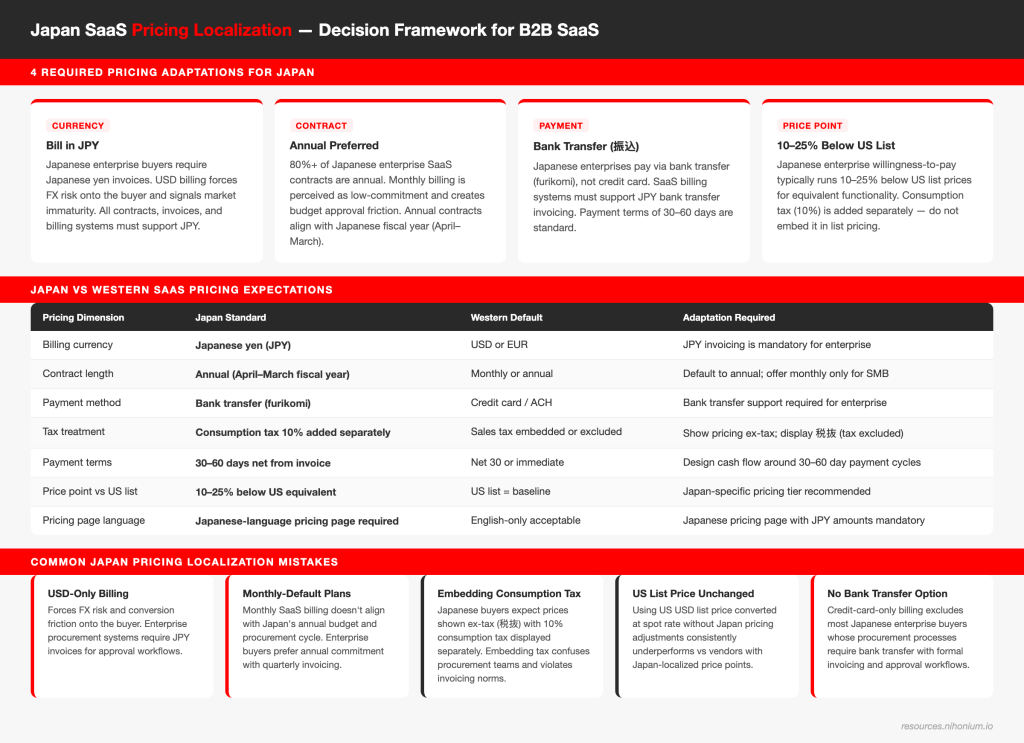
Japan requires four core pricing changes: bill in JPY, default to annual contracts, support bank transfer (furikomi) payment, and set a Japan-specific list price, quoted before consumption tax (10% standard rate) for business buyers.
1. Bill in Japanese Yen (JPY)
USD billing pushes exchange-rate risk and conversion work onto the buyer. Budgets, approvals and accounting run in yen, so many enterprise buyers will simply ask for a yen price. Every quote, contract, invoice and billing system integration should support JPY.
2. Default to Annual Contracts
Annual contracts are the norm for enterprise SaaS in Japan. Monthly billing fits poorly with budgets approved once a year. The national government and most large companies run an April 1 to March 31 fiscal year, so align annual terms, renewal workflows and negotiation calendars with it, and check each prospect’s year-end, since not every company closes in March. Our comparison of annual vs monthly billing in Japan covers when monthly plans still make sense.
3. Support Bank Transfer (振込 / Furikomi)
Japanese enterprises typically pay suppliers by bank transfer against an invoice (seikyūsho, 請求書), not by card. Card-only billing shuts out many enterprise buyers, whose procurement runs on formal invoices and approvals. Payment terms of 30 to 60 days are common, often month-end close with payment at the end of the following month (月末締め翌月末払い); build them into your cash flow projections.
4. Set a Japan-Specific List Price
We know of no published benchmark for how far Japanese prices sit from US list prices, so set a Japan list price from local competitors’ published prices and your own deal data rather than from a rule of thumb. Quote business buyers the price before consumption tax, marked 税抜 (tax excluded), and show the tax on the invoice. The total-price display rule, which requires tax-inclusive prices, applies to prices shown to consumers; the Ministry of Finance confirms that ordinary business-to-business price displays are outside it.
Japan vs. Western Pricing Expectations
Seven pricing dimensions differ between Japan and Western defaults: currency (JPY vs. USD), contract length (annual vs. monthly), payment method (furikomi vs. card), tax display (ex-tax for business buyers), payment terms (30 to 60 days), price point (set from local benchmarks) and pricing page language (Japanese).
| Pricing Dimension | Japan Standard | Western Default | Adaptation Required |
|---|---|---|---|
| Billing currency | Japanese yen (JPY) | USD or EUR | JPY quotes and invoices for enterprise |
| Contract length | Annual (April to March fiscal year at most large companies) | Monthly or annual | Default to annual; monthly mainly for SMB and trials |
| Payment method | Bank transfer (furikomi) against an invoice | Credit card / ACH | Bank transfer support required for enterprise |
| Tax treatment | Consumption tax (10% standard rate) shown separately to business buyers; tax-inclusive prices to consumers | Sales tax embedded or excluded | Show B2B pricing ex-tax, marked 税抜 |
| Payment terms | Commonly 30 to 60 days from invoice | Net 30 or immediate | Plan cash flow around 30 to 60 day cycles |
| Price point vs. US list | No published benchmark; set against local competitors | US list = baseline | Japan-specific pricing tier recommended |
| Pricing page language | Japanese-language pricing page expected | English-only acceptable | Japanese pricing page with JPY amounts |
How to Set Your Japan Price Point
Start from local benchmarks rather than your US list, fix a yen price at a conservative exchange rate, display it ex-tax for business buyers with consumption tax shown separately, and publish it on a dedicated Japanese pricing page.
A practical Japan pricing approach follows this sequence:
- Establish a Japan-specific pricing tier, do not simply convert US prices at the spot rate. Set a dedicated Japan list price that reflects local market benchmarks.
- Benchmark against local alternatives for each tier: Japanese competitors’ published prices, what prospects pay for the tools you replace, and the discounts your deals close at.
- Convert at a conservative rate, use a rate that builds in a buffer against exchange-rate moves to protect margin through the contract term.
- Display prices as 税抜 (tax excluded) for business buyers, with an explicit note that consumption tax (10%) is added; show tax-inclusive prices wherever you sell to consumers.
- Create a Japanese-language pricing page, enterprise buyers need to confirm pricing in their own language during internal approval.
SIer Channel Implications for Pricing
If you sell through SIers (system integrators), your Japan list price must leave room for the SIer’s reseller margin. The end-customer price is set against your Japan list, not your gross margin floor.
Reseller margins in Japan vary with the partner, the tier, the deal size and how much implementation the SIer does, and we know of no published benchmark, so agree them partner by partner. Account for this margin layer so the end-customer price stays competitive. A Japan list price built only around Western channel margins can leave SIer partnerships economically unworkable. Our guide to SIer partner management covers how those partnerships run.
Key Takeaways
- Japanese enterprise buyers expect yen quotes and invoices; USD-only billing blocks many enterprise deals.
- Annual contracts are the enterprise norm, ideally aligned to the customer’s fiscal year, which for most large companies runs April to March.
- Bank transfer (furikomi) against an invoice is the standard enterprise payment method; card-only billing shuts out many Japanese enterprise buyers.
- Set a Japan-specific list price from local benchmarks, quoted ex-tax (税抜) to business buyers with the 10% consumption tax shown separately.
- SIer distribution needs room for a reseller margin, agreed partner by partner; build it into the Japan list price.
Working with Nihonium. We are a Japan go-to-market partner for B2B SaaS companies: localization by SaaS experts. Talk to us about your Japan entry.
Citations
- National Tax Agency, consumption tax rates (No. 6303): 10% standard rate (7.8% national, 2.2% local), 8% reduced rate.
- National Tax Agency, Qualified Invoice System, in effect from 1 October 2023; for foreign businesses, consumption tax on cross-border electronic services (reverse charge).
- Ministry of Finance, Q&A on total-price display: business-to-business price displays are outside the obligation.
- Stripe, bank transfers documentation: JPY bank transfers are available to Stripe accounts based in Japan; cross-border payments are not supported.
Frequently Asked Questions
Should I use a dynamic FX-linked JPY price or a fixed JPY list price?
Use a fixed JPY list price. A price that moves with the exchange rate creates uncertainty during the buyer’s internal approval and can cause problems if the yen moves between quote and invoice. Review your Japan list price once a year, or sooner if the rate moves beyond a band you set in advance.
Can I use Stripe or another Western payment processor for Japan billing?
For card payments in yen, yes, and that suits SMB customers. Bank transfer is the catch: Stripe offers JPY bank transfers with Invoicing only to Stripe accounts based in Japan, and does not support them cross-border. Enterprise buyers also expect a formal JPY invoice and, if you are a registered issuer, a qualified invoice with your registration number, paid to a domestic bank account. For enterprise billing you will usually need a Japanese entity or a local billing partner.
What is the Japan consumption tax rate and how should I display it?
The standard rate is 10% (7.8% national and 2.2% local consumption tax), with a reduced 8% rate that does not apply to SaaS. For business buyers, show the base price marked 税抜 and add a line saying consumption tax (10%) will be added; prices shown to consumers must include the tax. Under the Qualified Invoice System (インボイス制度), in effect since 1 October 2023, a registered issuer’s invoices carry its registration number (適格請求書発行事業者登録番号, T followed by 13 digits) and the tax by rate; a foreign vendor selling cross-border to businesses may fall under the reverse charge instead, so settle which regime applies with a tax adviser.
How does Japan’s fiscal year affect SaaS contract timing?
The national government and most large companies run an April 1 to March 31 fiscal year. Budget requests for the next year are prepared in the second half of the fiscal year and IT budgets are usually settled between January and March, so get into the budget before that window closes and aim for contracts that start on April 1. Confirm each customer’s own year-end.