
SIer partner management is the work of finding, signing, enabling and co-selling with Japan’s systems integrators, the IT services firms most Japanese enterprises rely on to choose, implement and run their software. For a foreign SaaS company, a well-run SIer relationship is often the fastest route into enterprise accounts, and a neglected one is a common reason pipeline stalls. This guide covers how the SIer market is structured, how a partnership moves from first introduction to joint selling, and what it costs in margin, time and enablement.
What Is a SIer?
A SIer (pronounced “esu-ai-yaa”, エスアイヤー) is a Japanese systems integrator: an IT services company that designs, builds, implements and operates enterprise technology for its clients.
The role is broader than the Western one. In the US or Europe, an integrator is usually hired for a project. In Japan, the SIer is often the permanent, outsourced IT department. According to the government’s 2018 White Paper on Information and Communications, about 72% of Japan’s ICT professionals work at IT vendors, while in the United States about 65% work inside user companies. A department that needs new software typically asks its SIer before it evaluates any vendor, and the SIer then handles procurement, customization, integration with legacy systems and day-to-day operations.
The market is correspondingly large. IDC Japan put domestic IT services at about JPY 7.0 trillion in 2024 and forecasts more than JPY 9.6 trillion by 2029. NTT DATA alone reports about 197,800 employees worldwide as of March 2025.
Why SIers Dominate Japan Enterprise Software Distribution
Japanese enterprise procurement values established relationships, low risk and local accountability over price or feature novelty. SIers supply all three at once, and a foreign vendor selling direct usually cannot:
- Relationship capital: SIers hold multi-decade relationships with their accounts and have “uchi” (insider) status there. Cold outreach from an unknown foreign vendor rarely gains traction. An introduction from the account’s SIer gets a hearing.
- Japanese-language technical support: Enterprise buyers expect support in Japanese, on site when needed. Most foreign SaaS companies cannot staff that in their first years. A SIer can.
- Implementation accountability: The SIer takes contractual responsibility for implementation and performance. For a risk-averse buyer, that local accountability often matters more than the product comparison.
- Procurement access: SIers are already approved vendors in their clients’ purchasing systems. Buying through an existing agreement is far simpler than onboarding a new foreign supplier.
Zoom is the usual example of what this does to a sales model. Roughly 90% of its US sales were direct, while about 70% of its Japan sales came through partners, according to Firstlight Capital’s analysis of the SIer market.
The timing is also better than it was a decade ago. METI’s 2018 DX Report warned that aging legacy systems could cost the economy up to JPY 12 trillion a year from 2025 onward (the “2025 cliff”), and the large SIers have been adding cloud and SaaS resale to their custom-development businesses in response.
SIer Tier Structure
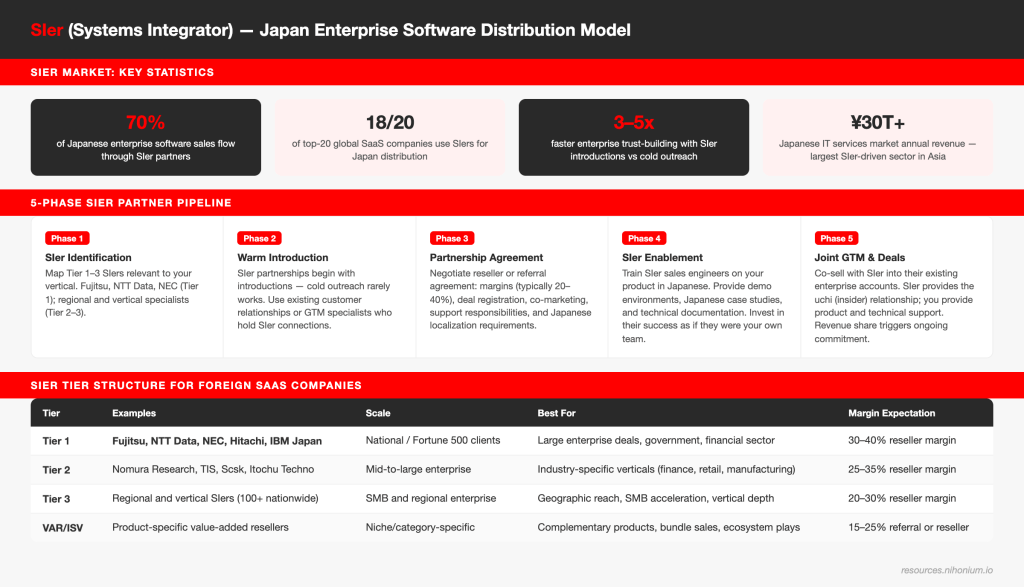
The SIer market is usually described in three tiers, plus product-specific resellers. Foreign SaaS companies typically start with Tier 2 or Tier 3 partners and earn Tier 1 introductions later.
| Tier | Examples | Scale | Best For | Indicative Reseller Margin |
|---|---|---|---|---|
| Tier 1 | Fujitsu, NTT DATA, NEC, Hitachi, IBM Japan | National; Japan’s largest corporations and government | Large enterprise, government, financial sector | 30–40% |
| Tier 2 | Nomura Research Institute (NRI), TIS, SCSK, Itochu Techno-Solutions (CTC), BIPROGY | Mid-to-large enterprise | Industry verticals: finance, retail, manufacturing | 25–35% |
| Tier 3 | Regional and vertical SIers | SMB and regional enterprise | Geographic reach, SMB scale, vertical depth | 20–30% |
| VAR/ISV | Product-specific value-added resellers | Niche or category-specific | Complementary products, bundle plays | 15–25% |
The margins above are indicative ranges, not published benchmarks. Actual terms are negotiated partner by partner and depend on how much selling, implementation and support the SIer takes on.
For most new entrants, Tier 1 SIers are aspirational. They want product maturity, Japanese localization and Japanese reference customers before they invest time in enablement. Tier 2 and Tier 3 SIers are more accessible, move faster and can build real pipeline in a specific vertical or region. Early wins with them are the proof a Tier 1 partner will ask for.
The 5-Phase SIer Partner Pipeline
A SIer partnership moves through five phases: identification, warm introduction, partnership agreement, enablement and joint go-to-market. The usual bottleneck is the introduction.
Phase 1: SIer Identification
Map the SIer landscape against your target verticals and segments. A SIer strong in financial services will have little reach into manufacturing, and the reverse. Find the Tier 2 and Tier 3 SIers that already serve your target customers and carry complementary products. With the largest firms, go one level deeper: they are organized into many business units by industry and technology, so “partnering with NTT DATA” means nothing until you have named the division whose customers need your product.
Phase 2: Warm Introduction
Cold outreach to SIers rarely turns into meetings, and generic corporate contact forms rarely reach a decision-maker. Partnership conversations start with an introduction: from an existing Japan customer, from a Japan go-to-market specialist with SIer relationships, or from a shared technology partner.
Phase 3: Partnership Agreement
Agreements cover the reseller margin, deal registration and protection, co-marketing commitments, the split of support responsibility and localization requirements. Tier 1 SIers will ask for product documentation, compliance certifications and escalation contacts in Japan before signing. Tier 2 and Tier 3 SIers are more flexible but still expect a JPY price schedule and Japanese-language training materials. The agreement also fixes the partnership model:
- Referral: the SIer passes leads for a fee. Lowest commitment on both sides, least revenue for the SIer.
- Resell: the SIer buys the subscription and resells it, handling billing and first-line support.
- Solution: the SIer wraps your product in implementation, integration and managed services. This is usually the most attractive model for the SIer and produces the deepest engagement.
- OEM or white-label: the SIer embeds your product in its own branded offering. Volume can be high, but your brand disappears from the end customer’s view.
Phase 4: SIer Enablement
Enablement is the phase foreign SaaS companies most often underfund. SIer sales engineers need training in Japanese, a Japanese demo environment, localized technical documentation and Japan-specific use cases. A SIer that cannot confidently demo your product to an enterprise buyer will leave it out of the proposal. Treat the SIer’s sales engineers as an extension of your own team and budget accordingly.
Phase 5: Joint GTM and Deal Co-Selling
An active partnership is a co-sell relationship. The SIer brings the insider relationship and procurement access. You bring product expertise, technical support and deal economics. SIers that see deals close will put your product into more proposals, so early wins matter more than a broad launch. Before any of this, the SIer runs its own nemawashi (informal consensus-building) to approve the partnership, allocate people and train them, which is why the timelines below are long.
SIer vs. Direct Sales: When to Use Each
| Scenario | SIer Channel | Direct Sales |
|---|---|---|
| Enterprise accounts (1,000+ employees) | Strongly preferred | Slower; requires deep relationship investment |
| SMB accounts (<200 employees) | Tier 3 SIer or direct | Viable with Japanese-language inside sales |
| Government and public sector | Usually needed | Rarely viable for a foreign vendor without a local track record |
| Startup and digital-native companies | Less critical | Product-led or inbound viable |
| Japanese subsidiaries of global companies | Less critical | Headquarters relationship can be used |
Key Takeaways
- SIers act as the outsourced IT department for much of corporate Japan: about 72% of the country’s ICT professionals work at IT vendors, so enterprise software decisions run through them.
- A direct-only enterprise strategy is slow. Even Zoom took about 70% of its Japan sales through partners.
- SIer partnerships begin with warm introductions. Cold outreach rarely works.
- Enablement needs Japanese-language training, demo environments and case studies. Underfunding it is the most common reason a signed partnership produces nothing.
- Start with Tier 2 and Tier 3 SIers to build traction, then use those wins to attract Tier 1 interest.
Working with Nihonium. We are a Japan go-to-market partner for B2B SaaS companies: Japan go-to-market strategy. Talk to us about your Japan entry.
Sources
- IDC Japan, Domestic IT Services Market Forecast (press release, 13 March 2025).
- Ministry of Internal Affairs and Communications, 2018 White Paper on Information and Communications.
- Firstlight Capital, System Integrators: The Key to Success for SaaS in Japan (July 2022).
- NTT DATA Group, Corporate Profile.
- Ministry of Economy, Trade and Industry (METI), DX Report (September 2018).
Frequently Asked Questions
How long does it take to activate a SIer partnership in Japan?
As a rough planning guide, a Tier 3 partnership can go from first introduction to first joint proposal in 3–6 months, and a Tier 2 partnership in 6–12 months. Tier 1 partnerships often need 12–18 months of trust-building, localization and reference-customer development before formal activation. Expect partner-sourced revenue to become meaningful later still, often 18–24 months after first contact.
What do SIers require before agreeing to a partnership?
It varies by tier, but most SIers expect Japanese-language product documentation, a JPY price schedule, at least one Japan reference customer or pilot, a clear support escalation path and deal registration protection. Tier 1 SIers add compliance certifications, a Japanese product interface and named contacts in Japan. All of them are also judging four things: whether they can make money from resale and services, whether their existing clients are asking for this kind of product, whether it sets them apart from rival SIers, and whether you are committed to Japan for the long term.
Can I use multiple SIers simultaneously?
Yes. Most foreign SaaS companies work with several SIers covering different verticals or regions. Deal registration prevents conflict when two partners pursue the same opportunity. Tier 1 SIers may ask for exclusivity in a vertical. Weigh that carefully against your go-to-market plan before agreeing.
Can we sell direct while also working with SIers?
Yes, and most foreign SaaS companies in Japan run both channels. It needs clear rules of engagement from the start: deal registration, defined segment or territory boundaries, and protection for partners on the accounts they originate. Be open with partners about your channel strategy. Going around a partner on an account it introduced will end the relationship, and word travels.
What is the typical SIer reseller margin for foreign SaaS products?
Indicatively, 15–40% depending on tier, product category and deal complexity. Tier 1 SIers ask for the top of that range on products they must heavily enable and support. Tier 3 SIers often accept less for products with strong self-serve documentation. Build the full channel margin into your Japan pricing model before you set list prices.
How much should we invest in SIer enablement?
There is no standard figure, but the line items are predictable: Japanese-language sales training and materials, technical certification, a demo environment, joint reference architectures and solution briefs, co-marketing, and a partner manager’s time. Budget for these per primary partner, every year. Partners cannot sell what they are not equipped to represent, and under-investment here is a common reason SIer partnerships fail.