

If you sell SaaS in Japan, trust often matters more than your demo or price. In most cases, your choice is simple: build trust yourself with a direct sales team, or lean on a local partner that buyers already know.
Here’s the short version:
- Direct sales gives me more control over pricing, messaging, and buyer contact
- Partner-led sales can get me into the market in 1–3 months
- Direct entry often takes 6–10 months to set up, with first deals in 12–18 months
- Year-one direct costs can go above $300,000
- Partner-led entry often starts at under $50,000
- Direct sales tends to fit higher-ACV, more complex deals
- Partner-led sales tends to fit teams that need early access, local coverage, and buyer comfort
- Hybrid works when I want partner access first, then direct control in key accounts
What matters most is where the first layer of trust comes from.
If I go direct, I need to show clear commitment to Japan with things like:
- Japanese-language product and support
- Local contracts and security docs
- Fast answers during the buying process
- A clear post-sale support plan
If I go through partners, trust comes from:
- Their buyer relationships
- Their local sales process
- Their handling of contracts, billing, and support in Japanese
- Their role in helping buyers move deals through internal approval
Japanese SaaS buying patterns also tend to involve 5–12 stakeholders, so trust has to hold up across a group, not just with one champion. That is why this choice affects far more than sales speed.
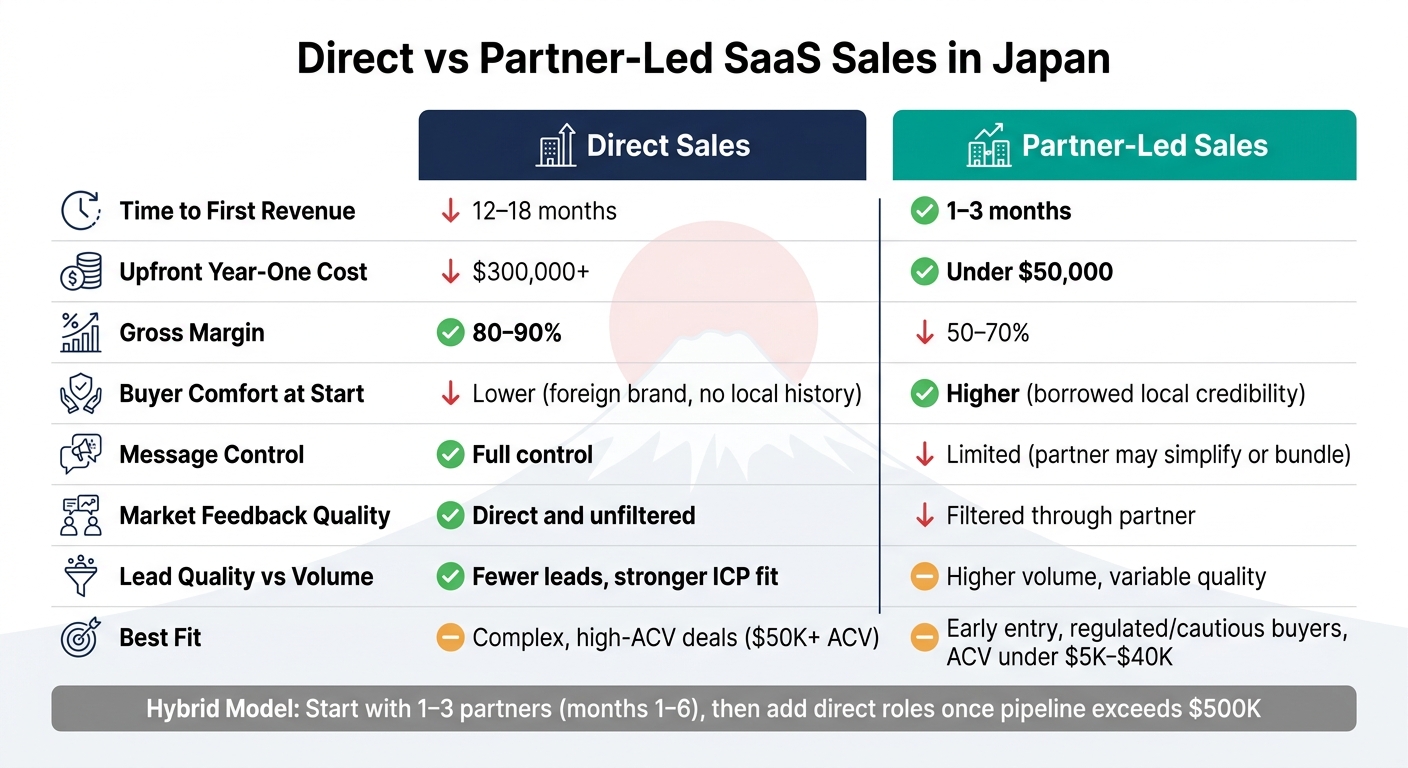
Direct vs Partner-Led SaaS Sales in Japan: Key Metrics Compared
Quick Comparison
| Criteria | Direct Sales | Partner-Led |
|---|---|---|
| First trust signal | My team and local presence | Partner reputation and local network |
| Time to first revenue | 12–18 months | 1–3 months |
| Upfront cost | $300,000+ | Under $50,000 |
| Buyer comfort at the start | Lower | Higher |
| Control over messaging | Full | Limited |
| Lead flow | Lower volume, tighter fit | Higher volume, mixed fit |
| Market feedback | First-hand | Filtered through partner |
| Margin | 80%–90% | 50%–70% |
| Best fit | Complex, high-ACV deals | Early entry, local reach, regulated or cautious buyers |
My takeaway: direct sales gives me control, while partner-led sales gives me access. If I need both, a hybrid model is often the better first move.
sbb-itb-a752276
Direct Sales: Trust Built Through Commitment and Control
How Direct Sales Builds Buyer Confidence
Direct sales can build trust in Japan because it shows commitment in ways buyers can see right away: a Japanese-language UI, Japanese contracts, Japanese security documents, and a team that can answer detailed questions without anything getting lost in translation. In this setup, trust is tied to what buyers can verify. Many buyers read localization as a sign that you’re serious about the market. Nihonium cites research showing that 72% of Japanese B2B buyers prefer to evaluate and buy software in Japanese, and 65% will not consider products without Japanese documentation and support. If your materials are only in English, the review process can slow down fast.
For enterprise buyers working through the ringi process, direct access to people who can speak to security, compliance, and workflow concerns matters a lot. There’s less risk of channel distortion, and buyers can get answers straight from the source. Direct sales also gives you control over pricing, positioning, and follow-up. That same line of contact shapes how the market understands your product.
This model tends to work best when the product is complex, deal size is high, or buyers need clear proof that you’re committed to Japan.
Tradeoffs: Slower Start, Stronger Message Control
The upside comes with a cost. Direct sales is slower to launch and more expensive at the start, but it gives you full control and a tighter learning loop. Local setup can take 6–10 months, first deals often take 12–18 months, and year-one costs often go past $300,000 once you factor in entity setup, localization, and local hiring.
What do you get for that spend and delay? You control pricing, positioning, and qualification standards. You hear objections straight from buyers, which helps you understand what the market is asking for. Volume may be lower, but the leads are often a better fit and closer to an actual buying decision.
Here’s how direct sales stacks up on the factors that matter most in Japan.
| Attribute | Direct Sales in Japan |
|---|---|
| Trust signal | High – local presence, native-language materials, direct expertise |
| Time to first deal | Slow – typically 12–18 months |
| Pricing control | Full – vendor sets and defends terms |
| Buyer relationship | Vendor-owned – supports renewals and expansion |
| Lead quality | Fewer leads, stronger intent and fit |
| Upfront investment | High – often $300,000+ in year one |
| Market feedback | Direct – unfiltered market feedback |
For teams going direct, Nihonium can help close localization gaps with product localization, marketing funnel creation, and fractional sales support.
Partner-Led Sales: Trust Borrowed From Local Credibility
If direct sales asks buyers to trust your team, partner-led sales leans on a local name they already know. In that sense, it’s the flip side of direct sales.
How Partners Raise Buyer Comfort
About 70% of SaaS sales in Japan move through partner channels, and 18 of the top 20 public SaaS companies in Japan run active partner programs. That pattern isn’t random. It shows how much trust and local familiarity shape enterprise buying in Japan.
Partners lower buyer hesitation in a few plain, practical ways. They sell and support in Japanese. They handle contracts and invoices in formats local legal, finance, and accounting teams already work with. That alone can remove a lot of friction.
For buyers dealing with the ringi approval process, this goes even further. A partner that already knows the buyer’s internal flow can line up stakeholders early and prepare documents before a formal proposal even arrives. That helps cut down on the informal vetoes that often slow deals.
The main partner types help in different ways:
- SIs tend to fit enterprise accounts
- Resellers often fit mid-market deals
- Distributors help expand reach
- Fractional local teams support in-market selling and localization
Tradeoffs: Faster Access, Less Control
The speed edge is hard to ignore. Partner-led entry often gets to first revenue in 1–3 months, compared with 12–18 months for direct sales. Upfront costs are also much lower – often under $50,000 versus $300,000+ for a full direct setup in year one.
But that speed and reach come with tradeoffs. 82.5% of Japanese resellers carry competing products. So your SaaS isn’t just competing in the market. It’s also competing for attention inside the partner’s own catalog.
If enablement is weak or incentives don’t line up, partners may push other products that are easier to sell or bring them better margins. Message drift is another risk. A partner may trim down your value proposition to fit its own sales story, and that can blur your differentiation and set the wrong expectations with buyers later.
| Aspect | Pros | Cons |
|---|---|---|
| Speed | Faster initial revenue | Depends on partner motivation |
| Reach | Access to established accounts | Coverage limited to partner network |
| Buyer comfort | Borrowed trust from existing relationships | Vendor remains unfamiliar directly |
| Control | Partner handles local contracting and invoicing | Limited visibility into positioning |
| Lead quality | Higher volume through partner networks | Quality varies by enablement and incentives |
| Market learning | Faster access to buyer feedback | Insights can be filtered or delayed |
Partner-led success depends on enablement and incentives. Japanese-language playbooks, localized demo environments, and clear qualification rules aren’t nice extras. They’re the difference between a partner relationship that produces deals and one that just creates activity without much to show for it.
Direct vs Partner: Side-by-Side Comparison for Japan SaaS
The core difference is simple: where does trust come from? With direct sales, trust has to come from your team, your local presence, and the signals you send to the market. With a partner-led route, you lean on trust that already exists.
Here’s the tradeoff in plain view:
| Attribute | Direct Sales | Partner-Led Route |
|---|---|---|
| Trust-Building Model | Built through local commitment, hiring, and direct presence | Borrowed from the partner’s existing reputation and relationships |
| Speed to First Revenue | Slow: typically 12–18 months | Fast: 1–3 months to activate |
| Buyer Comfort | Lower initially for unknown foreign brands | Higher; partners navigate ringi natively and carry local credibility |
| Message Control | Full control over positioning and narrative | Limited; partners may simplify or bundle your story |
| Lead Quality | Fewer leads, but tighter qualification and cleaner ICP fit | More leads earlier, but quality varies by partner enablement |
| Market Intelligence | Deep, first-hand feedback loops | Filtered through partner reports; insights can arrive late |
| Gross Margin | High: 80–90% | Lower: 50–70% after 20–40% channel margins |
| Typical Fit | Strategic accounts, high-ACV, complex multi-department deals | Conservative segments, regional enterprises, and government or regulated deals |
Use the matrix above to line up your go-to-market motion with your stage in Japan and the kind of sales cycle you’re dealing with.
Speed, Buyer Comfort, and Lead Quality
The speed gap shapes your first move in Japan. A partner-led route can get moving in 1–3 months, while a direct team often needs 6–10 months just to become operational.
That difference matters. If you need early pipeline, local introductions, and a way into accounts that don’t know your brand yet, partners can open doors fast.
Buyer comfort tends to follow that same pattern. Japanese enterprises often feel safer buying through a local name they already know. There’s shared accountability in that setup: if the product disappoints, the partner’s reputation is on the line too. For many buyers, that lowers the perceived risk. A foreign vendor selling direct usually can’t create that same feeling right away.
Lead quality, though, often swings back toward direct sales. Your own team decides who to target, how to position the product, and what counts as a qualified opportunity. Partner-sourced leads can come in earlier and in higher volume, but they’re not always tight fits. Sometimes they surface because of a separate services project, not because the account matches your ICP. When qualification rules are loose and enablement is thin, deals can stall, drift, or grow into scope creep.
Message Control, Positioning, and Long-Term Learning
Direct sales gives you one big advantage: you control the story. In Japan, that matters more than many teams expect. Word choice, risk framing, and how you explain business value can shape the whole buying process.
With partners, that control gets weaker. Most partners sell more than one product, so your SaaS becomes one item in a larger catalog. That can create a problem fast. A partner may shorten your pitch, fold it into their own services message, or explain it in a way that blurs what makes you different. And once that happens, bad expectations can get set before the deal even closes.
That’s why structured enablement matters so much. Useful partner programs usually include:
- Japanese-language playbooks
- Co-branded materials
- Clear qualification rules
Without that setup, a partner relationship can create more noise than progress.
Direct sales also gives you cleaner product learning. Your team hears objections, feature requests, and competitive comparisons firsthand. That kind of feedback helps shape localization choices with more precision – Japanese invoice field needs, local compliance integrations, or support SLAs tied to Japanese fiscal calendars, for example. Partner-filtered feedback is often shaped by the partner’s services goals, which can hide product UX issues and slow roadmap decisions over time.
Which Route Fits Your SaaS Profile and Japan Plan
Pick your route based on where trust needs to come from: your team, a partner, or a mix of both. Once that part is clear, the next step is simpler. You’re looking at product fit and how ready you are for Japan. The tradeoffs above help you sort out whether you need trust you build yourself, trust you borrow, or both.
Best Fit by SaaS Type and Entry Stage
SaaS with an ACV under $5,000 usually lines up with a partner-led or digital-first entry. If your ACV sits between $10,000 and $40,000, a hybrid route often makes sense. At $50,000 and up, direct or hybrid usually becomes easier to support.
Security, infrastructure, and compliance-heavy SaaS tends to need direct vendor involvement. That often shows up during discovery, proof of concept, and multi-department sign-off. Simpler productivity tools, especially ones with fast onboarding, give you more room to choose.
A partner-first route often makes sense if you don’t yet have Japanese speakers, local collateral, or coverage during Japan business hours. Move more direct when your pipeline reaches $500,000 in realistic annual pipeline, or when buyers start asking to work directly with your team.
When a Hybrid Model Makes Sense
A hybrid model fits when you need direct control and partner credibility at the same time. One common pattern is to start with one to three carefully selected partners in months one through six. That gives you live market signals, helps expose product gaps, and can bring in early reference customers. After demand is proven, you can add a direct role, like a bilingual account executive, a country manager, or fractional sales support, to lead key accounts and shorten the feedback loop.
Set rules of engagement early. Be clear about:
- which accounts are partner-led
- which accounts are direct
- how margins are split
- who owns customer success
Without that clarity, channel conflict can wear down trust on both sides.
If your team doesn’t yet have Japan-specific localization, marketing funnels, or sales support, Nihonium can step in as a fractional team for localization, Japanese funnels, and sales support while you figure out whether the market supports a full Japan setup.
FAQs
How do I choose direct, partner-led, or hybrid?
Choose your approach based on product maturity, target segment, and available resources. In Japan, about 70% of B2B SaaS sales go through partners, so a fully direct model can run into trust and access issues.
For many firms, a phased hybrid approach works best. Start with 1–3 anchor partners to test demand. Once you have product-market fit, build a direct foundation. From there, scale with direct sales for strategic accounts and partners for broader market coverage.
What trust signals matter most to Japanese buyers?
Japanese buyers tend to look for signals that lower risk and build trust. That usually means a few things matter right away:
- Introductions from respected partners or vendors
- The reputation of well-known brands
- Proven reliability and quality
Because many decisions move through ringi consensus, buyers also want proof that fits Japan. That includes localized UX and documentation, compliance and data security fit, and active engagement through Japanese reviews and responses.
When should I shift from partners to direct sales?
Treat it as a phased shift, not a binary switch. Start moving to direct sales after you’ve proven product-market fit in Japan and built reference customers through partners. For many companies, that point comes when local ARR hits $500,000 to $1,000,000.
Direct sales works well for strategic accounts and customer success. Partners can still handle regions, verticals, or SMEs. That split tends to work better than going all-in on one model too early.
Set clear partner terms from the start. If you don’t, channel conflict can show up fast and put customer relationships at risk.
Related Blog Posts
- Top 5 Japanese Marketing Channels for B2B SaaS
- Channel Partners vs. Distributors in Japan SaaS Market
- Long-Term Perspective in Japan: Lessons for SaaS
- 5 Customer Acquisition Tips for SaaS in Japan
 English
 Japanese