

The Problem: Entering Japan Without Evidence
Many SaaS companies that struggle in Japan committed to a full go-to-market investment before they had tested the market. Japan market validation combines desk research, primary buyer interviews, localized product-market fit (PMF) testing and a structured go/no-go decision, so that evidence replaces assumptions before significant capital is deployed.
Japan is a large SaaS market: Grand View Research puts it at USD 12.3 billion in 2025, growing about 12% a year to 2033. It is also structurally distinct: buying behaviour, procurement, channels and pricing expectations differ from North American and European norms, and assumptions built on US or EU experience create friction that structured validation would have surfaced early.
At Nihonium, validation is part of our Japan go-to-market strategy work: assessing the market, positioning the product and choosing the channel, so that the decision to invest in Japan rests on evidence rather than on a full country build-out made in hope.
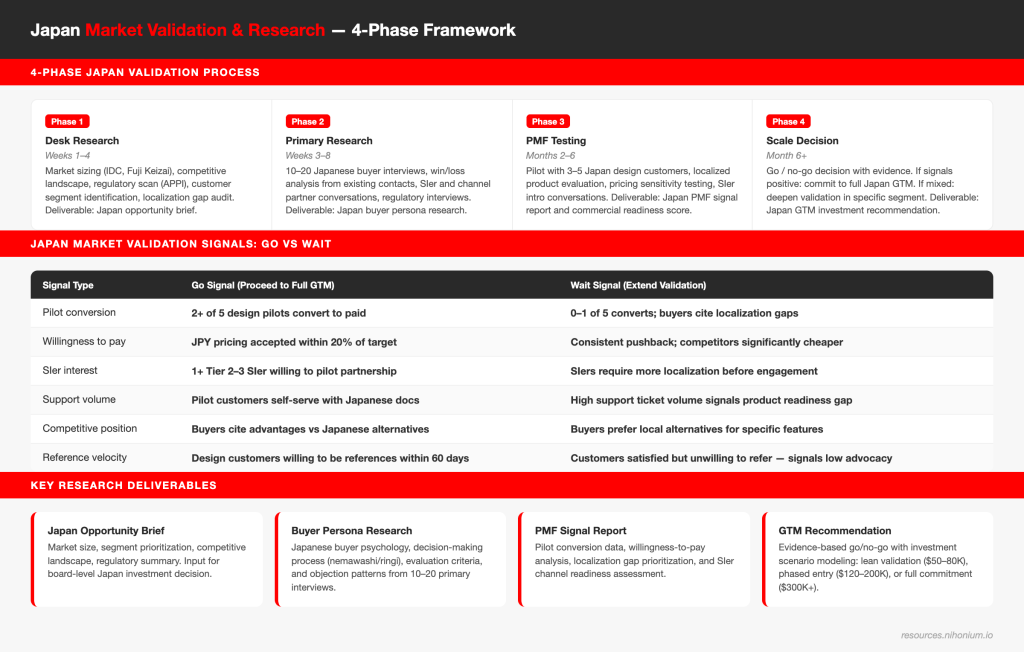
The 4-Phase Japan Validation Framework
Validation runs in four phases. Desk research and the first interviews can overlap; the pilots take longest, because Japanese buyers evaluate carefully and approval often goes through a formal internal process. Each phase produces an output that shapes the next.
Phase 1: Desk Research
Desk research lays the quantitative foundation for the Japan opportunity assessment. It covers:
- Market sizing, TAM/SAM analysis from sources such as IDC Japan, Fuji Keizai and METI, plus company counts by size and industry from the government’s Economic Census on e-Stat, to quantify the addressable opportunity in your category. IDC Japan, for example, put Japan’s IT services market at JPY 7.02 trillion in 2024.
- Competitive landscape, Mapping domestic Japanese competitors, international competitors with a Japan presence, and the incumbent solutions serving your target segment
- Regulatory scan, The Act on the Protection of Personal Information (APPI), sector rules (such as the FISC security guidelines for financial institutions and medical device rules for healthtech) and any export controls, as questions to put to qualified counsel
- Customer segment identification, Identifying the two or three most likely buyer segments in Japan from category penetration and your existing customer profiles
- Localization gap audit, Assessing current product, pricing and support gaps against what Japanese buyers expect
Output: a Japan opportunity brief, a structured market assessment ready for a board-level investment discussion.
Phase 2: Primary Research
Desk research informs but cannot replace conversations with buyers. The primary research phase runs structured interviews with Japanese buyers in your target segment, enough for the same themes to start repeating:
- Japanese buyer interviews, Understanding evaluation criteria, decision processes (nemawashi, 根回し, the informal consensus-building before a decision, and ringi, 稟議, the formal approval circular), budget cycles and relationships with incumbent vendors
- Win/loss analysis, Structured review of any existing Japan contacts or inbound leads to find recurring objections and the reasons deals were lost
- SIer and channel partner conversations, Early conversations with relevant system integrators (SIers) to gauge channel appetite and the localization they would need before a partnership
- Compliance conversations, Talking to buyers’ compliance teams to learn which APPI and sector-specific requirements come up in procurement
Output: Japanese buyer persona research documenting buyer priorities, evaluation criteria, the decision process and the main objection patterns.
Phase 3: PMF Testing
Product-market fit in Japan cannot be assumed from performance in Western markets. The PMF testing phase runs structured pilots with a small cohort of Japanese design customers to generate real conversion, pricing and localization data:
- Design customer pilots, Recruiting Japanese buyers willing to evaluate the product under commercial conditions in exchange for input into the Japan product roadmap
- Localized product evaluation, Testing the product against Japan-specific requirements: Japanese UI, Japanese documentation, support response during Japanese business hours
- Pricing sensitivity testing, Testing yen price points, contract structures and payment terms against buyer expectations
- SIer conversations, Using design customer relationships to open conversations with the SIers those customers already work with, to assess partnership early
Output: a PMF signal report covering pilot conversion, pricing acceptance, the localization gaps in priority order and the readiness of the SIer channel.
Phase 4: Scale Decision
Validation ends with an evidence-based investment recommendation. The scale decision phase brings the earlier research together into a go/no-go recommendation with three investment scenarios:
- Extended validation, If signals are mixed, run more buyer interviews or a second pilot cohort before committing further
- Phased entry, If signals are positive in one segment, commit to a focused entry into that segment with limited headcount, for example a fractional sales team before any local hire
- Full commitment, If signals are strongly positive across several segments, commit to a full Japan go-to-market with a local team, SIer partnerships and marketing investment. For scale, JETRO’s Tokyo model case puts the set-up of a two-person subsidiary at USD 264,000 to 289,000, including JPY 30 million of capital and before salaries
Output: a Japan go-to-market investment recommendation, an evidence-based go/no-go with the three scenarios costed for your company.
Japan Market Validation Signals: Go vs. Wait
Six signals show whether the evidence is strong enough to proceed to a full Japan go-to-market: pilot conversion, pricing acceptance, SIer interest, support self-service, competitive differentiation and how quickly customers agree to act as references. Set the thresholds before the pilots start; the figures below are examples, not benchmarks.
| Signal Type | Go Signal | Wait Signal |
|---|---|---|
| Pilot conversion | Pilots convert to paid at the rate you set in advance (for example, two of five) | Few or no pilots convert; buyers cite localization gaps |
| Willingness to pay | Yen pricing accepted close to your target (for example, within 20%) | Consistent pushback; competitors significantly cheaper |
| SIer interest | At least one SIer willing to pilot a partnership | SIers require more localization before engagement |
| Support volume | Pilot customers self-serve with Japanese docs | High support ticket volume signals product readiness gap |
| Competitive position | Buyers cite advantages vs. Japanese alternatives | Buyers prefer local alternatives for specific features |
| Reference velocity | Design customers willing to be references soon after go-live (for example, within 60 days) | Customers satisfied but unwilling to refer, signals low advocacy |
Who This Service Is For
Japan market validation is designed for:
- Series B to D SaaS companies considering Japan as the next geographic market after building revenue in North America or Europe
- Enterprise SaaS companies with inbound interest from Japan and no structured way to evaluate or act on it
- SaaS companies with Japan pilot customers that want to know whether early traction is a real market opportunity or an outlier
- PE- and VC-backed companies under board pressure to evaluate Asia-Pacific expansion with evidence rather than assumption
Key Takeaways
- Structured market validation before a full Japan go-to-market investment reduces the risk of expensive localization and hiring decisions built on wrong assumptions.
- Primary buyer interviews cannot be replaced: Japanese buyer priorities and decision processes (nemawashi, ringi) cannot be understood from desk research alone.
- PMF testing with a small cohort of Japanese design customers produces real conversion and pricing data, a better guide to go-to-market performance than analogies from Western markets.
- A go/no-go signal framework with thresholds set in advance gives the Japan scale decision specific, evidence-based criteria instead of judgment calls.
- Investment scenarios at the end of validation let leadership match the size of the Japan commitment to the evidence, avoiding both under-investment that fails and over-investment before the market is ready.
Working with Nihonium. We are a Japan go-to-market partner for B2B SaaS companies: Japan go-to-market strategy and localization by SaaS experts. Talk to us about your Japan entry.
Citations
- Grand View Research, “Japan Software as a Service (SaaS) Market Outlook, 2033”: USD 12.3 billion in 2025, about 12% a year to 2033.
- IDC Japan, Japan IT services market forecast (13 March 2025): JPY 7.02 trillion in 2024.
- JETRO, “How to Set Up Business in Japan: Cost Estimation” (Tokyo model case).
- Statistics Bureau of Japan, e-Stat: Economic Census for Business Activity, companies by size and industry.
Frequently Asked Questions
How much does Japan market validation cost?
It depends on scope. Desk research is the smallest part; buyer interviews add recruiting, interpreting and analysis time; design customer pilots cost the most, because they need a localized product and Japanese-language support during the pilot. We scope each engagement after a first conversation rather than publish a fixed price.
How is this different from hiring a Japan-based consultant?
Generalist Japan consultants bring local market knowledge but often not SaaS go-to-market experience: how pilots convert, how SaaS pricing and contracts land with Japanese buyers, how SIers treat a new SaaS product. Ask any firm you consider how its research questions are drawn from SaaS deals in Japan rather than a generic market-entry template.
What if the validation signals are mixed?
Mixed signals are a valid outcome. If validation shows strong signals in one segment and weak ones in another, the recommendation may be a focused segment entry rather than a full-market commitment. That avoids a binary choice between abandoning Japan and committing to it.
Can we start validation while still finishing product localization?
Yes. Desk research and buyer interviews can run in parallel with ongoing localization. The findings often set localization priorities: buyer interviews show which gaps block deals and which are nice to have, so validation becomes an input to the localization roadmap rather than a gate in front of it.