

Japan’s SaaS market is worth about USD 12 to 14 billion and is forecast to grow by 12 to 13.5% a year. Research Nester puts it at USD 13.8 billion in 2026 and USD 38.1 billion by 2035 (13.5% a year from 2026); Grand View Research puts it at USD 12.3 billion in 2025 and USD 31.3 billion by 2033 (12% a year).
Current Market Size and Growth Trajectory
The two publishers agree on the starting point and differ on the slope. Research Nester’s report sizes the market at over USD 12.2 billion in 2025 and USD 13.8 billion in 2026, then forecasts 13.5% a year to USD 38.1 billion by the end of 2035, close to three times the 2026 value. Grand View Research estimates USD 12.3 billion for 2025 and USD 14.2 billion for 2026, growing 12% a year to USD 31.3 billion in 2033. Because the two series use different scopes and end years, quote one publisher at a time, with its year, rather than mixing their figures. The wider cloud market is moving in the same direction: IDC Japan put domestic public cloud services at JPY 4.14 trillion in 2024, up 26.1% on the year, and forecasts JPY 8.82 trillion for 2029.
Several structural factors sit behind these forecasts. The government made digital transformation (DX) a national priority: the Digital Agency was set up in September 2021, with the Prime Minister at its head, and the Cabinet Office’s Society 5.0 concept frames the policy. The Ministry of Economy, Trade and Industry (METI) warned in its September 2018 DX Report of a “2025 digital cliff”: losses of up to JPY 12 trillion a year from 2025 if companies kept running ageing, hard-to-maintain legacy systems. That warning pushed modernization, and cloud and SaaS adoption with it, onto boardroom agendas across industries.
The COVID-19 pandemic added pressure. A business culture built on in-person meetings, personal seals (hanko, 判子) and paper workflows had to adopt remote collaboration tools, electronic signatures and cloud business applications at short notice. Some habits drifted back as restrictions eased, but the shift in how Japanese business leaders view cloud software has largely held.
The Underpenetration Opportunity
The most useful point about the Japanese SaaS market is not its absolute size but how much room it still has. In Okta’s Businesses at Work 2026 report, companies in Japan used 53 apps on average, against 98 globally. The gap is a rough signal of white space across many functional categories, not a forecast of how many apps Japanese companies will eventually buy.
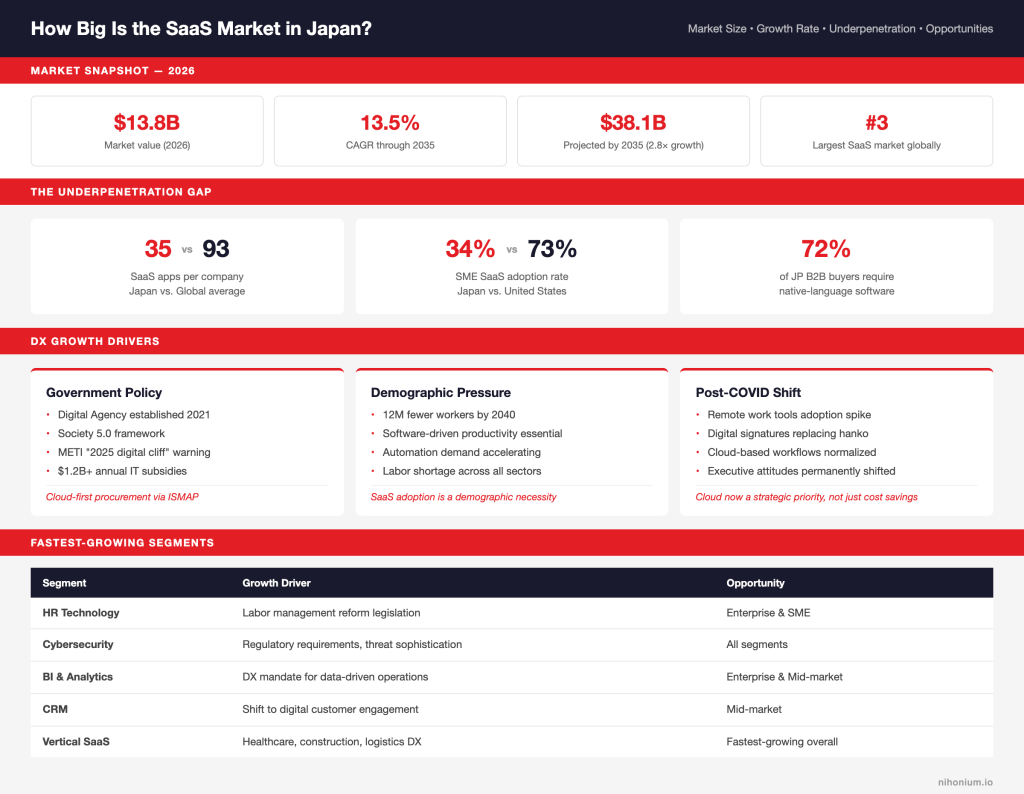
Adoption is uneven by company size. In the Ministry of Internal Affairs and Communications’ (MIC) 2025 communications usage survey, 83.5% of companies with 100 or more employees used cloud services at least in part, up from 70.4% in 2021. Smaller companies are harder to measure, and they are the bulk of the economy: the Small and Medium Enterprise Agency counted 3.365 million small and medium enterprises in 2021, 99.7% of all enterprises. That long tail is where much of the remaining headroom sits, and where subsidies matter most (see the FAQ).
Several factors have held SaaS adoption back. Language is the first: in CSA Research’s 2008 survey of business software buyers, every Japanese respondent preferred to buy in Japanese, and many global SaaS products are either not localized or poorly localized for Japan. Culture is the second: Japanese enterprises tend to be cautious technology buyers, expect complete feature sets rather than a minimum viable product, and rely on trusted channel partners and peer references before they commit.
These barriers are real but not permanent. For SaaS companies willing to invest in proper localization, channel partner development and a go-to-market approach built for Japan, they are also a moat: the companies that clear them face fewer direct competitors than in many Western markets.
DX Transformation as a Growth Accelerator
Japan’s digital transformation (DX) movement is a major driver of SaaS demand. The Digital Agency is modernizing government IT and promotes cloud-first procurement; cloud services sold to government agencies are assessed under ISMAP (the Information system Security Management and Assessment Program), operating since June 2020 and often compared to the US FedRAMP.
In the private sector, DX investment is driven by labour scarcity as much as by policy. Japan’s population is ageing fast, and the Recruit Works Institute projects a labour supply shortfall of about 11 million workers by 2040. That makes software-driven productivity a necessity rather than an option. SaaS that automates routine work, streamlines workflows and lets existing staff do more is the most direct answer.
Industry DX programmes add to this. In manufacturing, still central to the economy, smart factory projects create demand for IoT platforms, predictive maintenance and supply chain software. In financial services, regulatory modernization opens room for fintech SaaS. In healthcare, the digitization of medical records and telemedicine gathered pace during the pandemic and continues to attract investment.
Market Segmentation and Vertical Opportunities
The Japanese SaaS market is not monolithic, and its segments behave differently. Large enterprises (over 1,000 employees) already use cloud services widely, which means more competition and more demanding procurement. Small and medium enterprises are less penetrated, buy more simply and are often reached through subsidies and resellers. Mid-market companies (roughly 100 to 1,000 employees) sit in between: large enough to need serious software, small enough to adopt it without the multi-year migration projects typical of large enterprises. We found no published split of SaaS spending by company size, so treat these as tendencies to test in your own pipeline.
By function, demand is strongest where a structural pressure meets a manual process: HR technology (work-style reform and labour shortages), cybersecurity (rising regulatory and threat pressure), business intelligence and analytics (the DX push to become data-driven), customer relationship management (the shift to digital customer engagement) and collaboration tools (hybrid work).
Competitive Landscape
Competition in Japan looks different from Western markets. Global vendors such as Salesforce, Microsoft and ServiceNow sell to Japanese enterprises, while many functions are still served by on-premises systems from Japanese IT vendors. Domestic SaaS companies such as Cybozu (kintone), Sansan, freee and Money Forward have built large businesses with Japanese-native products, yet the market remains fragmented, with room for international entrants that localize well.
The lower number of apps per company suggests that many categories have not yet settled into the winner-take-most pattern of mature Western SaaS markets. For international SaaS companies, the window to establish a position is open, but it will not stay open indefinitely. As DX spreads, the vendors that have invested in localization, local sales capability and channel partnerships will be best placed to take share.
Implications for SaaS Companies Considering Japan
The data paints a consistent picture: Japan is a large, growing and still underpenetrated SaaS market, with government policy, demographics and changing attitudes to cloud all pushing in the same direction. The forecasts differ by publisher, so plan with a range rather than a single growth rate. Capturing the opportunity takes more than making the product available in Japan. It takes committed investment in localization, cultural adaptation and local sales capability, and patience with sales cycles that run longer than in Western markets. Our Japan go-to-market strategy guide covers how to sequence that investment.
Key Takeaways
- About USD 12 to 14 billion and growing: Research Nester puts Japan’s SaaS market at USD 13.8 billion in 2026 (USD 38.1 billion by 2035); Grand View Research at USD 12.3 billion in 2025 (USD 31.3 billion by 2033). Quote one publisher at a time, with the year.
- Policy-backed demand: The Digital Agency, METI’s DX agenda and the Digital and AI Introduction Subsidy for smaller companies support SaaS adoption across sectors.
- Room to grow: Companies in Japan used 53 apps on average against 98 globally (Okta, 2026), and smaller companies trail larger ones in cloud use.
- Labour scarcity is a lasting driver: With a projected shortfall of about 11 million workers by 2040 (Recruit Works Institute), software that raises productivity is a necessity.
- Localization is the entry ticket: Japanese business software buyers prefer to buy in Japanese, and channel partners and references carry weight in the decision.
Working with Nihonium. We are a Japan go-to-market partner for B2B SaaS companies: Japan go-to-market strategy. Talk to us about your Japan entry.
Sources
- Research Nester, Japan Software as a Service (SaaS) Market: over USD 12.2 billion (2025), USD 13.8 billion (2026), USD 38.1 billion (2035), 13.5% a year 2026 to 2035.
- Grand View Research, Japan Software as a Service Market Outlook: USD 12.3 billion (2025), USD 31.3 billion (2033), 12% a year 2026 to 2033.
- IDC Japan, domestic public cloud services market forecast (20 February 2025).
- Okta, Businesses at Work 2026: apps per company in Japan and globally.
- CSA Research, business software buyers prefer to buy in their own language. Also cited: METI, DX Report (September 2018); Digital Agency (launch, 1 September 2021); MIC, 2025 communications usage survey; SME Agency, enterprise counts for 2021; Recruit Works Institute, Future Predictions 2040; Digital and AI Introduction Subsidy secretariat (2026 normal track); ISMAP portal.
Frequently Asked Questions
What are the fastest-growing SaaS segments in Japan?
The clearest demand sits where labour shortages or regulation meet manual work: HR and workforce tools, cybersecurity, analytics, CRM and collaboration, plus industry software for construction, logistics, healthcare and manufacturing. AI features are spreading across all of them. Neither Research Nester nor Grand View publishes a public ranking of segment growth, so check the category you sell into before you size it.
How does Japan’s SaaS market compare to other Asian markets?
Japan is the fourth-largest economy by nominal GDP (IMF World Economic Outlook, October 2026), and its SaaS market is worth about USD 12 to 14 billion depending on the publisher. Compare countries within one publisher’s series, since scopes differ. What sets Japan apart is a mature enterprise buyer base that pays for quality, balanced by longer sales cycles and high localization expectations.
What impact do government subsidies have on SaaS adoption?
The Digital and AI Introduction Subsidy (デジタル化・AI導入補助金, formerly the IT Introduction Subsidy) covers up to half of eligible costs, two-thirds in some cases, at JPY 50,000 to 4.5 million per applicant under the 2026 normal track. Applicants are businesses registered in Japan, and they apply together with a registered IT support provider whose tools are registered with the secretariat. For SaaS vendors selling to smaller companies, being sold through such a provider can lower the buyer’s cost.
Is Japan’s SaaS growth sustainable long-term?
The structural drivers point that way. A shrinking workforce keeps automation demand high, legacy system replacement will take years, and government policy keeps funding digital transformation. Both publishers forecast double-digit annual growth into the 2030s, and Japan’s cloud adoption, while rising fast, still has room before it matches the most mature markets.