

Product-market fit validated in Western markets does not automatically transfer to Japan. Validating PMF in the Japanese market takes a structured approach: buyer interviews with Japanese prospects, a systematic feature-fit analysis against local requirements, channel partner feedback and a language accessibility test, because Japanese business buyers expect to evaluate and buy software in Japanese.
Why Western PMF Does Not Transfer
SaaS companies that have achieved strong product-market fit in the United States, Europe or other Western markets often assume the same dynamics will hold in Japan. The assumption is risky, and it lies behind many Japan entries that stall. The core value proposition of a SaaS product may be universal, but the way that value is delivered, communicated and consumed varies across markets, and Japan is one of the most distinctive.
Several factors cause Western PMF to break down in Japan. Feature expectations differ: Japanese enterprise buyers often expect more complete feature sets and more depth within each feature than Western buyers. The minimum viable product (MVP) approach that works for early validation in Western markets can look incomplete or unserious to Japanese evaluators. User experience standards differ: Japanese users have distinct expectations around information density, navigation and the level of detail in UI elements and documentation. An interface that feels clean and intuitive to Western users may feel sparse or under-explained to Japanese users.
Workflow integration requirements differ: Japanese enterprises often run legacy systems, domestic software and business processes with no direct Western equivalent. A product that integrates well with Western ecosystems (Salesforce, Slack, Microsoft 365) may lack integrations with Japanese platforms such as Cybozu’s kintone, Chatwork, Sansan or domestic ERP systems. Compliance and document requirements differ: Japan’s Act on the Protection of Personal Information (APPI), industry-specific rules and document standards such as the Qualified Invoice System (in effect since 1 October 2023) create product requirements that may not exist in the product’s home market.
These differences mean that a product with strong PMF in the United States might have no PMF, weak PMF, or PMF in a different segment in Japan. Validating Japanese PMF is not an academic exercise: it decides whether the investment a Japan entry requires is likely to pay off.
Structured Buyer Interviews
The foundation of Japan PMF validation is direct engagement with potential Japanese buyers through a structured interview program. Interviews should be run in Japanese by native speakers who understand both the product category and Japanese business culture. Running them in English, or through an interpreter, reduces the quality and candor of feedback: Japanese professionals tend to be more reserved, and less forthcoming, in a language that is not their own.
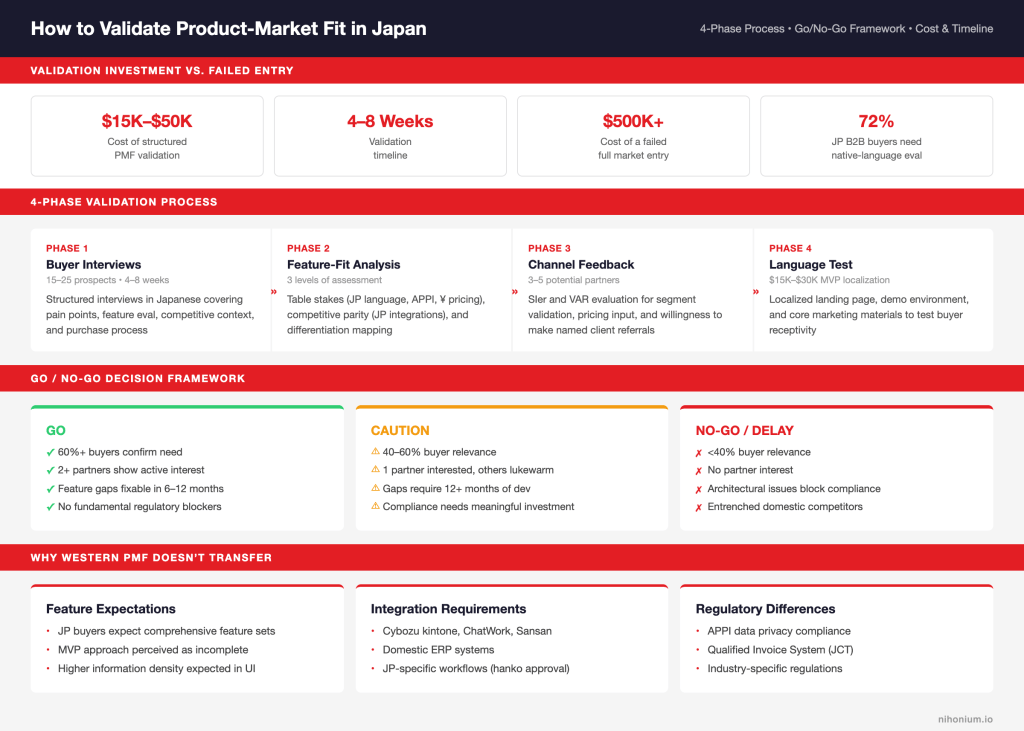
An effective interview program targets enough prospects for the same themes to start repeating across the company’s target segments, covering a range of company sizes, industries and regions within Japan. Fifteen to twenty-five interviews is a common planning range; it is a practical rule of thumb, not a statistical threshold. Each interview should explore the buyer’s current solution landscape (what tools they use today for the problems the product addresses), pain point validation (whether Japanese buyers recognize and prioritize those problems), feature evaluation (how the product’s capabilities map to the buyer’s requirements, with attention to gaps and needed adaptations), competitive context (which alternatives, including domestic Japanese products, are available and how they compare), and purchase process insights (who influences the decision, which approval process applies, what documentation is required and which criteria are used, often through ringi, 稟議, the formal approval circular in which a written proposal goes up the hierarchy for sign-off).
The interview findings should be synthesized into a Japan PMF assessment that identifies the product’s strongest segments, the feature gaps or adaptations needed to compete, and the messaging and positioning changes that would resonate with Japanese buyers. This assessment feeds localization priorities, product roadmap decisions and the go-to-market strategy for Japan.
Feature-Fit Analysis
Beyond qualitative interviews, a systematic feature-fit analysis compares the product’s current capabilities with the specific requirements of the Japanese market. The analysis works at three levels. At the table-stakes level, it identifies capabilities without which the product will not be seriously evaluated. These typically include full Japanese language support across the UI, Japanese documentation and help resources, yen pricing and billing, the security and data-handling practices APPI expects, and clear answers on where customer data is stored (APPI has no general data-localization rule, but regulated buyers in sectors such as finance and healthcare often ask for data held in Japan).
At the competitive parity level, the analysis identifies features where the product must match established competitors, global and domestic, to stay in consideration. These might include integrations with Japanese platforms, reporting formats that follow Japanese business practice, or support for Japanese-specific workflows such as the approval processes built around the hanko (判子, a personal or company seal) that some organizations still use.
At the differentiation level, the analysis identifies the capabilities that can give the product its edge in Japan. These may differ from what wins deals in Western markets. A product might win on analytics in the West, for example, and find that its edge in Japan is multi-language support or fine-grained permission controls that match a Japanese organization’s hierarchy.
The output of the feature-fit analysis is a prioritized gap assessment that feeds product planning and localization investment. Not every gap needs closing before market entry, but the table-stakes items must be addressed, and the company should have a credible roadmap for the competitive parity items.
Channel Partner Feedback
Channel partners in Japan are a valuable source of PMF evidence because they sit between the product and the market. Many Japanese enterprises rely on IT vendors: about 72% of Japan’s ICT professionals work at IT vendors rather than at user companies (MIC White Paper 2018). Experienced system integrators (SIers), value-added resellers (VARs) and consulting firms therefore talk to many enterprise buyers and know what those buyers look for, which products succeed and fail, and which needs are still unmet.
Structured evaluation conversations with three to five potential channel partners serve two purposes: they test PMF from the channel’s point of view, and they start the relationships needed for channel activation if the company proceeds. Partner feedback is especially useful for learning which customer segments are most likely to adopt the product, how it should be priced and packaged for Japan, what implementation and support resources it will need, and how it compares with the alternatives the partner recommends today.
Partners who show genuine enthusiasm about the product’s potential, rather than polite but non-committal interest, give a strong signal that PMF exists. Partners who name specific clients they would introduce give an even stronger one, because they are putting their own reputation and client relationships on the line.
The Language Accessibility Test
Language is a fundamental part of PMF validation in Japan. In CSA Research’s 2008 survey of business software buyers in eight countries, every Japanese respondent preferred to buy in Japanese, and only 5% were very comfortable buying in another language. Japan also ranks 86th of 117 countries and regions in the EF English Proficiency Index 2026. A product that cannot be evaluated in Japanese has, in practice, no product-market fit in Japan, however strong its underlying value proposition.
The most cost-effective approach is staged. Start by translating the key touchpoints, the landing page, core marketing materials and a demo environment with Japanese UI strings, rather than committing to full localization before PMF is validated. This minimum viable localization gives you enough Japanese-language material for meaningful buyer evaluations and partner conversations, at a fraction of the cost of full product localization. Get vendor quotes for both before deciding, because the cost depends on the size of the product and its documentation.
If buyer interviews and partner conversations held with these materials produce strong interest and positive feedback, the company has initial evidence of PMF and can move to full localization with more confidence. If feedback reveals fundamental product gaps or positioning problems, the company has learned this at a fraction of the cost of a full market entry.
Validation Framework and Go/No-Go Criteria
To structure validation and avoid confirmation bias (reading ambiguous signals as positive because the company wants Japan to work), set explicit go/no-go criteria before the validation starts. The thresholds below are examples to adapt, not benchmarks. A strong go signal might include a clear majority of interviewed buyers (for example, 60% or more) confirming that the product addresses a recognized and prioritized need, two or more channel partners expressing active interest in selling or recommending the product, feature gaps that can be closed within the product team’s next planning cycles, and no fundamental regulatory or compliance barriers that would require architectural changes.
A proceed-with-caution signal might include a middle band of buyers (for example, 40% to 60%) confirming relevance but with significant feature gap concerns, one channel partner interested while others are lukewarm, feature gaps that need a long development effort, and compliance requirements that are addressable but need meaningful engineering work. A no-go or delay signal might include fewer than 40% of buyers confirming relevance, no partner interest, product architecture issues that prevent meeting Japanese requirements, and a market dominated by entrenched domestic solutions deeply integrated into Japanese enterprise systems.
A structured framework of this kind means the Japan entry decision rests on evidence rather than aspiration. Validation costs far less than a full entry: for scale, JETRO’s Tokyo model case puts the set-up of a two-person subsidiary alone at USD 264,000 to 289,000, including JPY 30 million of capital and before salaries. The intelligence validation produces is valuable whether the conclusion is to proceed, to adapt, or to wait. For how validation fits into a full Japan go-to-market program, see our Japan market validation and research guide.
Key Takeaways
- Validation before investment prevents costly mistakes: A structured four-phase validation costs a fraction of a full market entry, which for a two-person Tokyo subsidiary alone runs to USD 264,000 to 289,000 in JETRO’s model case, before salaries.
- Japanese buyer feedback requires Japanese-language engagement: Japanese business software buyers prefer to buy in Japanese (CSA Research), so interviews and materials in Japanese are essential for accurate validation data.
- Channel partner interest is a strong signal: When two or more SIers or VARs are willing to make named client introductions, that is one of the strongest indicators of viable product-market fit in Japan.
- The go/no-go framework prevents emotional decisions: Thresholds set in advance (buyer confirmation, fixable gaps, no regulatory blockers) remove subjective bias from the market entry decision.
- Minimum viable localization tests demand at a fraction of the full cost: Translating the landing page, demo and core marketing reveals market receptivity before you commit to full product localization.
Working with Nihonium. We are a Japan go-to-market partner for B2B SaaS companies: Japan go-to-market strategy. Talk to us about your Japan entry.
Sources
- CSA Research, Businesses Prefer Local Language Purchasing: 2008 survey of business software buyers in eight countries, including Japan.
- JETRO, How to Set Up Business in Japan: Cost Estimation (Tokyo model case).
- Sansan, Eight passes 4.5 million users (31 July 2026).
- Also cited: MIC, Information and Communications White Paper 2018 (share of ICT professionals at IT vendors); EF English Proficiency Index 2026; Steve Blank and Bob Dorf, The Startup Owner’s Manual (2012), on customer development and product-market fit.
Frequently Asked Questions
How many buyer interviews are needed for reliable validation?
Fifteen to twenty-five interviews with Japanese prospects in your target segment, run in Japanese by native speakers, is a common planning range. It is not a statistical sample: the real test is whether the same themes keep coming back. If new interviews still produce new objections, keep going; if they repeat what you have heard, you have enough. Structure each interview around pain point validation, feature gaps and competitive context.
What if validation results are mixed, neither clearly Go nor No-Go?
Mixed results (the caution zone) are common and call for interpretation rather than abandonment. If only part of the buyers confirm relevance, check whether the rest belong to a different segment you can deprioritize; if the gaps need a long development effort, see whether a phased rollout could close the most critical ones first. Often the answer is a narrower target segment, tested in a second, focused round of validation.
Can we validate PMF remotely without traveling to Japan?
Video interviews can supplement in-person conversations but should not replace them. Japanese enterprise buyers tend to be more candid face to face, particularly about competing alternatives and price sensitivity, and remote validation tends to produce politely positive but less actionable feedback. Combining a few trips to Japan with follow-up video calls works well, and a local partner or fractional team can improve interview quality.
How do we identify the right Japanese prospects for validation interviews?
Start with industry events and trade associations where your target buyers gather, such as Japan IT Week, SaaS meetups and vertical conferences. LinkedIn and Eight, Sansan’s business card app (more than 4.5 million users in July 2026), help identify and reach prospects, and existing customers can introduce their Japanese counterparts. SIers and VARs can also make introductions during the partner feedback phase.