
Eigyō (営業) is the Japanese word for the sales function, and in B2B it names a relationship-driven way of selling: building trust, helping the buyer reach internal consensus, and supporting the formal approval that decides how deals are won and kept in Japan.
The word’s first dictionary sense is running a business for profit on a continuing basis, especially a company’s sales activity; its second is visiting customers to keep in touch, introduce and sell products, and opening new accounts (Shogakukan’s Digital Daijisen). In everyday business Japanese, eigyō means the sales function, the people who do it (eigyō-man, 営業マン, or 営業担当), and the way they work. Hōjin eigyō (法人営業) is sales to companies, the kind that matters for SaaS. For foreign SaaS companies, understanding eigyō is practical, not cultural trivia: it sets the conditions under which deals close, accounts are kept and partnerships are built.
No public benchmark compares Japanese and Western B2B deal cycles. As a planning assumption, allow two to three quarters for a mid-market deal and nine months to a year or more for an enterprise deal. One Marketing’s 2025 survey of 600 Japanese B2B buyers points the same way: 54% of high-price purchases took six months or more from consideration to contract, and the average number of people involved rose from 5.6 in the lowest price band (under JPY 3 million) to 18.3 in the highest. Much of that time goes into the relationship-building and consensus work that eigyō is built around.
How Eigyō Works in Practice
Eigyō in Japanese B2B sales follows a relationship-first model that differs from the pipeline-velocity approach common in Western SaaS.
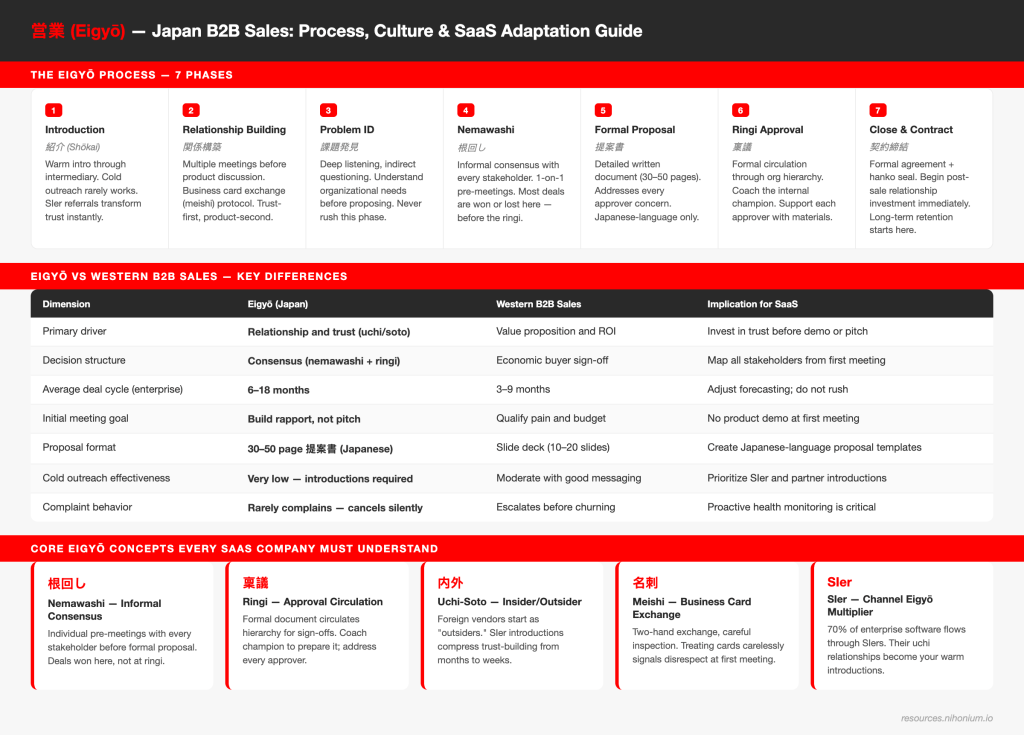
A Japanese eigyō process usually moves through five phases: an introduction (ideally through a trusted intermediary), relationship-building meetings, problem identification, a written proposal, and support for the buyer’s formal approval through the ringi (稟議) process.
Each phase has its own expectations. The first meeting establishes trust and mutual respect; it is not a pitch. Product discussion often starts only after rapport exists. Problem identification is collaborative, and a good eigyō professional listens far more than they talk before proposing anything. Proposals (teian-sho, 提案書) are detailed written documents that try to answer every concern the stakeholders are likely to raise. In the ringi phase, the eigyō professional works almost as a consultant to the internal champion, providing materials and answers for each approver.
| Eigyō Phase | Japanese Practice | Western Sales Equivalent | What Sets the Pace |
|---|---|---|---|
| Introduction | Warm introduction through an intermediary (紹介, shōkai) | Cold outreach or SDR qualification | Whether a trusted introducer exists |
| Relationship building | Face-to-face meetings, business card exchange, getting to know the company | Discovery call | Meeting availability and the buyer’s comfort with a new vendor |
| Problem identification | Deep listening, needs clarified through indirect questions | MEDDIC qualification | How openly the buyer shares problems with an outsider |
| Informal consensus (nemawashi) | One-on-one stakeholder meetings to build consensus | Champion coaching | The number of stakeholders and departments involved |
| Formal proposal | Detailed written proposal (提案書, teian-sho) | Proposal / pitch deck | How quickly Japanese-language materials can be produced |
| Ringi approval | Formal approval document circulated through the hierarchy | Legal / finance sign-off | The amount, the company’s approval rules and the budget calendar |
| Closing and contracting | Formal agreement, hanko (company seal) or electronic contract | DocuSign / e-signature | Legal review of a Japanese-language contract |
Core Eigyō Concepts for B2B SaaS
A few cultural and procedural concepts shape how eigyō professionals work in the Japanese enterprise technology market. Knowing them lets foreign SaaS companies match their sales motion to Japanese buyers’ expectations.
Nemawashi (根回し), informal consensus-building. Before a formal decision, the relevant stakeholders are consulted individually and their concerns addressed in informal one-on-one conversations. The word combines 根 (ne, root) and 回し (mawashi, going around) and comes from horticulture: before a large tree is moved, the gardener digs around it and prepares its roots. Nemawashi is the invisible work that decides whether a formal proposal succeeds. A proposal that reaches the ringi stage without it is likely to stall or come back. The champion leads nemawashi inside the company; the vendor’s job is to supply the champion with the materials and answers each stakeholder needs. Our nemawashi glossary entry explains the practice in more depth.
Ringi (稟議), formal approval circulation. The ringisho (稟議書) is a written proposal that circulates through the approval hierarchy for sign-off. It is not a substitute for nemawashi but the formal step that follows it; by the time it circulates, the decision is largely “confirmed (rather than made)”, as an EU-Japan Centre report puts it. A good ringisho answers every expected question, gives supporting data and is written in the formal Japanese senior approvers expect. The eigyō professional helps the champion prepare it and answers questions as it moves through the chain. See our guide to ringi decision-making.
Uchi-soto (内外), insider-outsider distinction. Japanese business culture distinguishes uchi (insiders, inside the trusted network) from soto (outsiders, not yet trusted). A foreign SaaS vendor starts as soto and earns trust through consistent, reliable engagement over time. An introduction from a trusted intermediary speeds this up: when an SIer or an existing customer introduces you, some of its credibility transfers to you.
Meishi (名刺) exchange, business card protocol. The business card exchange at a first meeting carries real weight. Cards are offered and received with both hands, read carefully, and kept on the table during the meeting. Treating a card carelessly signals disrespect, a poor start to a relationship that depends on trust.
Eigyō in the SaaS Context: Adaptation Requirements
Global SaaS companies entering Japan need to adapt their standard sales process to eigyō norms. Four adaptations matter most.
Plan for longer deal cycles. Japanese B2B deals involve more people and more formal approval than a typical Western SaaS deal, and the One Marketing survey shows most high-price purchases taking six months or more. Japan pipeline forecasts, headcount plans and board reporting should use the planning assumption above, not your home-market cycle. Importing Western quarter-end pressure into a Japanese deal creates friction that can cost you the deal.
Invest in the relationship before the product. Eigyō rewards vendors who show patience, respect and a real interest in the buyer’s business before proposing a solution. Rushing to a product demonstration before trust exists is a common mistake foreign SaaS companies make in Japan.
Enable the internal champion. Japanese enterprise deals are won through the support the vendor gives the champion who carries the ringi. Thorough Japanese-language proposal materials, ROI analyses, security documentation and competitive comparisons give the champion what each approver will ask for.
Build SIer relationships as eigyō multipliers. Systems integrators (SIers) such as NTT Data, Fujitsu and NEC already hold insider relationships with enterprise IT buyers. That reflects how Japanese IT is organized: about 72% of Japan’s ICT professionals work at IT vendors rather than at user companies (MIC White Paper 2018). Partnering with SIers gives a foreign vendor warm access to networks that would take years to build alone.
Key Takeaways
- Eigyō is relationship-driven, not transaction-driven: Japanese B2B sales puts long-term trust ahead of deal velocity. For planning, allow two to three quarters for mid-market deals and nine months to a year or more for enterprise deals; no public benchmark gives a precise figure.
- Nemawashi decides deal outcomes before the ringi is submitted: Informal one-on-one consensus-building precedes the formal approval and largely decides it. A proposal that skips it is likely to stall.
- Intermediary introductions (shōkai) speed up trust: Foreign SaaS vendors start as outsiders (soto). An introduction through a trusted SIer, partner or existing customer shortens the trust-building phase.
- Champion enablement is the eigyō professional’s most important skill: Deals are won or lost on how well the champion is equipped, with Japanese-language proposal materials and answers tailored to each stakeholder.
- You need native eigyō capability from the first meeting: A Japanese-speaking seller who knows these norms, hired or through a fractional sales team, is a precondition for selling to Japanese companies, not a later upgrade.
Working with Nihonium. We are a Japan go-to-market partner for B2B SaaS companies: Japan go-to-market strategy. Talk to us about your Japan entry.
Sources and Further Reading
- Shogakukan, Digital Daijisen, 営業 (eigyō), via Kotobank.
- One Marketing, BtoB購買プロセス白書2025 (survey of 600 executives and purchasing staff, released 11 November 2025).
- EU-Japan Centre for Industrial Cooperation, From Understanding to Navigating Japanese Business Culture (Martin Glisby, January 2018).
- Ministry of Internal Affairs and Communications, Information and Communications White Paper 2018: share of ICT professionals at IT vendors.
- Ministry of Internal Affairs and Communications, Information and Communications White Paper 2021: telework in 2020 (Persol surveys).
Frequently Asked Questions
How long does a typical eigyō process take for a foreign SaaS company in Japan?
There is no published benchmark. As a planning assumption, allow two to three quarters from first introduction to signed contract for a mid-market company, and nine months to a year or more for an enterprise account. These timelines reflect relationship-building and ringi approval, not inefficiency, so build your first Japan forecasts on them rather than on your home-market cycle.
Can SaaS companies use a product-led growth (PLG) motion instead of eigyō in Japan?
PLG can win early users at smaller Japanese companies and in developer-led teams, but enterprise purchases still need human contact, a formal proposal and ringi approval, however well the self-service product performs. Most SaaS companies in Japan end up with a hybrid: self-service trials for smaller accounts, with eigyō for larger accounts and expansion. Our PLG vs sales-led comparison covers the trade-offs.
Is it possible to conduct eigyō remotely, or does it require face-to-face meetings?
Remote work spread quickly in 2020: Persol surveys cited in the MIC White Paper 2021 show telework among full-time employees rising from 13.2% in March to 27.9% in April 2020, and video meetings are now normal for routine follow-up. Face-to-face meetings are still preferred for first introductions and for key proposal and negotiation milestones, so plan regular visits to Japan during active enterprise deals.
How do I adapt my sales playbook for eigyō without rebuilding it entirely?
Add a relationship phase at the front of your existing process and lengthen the timelines throughout. Start with introductions and trust-building before discovery, allow more time between milestones, create a Japanese-language proposal template with the depth and formality Japanese approvers expect, and build a champion kit in Japanese with the documents each stakeholder will ask for.