

In Japan’s B2B market, sales-led growth (SLG) remains the dominant go-to-market motion, while product-led growth (PLG) is gaining ground among startups and smaller, tech-forward companies. The difference comes down to fit with how Japanese companies decide: consensus-driven buying, built on ringi (稟議, the formal approval process in which a written proposal circulates for sign-off) and nemawashi (根回し, informal consensus-building beforehand), favors a relationship-driven sales motion over self-service adoption. Neither approach works well in isolation, though. For most SaaS companies entering Japan, a hybrid model works best: PLG mechanics for awareness and trials, with a dedicated sales overlay for conversion and expansion.
Research Nester sizes Japan’s SaaS market at USD 13.8 billion in 2026 and expects it to grow about 13.5% a year to 2035. Adoption is uneven by company size: in IPA’s DX Trend 2024 survey, 87.6% of companies with more than 1,000 employees were pursuing digital transformation under a company-wide strategy, against 31.0% of companies with 100 or fewer. For a foreign SaaS company, the choice between PLG and SLG is not binary. It depends on how Japanese organizations evaluate, approve and adopt software, which differs from Western markets in ways that matter.
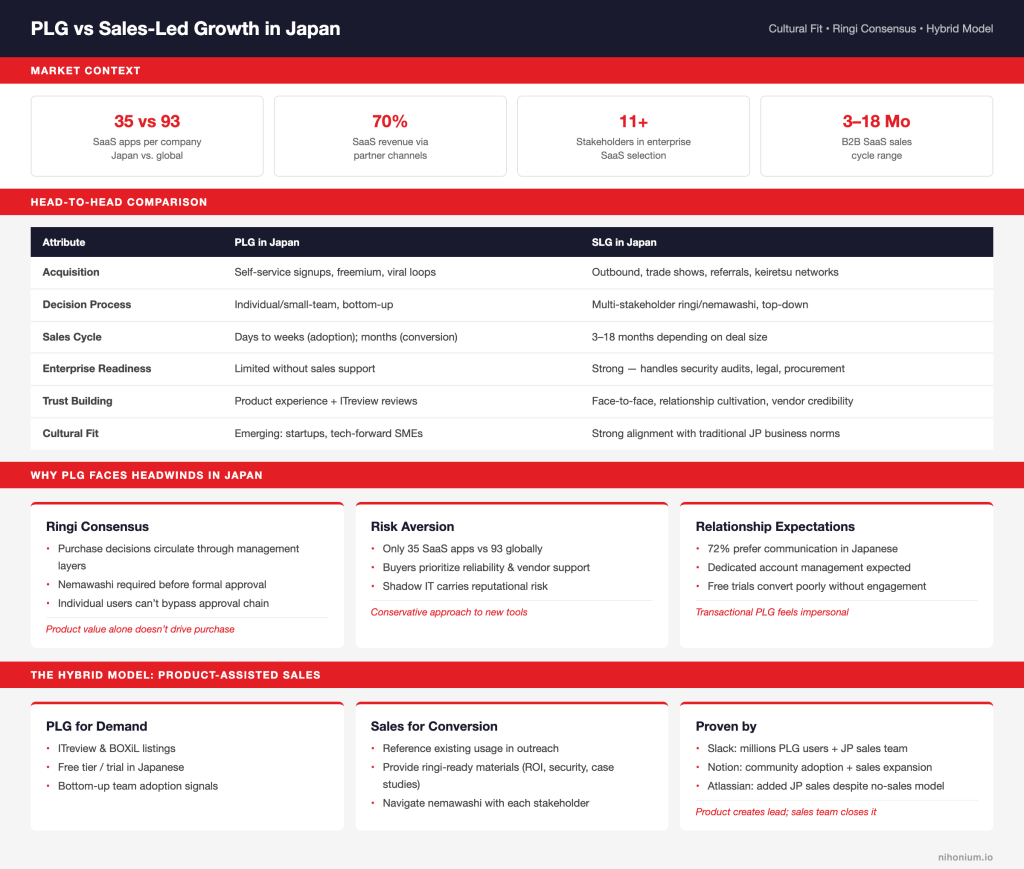
Comparison Overview
| Attribute | PLG in Japan | SLG in Japan |
|---|---|---|
| Acquisition Model | Self-service signups, freemium tiers, viral loops within teams | Outbound sales, trade shows, referrals through business networks and group companies (keiretsu, 系列) |
| Decision Process | Individual or small-team adoption, bottom-up expansion | Multi-stakeholder consensus via nemawashi and ringi, with formal sign-off up the hierarchy |
| Sales Cycle Length | Days to weeks for initial adoption; longer for paid conversion | As a planning assumption, two to three quarters for mid-market deals and nine months to a year or more for enterprise deals |
| Customer Onboarding | In-product guidance, self-serve documentation, community resources | High-touch onboarding, a dedicated CSM, on-site training sessions |
| Pricing Transparency | Public pricing pages, clear tier structure, monthly billing | Custom quotes, annual contracts, pricing shared only after consultation |
| Self-Service Capability | High: users can evaluate, purchase and deploy on their own | Low: buyers expect guided demos, proposals and contract negotiation |
| Enterprise Readiness | Limited without sales support; security and compliance questions need a human answer | Strong: sales teams handle procurement, security reviews and legal review directly |
| Trust Building | Product experience builds trust; reviews on ITreview and BOXIL supplement it | Face-to-face meetings, long-term relationships, vendor credibility |
| Cultural Fit | Emerging fit among younger companies, startups and tech-forward SMEs | Strong alignment with traditional Japanese business norms and hierarchy |
| Typical Conversion Path | Free trial → individual use → team adoption → paid upgrade | Introduction → demo → proposal → ringi approval → contract → deployment |
Core Distinction: Self-Service vs Relationship-Driven
Japan’s consensus-based decision-making gives sales-led growth a structural advantage that goes beyond preference: it reflects how Japanese organizations actually function.
In the ringi system, a purchase proposal, the ringisho (稟議書), circulates to every manager the decision affects, from the originator through supervisors and department heads and often across related departments. Before it starts to circulate, nemawashi has to take place: one-on-one conversations that build consensus in advance. So even a mid-level manager who discovers and likes a SaaS product through self-service cannot simply buy it. They have to build internal support, answer objections from stakeholders they may not work with directly, and shepherd a formal proposal through the approval chain.
This challenges the PLG assumption that product value alone drives the purchase. A middle manager who wants a new tool faces hurdles a self-service product cannot clear on its own: budget approval from finance, a security review by IT, endorsement from their own superior, and making sure peer departments do not object. The bigger the purchase, the more people are involved: in One Marketing’s 2025 survey of 600 Japanese B2B buyers (all purchases, not only software), the average number of people involved rose from 5.6 for purchases under JPY 3 million to 18.3 in the highest price band, and 54% of high-price purchases took six months or more from consideration to contract.
Sales-led approaches fit this process. A dedicated sales representative can provide the proposal documents, ROI calculations, security documentation and reference cases that each stakeholder in the ringi chain needs before approving. The vendor does not run the buyer’s internal nemawashi, but it can support it: by meeting departments when the champion arranges it, answering concerns early and supplying the formal materials Japanese business culture expects.
Why PLG Faces Headwinds in Japan
Product-led growth meets four cultural and structural barriers in Japan, though none is insurmountable, especially as younger companies and digital-native workers change buying behavior.
Risk aversion and the preference for proven solutions. Japanese organizations tend to put reliability and long-term vendor support ahead of novelty and speed. Okta’s Businesses at Work 2026 report counts 53 apps per company in Japan against 98 globally, a sign of a more conservative approach to adding software. Buyers want assurance that a vendor will provide Japanese-language support, keep a local presence and stay in the market. A self-service signup page cannot communicate that commitment.
Group decision-making over individual initiative. PLG thrives when individual users can adopt tools and spread them organically. In Japan, the norm of group decision-making means even enthusiastic users hesitate to introduce unapproved tools. Shadow IT carries reputational risk in a culture that values harmony (wa, 和) and consensus, and employees are less likely to champion a tool they found on their own if it has not been formally vetted.
Vendor relationship expectations. Japanese B2B buyers expect a relationship with their software providers: regular check-ins, responsive Japanese-language support and a willingness to adapt the product. The transactional nature of pure PLG, where the product is the main interface, can feel impersonal and insufficient.
Limited self-service adoption history. A large part of the Japanese market still runs on long-established on-premise systems, and many buyers are making their first SaaS purchases in a category. First-time buyers in any market need more guidance, and in Japan the installed base is heavy: in the JUAS survey that METI’s 2018 DX Report drew on, 39.9% of companies spent more than 90% of their IT budget on running existing business systems (fiscal 2016 survey).
That said, PLG is not dead in Japan. Startups, tech-forward SMEs and developer communities are increasingly open to self-service products. IT review sites such as ITreview and BOXIL create a discovery channel that suits PLG: in a March 2026 survey of 300 people involved in IT purchases, run by ITreview’s operator, 37.7% of those who answered had found candidate products on comparison or review sites. METI’s “2025 digital cliff” warning (losses of up to JPY 12 trillion a year from 2025 if legacy systems were not replaced, in its 2018 DX Report) and chronic labor shortages are pushing even traditional companies toward faster software adoption.
When to Choose Each
| Scenario | Recommended Approach | Rationale |
|---|---|---|
| Targeting SMEs (under 300 employees) | PLG with sales assist | Smaller companies have shorter approval chains; freemium models reduce adoption friction, but a local contact speeds up conversion |
| Enterprise deals (1,000+ employees) | SLG (primary) | Longer ringi chains, many stakeholders, security reviews and custom contract terms call for a dedicated sales team |
| Developer tools and APIs | PLG (primary) | Developers tend to adopt tools much as their global peers do; good documentation and community-driven adoption matter most, though Japanese documentation still helps |
| Horizontal SaaS (CRM, HR, accounting) | SLG with PLG elements | These categories need deep localization for Japanese workflows (for example nenmatsu chōsei, 年末調整, the employer’s year-end tax adjustment); buyers compare extensively on review sites before contacting sales |
| Vertical SaaS (industry-specific) | SLG | Niche industries rely on trusted vendor relationships and domain expertise that a sales team can demonstrate |
| Freemium model launch | PLG for acquisition, SLG for monetization | Free tiers generate awareness and usage data; a sales team converts high-potential accounts using product usage signals |
| Collaboration and productivity tools | PLG with viral mechanics | Tools like Slack and Notion spread through team invites; organic expansion within organizations is possible, though paid conversion often needs sales engagement |
| Security and compliance software | SLG | High-trust category where buyers want vendor credibility, detailed technical documentation and face-to-face assurance before procurement |
The Hybrid Model: Product-Assisted Sales
The most effective go-to-market for Japan is usually neither pure PLG nor pure SLG but a hybrid, where product-led mechanics generate demand and sales teams convert it. McKinsey’s 2023 survey of 625 SaaS buyers found that 65% strongly prefer both sales- and product-led experiences, and the case is stronger in Japan, where buying norms make a sales overlay close to necessary.
In practice, product-assisted sales in Japan works like this. The product generates awareness and trials through listings on Japanese IT review sites such as ITreview and BOXIL, backed by a localized free tier or trial. Users sign up, see the core value and start using the product in their teams. This bottom-up adoption creates signals (active workspaces, feature usage, team growth) that a sales team watches and acts on.
When usage signals point to a high-potential account, the Japanese sales team (or a local partner) gets in touch. This is not a cold call: the representative refers to the prospect’s existing usage, understands the context and offers to help with the internal approval process. They provide the ringi-ready materials the internal champion needs to build consensus through nemawashi: ROI documentation, security and compliance sheets, Japanese-language case studies and competitive comparisons.
Global PLG companies have followed this pattern in Japan. Slack launched its Japanese version in November 2017, called Japan its second-largest market in 2019 and built a local team that included sales and customer success. Notion opened a Japanese beta in October 2021, set up a Japanese entity in 2022 and launched officially in Japanese in November 2022. Atlassian, long known for selling with a light sales touch, has had a Japanese company since 2013, which handles Japanese pre-sales questions and support, and sells through local partners.
The hybrid approach also matches how Japanese buyers research software. Discovery is increasingly self-directed: ITreview’s survey also found that 79.7% of those asked always or usually check user reviews when choosing an IT tool. But conversion, especially for larger deals, almost always involves people. The product creates the lead; the sales team closes it.
For SaaS companies entering Japan, this means budgeting for both: a localized product experience that can generate organic signups, and a Japan-based or Japan-literate sales function that can guide those signups through consensus-driven buying.
Key Takeaways
- Japan’s ringi and nemawashi consensus process makes pure PLG insufficient for most B2B SaaS categories: even enthusiastic individual users cannot bypass the multi-stakeholder approval chain Japanese organizations use for software purchases.
- A hybrid product-assisted sales model suits most Japan market entries: use PLG mechanics (free tiers, IT review site listings, localized onboarding) to generate demand, and a sales team to convert accounts through the formal buying process.
- Japan’s SaaS market, USD 13.8 billion in 2026 by Research Nester’s estimate, still has room to grow, but capturing it takes deep localization, Japanese-language support and patience with longer sales cycles: as a planning assumption, two to three quarters for mid-market and nine months to a year or more for enterprise.
- Developer tools and collaboration software are the strongest PLG candidates in Japan: they can achieve bottom-up adoption among tech-forward users, though enterprise conversion still benefits from sales engagement.
- Invest in Japanese IT review sites as a PLG channel from day one: buyers find candidate products there and check reviews before they shortlist, which makes a review presence one of the most cost-effective ways to generate self-service demand in Japan.
Working with Nihonium. We are a Japan go-to-market partner for B2B SaaS companies: Japan go-to-market strategy and fractional sales team (Japanese-speaking sales, first email to closing to account management). Talk to us about your Japan entry.
Sources
- Research Nester, Japan Software as a Service (SaaS) Market Size and Growth Outlook 2035: over USD 12.2 billion in 2025, USD 13.8 billion in 2026, 13.5% CAGR from 2026 to 2035.
- Nihonium, 10 Data Trends Shaping Japan’s SaaS Market in 2025: further reading on the market (not the source of the figures in this post).
- Nihonium, Nemawashi in B2B Sales: What SaaS Teams Need: further reading on consensus-building and its effect on SaaS sales cycles in Japan.
- Stripe, B2B SaaS in Japan: Market Traits and Keys to Success (updated February 2026): a payments vendor’s overview of Japanese B2B SaaS buying, including team evaluation and senior approval before contract.
- McKinsey & Company, From Product-Led Growth to Product-Led Sales: Beyond the PLG Hype (August 2023): survey of 625 SaaS buyers; 65% strongly prefer both sales- and product-led experiences.
- IPA, DX Trend 2024 (June 2024; 1,013 companies): DX under a company-wide strategy by company size.
- One Marketing, BtoB Purchasing Process White Paper 2025 (600 buyers, September to October 2025): people involved and time to contract by price band.
- JUAS, Corporate IT Trend Survey 2018: share of companies spending more than 90% of IT budget on running existing business, 39.9% in the fiscal 2016 survey. METI, DX Report (September 2018): the “2025 digital cliff” (METI blocks automated access; cited without a link).
- Okta, Businesses at Work 2026: 53 apps per company in Japan, 98 globally.
- ITcrowd, IT product selection white paper (300 people involved in IT purchases, March 2026). Recruit Works Institute, Future Predictions 2040: labor supply shortfall of about 11 million by 2040.
- Company pages: Slack, 10 million daily active users (January 2019; Japan as second market) and growth in Asia (October 2019; local sales and customer success); Notion, Japanese release (November 2022); Atlassian, ten years in Japan (June 2023).
Frequently Asked Questions
Can product-led growth work in Japan without any sales team?
Pure PLG without a sales overlay is very difficult in Japan for most B2B SaaS categories. Individual users may sign up and trial your product, but converting them to paid accounts, especially in organizations of more than a few dozen people, almost always needs human engagement: Japanese buyers expect a vendor relationship, Japanese-language support and formal proposal documents for their internal approval. The exceptions are developer tools and low-cost individual productivity apps, where purchases can sometimes bypass formal ringi. For everything else, plan on a sales function, whether in-house, through a local partner or via a Japan-based reseller.
How long does a typical B2B SaaS sales cycle take in Japan?
No reliable public statistic exists, so plan with assumptions you can test against your own pipeline: two to three quarters from first meaningful contact to a signed contract for mid-market deals, and nine months to a year or more for enterprise deals. Deal size matters: in One Marketing’s 2025 survey of Japanese B2B buyers, more people were involved in larger purchases and 54% of high-price purchases took six months or more. The length comes from consensus-building: stakeholders are consulted through nemawashi before the ringisho circulates for formal approval. Once a decision is made, implementation tends to be quick, because buy-in has already been secured across the organization.
Which Japanese SaaS review sites should PLG companies prioritize?
The two most important are ITreview and BOXIL. ITreview, launched in partnership with G2, is built around user reviews that Japanese B2B buyers consult during research, and it offers a free vendor listing. BOXIL combines product listings with paid lead generation (document requests charged per lead), which suits a PLG-to-sales conversion model once you can follow up in Japanese. Other useful channels include PR TIMES for press releases, LISKUL (a web marketing media site run by Media Engine) and STARTUP DB (for Startups’ database of Japanese startups) for visibility with investors and corporate partners. Our guide to Japanese SaaS review sites compares them.
Is Japan’s preference for sales-led growth changing?
Yes, gradually. Several forces are moving Japanese buying toward more self-service. The Digital Agency, set up in September 2021, and the attention METI’s “2025 digital cliff” warning drew to legacy systems are pushing organizations to adopt software faster. Labor shortages add pressure: Recruit Works Institute projects a labor supply shortfall of about 11 million workers by 2040, so companies cannot afford long evaluations for every tool. Younger professionals, particularly in tech and startups, are more comfortable with self-service software, and remote work since 2020 has made online evaluation more normal. The shift is evolutionary, not revolutionary: ringi and nemawashi remain embedded in Japanese organizations, so plan your go-to-market around the current reality while positioning for a more PLG-friendly future.