
Japan’s SaaS market, which Research Nester sizes at USD 13.8 billion in 2026, growing about 13.5% a year to 2035, demands a purpose-built Japan SaaS go-to-market strategy. Five core decisions shape Japan GTM outcomes: PLG vs SLG, inbound vs outbound, CLG vs SLG, direct vs partner, and phased vs full launch. Each interacts with Japan’s consensus-driven buying culture, ringi approval cycles (ringi 稟議, the formal approval circulation), nemawashi consensus-building (nemawashi 根回し, informal alignment before a proposal) and a lower app count per company (53 against 98 globally in Okta’s Businesses at Work 2026 report), in ways that break Western defaults.
Adoption is uneven by company size: in IPA’s DX Trend 2024 survey, 87.6% of companies with more than 1,000 employees pursued digital transformation under a company-wide strategy, against 31.0% of companies with 100 or fewer. That’s an opportunity, and a warning. The companies that win Japan don’t transplant their global playbook. They build a motion set where each decision reinforces the next.
This guide covers each decision in the Japan context: PLG vs SLG (and why hybrid wins for most entrants), inbound vs outbound (and why inbound alone structurally underdelivers), CLG as a distinct trust-building motion, direct vs partner models (with the risks of over-indexing on either), and phased vs full launch sequencing. It closes with a synthesizing decision matrix, mapping ACV, product complexity, and target segment to the recommended motion combination. For the step-by-step plan that follows these decisions, see our complete guide to Japan SaaS go-to-market strategy.
Why Japan Requires a Different SaaS Go-to-Market Strategy
Japan’s B2B buying culture is structurally different from Western markets in three ways that directly constrain GTM motion choices. The ringi approval system requires multi-layered sign-off before any purchase, extending sales cycles and eliminating bottom-up viral adoption at scale. Japanese companies run 53 apps per company against 98 globally (Okta, Businesses at Work 2026), a sign that software is adopted cautiously, through trust and relationships. And indirect channels carry unusual weight: about 72% of Japan’s ICT professionals work at IT vendors rather than user companies (MIC White Paper 2018), and Zoom, for example, made about 70% of its Japan sales through partners against about 90% direct in the US (Zoom’s figure, not a market statistic). Many of those relationships run through keiretsu networks (keiretsu 系列, corporate groups), so direct-only entry bypasses much of the commercial infrastructure.
If your product already works globally with inbound, you may assume Japan will follow. It won’t. Here’s why.
Ringi and Nemawashi: How Japan’s Approval Culture Extends Every Sales Cycle
Nemawashi, the informal pre-consensus building that happens before any formal proposal, is not a courtesy step. It’s the real decision-making process. By the time a ringi document (稟議書) is circulated for formal approval, every relevant stakeholder has already been consulted, and the outcome is largely predetermined. The ringi circulation itself is the documentation and ratification phase, not the deliberation phase.
In practice, this means your champion inside a Japanese enterprise must do weeks or months of informal lobbying before they can even submit a purchase request. That request then circulates to every manager the decision affects, such as the section chief (kachō 課長), the department general manager (buchō 部長) and executive officers, with each stamp (hanko 判子) representing a gatekeeping moment. The bigger the purchase, the more people are involved: in One Marketing’s 2025 survey of 600 Japanese B2B buyers (all purchases, not only software), the average rose from 5.6 people for purchases under JPY 3 million to 18.3 in the highest price band, and 54% of high-price purchases took six months or more. No public benchmark measures SaaS sales cycles, so as a planning assumption allow two to three quarters for mid-market deals and nine months to a year or more for enterprise deals.
The implication for GTM: self-serve adoption rarely reaches contract stage without human intervention. A user might love your product during a free trial. But converting that enthusiasm into a ringi-approved contract requires someone, your sales team, a partner, or an internal champion with political capital, to shepherd the process. Pure PLG ignores this entirely.
The App Adoption Gap: What 53 vs 98 Apps Signals for GTM
The 53-app-per-company average in Japan versus 98 globally (Okta, 2026) is not a penetration gap waiting to be filled by aggressive growth marketing. It’s a signal about how Japanese companies evaluate and adopt software: cautiously, through consensus, and with deep vendor relationship dependency.
Each new SaaS tool added to a Japanese enterprise’s stack represents a ringi-approved decision with organizational accountability attached to the recommender. There’s reputational risk in championing a tool that fails. This makes Japanese buyers risk-averse in tool selection and relationship-anchored in vendor trust, they prefer vendors introduced through known networks over unknown products discovered through ads or content.
For PLG, this means viral loops compress dramatically. In Western markets, one user adopting a tool can lead to organic spread across teams. In Japan, one user adopting a tool often leads to one user with a tool that may never pass ringi. The viral spread that drives PLG economics in the US rarely replicates at the same rate in Japan’s consensus-dependent organizations.
Keiretsu Networks and the Embedded Channel Reality
Keiretsu, Japan’s interconnected corporate group networks, are not cultural nostalgia. They’re active commercial infrastructure. Major Japanese enterprises maintain long-standing vendor and supplier relationships that function as trust networks. A recommendation from within the keiretsu carries weight that no amount of content marketing or cold outreach can replicate.
Because so much of Japan’s IT capability sits with vendors and integrators, foreign vendors who ignore partners face predictable consequences: longer sales cycles, lower trust, and higher customer acquisition costs. The SIer (Systems Integrator) ecosystem is a major commercial gateway for enterprise software: Fujitsu, Hitachi, NEC and NTT Data lead IDC Japan’s 2024 IT services ranking, and firms such as TIS and their downstream partners extend the network. Your product’s quality matters. But who introduces it matters more.
Smaller companies lag larger ones in digital transformation (31.0% against 87.6% in IPA’s 2024 survey). That gap won’t be closed by inbound funnels alone. It’ll be closed by trust-mediated distribution through the channels Japanese buyers already use.
PLG vs SLG in Japan: Choosing the Right Growth Motion
Sales-led growth is the default motion in Japan’s B2B SaaS market. Pure PLG is not broken in Japan, but its viable window is narrow: as a rule of thumb, sub-$10K ACV tools targeting tech-forward SMEs and startup-ecosystem companies, where individual adoption can precede formal approval. For ACV above about $25K or any enterprise segment, SLG is in practice required. The model that usually works best for foreign entrants is a hybrid: PLG for discovery and product validation, SLG for conversion and expansion. Buyers want both: in McKinsey’s 2023 survey of 625 SaaS buyers, 65% strongly preferred both sales- and product-led experiences.
| Attribute | PLG | SLG | Hybrid (PLG + SLG) | Japan-Fit Callout |
|---|---|---|---|---|
| ACV Fit | Sub-$10K | $10K–$500K+ | $10K–$100K (sweet spot) | Ringi overhead makes sub-$5K self-serve purchases the only PLG-completable deals without human intervention |
| Sales Cycle Length | Days to weeks | As a planning assumption, two to three quarters mid-market; nine months to a year or more enterprise | Shorter discovery (PLG); approval still follows ringi | Nemawashi adds time to any deal requiring organizational buy-in |
| Decision Process Compatibility (Ringi) | Low, bypasses ringi | High, maps to ringi flow | Medium-High, PLG generates PQLs, SLG handles ringi | PLG-only fails at the ringi stage; hybrid captures value from both motions |
| Onboarding Model | Self-serve, in-product | White-glove, CSM-led | Self-serve discovery → CSM-assisted conversion | Japanese buyers expect omotenashi-level onboarding support at enterprise scale |
| Pricing Transparency | Public pricing required | Custom/quote-based | Public entry tier + custom enterprise | Japanese enterprises expect formal quotes (mitsumorisho 見積書) and negotiated pricing for larger contracts |
| Enterprise Readiness | Low | High | High (SLG layer handles enterprise needs) | Enterprise deals require Japanese-language contracts, invoice system compliance, and APPI alignment |
| Primary Trust Mechanism | Product experience | Relationship + references | Product experience → relationship validation | Trust in Japan is relationship-mediated; product quality is necessary but not sufficient |
| Japan Cultural Fit Score | Low | High | High | Hybrid aligns with Japan’s preference for “try then commit through proper channels” |
| Typical Conversion Path | Free trial → paid | Demo → proposal → ringi → contract | Free trial → PQL signal → sales engagement → ringi → contract | PQL-to-sales handoff must be localized in Japanese with ringi-stage support materials |
| Recommended Japan Segment | Tech-forward SMEs, startups, developers | Enterprise, traditional mid-market | Growth-stage mid-market, digital-native enterprises | Whatever the motion, Japan execution requires full Japanese localization |
The ACV bands are rules of thumb from practice, not published benchmarks. The sales-cycle ranges are planning assumptions, as in our PLG vs SLG comparison.
When PLG Works in Japan: The SME and Startup Window
PLG generates meaningful traction in Japan under specific conditions: sub-$10K ACV, tech-forward SMEs or startup ecosystem companies, and products where a single user can derive full value before organizational sign-off is required. Think Figma-style design tools, developer infrastructure (CI/CD, monitoring, API platforms), and lightweight productivity tools where a credit card purchase doesn’t trigger ringi.
Japan’s startup ecosystem, concentrated in central Tokyo, tends to adopt faster and with flatter approval structures than traditional enterprises. A PLG motion targeting this segment can work, provided the product UI, onboarding, and support are fully localized in Japanese. English-only PLG in Japan is not PLG, it’s a friction layer.
If you invest in PLG for Japan, concentrate it on the segments where it actually converts, not across the entire addressable market.
Why SLG Dominates Japan Enterprise: The Relationship and Ringi Imperative
Enterprise SaaS in Japan structurally requires SLG. Not because Japanese enterprises are technophobic, many are actively pursuing DX (Digital Transformation), but because the buying process demands human advocacy at every stage.
Ringi approval requires an internal champion who will put their professional reputation behind the recommendation. Nemawashi requires that champion to build consensus across departments before formal submission. Both processes rely on relationship capital, either the vendor’s direct relationship with the buyer or a trusted intermediary’s endorsement. Product trials alone don’t build this capital.
Enterprise buyers expect dedicated support, Japanese-language demos, reference customers in their industry vertical, and often a face-to-face meeting (or structured video call) before they’ll champion your product through ringi. That makes SLG expensive per deal, so plan for a long CAC payback in Japan enterprise and recover the investment through renewals and expansion, which Japanese customers tend to give vendors who have earned their trust.
The Hybrid Model: PLG for Awareness, SLG for Conversion
The hybrid model isn’t “run both at once.” It’s a sequenced playbook. Use PLG (freemium tier, free trial, self-serve onboarding) to generate product-qualified leads and build brand familiarity among Japanese users. Then trigger an SLG handoff at organizational sign-up signals, multiple users from the same domain, feature usage above a threshold, or direct upgrade inquiries.
Companies known for product-led growth have added sales and partners in Japan. Slack launched its Japanese version in November 2017 and built a local team that included sales and customer success. Atlassian, long known for selling with a light sales touch, has had a Japanese company since 2013, which handles Japanese pre-sales questions and support, and sells through local partners.
In Japan, the hybrid model requires two non-negotiable adaptations: the in-product experience must be fully Japanese-language (not “mostly translated”), and the SLG handoff protocol must include ringi-compatible sales materials, proposal templates, ROI documentation formatted for circulation, and reference case studies in Japanese. Without these, PLG generates leads that SLG can’t convert. For deeper guidance on structuring this transition, see our PLG vs SLG Japan comparison.
Inbound vs Outbound in Japan: Where Demand Actually Comes From
Japanese buyers do search: in ITreview’s March 2026 survey of people involved in IT purchases, 47.3% had found candidate products through web search and 37.7% on comparison or review sites. But foreign vendors in Japan face a structural inbound yield problem. Lower Japanese-language search demand for international SaaS categories, a review culture concentrated on local platforms (ITreview, BOXIL) rather than G2 or Capterra, and a buying process where decision-makers rely on peer referrals over content discovery, all compress inbound returns for non-Japanese brands. The highest-performing acquisition model combines localized Japanese-language content for inbound with warm-introduction-led outbound through trusted intermediaries or partner networks.
Why Inbound Underdelivers for Foreign SaaS in Japan
Foreign SaaS vendors optimizing for G2, Capterra, and Product Hunt are optimizing for platforms Japanese buyers rarely consult. Japan’s B2B SaaS evaluation process centers on ITreview and BOXIL, domestic platforms where peer reviews, category rankings, and Grid awards drive shortlisting decisions. If your company isn’t on these platforms, you’re easy to miss during evaluation: in the same ITreview survey, 87.4% had dropped or deprioritized a product with too few reviews.
Japanese-language search volume for international SaaS categories is structurally lower than English equivalents. Fewer people search for your product category in Japanese, and the searches that do exist often favor domestic competitors with stronger Japanese SEO presence. English-language content doesn’t rank in Japanese search results, and translated content often fails to match the search intent patterns Japanese buyers use.
This isn’t fixable by translation alone. It requires Japanese-native content strategy, content written for Japanese search intent, published on platforms Japanese buyers trust, and distributed through channels where the target audience actually discovers vendors (Qiita for developers, note for business audiences, X and LinkedIn for executives).
Outbound in Japan: Warm Introductions, Not Cold Sequences
Standard Western outbound (cold email sequences, LinkedIn automation, cold calling) tends to get little response in Japan. Unsolicited contact from unknown vendors cuts across unspoken norms about how business relationships are initiated. Japanese buyers don’t reject outreach. They reject unmediated outreach.
Japan-effective outbound follows a warm-introduction model: introductions through trusted intermediaries (a mutual business contact, an SIer partner, a VC connection), SIer– or partner-facilitated warm leads, and event/seminar-based relationship initiation. These are structured outbound, there’s targeting, sequencing, and conversion tracking, but with relationship mediation inserted at the first contact point.
Cold email can be improved with sharper targeting and timing, but in Japan even a well-built cold email performs better when a warm touchpoint comes first. The inbound vs outbound comparison for Japan B2B SaaS covers tactical channel selection in detail.
Signal-Based Selling: Bridging Inbound and Outbound for Japan
Signal-based selling uses hiring signals, funding events, technology adoption changes and review-site activity as triggers for personalized outreach, instead of working through a list. It’s the most viable modern outbound approach for foreign SaaS vendors in Japan.
The logic: instead of blasting a list, you monitor Japanese companies for buying signals, a new CTO hire, a Series B raise from a Japan-based VC, a DX initiative announcement, or active engagement on ITreview in your category, and initiate contact with a contextual, personalized message. This works in Japan because it demonstrates that you’ve done your homework (a nemawashi-adjacent behavior) and aren’t treating the prospect as a name on a spreadsheet.
Signal-based selling bridges the targeting precision of inbound intent data with the relationship-initiation structure Japan buyers expect. It’s not cold. It’s not inbound. It’s informed outreach, and in our experience it gets a better hearing in Japan than either extreme; measure it against your own cold and inbound numbers. Pair it with a fractional Japan sales team to execute without a full-time local hire.
Direct Entry vs Channel Partner Model in Japan
Because indirect channels carry so much weight in Japan, a pure direct-to-market entry strategy faces structural headwinds: no keiretsu trust access, no local support capacity, and no embedded referral networks. Japanese SIers and resellers provide buyer trust, implementation capacity, and commercial infrastructure that foreign vendors take years to replicate. However, a partner-only model without parallel direct capability creates critical long-term risks: margin compression, customer relationship opacity, and strategic dependency on a channel the vendor doesn’t control.
| Attribute | Direct | Partner-Led | Hybrid (Direct + Partner) | Japan-Specific Consideration |
|---|---|---|---|---|
| Time to First Customer | Longest: trust and pipeline built from zero | Often shortest, once the partner is active | In between | Partner-led can shorten time because the partner already has buyer trust and active pipelines; no public benchmark measures the gap |
| Buyer Trust & Credibility | Low (unknown gaishi-kei, 外資系, foreign-affiliated company) | High (partner endorsement) | Medium-High (partner intro + direct relationship building) | Japanese enterprises default to low trust for unknown foreign vendors; partner endorsement resets this |
| Gross Margin Structure | Highest (your full SaaS margin) | Lower: the partner keeps a share of the price | Blended | We found no published benchmark for Japanese channel margins; agree them early and model them in your Japan plan |
| Customer Relationship Intimacy | High (direct feedback loop) | Low (partner-mediated) | Medium (direct for strategic accounts, partner for long tail) | Losing direct customer feedback in Japan delays product-market fit iteration |
| Local Support Scalability | Low without Japan headcount | High (partner provides support) | Medium-High | Japanese buyers expect Japanese-language support during business hours; partner covers this initially |
| Pricing Control | Full | Limited (partner sets street price) | Moderate (direct pricing for direct deals; partner pricing governance) | Partners may discount or bundle in ways that erode perceived value; governance is essential |
| Speed to $1M ARR | Slowest to start | Can be faster with an active partner | Usually between the two | Partner acceleration is real but depends on partner enablement and sales incentives; plan in quarters, not months |
| Long-Term Strategic Risk | Low (full control) | High (dependency, opacity) | Medium (managed through governance) | Partners can shift priority to competing products; build direct capacity as insurance |
The Japan Partner Ecosystem: SIers, Resellers, and Value-Added Distributors
Japan’s partner ecosystem operates in three tiers, each with a distinct commercial role:
- Tier 1 SIers (NTT Data, Fujitsu, NEC, TIS, Hitachi Solutions): Hold long-standing relationships with Japan’s largest corporations. They don’t just resell, they implement, customize, and support, and they expect a margin that pays for that work. As a rule of thumb, they fit products above $50K ACV that require integration work.
- Mid-market resellers: Regional or vertical-specialized firms with strong relationships in specific industries (manufacturing, financial services, healthcare). A fit for products in roughly the $10K–$50K ACV range with clear vertical value propositions.
- Value-added distributors (VADs): Aggregate multiple SaaS products and provide second-tier enablement to smaller resellers. Lower margin per deal but wider reach. A fit for horizontal tools with broad applicability.
The right partner type depends on your ACV and target segment. Don’t approach a Tier 1 SIer with a $5K ACV product, the economics don’t justify their engagement. And don’t expect a VAD to run enterprise sales cycles. For detailed guidance on Japan channel partner development, including partner selection criteria and agreement structuring, see our guide.
Partner Model Risks: Dependency, Margin Compression, and Customer Opacity
Three failure modes define pure partner-led entry in Japan:
- Strategic dependency: The partner controls customer relationships and can switch to a competing product. If your main SIer partner signs with a competitor, much of your Japan pipeline can stall at once.
- Margin compression: Channel margins compress SaaS unit economics meaningfully. As an illustration, if serving a customer costs you 20% of the list price (an 80% gross margin when you sell direct) and your partner keeps 35% of that price, you keep 45 of every 100 yen the customer pays instead of 80. At scale, this changes the investment calculus.
- Customer opacity: When the partner owns the customer relationship, you lose the direct feedback loops needed to iterate on product-market fit, identify expansion opportunities, and build reference customers you can name publicly.
The answer isn’t “avoid partners.” It’s “don’t abdicate.” The question of whether to enter Japan directly or through partners is not binary, it’s about sequencing and governance.
Building a Hybrid Direct-Plus-Partner Motion
The hybrid model follows a deliberate sequence: launch with one or two anchor partners to reach your first customers (set the number you need, for example five to ten) and validate product-market fit in Japan. Simultaneously build a direct inside sales function, Japan-based or remote Japanese-speaking, to establish direct customer relationships from the start.
Set a milestone, for example within 12 to 18 months, to shift the direct/partner revenue ratio from about 20/80 toward 40/60. These are targets to set and test, not benchmarks. This isn’t about replacing partners. It’s about building strategic optionality.
Governance principles that prevent partner conflict:
- Clear deal registration rules with a defined first-touch attribution window
- Named account lists specifying which accounts are partner-led vs. direct-led
- Joint QBRs with shared pipeline visibility
- Direct customer access for product feedback (even on partner-led accounts) written into the partner agreement
See the direct vs partner model comparison for a deeper breakdown of contractual structures and margin negotiation tactics.
CLG vs SLG in Japan: Is Community-Led Growth a Viable Motion?
Community-led growth is a distinct GTM motion, separate from PLG and SLG, where developer communities, user groups, and review ecosystems drive discovery, trust, and expansion. In Japan, CLG is nascent but commercially real in two pockets: developer tooling (Qiita, GitHub, connpass event networks) and SME peer review ecosystems (BOXIL, ITreview). For enterprise-targeting foreign SaaS vendors, CLG cannot replace SLG but functions as a high-return trust-building and SEO infrastructure investment, particularly through active ITreview and BOXIL profile management, which feeds Japan’s peer-referral-driven evaluation process.
Where CLG Works in Japan: Developer Tools, OSS-Adjacent Products, and SME Verticals
CLG generates meaningful commercial traction in Japan under specific conditions:
- Developer infrastructure tools: Products with a developer audience benefit from Qiita (a Japanese knowledge-sharing site for engineers), the connpass event platform, and developer meetups. If Japanese developers are writing Qiita articles about your tool, you have organic CLG traction. Examples: CI/CD platforms, observability tools, API management products.
- OSS-adjacent products: Open-source projects with a Japanese contributor base create natural community gravity. Commercial layers built on top of these projects (the “open-core” model) can convert community trust into commercial pipeline.
- SME software categories: HR tech, accounting, project management, and back-office SaaS, categories where BOXIL and ITreview peer reviews directly influence buying decisions among small and mid-size Japanese companies. In these categories, review volume and rating on BOXIL or ITreview functions as community-driven endorsement.
For a full analysis of when CLG outperforms SLG in Japan’s market, see our CLG vs SLG Japan SaaS comparison.
ITreview and BOXIL as CLG Infrastructure: Japan’s Peer-Referral Engine
Reframe how you think about ITreview and BOXIL. They’re not “Japanese G2.” They’re Japan’s primary peer-referral infrastructure, the mechanism through which community-driven trust translates into commercial pipeline. When a Japanese company evaluates SaaS vendors, the people involved often check ITreview ratings, read peer reviews, and look at Grid positions. An absent or unmanaged profile is a trust gap that can stall ringi approval.
Tactical guidance for building CLG through these platforms:
- Seed reviews within each site’s rules: ITreview asks vendors to request reviews through their sales and customer success teams, so ask early Japanese customers within the first 60 days of deployment, when the implementation experience is fresh. BOXIL’s guidelines ban vendor-paid or vendor-solicited reviews except joint campaigns with its operator, SmartCamp.
- ITreview Grid awards: A product appears on ITreview’s Grid once it has more than three reviews, the Grid updates monthly, and the quarterly “Leader” and “High Performer” awards need 10 or more reviews. An award gives you social proof for sales collateral and ringi support documents.
- BOXIL category presence: BOXIL is a paid listing (JPY 50,000 a month on a one-year minimum, plus a per-lead fee by category) that captures buyers comparing products. A complete profile with screenshots, Japanese-language descriptions, and pricing information makes that spend count.
- Review response: Respond to every review in Japanese, positive and negative. This signals active vendor engagement, which Japanese buyers interpret as commitment to the Japan market.
For platform-specific tactics, see what Japanese review sites your SaaS should be listed on.
Phased Launch vs Full Launch: Sequencing Your Japan GTM
A phased Japan launch, starting with one segment, one city (Tokyo), or one use case before scaling nationally, usually beats full-market entry for foreign SaaS vendors. The Tokyo area holds about 30% of Japan’s population (36.975 million in the 2025 Census) and many enterprise headquarters, and concentrated entry reduces support load, localization costs, and sales cycle complexity during proof-of-concept. In Benchmarkit’s 2025 survey of B2B SaaS companies, the median company spent $2.00 in sales and marketing to add $1 of new-customer ARR in 2024, 14% more than the year before, which makes disciplined phased entry a financial imperative.
Phased Entry Playbook: Segment-First, Tokyo-First, Use-Case-First
Three viable phased entry sequences, each mapped to a revenue stage:
1. Segment-first (best for pre-$1M ARR companies): Pick the highest-fit Japanese vertical, manufacturing, fintech, HR, or the vertical where you have the strongest global case studies, and concentrate all sales, marketing, and partner activity on that single segment. Build 3–5 reference customers in the vertical before expanding. This approach aligns well with a partner-led model because Japanese partners are often vertical-specialized.
2. Tokyo-first (best for $1M–$5M ARR companies): Establish enterprise density coverage in Tokyo before extending to Osaka, Nagoya, or regional markets. Tokyo concentrates Japan’s enterprise headquarters, SIer partner offices, and tech-forward SMEs. Your first Japan-based sales hire should be Tokyo-based.
3. Use-case-first (best for complex platforms): Enter with a single, fully localized use case rather than the full product surface area. This reduces localization scope, shortens time-to-value for early customers, and gives your sales team a focused story. Expand to additional use cases after the first use case has 5–10 paying customers.
An example 0–12 month plan (targets to set, not benchmarks): months 1–3, partner agreements signed and first Japanese-language materials live; months 3–6, first pilots and ITreview/BOXIL profiles in place; months 6–9, direct pipeline building and the first paying customers (likely partner-facilitated); months 9–12, revenue run-rate validation and expansion sequence planning. As a planning assumption, allow 6 to 12 months to first mid-market revenue and 12 to 18 months to meaningful enterprise revenue. For more on how to evaluate the phased vs full launch tradeoff, see our dedicated comparison.
Full Launch Readiness: The Four Conditions That Must Be Met
Full Japan market launch, targeting multiple segments, geographies, and use cases simultaneously, is justified only when all four of these conditions are met:
- Existing brand recognition or analyst coverage in Japan: Japanese enterprise buyers or their advisors already know your product name. (Rare for most new entrants.)
- A committed national-coverage channel partner with active sales capacity: Not just a signed agreement, an activated partner with trained sales reps and pipeline targets.
- Full Japanese-language product localization: UI, support documentation, onboarding materials, in-app help, and a Japanese-language website. Not “80% translated.” Fully localized, including cultural adaptation of UX patterns.
- Dedicated Japan-based headcount: Minimum one Japan country manager or senior account executive who can represent the company in face-to-face meetings, manage partner relationships, and handle ringi-stage sales support.
If you can’t check all four boxes, phase your entry. Japan’s SaaS market (USD 13.8 billion in 2026 by Research Nester’s estimate) isn’t going anywhere. A disciplined 12-month phased launch that builds the right foundation will outperform a premature full launch that burns budget and trust.
How the Five GTM Decisions Interact: The Japan GTM System
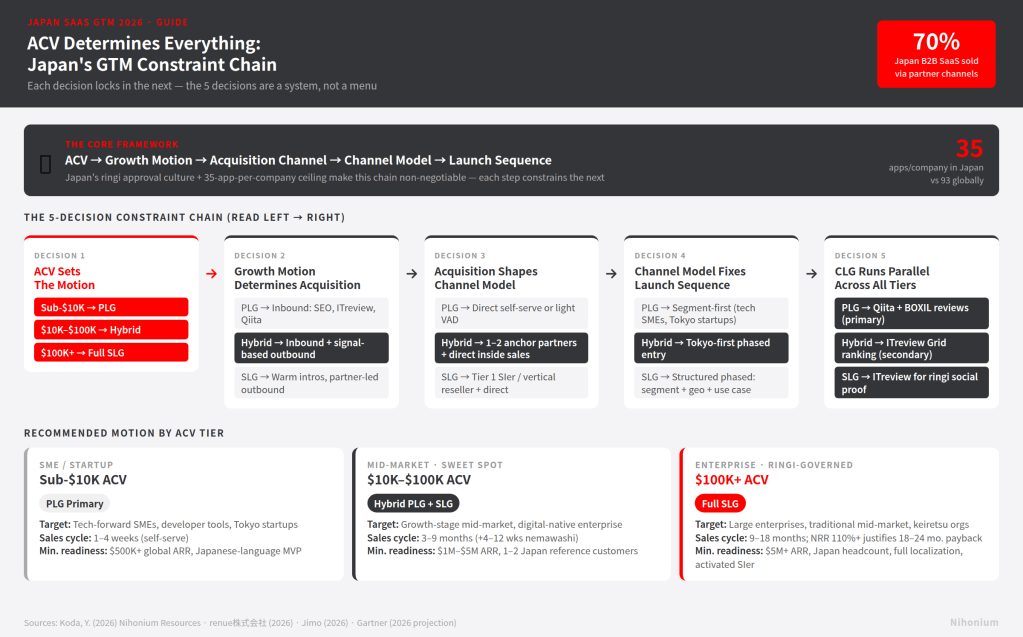
The five Japan GTM decisions are not independent dials, they form a constraint system. Choosing PLG as the primary growth motion requires inbound or self-serve acquisition, which limits partner channel relevance and pushes toward a segment-first phased entry. Choosing SLG requires outbound or warm-introduction acquisition, which demands partner involvement or direct local headcount, and necessitates a structured phased launch with dedicated onboarding resources. Understanding these dependencies prevents the most common Japan GTM failure: assembling a contradictory motion set that fails not because of any single bad decision, but because the decisions don’t cohere.
Dependency Map: How Each Decision Constrains the Next
Think of the five decisions as a linear constraint chain, not a menu of independent choices:
If PLG-primary:
- Growth motion: PLG (freemium/free trial) → Acquisition channel: inbound-compatible (SEO, review platforms, developer communities) → Channel model: direct or light-touch partner (VAD for distribution reach, not SIer for relationship selling) → Launch sequence: segment-first phased entry (target tech-forward SMEs where self-serve completes) → CLG role: primary trust-building channel (Qiita, ITreview)
If SLG-primary:
- Growth motion: SLG (demo-to-contract) → Acquisition channel: outbound/warm introductions → Channel model: partner-led or direct with local headcount → Launch sequence: structured phased launch with support readiness (Tokyo-first or segment-first) → CLG role: secondary, ITreview/BOXIL for evaluation-stage social proof
If Hybrid (most common for $10K–$100K ACV):
- Growth motion: PLG for discovery + SLG for conversion → Acquisition: mixed inbound + signal-based outbound → Channel model: selective partner involvement (1–2 anchor partners) + direct capability building → Launch sequence: Tokyo-first phased entry → CLG role: ITreview/BOXIL seeding from month one
Each “if” constrains every downstream decision. This is what makes it a system. A detailed walkthrough of Japan’s enterprise decision frameworks reinforces how these constraints play out at the deal level.
The Most Common Incoherent GTM Combinations (And Why They Fail)
Three combinations that fail again and again:
Failure pattern 1: PLG + enterprise-only target + full national launch with English-only product. The company assumes their strong US PLG numbers will transfer. They launch a free trial in Japan without localizing the product UI, targeting enterprise accounts with $50K+ ACV expectations. Result: free trial signups trickle in from English-fluent individual users, none of whom can shepherd a ringi process using English-language materials. Zero enterprise conversions in 12 months. The company concludes “Japan is too hard”, but the motion, not the market, was broken.
Failure pattern 2: SLG + inbound-only acquisition + no partner channel + 6-month revenue expectation. The company hires a Japan country manager and points them at the inbound pipeline, which barely exists because the company has no Japanese-language content, no ITreview presence, and no BOXIL profile. The country manager cold-calls into enterprises without warm introductions. Sales cycles stall because there’s no partner trust to accelerate evaluation. Six months later, the board questions the Japan investment. The country manager quits.
Failure pattern 3: Partner-only + no direct capability + full product surface area launch. The company signs a Tier 1 SIer agreement and assumes the partner will drive all sales. The partner sells 3–5 deals in year one but positions the product incorrectly, discounts aggressively, and provides no customer feedback to the vendor. The vendor can’t iterate on product-market fit. By month 18, the partner shifts focus to a competing product. The vendor has no direct customer relationships and must restart from scratch.
Each failure comes from treating the five decisions as independent. They’re not.
Japan GTM Decision Matrix: Matching Your Motion to Your Market
The optimal Japan GTM motion combination is determined by the intersection of ACV, product complexity, and target customer segment. This matrix synthesizes every section of this guide into a single reference table. Sub-$10K ACV tools targeting SMEs: PLG-primary. Mid-market products ($10K–$100K ACV): hybrid. Enterprise above $100K ACV: full SLG. CLG applies as a parallel trust-building motion across all three tiers. Track LTV to CAC and pipeline coverage for Japan against the same targets your board uses for other markets.
| Decision Dimension | SME / Startup (Sub-$10K ACV) | Mid-Market ($10K–$100K ACV) | Enterprise ($100K+ ACV) |
|---|---|---|---|
| Primary Growth Motion | PLG (freemium or free trial) | Hybrid PLG + SLG | Full SLG (demo → proposal → ringi) |
| Acquisition Channel | Inbound: Japanese SEO, ITreview/BOXIL, Qiita (dev tools) | Mixed: inbound content + signal-based outbound + warm intros | Outbound: warm introductions via partners, SIer-facilitated, event-based |
| Channel Model | Direct (self-serve) or light-touch VAD | Selective: 1–2 anchor partners + direct inside sales | Partner-led: Tier 1 SIer or vertical reseller + parallel direct capability |
| Launch Sequence | Segment-first phased (tech-forward SMEs, Tokyo startups) | Tokyo-first phased (enterprise density) | Structured phased: segment + geography + use case sequenced |
| Localization Requirement | Japanese UI + onboarding + support docs | Full Japanese product + sales collateral + website + contracts | Full localization + Japanese-language RFP responses + compliance docs (APPI) |
| Typical Sales Cycle | Days to weeks (self-serve) | Two to three quarters (planning assumption) | Nine months to a year or more (planning assumption) |
| CLG Role | Primary: developer community, BOXIL reviews | Secondary: ITreview Grid ranking, review seeding | Supporting: ITreview presence for evaluation-stage social proof |
| Stage Gate (Minimum Readiness) | $500K+ global ARR, Japanese-language MVP | $1M–$5M ARR, 1–2 Japan reference customers, partner agreement | $5M+ ARR, dedicated Japan headcount, full localization, activated partner |
The ACV bands, stage gates and ARR thresholds in this matrix are our rules of thumb, not published benchmarks; the sales cycles are planning assumptions.
Save this matrix. Share it with your GTM team. It’s the starting point, not the final answer. Your specific product, competitive positioning, and existing Japan relationships will adjust the recommendations. But the structural logic holds: ACV determines growth motion, growth motion determines acquisition channel, acquisition channel determines channel model, and channel model determines launch sequence. For a fuller strategic assessment, explore Nihonium’s Japan go-to-market strategy service.
Key Takeaways
Japan’s GTM environment rewards deliberate motion design: the five decisions, PLG vs SLG, inbound vs outbound, CLG vs SLG, direct vs partner, phased vs full, interact with Japan’s ringi-driven, relationship-anchored buying culture in predictable ways. Pure PLG fails at enterprise scale; pure inbound underdelivers without Japanese-language presence; pure partner dependency creates long-term control risk; and full-market launch without localization readiness wastes early trust-building capital.
- PLG works in Japan, within a narrow window. Sub-$10K ACV, tech-forward SMEs, developer audiences. Outside that window, SLG is structurally required because ringi demands human advocacy to reach contract stage.
- The hybrid PLG + SLG model usually fits $10K–$100K ACV entrants best. Use PLG for discovery and product-qualified lead generation; use SLG with ringi-compatible materials for conversion and expansion. In McKinsey’s 2023 survey, 65% of SaaS buyers strongly preferred both sales- and product-led experiences.
- Inbound alone is structurally insufficient for foreign SaaS vendors in Japan. Japanese buyers evaluate on ITreview and BOXIL, not G2. Without Japanese-language content and review platform presence, expect your inbound pipeline to fall well short of your global benchmarks.
- Partners carry unusual weight in Japan, but pure partner dependency is dangerous. About 72% of Japan’s ICT professionals work at IT vendors, and Zoom made about 70% of its Japan sales through partners (its own figure, not a market share). Build a hybrid direct-plus-partner motion, with a target such as a 40/60 direct/partner revenue split within 18 months. Governance and deal registration rules prevent channel conflict.
- CLG is a real motion in Japan, not a buzzword. ITreview Grid rankings, BOXIL category presence, and Qiita developer community engagement function as trust-building infrastructure that accelerates both PLG and SLG outcomes.
- Phased entry beats full launch for most new entrants. Start segment-first, Tokyo-first, or use-case-first. Full national launch requires brand recognition, an activated national partner, full localization, and Japan-based headcount, conditions most companies don’t meet at entry.
- The five GTM decisions form a constraint system, not a menu. PLG constrains acquisition to inbound; SLG requires outbound or partner channels; channel model determines launch sequencing. Incoherent combinations, not “Japan being difficult”, cause most GTM failures.
- $1 of new-customer ARR cost a median $2.00 in sales and marketing in 2024 (Benchmarkit), up 14% in a year. In Japan, disciplined phased entry isn’t optional frugality. It’s the math of SaaS economics applied to a market where enterprise deals can take a year or more.
Working with Nihonium. We are a Japan go-to-market partner for B2B SaaS companies: Japan go-to-market strategy and fractional sales team (Japanese-speaking sales, first email to closing to account management). Talk to us about your Japan entry.
Sources
- Research Nester, Japan Software as a Service (SaaS) Market Size and Growth Outlook 2035: USD 13.8 billion in 2026, about 13.5% a year to 2035.
- Okta, Businesses at Work 2026: 53 apps per company in Japan against 98 globally.
- IPA, DX Trend 2024: DX under a company-wide strategy by company size (87.6% against 31.0%).
- One Marketing, BtoB Purchasing Process White Paper 2025 (600 buyers): people involved and time to contract by price band.
- Benchmarkit, 2025 B2B SaaS Performance Metrics Benchmarks: median New CAC Ratio of $2.00 in 2024, up 14%.
- Platform pages: ITcrowd, ITreview IT product selection white paper (300 people involved in IT purchases, March 2026), and ITreview’s vendor FAQ (Grid and award rules); BOXIL service page (plans) and review guidelines.
- Also cited: MIC, Information and Communications White Paper 2018 (72% of ICT professionals at IT vendors); Zoom’s Japan partner share via Firstlight Capital (Zoom’s figure, not a market statistic); IDC Japan, 2024 IT services vendor ranking; McKinsey & Company, From Product-Led Growth to Product-Led Sales (August 2023, 625 SaaS buyers); Statistics Bureau of Japan, 2025 Census; Robert Walters, Salary Survey 2026 (Japan); Slack and Atlassian company pages on their Japan launches.
- Further reading: Koda, Y. (2026, February 21). Product-Led Growth vs Sales-Led Growth in Japan. Nihonium.
Frequently Asked Questions
Can PLG work in Japan, or is it always the wrong motion?
PLG works in Japan for sub-$10K ACV products targeting tech-forward SMEs, startup-ecosystem companies, and developer audiences, segments where individual adoption can complete without ringi approval. It fails as a standalone enterprise motion because ringi requires human advocacy that self-serve can’t provide. The viable path for most entrants is PLG for awareness and lead generation, SLG for conversion. Don’t write off PLG entirely; narrow its application to segments where it structurally works.
How long does it take to close the first enterprise deal in Japan?
No public benchmark exists, so plan with assumptions: nine months to a year or more for an enterprise deal, including nemawashi time for stakeholder alignment, and 12 to 18 months to meaningful enterprise revenue. A realistic 12-month plan: months 1–3 for partner activation and pipeline building, months 3–6 for first pilot or POC agreements, months 6–12 for the first contracts through ringi. Set board expectations accordingly, and see our ROI timeline guide for detailed benchmarks.
What is the minimum localization required before launching in Japan?
Japanese-language product UI, support documentation, onboarding materials, and a Japanese-language website are table stakes. For SLG to function, sales collateral, proposal templates, and contract documents must also be in Japanese, these circulate through ringi and must be readable by every approver in the chain. An English-only product cannot progress through ringi approval at most Japanese enterprises. Even for PLG-targeted SME segments, Japanese-language in-product experience is required for meaningful conversion. See our SaaS localization for Japan guide for scope and prioritization.
Should we hire a Japan country manager before or after finding a channel partner?
For most early-stage SaaS companies entering Japan, a channel partner with an embedded sales support resource is faster to first revenue than a standalone country manager hire. However, a Japan-based business development lead, even part-time or fractional, is needed to manage the partner relationship, handle ringi-stage sales support, and build direct customer relationships. The hybrid approach: sign a partner first, support the partner with a fractional Japan sales resource, and hire a full-time country manager once Japan revenue justifies the cost: Robert Walters’ 2026 salary survey puts an IT software country manager’s base pay at JPY 30 to 60 million a year.
How do ITreview and BOXIL affect our Japan GTM strategy?
ITreview and BOXIL are Japan’s main peer-review infrastructure for software: in ITreview’s March 2026 survey, 37.7% of people involved in IT purchases had found candidate products on comparison or review sites. An unmanaged or absent profile is a trust gap that can stall ringi approval. Start at launch: ask early ITreview customers for reviews within 60 days of deployment (BOXIL bans vendor-solicited reviews outside its own campaigns), respond to reviews in Japanese, and aim for an ITreview “High Performer” award, which needs 10 or more reviews. These platforms function as community-led growth infrastructure, not just review sites.
Is a full national Japan launch ever the right call for a new entrant?
Rarely. Full launch is justified only when all four conditions above are met: existing brand recognition or analyst coverage in Japan, a committed national-coverage channel partner with active sales capacity, full Japanese-language product localization (including support and contracts), and dedicated Japan-based headcount. Most companies that attempt full launch prematurely burn localization budget on features that don’t matter yet and delay first revenue by spreading resources across too many segments and geographies. A phased entry that builds reference customers and iterates on product-market fit usually does better.
What is the most common Japan GTM mistake global SaaS companies make?
Importing a Western motion set unchanged, typically inbound-led PLG with English-language content and a direct self-serve sales model, and attributing failure to “Japan being a difficult market” rather than motion mismatch. The market isn’t resistant to SaaS (Research Nester expects about 13.5% growth a year to 2035). It’s resistant to SaaS motions that ignore ringi, nemawashi, and keiretsu dynamics. The companies that get this wrong spend more on remediation than they would have spent getting it right from the start.