
Japan marketing funnel development is the process of building localized lead generation channels, from awareness through conversion, designed for the Japanese B2B market. Research Nester sizes Japan’s SaaS market at USD 13.8 billion in 2026, growing about 13.5% a year to 2035, so the opportunity for foreign software companies is real, but only for those that build funnels around how Japanese buyers actually discover, evaluate and purchase technology.
Japan’s B2B purchasing process is relationship-driven, consensus-based and shaped by local intermediaries. Buyers find software in a few predictable places: in a March 2026 survey of 300 people involved in IT purchases, run by ITreview’s operator ITcrowd, 47.3% of those who answered had found candidate products through web search and 37.7% on IT comparison or review sites such as ITreview and BOXIL. Language is the other gate: in CSA Research’s 2008 survey of business software buyers, every Japanese respondent preferred to buy in Japanese. A translated landing page and a few Google Ads will not build a sustainable funnel in this market.
Nihonium’s sales and marketing funnel service, as described on our services page, helps SaaS companies entering Japan create a local funnel with real leads, generating awareness and traffic with Japanese SEO and other marketing channels, with webinars, local meetups and custom Japanese collateral where the strategy calls for them. The aim is a funnel localized not just in language, but in format, tone and go-to-market logic.
Key Capabilities
A Japan marketing funnel requires several capabilities adapted to local buyer behavior. The table below outlines what a full funnel needs.
| Capability | What It Does | Benefit |
|---|---|---|
| Japanese SEO | Keyword research across kanji, hiragana, katakana and English loanwords; on-page optimization; technical SEO for Japanese search | Captures organic demand using the keyword patterns Japanese buyers actually use, not direct translations of English terms |
| Content Marketing | Native-quality blog posts, white papers, case studies and comparison articles written for Japanese B2B audiences | Builds topical authority and trust with buyers who expect detailed documentation before they contact a vendor |
| ITreview & BOXIL Listings | Product registration, profile optimization, review campaigns within each site’s rules, and lead generation on Japan’s main SaaS review platforms | Reaches buyers while they compare products; ITreview offers a free listing, BOXIL is paid with a per-lead fee |
| Webinar Programs | Webinar production: topic planning, speaker coordination, promotion, hosting and post-event follow-up | Gives buyers detailed information without sales pressure, and gives the internal champion material to share with colleagues |
| Partner Co-Marketing | Joint campaigns with local IT vendors, system integrators and complementary SaaS providers | Provides third-party credibility and access to buyer networks that foreign brands cannot reach through direct outreach |
| Paid Media | Campaign management across Google Ads, Yahoo! JAPAN Ads and targeted display networks | Speeds up top-of-funnel awareness while organic channels build; Yahoo! JAPAN remains a major portal with its own ad platform |
| Email Nurture | Segmented drip campaigns, event follow-ups and lifecycle sequences written in business-appropriate Japanese | Keeps leads engaged through long evaluations (as a planning assumption, two to three quarters for mid-market deals and nine months to a year or more for enterprise) |
| Social Media | Strategy and content for platforms where Japanese business professionals are active, including X (Twitter), Facebook, YouTube and note | Reaches buyers where they look: 26.7% of buyers in ITreview’s 2026 survey had found candidate products through social media |
| PR & Media Relations | Press releases via PR TIMES, journalist outreach, and placement in Japanese IT media and industry publications | Earned coverage builds brand recognition and trust with risk-averse Japanese enterprise buyers |
| Analytics & Reporting | Funnel performance tracking, channel attribution, conversion analysis and monthly reporting | Shows what is working so budget and effort go to the highest-performing channels |
How It Works
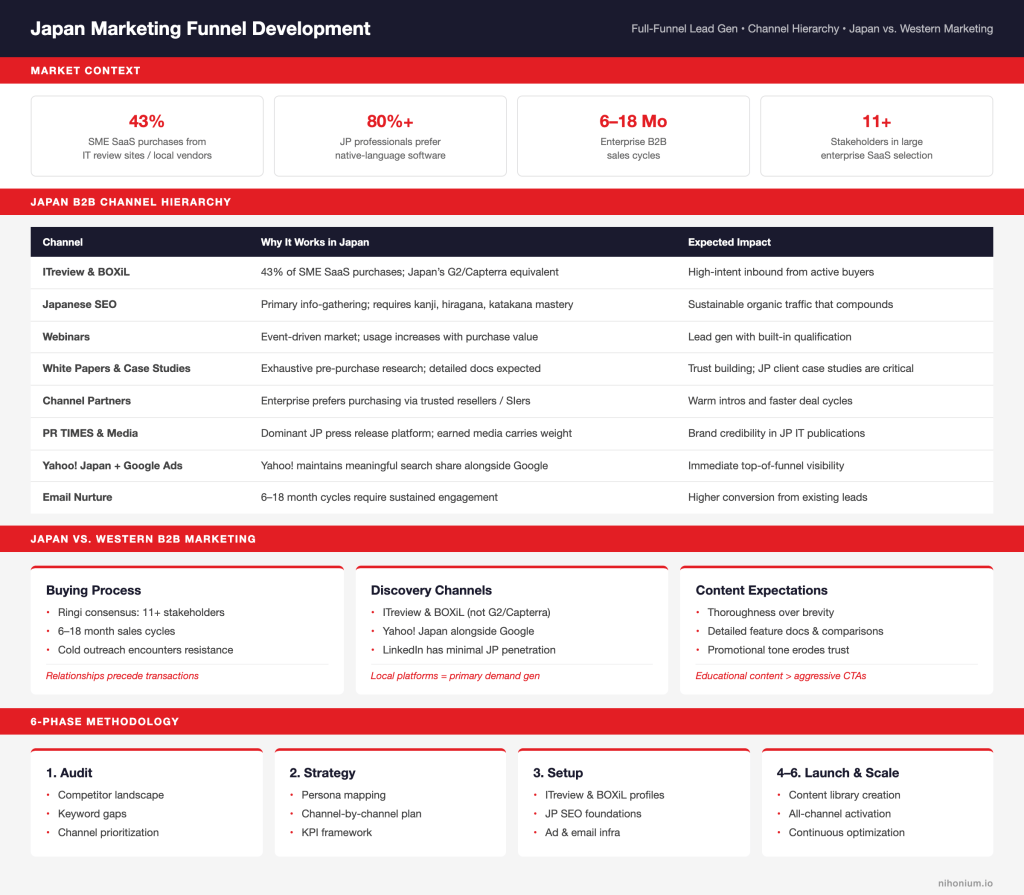
A funnel build usually runs in six phases, designed to limit risk and reach the first qualified leads as early as possible.
Phase 1: Market & Competitive Audit. The audit maps your category in Japan: competitors, the keywords they rank for, where they are listed and reviewed, and the gaps. Deliverable: a market assessment with channel priorities.
Phase 2: Funnel Strategy & Channel Plan. Based on the audit, a channel-by-channel plan sets target personas, messaging, content themes and KPIs. The plan has to account for consensus-driven buying, where the number of people involved grows with the size of the purchase: in One Marketing’s 2025 survey of 600 Japanese B2B buyers, the average rose from 5.6 people for purchases under JPY 3 million to 18.3 in the highest price band.
Phase 3: Channel Setup & Localization. Profiles go up on ITreview, BOXIL and other relevant listing platforms. The Japanese SEO foundations follow: site structure, hreflang tags and keyword mapping across all three writing systems, along with advertising accounts, email infrastructure and social media profiles in native Japanese.
Phase 4: Content Creation. Native Japanese writers produce the initial content library: landing pages, blog articles, white papers, case studies, webinar scripts, email sequences and ad copy. Every asset is written for Japanese audiences, not translated from English.
Phase 5: Launch & Activation. Campaigns go live across the chosen channels: SEO content is published, review site profiles open, the first webinar runs, paid media starts and the first press release goes out via PR TIMES.
Phase 6: Optimize & Scale. With data flowing, the funnel enters a continuous improvement cycle: adjusting keyword targets, refining ad audiences, iterating on webinar formats, and moving budget toward the channels with the best cost per lead and pipeline contribution.
Marketing Channels That Work in Japan
Buyer behavior and business norms create a channel mix in Japan that differs from Western B2B marketing.
| Channel | Why It Works in Japan | Expected Impact |
|---|---|---|
| IT Review Sites (ITreview, BOXIL) | In ITreview’s March 2026 survey, 37.7% of IT buyers found candidate products on comparison or review sites and 79.7% always or usually check user reviews; these platforms play the role G2 and Capterra play in the West | High-intent inbound leads from buyers actively comparing solutions in your category |
| Japanese SEO | Web search was the most common way buyers found candidate products in the same survey (47.3%); ranking requires keyword research across kanji, hiragana and katakana variations | Sustainable organic traffic that compounds as the content library grows |
| Webinars | Japan is an event-driven market: 24.3% of buyers in ITreview’s survey found candidate products at exhibitions, events or talks, and webinars bring that format online for mid-market and enterprise buyers | Lead generation with built-in qualification; attendees show active buying interest |
| Content Marketing (White Papers, Case Studies) | Japanese buyers research thoroughly before purchase and value detailed documentation, implementation case studies and feature comparisons | Builds trust and authority; case studies featuring Japanese clients are particularly influential |
| Channel Partners & Resellers | Enterprises often buy software through resellers and system integrators: about 72% of Japan’s ICT professionals work at IT vendors rather than at user companies (MIC White Paper 2018) | Access to established buyer networks and warm introductions |
| PR TIMES & Media Relations | PR TIMES is Japan’s most widely used press release service: 65.8% of listed companies in Japan used it at the end of May 2026, by its own count; earned coverage carries weight with risk-averse buyers | Brand awareness and credibility; coverage in Japanese IT publications builds legitimacy |
| Yahoo! JAPAN & Google Ads | Yahoo! JAPAN has used Google’s search engine since 2010, so organic SEO is largely Google SEO, but its portal and ad platform are separate and worth testing alongside Google Ads | Immediate top-of-funnel visibility while organic channels build momentum |
| Email Nurture Sequences | Long, consensus-driven evaluations need sustained engagement; Japanese-language sequences keep your brand present while the buyer’s internal approval runs | Higher conversion from existing leads through consistent, culturally appropriate follow-up |
Japan Marketing vs Western Marketing
Strategies that drive pipeline in North America and Europe often fail when applied directly to Japan.
Buying process and decision speed. Western B2B purchases often involve a small buying committee moving through a fast evaluation. In Japan, consensus-based decision-making through ringi (稟議, the formal approval circular) and nemawashi (根回し, informal consensus-building beforehand) means purchasing decisions pass through several layers of approval. In Medix’s 2020 survey of people who select IT products, 11 or more people involved was the most common answer at companies with more than 5,000 employees. No public benchmark exists for cycle length; as a planning assumption, enterprise deals take nine months to a year or more.
Language and localization depth. Japan ranks 86th of 117 countries and regions in the EF English Proficiency Index 2026, and Japanese business buyers prefer to buy in Japanese, so every funnel asset must be written in fluent, business-grade Japanese. Machine translation is easy to spot and damages credibility.
Discovery channels. Western SaaS buyers rely on G2, Capterra, Google and LinkedIn. Japanese buyers use web search, ITreview and BOXIL, social media and events, and lean on local IT vendors and system integrators. LinkedIn plays a smaller role than in the West, so plan social activity around the platforms in the table above.
Content expectations. Western marketing favors brevity and strong calls to action. Japanese B2B audiences expect thoroughness: detailed feature documentation, comparison tables, implementation case studies and a formal tone. Content that feels promotional erodes trust rather than building it.
Relationship and trust dynamics. Cold outreach that works in the West meets more resistance in Japan. Business culture values long-term relationships, introductions through trusted intermediaries and visible commitment to the market. Partner co-marketing and Japanese client references carry more weight than marketing automation volume.
Key Takeaways
- Japan’s SaaS market is large, and adoption is uneven by company size: in IPA’s DX Trend 2024 survey, 87.6% of companies with more than 1,000 employees pursued digital transformation under a company-wide strategy, against 31.0% of those with 100 or fewer.
- IT review sites are a primary discovery channel: 37.7% of IT buyers in ITreview’s March 2026 survey found candidate products on comparison or review sites, so ITreview and BOXIL belong at the center of the funnel, not on the side.
- Japanese B2B funnels must work across three writing systems and Japanese search habits: direct translation of English keywords fails because Japanese buyers search with different query patterns.
- Webinars, white papers and case studies tend to work better than aggressive direct outreach: Japan rewards educational, trust-building content delivered through culturally appropriate channels.
- Long, consensus-driven buying requires sustained nurture: a Japan marketing funnel is a system you build and compound over quarters, not a campaign you measure in weeks.
Sources
- Research Nester, “Japan Software as a Service (SaaS) Market Size & Growth Outlook 2035”. researchnester.com
- ITcrowd (ITreview), IT product selection white paper (300 IT buyers, March 2026). vendor.itreview.jp
- Grand View Research, “Japan Software as a Service (SaaS) Market Size & Outlook”. grandviewresearch.com
- CSA Research, “Businesses Prefer Local Language Purchasing” (2008). csa-research.com
- One Marketing, BtoB Purchasing Process White Paper 2025. prtimes.jp
- Medix, survey of IT product selectors (2020). btob.medix-inc.co.jp
- PR TIMES, first-quarter results release (14 July 2026). prtimes.jp
- Yahoo Japan Corporation (now LY Corporation), 27 July 2010 release on adopting Google’s search engine. lycorp.co.jp
- Also cited: IPA DX Trend 2024; MIC White Paper 2018; EF EPI 2026; G2 and ITreview listing counts (company pages, November 2026).
Frequently Asked Questions
How long does it take to see results from a Japan marketing funnel?
No public benchmark exists, so plan with assumptions you can test against your own data. Review site listings usually produce the earliest inquiries, once a profile is complete and has collected reviews; Japanese SEO follows a longer compounding curve, and paid media gives immediate visibility but needs ongoing optimization. Pipeline then moves at the pace of Japanese B2B buying: as a planning assumption, two to three quarters for mid-market deals and nine months to a year or more for enterprise.
Do we need a local entity or team in Japan before building a marketing funnel?
No. Japanese content, review site profiles, webinars and campaigns can run before you set up an entity, through a partner such as Nihonium. Early lead flow helps validate demand and build the business case for deeper investment. If you later set up a kabushiki kaisha (株式会社, a Japanese joint-stock company) or hire locally, the funnel is already producing pipeline.
Why can we not just translate our existing English marketing materials for Japan?
Translation addresses language but misses the deeper localization Japan requires. Japanese buyers search with different keyword patterns across three writing systems, evaluate software on different criteria, and discover products through different channels. A translated landing page will not rank for the terms Japanese buyers search, will not appear on the review sites they trust, and will not match the formality they expect.
Which channels should we prioritize if we have a limited budget?
Start with an ITreview listing, which has a free plan, and foundational Japanese SEO. Review sites reach buyers already in active evaluation, and the field is smaller than on Western platforms: ITreview lists about 16,000 products, while G2 lists more than 200,000. BOXIL has no free plan (JPY 50,000 a month on a one-year minimum, plus a fee per lead), so add it once you can follow up leads in Japanese. Once these channels produce steady lead flow, webinars and content marketing are usually the next priorities.