
Translation converts words; localization transforms the entire product experience. For SaaS companies entering Japan, a SaaS market Grand View Research puts at USD 12.3 billion in 2025 and growing about 12% a year to 2033, this distinction decides whether your product gains traction or stalls at the gate. Translation handles linguistic accuracy: converting your UI strings, help docs and marketing copy into Japanese. Localization goes further, adapting UI and UX patterns, payment flows, date formats, honorific registers, legal pages and cultural expectations so the product feels built for Japan rather than imported.
Language matters more in Japan than almost anywhere. In CSA Research’s 2020 “Can’t Read, Won’t Buy” survey of 8,709 consumers in 29 countries, 76% of all respondents, given two similar products, chose the one with information in their own language; among Japanese respondents it was 90%. And when a major global brand competes with a product that offers local-language information, only 50% of Japanese respondents chose the global brand, against 69% across all countries: the lowest share of any nationality. These are consumer findings, but they match what we see with business buyers. No public study we could verify measures how much more a fully localized SaaS product earns than a translated one, so the case rests on that language preference and on your own funnel data.
This guide breaks down what separates translation from localization, when each approach makes sense, and how to build a phased strategy for Japan.
Comparison Overview
The following table summarizes the ten key dimensions where translation and localization diverge for SaaS products targeting Japan.
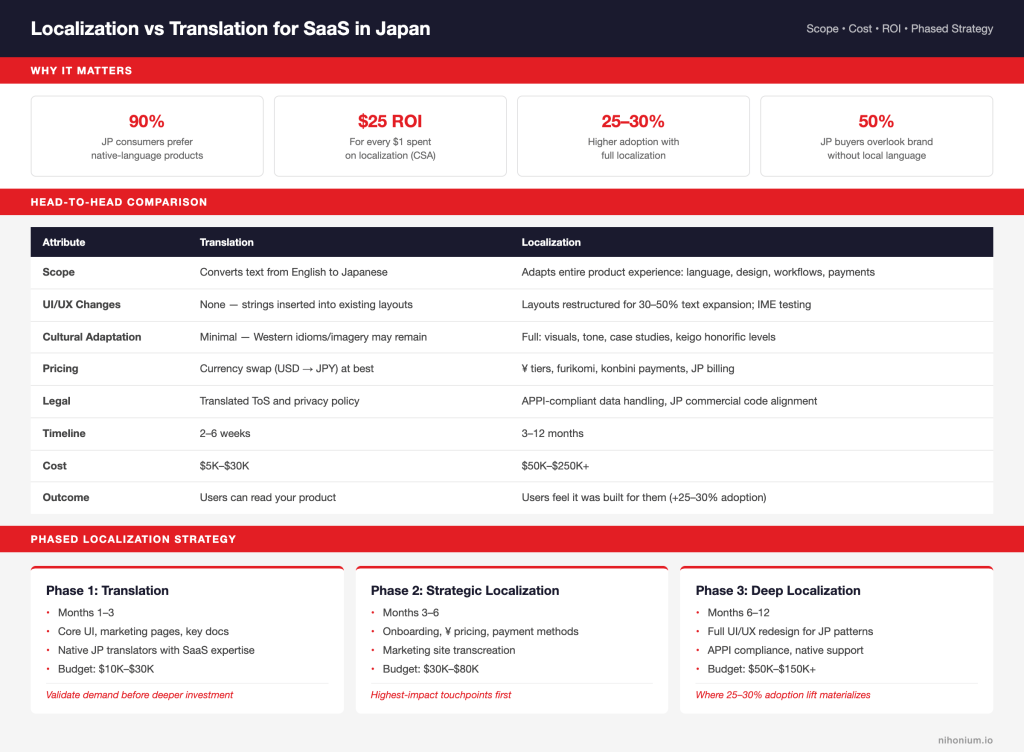
| Attribute | Translation | Localization |
|---|---|---|
| Scope | Converts text from source language to Japanese | Adapts the entire product experience, language, design, workflows, and business logic, for the Japanese market |
| Content Adaptation | Literal or near-literal text conversion preserving source meaning | Transcreation of messaging, tone adjusted to formal Japanese business norms (keigo, 敬語), and audience-specific content strategy |
| UI/UX Changes | None, translated strings inserted into existing layouts | Layout changes for Japanese strings and typography, IME compatibility testing, information-rich design patterns preferred by Japanese users |
| Cultural Adaptation | Minimal, imagery, metaphors, and idioms may remain Western-centric | Full adaptation of visuals, examples, case studies, tone, and communication style to match Japanese business culture |
| Pricing | Currency symbol swap (USD to JPY) at best | Yen-denominated pricing tiers, local payment methods (bank transfer, and convenience store payment for smaller customers), Japan-specific packaging |
| Legal & Compliance | Translated terms of service and privacy policy | Natural Japanese privacy notices and terms covering what APPI requires, confirmed by Japanese counsel, and contracts in the form Japanese procurement expects |
| Support | English support with possible translation layer | Japanese-language support, a Japanese knowledge base, and service levels and communication that fit local expectations |
| Timeline | Shorter; set by content volume | Longer and ongoing; runs in phases and continues with every release |
| Cost | Priced mainly by word volume; get quotes on your own content | Higher; depends on product complexity, the number of surfaces and depth of adaptation |
| Outcome | Japanese users can read your product; comprehension gaps and friction remain | Japanese users feel the product was built for them; measure the effect in your own conversion and activation data |
Core Distinction: Words vs Experience
Translation is a language task. Localization is a market entry strategy. Understanding this distinction is critical for SaaS leaders budgeting their Japan expansion.
Translation focuses on linguistic equivalence, converting your UI labels, error messages, help articles, and marketing copy into Japanese versions that preserve the original meaning. The work stops at the boundary of language. Localization includes translation as one component of a far broader adaptation. For Japan, localization addresses:
- UI patterns and information architecture: Japanese business users tend to expect detailed product information and thorough navigation. Minimalist Western SaaS designs can feel thin. Localization adjusts layouts to match these expectations.
- Date, time, and number formats: Japan writes dates year first (YYYY/MM/DD), and the national government and most large companies run an April to March fiscal year. Yen amounts are shown with the yen symbol (¥) or 円 and no decimal places.
- Payment methods: Bank transfers (furikomi, 振込) against an invoice (seikyūsho, 請求書) are standard in B2B SaaS, with convenience store payment (konbini, コンビニ) for smaller buyers. Payment methods matter: in a holdback test across businesses using its checkout, Stripe found that showing at least one relevant payment method beyond cards raised conversion by 7.4% on average (Stripe, April 2025).
- Honorific systems and formality levels: SaaS copy must use appropriate keigo in customer-facing contexts. Error messages, tooltips and onboarding flows all need to match the expected register. Incorrect formality erodes trust.
- Business etiquette and sales processes: Enterprise SaaS sales in Japan follow relationship-driven timelines. Localization adapts sales collateral, proposal formats and contract structures to match Japanese procurement norms.
Japanese uses three writing systems, often in one sentence: hiragana (46 basic characters, for native words and grammar), katakana (46 basic characters, for loanwords and many technical terms) and kanji, of which the official list of characters for general use (jōyō kanji) has 2,136. Choosing the wrong script, or the katakana form of a term where users expect kanji or English, immediately signals a foreign product. Localization makes sure every text element uses the form users expect in context.
Japanese strings also do not map one for one onto English ones. Character width, line breaking and font metrics all change, so a label that fits in English can overflow a button in Japanese, while a short kanji compound can leave a layout looking empty. Localization accounts for both, which a string-by-string translation cannot.
What Localization Covers Beyond Translation
Full localization for Japan spans five domains that translation never touches. Each addresses a different dimension of the product experience that Japanese users evaluate, consciously or not, when deciding whether to adopt, purchase and renew.
UI/UX Localization
Japanese users tend to expect information-rich interfaces with detailed navigation and tooltips. Localization involves restructuring layouts to present more information upfront, choosing Japanese typefaces and line spacing that keep mixed-script text readable, and testing Input Method Editor (IME) compatibility across all text input fields. Search boxes, form fields and auto-complete must handle the conversion from typed romaji to kana and kanji without breaking.
Content Transcreation
Marketing copy, case studies and sales collateral need transcreation, not translation. Transcreation preserves intent and impact while reworking expression for a Japanese audience: replacing Western idioms, adjusting tone from casual to formal, building social proof with Japan-relevant references, and structuring content for the longer Japanese B2B buying journey. As Naoki Togawa of Nikkei Business Publications put it in a 2021 interview: “It’s easy to tell which vendors know what they are doing and are really committed to the market just through the quality of their materials and programs.”
Legal and Regulatory Adaptation
Japan’s Act on the Protection of Personal Information (APPI) applies to foreign companies that handle the personal information of people in Japan when supplying them goods or services, even without a physical presence. In practice that means Japanese-language privacy notices that state the purpose of use, consent before acquiring sensitive (special care-required) personal data, a preliminary breach report to the Personal Information Protection Commission (PPC) within about 3 to 5 days, and either consent or equivalent safeguards for transfers abroad. A company that breaches a PPC order can be fined up to JPY 100 million today; the amendment passed in July 2026 adds a surcharge based on the gain from serious violations, in force by July 2028. Localization produces natural Japanese versions of these documents for your Japanese counsel to confirm; it also covers invoices that work under the Qualified Invoice System (from 1 October 2023), although a foreign vendor selling cross-border to businesses may fall under the reverse charge instead, which a tax adviser should settle.
Payment Localization
Payment infrastructure shapes conversion. Localization means yen-denominated pricing rather than a converted dollar price (Paddle’s guidance on localized pricing makes the same point: buyers are quickly put off when prices are not in their own currency), Japanese bank transfers and, for smaller customers, convenience store payments, invoices with the right tax handling, and pricing tiers set for Japanese buyers. Our guide to annual vs monthly billing in Japan covers the billing side.
Support Localization
Japanese customers expect responsive support in Japanese with the right formality. That means a Japanese support operation with local communication norms, thorough documentation (user guides, onboarding materials, Japan-specific FAQs) and response times that meet local expectations. In CSA Research’s 2020 survey, 75% of respondents across all countries said they were more likely to buy the same brand again if customer care was in their language. Our guide to onboarding and support localization goes further.
When to Choose Each
The right approach depends on your stage, budget, and commitment level. Use the following decision matrix to match your situation to the appropriate strategy.
| Scenario | Recommended Approach | Rationale |
|---|---|---|
| Internal documentation for bilingual team | Translation | Low external visibility; accuracy matters more than cultural nuance |
| MVP market validation with Japanese prospects | Translation + selective localization | Enough to test demand signals; full localization premature before product-market fit is confirmed |
| Marketing website and landing pages | Localization (transcreation) | First impression determines engagement; 90% of Japanese consumers in CSA Research’s survey chose the product with information in Japanese |
| Full product launch in Japan | Full localization | Competing against domestic alternatives requires a native-feeling experience across all touchpoints |
| Enterprise sales to Japanese corporations | Full localization + custom adaptation | Enterprise buyers expect Japanese contracts and support, APPI-ready privacy documents, and sales processes that fit their procurement |
| Partner channel or reseller model | Full localization | Partners need localized sales collateral, training materials, and co-branded assets to sell effectively |
| Technical API documentation | Translation with terminology management | Developer audiences tolerate English but appreciate accurate Japanese references; consistency across terms is critical |
| Customer support and knowledge base | Localization | Support interactions require cultural sensitivity, proper formality levels, and Japan-specific troubleshooting scenarios |
The Hybrid Approach: Phased Localization
Many SaaS companies entering Japan do best with a phased approach: start with translation for validation, then deepen to full localization as the market proves out. This balances speed to market against the risk of over-investing before product-market fit is confirmed. The scope of each phase, not a fixed number of months, decides how long it takes.
Phase 1: Translation Foundation
Begin with professional translation of your core product UI, key marketing pages and essential documentation. Focus on linguistic quality: use native Japanese translators with SaaS domain expertise, not general-purpose services. Establish a terminology glossary for consistency from the first file.
Phase 2: Strategic Localization
With traction signals (inbound inquiries, pilot customers or partnership interest), invest in the highest-impact touchpoints: onboarding flow, yen pricing with local payment methods, marketing site transcreation and a Japanese knowledge base. Run usability tests with Japanese users to find the worst friction.
Phase 3: Deep Localization
With paying customers and revenue data, commit to comprehensive localization: UI and UX adapted to Japanese design patterns, APPI-ready privacy documents, Japanese support, enterprise sales collateral, and ongoing localization of every release. Track trial-to-paid conversion, activation and support tickets before and after each phase so you can see what the work returns.
This phased model treats localization as an iterative investment guided by market feedback. Each phase produces data that informs the next, reducing the risk of misallocating resources before validating demand.
Key Takeaways
- Translation is necessary but insufficient for Japan. In CSA Research’s 2020 survey, 90% of Japanese consumers chose the product with information in Japanese and only 50% would pick a global brand over a local-language competitor, so text conversion alone leaves your product at a disadvantage against localized alternatives.
- Localization is a product strategy, not a language task. It covers UI and UX adaptation, payments, the Japanese text of legal documents, cultural alignment and support: every touchpoint that shapes whether Japanese users see your product as built for them or merely translated.
- Japan’s linguistic complexity demands specialized handling. Three writing systems, strict formality registers and strings that do not map one for one onto English mean that even good translation fails without design and engineering support.
- Measure the return in your own funnel. No verifiable public benchmark gives the revenue uplift from localization; conversion, activation and support data before and after each phase will show it.
- A phased approach reduces risk. Start with translation to validate demand, then deepen localization as market signals confirm the opportunity, aligning investment with evidence at every stage.
Working with Nihonium. We are a Japan go-to-market partner for B2B SaaS companies: localization by SaaS experts. Talk to us about your Japan entry.
Sources
- CSA Research, “Can’t Read, Won’t Buy, B2C” (2020), press release “Consumers Prefer their Own Language” (7 July 2020). Survey of 8,709 consumers in 29 countries: 76% overall and 90% in Japan chose the product with information in their language; 69% overall and 50% in Japan would choose a major global brand; 75% more likely to buy again with customer care in their language. csa-research.com
- Globalization and Localization Association (GALA), industry association for the localization sector; background on localization practice, not a data source. gala-global.org
- CSA Research, “Businesses Prefer Local Language Purchasing” (2008 survey of business software buyers in eight countries). csa-research.com
- Personal Information Protection Commission (PPC), Japan, official guidance on the Act on the Protection of Personal Information (APPI); the July 2026 amendment (surcharge, in force within two years). ppc.go.jp
- Paddle, “Localized pricing: Definitions + how it can increase your revenue” (January 2021). Vendor guidance on showing prices in local currency. paddle.com
- Stripe, “Testing the conversion impact of 50-plus global payment methods” (April 2025): 7.4% higher conversion on average when at least one relevant non-card method was shown (Stripe’s own merchant data).
- Grand View Research, Japan SaaS market outlook: USD 12.3 billion in 2025, USD 31.3 billion forecast for 2033, about 12% a year.
- Agency for Cultural Affairs, jōyō kanji list (Cabinet notice of 30 November 2010): 2,136 characters.
- EF Education First, EF English Proficiency Index 2026, Japan: 86th of 117 countries and regions.
- Interview with Naoki Togawa, Nikkei Business Publications, published by Japan Cloud, 1 March 2021.
Frequently Asked Questions
Can machine translation replace professional localization for Japanese SaaS products?
Not on its own. Japanese is hard for machine translation because of its three writing systems, context-dependent formality and frequent omission of the subject. Machine translation can speed up internal drafts, but customer-facing text needs review by native Japanese linguists with SaaS domain expertise, because poor Japanese is noticed at once and undermines trust in the product.
How long does full SaaS localization for Japan typically take?
It depends on string volume, how much text is hardcoded, the number of surfaces and whether the product serves a regulated industry. The work runs through strategy and terminology, core product and content translation, UI and UX adaptation with technical changes (payment methods, date formats, IME testing), and QA with user testing. The phased approach in this guide lets you enter the market with a translation foundation and deepen localization over the following quarters; agree the timeline after an audit of your own product rather than from a benchmark.
What is the biggest localization mistake SaaS companies make when entering Japan?
Treating localization as a one-time project rather than an ongoing function. Companies translate, launch, then let quality slip as new features and content ship, and within months the product is a patchwork of polished legacy content and rough additions. The second mistake is skipping UI and UX adaptation, inserting Japanese text into English-designed layouts. Both signal a lack of commitment to the market, which Japanese buyers, who value long-term business relationships, notice.
Is Japan worth the localization investment compared to other Asian markets?
For most B2B SaaS companies, yes. Grand View Research puts the Japan SaaS market at USD 12.3 billion in 2025, growing about 12% a year to 2033. The localization barrier is also high: Japan ranks 86th of 117 countries and regions in the EF English Proficiency Index 2026, its writing system is complex, and buyers expect careful Japanese. Companies that clear that barrier face fewer foreign competitors who have done the same; see our guide to SaaS localization for Japan for the work involved.