
The five most effective enterprise decision framework Japan SaaS models are: Ringi-sho (formal approval chain), Nemawashi (consensus pre-alignment), QCD Evaluation (Quality-Cost-Delivery scoring), Risk-First Vendor Assessment, and the IT Steering Committee Gate Model. Each maps to a distinct stage of the Japanese enterprise buying cycle, and ignoring any one of them can stall or kill a deal regardless of product quality.
Selling enterprise SaaS into large Japanese companies, I’ve watched global vendors lose deals they should have won. Not because their product was inferior, but because they ran a standard enterprise sales playbook against a different decision architecture.
The opportunity is real: Grand View Research puts Japan’s SaaS market at USD 12.3 billion in 2025, growing about 12% a year to 2033. But the frameworks Japanese enterprises use to evaluate, approve and procure SaaS look nothing like what you’re used to in North America or Europe.
This guide names and explains each framework, then shows how to align your sales motion with each one.
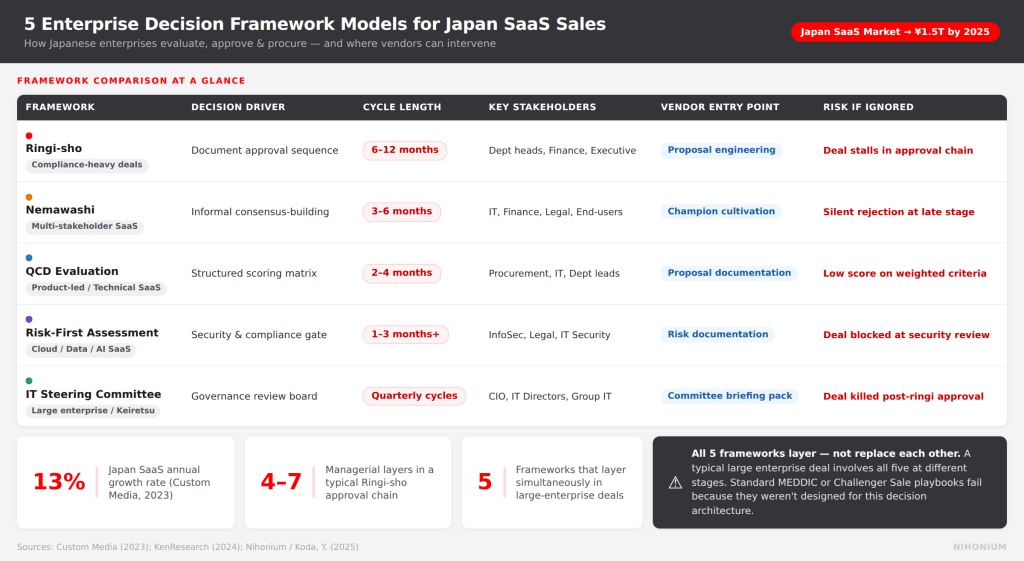
Quick Comparison: Japan SaaS Enterprise Decision Frameworks at a Glance
The five frameworks differ in who drives the decision, what sets their pace, and where vendors can intervene. Ringi-sho is document-centric and sequential; Nemawashi is relationship-centric and parallel; QCD is criteria-centric; Risk-First is compliance-centric; and the IT Steering Committee Gate is governance-centric.
If you’re wondering why Japan needs a separate decision framework strategy when your SaaS already has a standard enterprise playbook, this table answers that question directly:
| Framework Name | Decision Driver | What Sets the Pace | Key Stakeholders | Vendor Entry Point | Risk if Ignored | Best-Fit Deal Type |
|---|---|---|---|---|---|---|
| Ringi-sho | Document approval sequence | The number of approvers on the chain and how often the document is sent back | Department heads, Finance, Executive | Proposal engineering | Deal stalls in approval chain | Compliance-heavy, regulated industries |
| Nemawashi | Informal consensus-building | How many stakeholders must be consulted, often more than once; runs in parallel with ringi preparation | IT, Finance, Legal, End-users, Executive sponsor | Champion cultivation | Silent rejection or late-stage objections | Multi-stakeholder, cross-functional SaaS |
| QCD Evaluation | Structured scoring matrix | The buyer’s comparison process and the completeness of your proposal documents | Procurement, IT, Department leads | Proposal documentation | Low score on weighted criteria | Product-led, technical SaaS |
| Risk-First Assessment | Security/compliance gate | The length of the security questionnaire and how quickly you answer it; open questions can hold it indefinitely | InfoSec, Legal, IT Security Committee | Proactive risk documentation | Deal blocked at security review | Cloud, data, AI/ML SaaS |
| IT Steering Committee Gate | Governance review board | The committee’s meeting calendar and submission deadlines | CIO, IT Directors, Group IT leads | Committee briefing package | Deal killed post-ringi approval | Large enterprise, keiretsu group deals |
Your standard MEDDIC or Challenger playbook wasn’t designed for this. The Japanese enterprise SaaS evaluation process layers these frameworks, often at the same time, in ways that require deliberate changes to your discovery, proposal and stakeholder engagement.
1. Ringi-sho: The Formal Approval Chain Framework, Best For Compliance-Heavy Deals
Best For: Compliance-heavy deals in regulated industries (finance, healthcare, government).
Ringi-sho (稟議書, the approval request document) is the core of ringi (稟議), a bottom-up written approval system: a proposal circulates through departmental stakeholders, each adding a hanko (判子, seal) or an electronic approval, before it reaches the final decision-maker. For SaaS vendors, this means proposals must be built as internal advocacy documents: structured, risk-mitigating and ready for any reviewer in the chain.
The chain can include several managerial layers before executive sign-off, and that is a large part of why enterprise SaaS deals in Japan take longer than comparable deals in the US. Not because buyers are slow, but because the document must survive scrutiny from people who have never met you.
Pricing is where this shows first. Complex or ambiguous pricing raises a question at every approval layer, and every question adds a round trip.
What the Ringi Document Must Contain for SaaS Proposals
Your champion inside the company will draft the ringi document. But if you haven’t given them the right material, the document will fail. A ringi-ready SaaS proposal includes:
- Problem statement with internal data: the pain point quantified in the buyer’s own metrics, not your marketing claims
- Solution overview in Japanese business terms: features translated into outcomes relevant to each reviewing department
- Total cost of ownership (TCO) breakdown: all costs surfaced upfront; hidden fees kill ringi approvals
- Implementation timeline with milestones: Japanese approvers need to see predictability
- Risk assessment and mitigation plan: pre-answer the security, compliance and operational risks each reviewer will raise
- Reference customers in similar industries: ideally Japanese enterprises; if not, similar-scale companies with relatable use cases
- Vendor stability indicators: financial statements, longevity, exit provisions
Missing any section gives a mid-chain reviewer a reason to send the document back. And in ringi, a document sent back doesn’t just delay; it often dies.
How to Accelerate Ringi Without Bypassing It
You can’t skip ringi. Trying to escalate around it signals that you don’t understand how the organization works, a serious positioning error.
But you can shorten the cycle by aligning content with each reviewer’s concerns before formal circulation:
- Map the approval chain early: ask your champion to walk you through who will review and in what order
- Create reviewer-specific addenda: Finance needs TCO detail; IT needs integration specs; Legal needs data processing terms
- Run pre-ringi briefings: request short meetings with key reviewers before circulation to surface objections early
- Provide a one-page executive summary: senior approvers review many ringi documents; make yours easy to scan
- Localize pricing structure: Yen-denominated, annual-contract pricing reduces finance department questions
The goal isn’t to rush the process. It’s to remove the friction that causes delays.
2. Nemawashi: The Consensus Pre-Alignment Framework, Best For Multi-Stakeholder Enterprise Deals
Best For: Multi-stakeholder deals where IT, Finance, Legal and end-user departments all have veto power.
Nemawashi (根回し, literally “going around the roots”, from digging around a tree’s roots before it is moved) is the process of building informal consensus among all key stakeholders before a formal decision is proposed. In SaaS sales, vendors who engage only the formal decision-maker, without supporting nemawashi with IT, finance, legal and end-user champions, meet unexpected objections during the ringi phase. Or worse: a silent rejection where no one tells you why you lost.
Some global vendors object: doesn’t mapping to internal frameworks slow down the sales cycle? Nemawashi runs in parallel with your other sales activities. Skipping it doesn’t save time; it creates late-stage objections that reset your timeline.
Buyers who move core operations to the cloud want every function to see its risks handled before they commit. That scrutiny is spread across many stakeholders, and nemawashi is how Japanese organizations surface and resolve concerns before the formal decision.
Stakeholder Mapping for Nemawashi: Who to Align and In What Order
The sequence matters. Engaging stakeholders out of order creates political complications your champion has to clean up.
A sequence that works in many enterprise SaaS deals:
- End-user department head: the person who feels the problem daily and will sponsor the request
- IT security/InfoSec: must clear security concerns before broader IT engagement
- IT architecture/operations: must validate integration feasibility
- Finance/procurement: must approve the budget approach
- Legal: must review contract terms, data processing and liability
- Executive sponsor: informed once consensus is built, to give final endorsement
At each step, you’re not selling. You’re understanding concerns, adapting your proposal and gaining implicit agreement not to block the deal.
Nemawashi vs. Western Champion-Building: Key Differences
If you’ve run MEDDIC or the Challenger Sale, you understand champion-building. But nemawashi differs in important ways:
| Dimension | Western Champion-Building | Japanese Nemawashi |
|---|---|---|
| Goal | Empower champion to drive deal | Achieve universal non-objection |
| Focus | Identify and mobilize decision-maker | Neutralize all potential blockers |
| Timing | Champion leads formal process | Consensus built before formal process |
| Vendor role | Directly coach and enable champion | Provide materials; champion runs relationships and arranges vendor meetings |
| Success metric | Champion commitment | Absence of objections from any stakeholder |
In Western sales, a strong champion can push through despite detractors. In Japan, a single unaddressed objection from a secondary stakeholder can kill a deal that appeared certain. Nemawashi is insurance against that outcome.
3. QCD Evaluation Framework, Best For Product-Led or Technical SaaS Deals
Best For: Product-led or technical SaaS where buyers run structured vendor comparisons.
QCD (Quality, Cost, Delivery) comes from Japanese manufacturing management, where it is the standard way to judge suppliers, and many enterprise buyers apply the same lens to software. Quality covers reliability, uptime SLAs and support responsiveness. Cost covers TCO and pricing predictability. Delivery covers implementation timelines and onboarding certainty.
Japanese B2B buyers put weight on budget predictability and pricing clarity, both part of the “Cost” dimension. Proposals organized around Q, C and D are easier for an evaluator to score than a generic ROI deck that buries these details.
Hybrid pricing, a base subscription with usage-based add-ons, is one way to give buyers a predictable core cost while keeping room to scale. If your pricing is purely usage-based with variable costs, expect friction on the “C” dimension.
Scoring Your SaaS Against QCD: A Self-Assessment Checklist
Before entering a Japanese enterprise evaluation, audit your offering against each dimension:
Quality (品質, hinshitsu)
- Can you document 99.9%+ uptime with third-party verification?
- Do you have Japanese-language support with defined SLA response times?
- Can you provide security certifications (SOC 2, ISO/IEC 27001) and, for government-related deals, an ISMAP listing?
- Do you have reference customers who can attest to reliability?
Cost (コスト, kosuto)
- Is your pricing yen-denominated with predictable annual costs?
- Can you provide a 3-year TCO projection including all fees?
- Are implementation and training costs clearly separated?
- Do you offer annual contracts (preferred in Japan) with multi-year discounts?
Delivery (納期, nōki)
- Can you commit to a fixed implementation timeline with penalty clauses?
- Do you have a documented onboarding process with milestone definitions?
- Can you provide a dedicated Japanese-speaking customer success manager?
- What’s your track record for on-time delivery with similar-scale customers?
Weaknesses on any dimension don’t disqualify you, but address them before the buyer finds them in scoring.
4. Risk-First Vendor Assessment Framework, Best For Cloud, Data, and AI SaaS Deals
Best For: Cloud infrastructure, data platforms and AI/ML SaaS, where security and compliance scrutiny is highest.
Japanese enterprises run a risk-first vendor assessment before a SaaS deal progresses, covering data location, security certifications, regulatory compliance, vendor financial stability and exit risk. For cloud and AI SaaS, failing to get ahead of this assessment with prepared risk documentation is one of the most common reasons global vendors stall in Japan.
Some vendors assume these frameworks are fading as Japanese enterprises modernize. They aren’t: legacy systems, data migration and security remain the questions a cloud vendor has to answer before anything else moves.
If your product touches sensitive data, or uses AI on customer data, expect the assessment to be exhaustive, and treat a security posture you can document as a selling point rather than a hurdle.
The 7 Risk Categories Japanese Enterprise Security Teams Evaluate
Expect security questionnaires to cover these seven areas:
- Data residency: Where is data stored? Can it be stored in Japan? What’s the data transfer policy? APPI does not require storage in Japan, but enterprise buyers ask, and transfers abroad bring APPI consent and information duties.
- Security certifications: SOC 2 Type II, ISO/IEC 27001 (called ISMS certification in Japan), and ISMAP for government-related deals
- Regulatory compliance: APPI compliance, sector-specific regulations, cross-border transfer mechanisms
- Vendor financial stability: audited financial statements, funding status, profitability trajectory
- Business continuity: disaster recovery plans, backup procedures, RTO/RPO commitments
- Exit provisions: data portability, contract termination terms, migration support
- Support SLAs: response time commitments, Japanese-language availability, escalation procedures
Each category needs specific documentation. Vague answers or “we’ll get back to you” responses create delays measured in months.
Building a Risk Mitigation Document Package for Japanese Procurement
Prepare this documentation set before you need it:
- Security whitepaper: architecture overview, encryption standards, access controls, penetration testing history
- Data processing agreement: APPI-compliant terms, subprocessor lists, data deletion procedures
- Compliance certification copies: SOC 2 report, ISO certificates, ISMAP listing (if applicable)
- Reference customers: ideally Japanese enterprises in similar industries with similar data sensitivity
- Financial statements: audited statements for the past 2 to 3 years, or investor backing documentation for startups
- Business continuity plan summary: DR procedures, backup frequency, geographic redundancy
- Japanese-language support documentation: support hours, escalation paths, SLA commitments
Global vendors selling AI and data platforms into Japan should treat this documentation as a prerequisite, not a reaction to buyer requests.
5. IT Steering Committee Gate Model, Best For Large Enterprise and Group-Company Deals
Best For: Large enterprise deals and keiretsu group-company sales where centralized IT governance applies.
Many large Japanese enterprises and keiretsu (系列, corporate group) companies run an IT steering committee or a group IT governance body that reviews enterprise software before executive approval. It meets on a fixed calendar, judges vendors on strategic fit and IT architecture alignment, and can stop a deal that has already cleared departmental ringi.
Group-wide licensing raises the stakes: when a parent company standardizes on a tool for its subsidiaries, the decision moves from a department to group IT, and the committee becomes the gate.
Cross-functional and company-wide tools, including AI tools meant to improve operations across departments, are exactly the purchases that go to this committee rather than staying with a departmental buyer. If you’re selling enterprise-wide or cross-functional SaaS, you will meet this gate.
What IT Steering Committees Look For in SaaS Vendor Briefings
IT steering committees judge different criteria from departmental buyers. Your ringi-ready proposal won’t be enough. Prepare a separate committee-level briefing that addresses:
- Enterprise roadmap alignment: How does your product fit the company’s stated DX (digital transformation) strategy?
- IT architecture compatibility: API standards, integration with existing systems, authentication protocols
- Multi-entity licensing: Can your licensing model accommodate group-company rollouts with centralized administration?
- Data governance implications: How does your product affect the company’s data architecture and governance policies?
- Vendor strategic partnership potential: Is this a transactional purchase or a long-term technology partnership?
- Total enterprise impact assessment: Beyond the requesting department, what’s the potential footprint across the organization?
Steering committees think over the multi-year horizon of the company’s IT plan. A proposal that solves today’s departmental problem but creates tomorrow’s enterprise architecture conflict will be rejected, even after ringi approval.
How We Evaluated These Enterprise Decision Frameworks
These five frameworks were selected on three criteria: how often they appear in Japanese enterprise SaaS deals, how much damage misreading them does to a deal, and how far a global SaaS vendor can prepare for them in advance.
The selection criteria:
- Frequency: each framework appears in a typical large-enterprise SaaS deal in Japan, often alongside the others
- Impact: misalignment with any single framework can cause a lost deal or a long delay
- Actionability: vendors can take specific preparatory steps to align with each framework before entering a Japanese sales cycle
No public survey counts how often each framework appears or how many deals each one costs, so treat the selection as a practitioner’s view rather than a statistic. With Japan’s SaaS market growing about 12% a year (Grand View Research), framework-aware selling is the difference between winning and watching competitors close deals you should have won.
The frameworks are described from our work selling SaaS into Japanese enterprises; for the wider picture, see what a full Japan market entry program covers.
Key Takeaways
- Five frameworks govern Japanese enterprise SaaS buying: ringi-sho (document approval), nemawashi (consensus-building), QCD (Quality-Cost-Delivery scoring), risk-first assessment (security scrutiny) and IT steering committee gates (governance review)
- These frameworks layer; they don’t replace each other: a large enterprise deal can involve all five at different stages
- Standard Western playbooks need adapting: MEDDIC and Challenger Sale concepts apply, but the execution must fit Japanese decision architecture
- Proactive documentation wins: vendors who prepare ringi-ready proposals, risk documentation and steering committee briefings before being asked remove the most common causes of delay
- Framework alignment isn’t cultural theater: it’s operational necessity; Japanese enterprise buyers use these frameworks systematically, and vendors who ignore them lose to those who don’t
Working with Nihonium. We are a Japan go-to-market partner for B2B SaaS companies: Japan go-to-market strategy. Talk to us about your Japan entry.
Sources
- Grand View Research, Japan Software as a Service (SaaS) Market Outlook, 2033: USD 12.3 billion in 2025, USD 31.3 billion forecast for 2033, about 12% a year.
- Digital Agency, ISMAP Cloud Services List Published: the government’s cloud security assessment program and its registered service list (the list itself is on the ISMAP portal run by IPA).
- Personal Information Protection Commission, APPI guidelines on provision to third parties: cross-border transfer rules.
- EU-Japan Centre for Industrial Cooperation, From Understanding to Navigating Japanese Business Culture: nemawashi and ringi from an outsider’s perspective, including the vendor’s supporting role.
FAQ: Enterprise Decision Frameworks for Japan SaaS Sales
Frequently asked questions about enterprise decision frameworks in Japan SaaS cover ringi-sho timelines, how to support nemawashi as a foreign vendor, ISMAP, QCD scoring, and how to engage IT steering committees in keiretsu structures.
How long does a typical enterprise SaaS deal take to close in Japan?
There is no published benchmark. As a planning assumption (not a statistic), we plan nine months to a year or more from first meeting for a large-enterprise deal that needs full ringi-sho approval, and two to three quarters for a mid-market deal. What sets the pace at each stage:
- Discovery and nemawashi: how many stakeholders must be consulted, and how quickly your champion can arrange it
- Proposal development and QCD evaluation: whether your proposal documents answer every scoring question the first time
- Risk-first security assessment: the length of the questionnaire and your response time (often parallel to evaluation)
- Ringi-sho circulation: the number of approvers and whether the document is sent back
- IT steering committee review (if applicable): the committee’s meeting calendar
Mid-market companies usually run lighter versions of these frameworks. Smaller companies may skip ringi and steering committee gates entirely.
Can foreign SaaS vendors run nemawashi themselves or do they need a local partner?
A vendor does not run the buyer’s internal nemawashi, but it can support it. The obstacles to doing more:
- Language: nemawashi conversations happen in Japanese, often in informal settings
- Relationships: your champion has internal relationships you don’t
- Cultural nuance: reading implicit objections requires deep familiarity with Japanese business communication
Foreign vendors usually support nemawashi in one of three ways: through a local sales team or fractional sales resource, through a channel partner with established enterprise relationships, or through their internal champion, who runs nemawashi with vendor-provided materials and arranges individual meetings with stakeholders when they help.
What is ISMAP and why does it matter for the Risk-First Vendor Assessment?
ISMAP (Information system Security Management and Assessment Program) is the Japanese government’s security assessment program for cloud services. Government agencies use its registered list, the ISMAP cloud service list, when they procure cloud services.
ISMAP is not required for private-sector sales, but its influence extends further:
- Public-sector and government-related buyers may require a listing
- Some large enterprises use ISMAP criteria as a reference point even when it is not mandatory
- A listing signals a serious commitment to the Japanese market
For security and compliance SaaS selling to the public sector, a listing removes a common deal blocker. The assessment is demanding, and its criteria are under revision, with the new version expected to apply after March 2027; check the current requirements before you budget for it.
How do QCD evaluation criteria differ from Western RFP scoring models?
Western RFP processes typically weight criteria such as feature completeness, vendor market position (Gartner Magic Quadrant) and projected ROI. Japanese QCD evaluation differs:
- Quality emphasizes reliability and support responsiveness over feature richness
- Cost emphasizes predictability over lowest price; Japanese buyers often accept a higher price for stable pricing
- Delivery emphasizes commitment and certainty over speed; a longer timeline with guaranteed milestones beats a fast timeline with caveats
The practical implication: your Western-market ROI deck probably emphasizes the wrong things. Rebuild your proposal around QCD dimensions for Japanese evaluations.
What documentation do IT steering committees in Japan typically require from SaaS vendors?
Prepare these deliverables for committee-level review:
- Executive summary (1 to 2 pages) focused on strategic fit and enterprise impact
- Technical architecture overview with integration specifications
- Multi-entity licensing terms and centralized administration capabilities
- Data governance and compliance documentation
- Roadmap alignment analysis showing how your product supports the buyer’s DX strategy
- Reference customers at similar scale with comparable governance requirements
- Vendor partnership proposal (if positioning for a long-term strategic relationship)
Ask your champion when the committee meets and when materials are due. Late submissions mean waiting for the next meeting.
Do these decision frameworks apply equally to SMBs and enterprises in Japan?
No. Framework intensity scales with company size:
- Large enterprises (1,000+ employees): all five frameworks can apply, often at the same time
- Mid-market (100 to 1,000 employees): ringi-sho and nemawashi apply; QCD and risk-first appear in lighter forms; IT steering committees are rare
- SMBs (under 100 employees): nemawashi principles apply informally; QCD criteria matter but aren’t formally scored; ringi may be just the owner’s approval; steering committees don’t exist
The frameworks in this article are calibrated for enterprise deals. If you’re targeting SMBs, product-led growth strategies with lighter-touch sales processes may be more appropriate.