

Japan’s AI market is growing fast: IDC Japan puts domestic AI spending at JPY 2.37 trillion in 2025 and forecasts JPY 6.89 trillion in 2029, 2.9 times larger, with average growth of 36.0% a year from 2024. For AI/ML tools, data platforms and analytics providers, success requires a clear position under the Act on the Protection of Personal Information (APPI) and the 2025 AI Promotion Act, confirmed with Japanese counsel, a go-to-market motion adapted to Japanese buyers, and a channel strategy built around Japan’s consensus-driven enterprise buying process.
Capital is flowing in. SoftBank Group said in February 2025 that it would spend USD 3 billion a year to deploy OpenAI’s solutions across its group companies, and set up SB OpenAI Japan with OpenAI to sell them to large Japanese companies. Microsoft committed USD 2.9 billion over two years to AI and cloud infrastructure in Japan in April 2024. On the demand side, METI projected in March 2019 that Japan would be short of 160,000 to 790,000 IT professionals in 2030, depending on the scenario (about 450,000 in the middle case).
Key Capabilities
| Capability | What It Does | Benefit |
|---|---|---|
| APPI & AI Regulation Review (with Japanese counsel) | Maps data handling, model training and cross-border transfers against the APPI and the AI Promotion Act, for a Japanese lawyer to confirm | Launch with a documented position that answers buyers’ legal and security reviews |
| Government Cloud Readiness | Runs the platform on one of the five cloud services selected for the Digital Agency’s Government Cloud where public-sector buyers require it | Removes an infrastructure objection in national and local government deals |
| Enterprise Channel Strategy | Selects and approaches the Japanese SIers (NTT Data, Fujitsu, NEC) and consulting firms that shape enterprise IT procurement | Builds pipeline through the partners Japanese enterprises already trust for technology decisions |
| Product Localization for Data Culture | Adapts UI, documentation, data schemas and workflows to Japanese enterprise conventions, in natural Japanese | Removes adoption friction and meets the quality standard Japanese enterprise buyers expect |
| DX Narrative Positioning | Connects the product to METI’s DX agenda and the “2025 digital cliff” warning about legacy systems | Aligns messaging with priorities already driving enterprise and government purchasing |
| Intent Data & ABM Localization | Builds Japan-specific account-based programs with Japanese target lists, intent signals and outreach | Reaches likely buyers with culturally appropriate outreach at the right moment |
| Data Residency Architecture Review | Documents where data is stored and processed, and how cross-border transfers meet the APPI, for your engineers and counsel to confirm | Answers the data-location question that government and regulated-industry buyers ask |
| Talent Gap Positioning & Enablement | Positions the platform as a force multiplier against Japan’s projected shortage of IT professionals | Frames the product as a strategic necessity in budget conversations with Japanese CIOs |
How It Works
A Japan entry for an AI or data platform usually runs in five overlapping phases, paced by Japan’s long evaluation cycles and consensus-based procurement. Japanese counsel owns the regulatory work.
Phase 1: Regulatory Questions for Counsel
List the questions a Japanese lawyer needs to answer about the platform under the APPI, the AI Promotion Act and any sector rules: training data provenance, purpose of use, cross-border transfers and what customers may put into the product. The output is a documented position and a list of product changes ranked by their effect on market entry.
Phase 2: Market Intelligence and Positioning
Map the competition in your category and position the platform against Japan’s DX agenda and the IT talent shortage, with a Japan-specific value proposition, battle cards and localized messaging.
Phase 3: Channel Strategy and Partner Activation
Select the SIers, consulting firms and technology distributors most relevant to your category and approach them with a partner pitch in Japanese. Many enterprises buy software through the SIer that runs their systems: about 72% of Japan’s ICT professionals work at IT vendors rather than at user companies (MIC White Paper 2018). Partner evaluation is consensus-driven and takes time.
Phase 4: Localized Launch Execution
Launch with localized demonstrations, Japanese collateral and targeted outreach. Proofs of concept around Japan-specific use cases (manufacturing quality control, predictive maintenance) suit AI platforms; reference architectures showing APPI-aware data flows help data platforms through buyers’ reviews.
Phase 5: Sustained Market Development (Ongoing)
Keep partners active, track rule changes with counsel, and expand across verticals as references come in.
Nihonium’s part of such an entry is the go-to-market work, through five services listed on our services page: Japan go-to-market strategy; localization by SaaS experts; a sales and marketing funnel (awareness, SEO, local leads); a fractional sales team that runs Japanese-speaking sales from the first email to closing and account management; and local thought leadership, including evangelism alongside local thought leaders. The legal review stays with Japanese counsel and the engineering with your own team.
AI & Data Categories in Japan
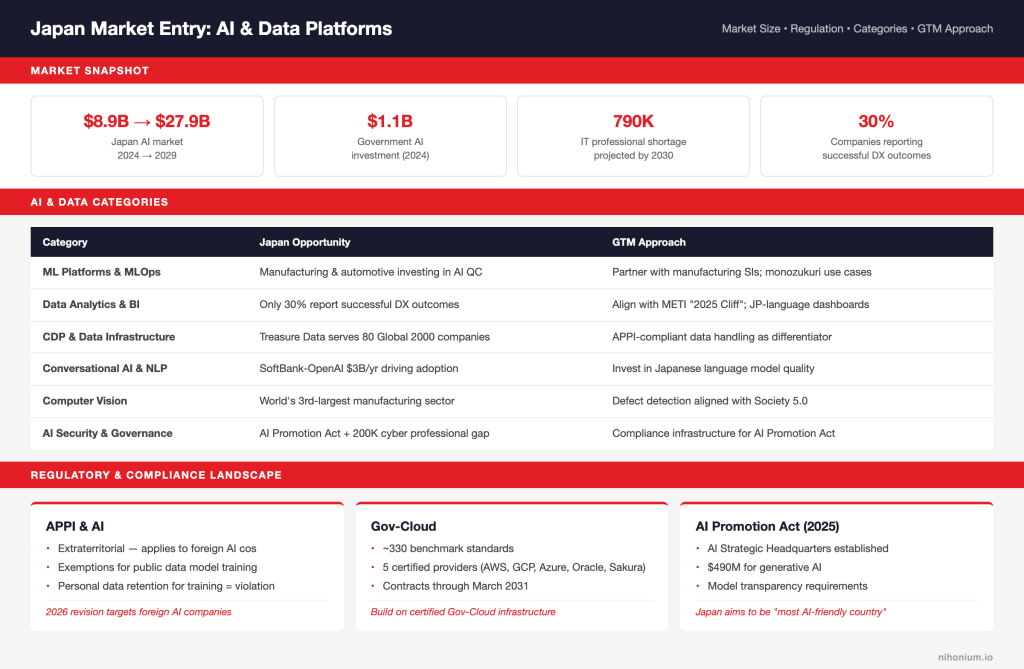
| Category | Japan Opportunity | GTM Approach |
|---|---|---|
| ML Platforms & MLOps | Manufacturing and automotive companies are investing in AI-driven quality control. The projected IT talent shortage (METI, up to about 790,000 people in 2030 in the high scenario) drives demand for platforms that reduce the need for specialist ML engineers. | Partner with manufacturing-focused SIers. Lead with monozukuri (ものづくり, manufacturing craftsmanship) use cases. Position automated ML workflows as an answer to the talent gap. |
| Data Analytics & BI | DX maturity is uneven: in IPA’s DX Trend 2024 survey, 87.6% of companies with more than 1,000 employees ran DX under a company-wide strategy, against 31.0% of companies with 100 or fewer. | Connect to METI’s “2025 digital cliff” message. Offer Japanese-language dashboards. Build Japanese reference customers to overcome risk-averse procurement. |
| CDP & Data Infrastructure | Enterprises are unifying customer data, and buyers ask how personal data is handled under the APPI before they sign. | Make the APPI position documented and easy to review. Integrate with Japanese marketing automation. Highlight omnichannel data unification. |
| Conversational AI & NLP | SB OpenAI Japan sells enterprise AI to large Japanese companies. Japanese language processing remains demanding, which protects well-localized solutions. | Invest in Japanese language quality. Consider carrier and SIer channels. Target customer service automation in financial services and telecom. |
| Computer Vision & Industrial AI | A large manufacturing sector with a culture of visual inspection and aging factory workforces creates demand for vision-based automation. | Build integrations with Japanese industrial equipment (Fanuc, Keyence, Omron). Lead with defect detection use cases. |
| AI Security & Governance | The AI Promotion Act and the 2026 APPI amendment raise governance questions about training data and AI use. ISC2 estimated Japan’s cybersecurity workforce gap at about 110,000 people in 2023, which amplifies demand for automation. | Position as governance infrastructure for enterprise AI use. Target regulated industries first. Partner with Japanese security vendors such as Trend Micro. |
Japan’s AI Landscape: Opportunity and Regulation
Government Support and Strategic Intent
The AI Promotion Act (Act No. 53 of 2025, fully in force since 1 September 2025) set up an AI Strategy Headquarters in the Cabinet to coordinate policy across ministries. The Cabinet approved the first AI Basic Plan under the act on 23 December 2025 and a second plan on 14 July 2026, which says Japan aims to become “the most AI-friendly country in the world”. The government is also a buyer: the Digital Agency began a large-scale trial of its generative AI environment, Gennai (源内), for about 180,000 government staff in May 2026, with about 100,000 able to use it by 29 May. It wants AI, from partners who meet its security and data-handling standards.
Data Sovereignty and Gov-Cloud
The Digital Agency’s Government Cloud is the shared cloud environment for national and local government systems. Providers must meet a long list of technical requirements (305 in the fiscal 2023 round). For the fiscal 2026 round the agency selected five services: Amazon Web Services, Google Cloud, Microsoft Azure, Oracle Cloud Infrastructure and Sakura Internet’s Sakura Cloud, which the agency confirmed had met all technical requirements in March 2026. Central government agencies procure cloud services in principle from the ISMAP list. The APPI itself has no general data-localization rule, but government and regulated-industry buyers often ask for data held in Japan, so AI and data platforms selling to them should be able to run in a Japan region or on a Government Cloud service.
APPI Implications for AI
The APPI applies to foreign businesses that handle the personal information of people in Japan in connection with supplying goods or services to them. The amendment passed in July 2026, in force by July 2028, removes the need for consent to provide personal data to a third party, or to acquire publicly available sensitive personal data, when it is used only to create statistical information, which the Personal Information Protection Commission (PPC) says includes AI development that can be treated as statistics. In June 2023 the PPC warned companies that putting personal data into a generative AI service without consent may breach the APPI if the provider uses it for anything other than producing the answer, such as training, and told them to check that it does not. Enforcement has so far relied on guidance: in fiscal 2025 the PPC received 17,139 breach reports and issued 455 instances of guidance and advice, 2 recommendations and 1 order. The 2026 amendment adds a gain-based surcharge for serious violations.
Key Takeaways
- Japan’s AI market is set to almost triple: IDC Japan forecasts AI spending of JPY 6.89 trillion in 2029, up from JPY 2.37 trillion in 2025.
- Regulatory clarity comes first. The APPI’s cross-border rules, the 2026 amendment and the AI Promotion Act define the questions buyers will ask; settle your position with Japanese counsel before launch, and plan for the Government Cloud and ISMAP only if you sell to government.
- The IT talent shortage makes AI a strategic purchase: up to about 790,000 IT professionals short in 2030 in METI’s high scenario.
- Channel partners shape enterprise procurement. With about 72% of ICT professionals working at IT vendors, SIers such as NTT Data, Fujitsu and NEC give access to pipelines that a direct-only model struggles to reach.
- DX maturity is uneven by company size (IPA, 2024); early entrants that build references in a segment are hard to displace.
Sources
- IDC Japan, domestic AI market forecast (Worldwide AI and Generative AI Spending Guide 2026V1, March 2026)
- U.S. International Trade Administration, Japan Artificial Intelligence Market Intelligence
- Digital Agency of Japan, Government Cloud Policy
- Personal Information Protection Commission, the 2026 APPI amendment and alert on generative AI services (2 June 2023)
- Cabinet Office, AI Basic Plan (23 December 2025; second plan 14 July 2026)
- SoftBank Group and OpenAI, joint release of 3 February 2025; Microsoft, investment in Japan (9 April 2024)
- ICLG, Data Protection Laws and Regulations Report 2025-2026: Japan (further reading)
- Also relied on, cited in plain text: METI IT talent study (March 2019, via JILPT); Digital Agency Gennai trial (May 2026); MIC White Paper 2018; IPA DX Trend 2024; ISC2 (2023); PPC annual report FY2025.
Frequently Asked Questions
What makes Japan’s AI market different from other APAC markets for data platform companies?
Three things. The government aims to make Japan “the most AI-friendly country in the world” and is rolling out generative AI to its own staff. The projected IT talent shortage creates demand for platforms that automate data work. And Japanese procurement rewards long-term vendor relationships, so a well-built position is hard for later entrants to displace.
How does Japan’s APPI affect AI and data platforms operating from outside Japan?
The APPI applies to foreign businesses that handle the personal information of people in Japan in connection with supplying goods or services to them. The 2026 amendment, in force by July 2028, removes the consent requirement for data used only to create statistics, including AI development that can be treated as statistics; until then, and for any other use, the existing consent and cross-border transfer rules apply. Document data flows and purposes of use, and confirm the position with Japanese counsel.
What is the Government Cloud program and how can AI platforms participate?
The Digital Agency’s Government Cloud is the shared cloud infrastructure for national and local government systems; for fiscal 2026 it selected AWS, Google Cloud, Microsoft Azure, Oracle Cloud Infrastructure and Sakura Cloud. AI platforms do not need to become Government Cloud providers themselves: they can run on one of those services and position their solution for public-sector buyers, who will also look for an ISMAP listing for cloud services sold to central government.
How long does Japan market entry typically take for an AI or data platform company?
There is no public benchmark, so use planning assumptions: 6 to 12 months to first mid-market revenue, 12 to 18 months to meaningful enterprise revenue, and enterprise deal cycles of nine to twelve months or more, because consensus-based approval (ringi, 稟議) takes time even for warm opportunities. Set milestones (pipeline, pilots, first contracts) in advance.