
For most B2B SaaS companies entering Japan, inbound marketing builds trust at a lower long-run cost per lead and fits the way Japanese buyers research, while outbound sales remains essential for converting enterprise deals. The strongest Japan entries integrate both: inbound to build trust and generate demand, then relationship-driven outbound to close high-value accounts. Buyers find software through web search and review sites (47.3% and 37.7% of IT buyers in ITreview’s March 2026 survey), while enterprises often buy through partners and introductions, so neither approach alone is sufficient.
Grand View Research estimates Japan’s SaaS market at USD 12.3 billion in 2025, growing about 12% a year to USD 31.3 billion in 2033. Adoption is uneven: in IPA’s DX Trend 2024 survey, 87.6% of companies with more than 1,000 employees pursued digital transformation under a company-wide strategy, against 31.0% of companies with 100 or fewer. That gap is the opportunity, but capturing it requires understanding how Japanese buyers discover, evaluate and purchase software. The dynamics differ sharply from Western markets, and the inbound-versus-outbound calculus shifts accordingly.
Comparison Overview
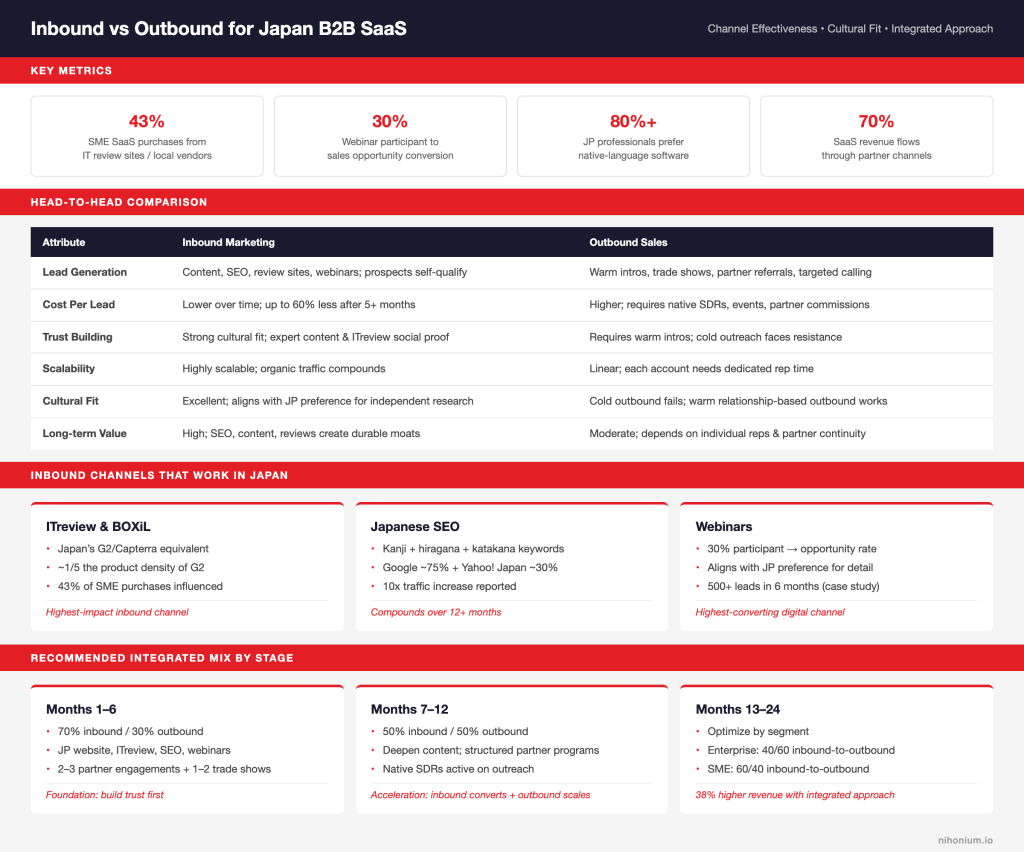
| Attribute | Inbound Marketing | Outbound Sales |
|---|---|---|
| Lead generation method | Attracts buyers through Japanese-language content, SEO, review site listings and webinars; prospects self-qualify | Proactive outreach via warm introductions, trade show follow-ups, partner referrals and targeted calling |
| Cost per lead | High at first, lower over time as content, rankings and reviews compound; measure it by channel in your own data | Higher per-lead cost due to staffing, events and partner commissions; requires native-speaking SDRs |
| Sales cycle impact | Shortens the evaluation phase; pre-educated buyers enter the funnel with higher intent | Speeds up enterprise deals when it builds on existing relationships and partner introductions |
| Trust building | Strong cultural fit; builds credibility through expert content and user reviews on ITreview and BOXIL | Requires warm introductions or established brand recognition; cold outreach meets significant resistance |
| Scalability | Highly scalable; organic traffic compounds over time with low marginal cost | Linear scaling; each account needs dedicated rep time and partner coordination |
| Cultural fit | Excellent; matches the Japanese preference for thorough independent research before engaging a vendor | Moderate; effective when relationship-based, while cold outreach is culturally less appropriate |
| Content requirements | Substantial; native-quality Japanese across three writing systems (kanji, hiragana, katakana) with proper keigo (敬語, honorific language) | Focused on sales collateral and proposals; still requires localization but a narrower scope |
| Localization depth | Deep; SEO keyword research across multiple scripts, culturally adapted messaging, Japan-specific case studies | Moderate to deep; native-speaking sales team essential, formal business communication required |
| Measurement | Trackable through web analytics, review site metrics, content engagement and attribution modeling | Tracked through CRM pipeline stages, partner-sourced deal flow and event conversion rates |
| Long-term value | High; content assets, SEO rankings and review site presence build durable advantages | Moderate; relationships are valuable but depend on individual reps and partner continuity |
Core Distinction: Pull vs Push in a Trust-Based Market
Answer capsule: Japan’s relationship-driven business culture shapes both approaches. Inbound fits Japanese buyers’ preference for independent research and consensus-based decision-making, while outbound has to rely on warm introductions rather than cold outreach.
Japan is a high-context business culture where trust is built step by step. Nemawashi (根回し), laying groundwork and building consensus before a formal decision, means buying cycles involve several stakeholders and long deliberation. The ringisho (稟議書), the written proposal that circulates through management for sign-off, further extends timelines and demands thorough documentation.
This gives inbound marketing a structural advantage. In CSA Research’s 2008 survey of business software buyers in eight countries, every Japanese respondent preferred to buy in Japanese, and buyers research on their own before contacting vendors: in ITreview’s March 2026 survey of 300 people involved in IT purchases, web search was the most common way to find candidate products, and 79.7% always or usually check user reviews. The company with the strongest Japanese-language presence wins the consideration phase. Inbound builds the quiet, persistent credibility Japanese decision-makers value: expert articles, peer reviews on trusted platforms and educational webinars that show competence without aggressive selling.
Outbound faces headwinds when it relies on cold tactics. Unsolicited outreach from an unknown company tends to get little response and can come across as presumptuous. Outbound becomes effective through established channels, however: partner introductions, trade show follow-ups, and targeted calling by native Japanese speakers who use keigo correctly. The distinction is not that outbound fails in Japan; it is that cold outbound struggles. Warm, relationship-mediated outbound remains essential for enterprise sales.
Inbound Channels That Work in Japan
Answer capsule: The most effective inbound channels are Japanese SEO, listings on the ITreview and BOXIL review sites, webinars, and social presence on the platforms where Japanese professionals actually engage: X (Twitter), Facebook, note and LINE, rather than LinkedIn alone.
Japanese SEO and Content Marketing
Japanese SEO requires a different approach. Yahoo! JAPAN, a major portal, has used Google’s search engine since 2010, so organic optimization for both is largely Google optimization, while Yahoo! JAPAN’s ad platform is separate. Keyword research is complex: one concept can be searched in kanji, hiragana, katakana or romaji, each returning different results. Native speakers are essential for mapping keyword strategies across all scripts.
Machine translation is not a shortcut. Search engines reward helpful, well-written content, and Japanese buyers read language quality as a sign of product quality. English is not a workaround either: Japan ranks 86th of 117 countries and regions in the EF English Proficiency Index 2026, so native-quality Japanese content is a requirement.
ITreview and BOXIL Listings
ITreview and BOXIL play the role in Japan that G2 and Capterra play in the West. In ITreview’s March 2026 survey, 37.7% of IT buyers had found candidate products on comparison or review sites, and 87.4% said too few reviews would lead them to drop a product or lower its priority. ITreview, launched in 2018 in partnership with G2 and run by ITcrowd, screens every review by hand, requires reviewers’ real names and offers vendors a free listing. BOXIL, run by SmartCamp, combines reviews with lead generation through document requests, on a paid plan of JPY 50,000 a month (one-year minimum) plus a fee per lead.
There is also less crowding: ITreview lists about 16,000 products (15,990 on 19 November 2026), while G2 lists more than 200,000 products and services, so a new entrant has fewer listings to stand out from. An early presence, with Japanese-language product pages, localized screenshots and reviews collected within each site’s rules, builds steady inbound lead flow. Note that BOXIL bans reviews paid for or solicited by the vendor, except in campaigns run jointly with SmartCamp; ITreview asks vendors to request reviews from their customers through sales and customer success.
Webinars and Virtual Events
Webinars are one of the most productive inbound channels in Japan. Events already matter: 24.3% of buyers in ITreview’s survey had found candidate products at exhibitions, events or talks, and webinars bring that format online. Japanese audiences expect technically rigorous presentations with clear agendas and ample time for Q&A. The format suits Japanese business culture: detailed information without high-pressure tactics, and materials attendees can share with colleagues during nemawashi and attach to the ringisho.
Social Media: Beyond LinkedIn
Social media is a real discovery channel: 26.7% of buyers in ITreview’s survey had found candidate products through it. LinkedIn plays a smaller role in Japan than in the West, and many professionals see it mainly as a job-hunting tool. Other useful channels include Facebook (used for professional networking), X (industry news and thought leadership), note (long-form business writing) and LINE (messaging, with business accounts).
When to Choose Each
Answer capsule: Inbound is stronger for brand building, SME acquisition and budget-constrained entry. Outbound is essential for enterprise targeting, where partner networks can be leveraged. New entrants benefit most from leading with inbound while building outbound capabilities in parallel.
| Scenario | Recommended Approach | Rationale |
|---|---|---|
| Brand building | Inbound-led | Content, SEO and review site presence build awareness at scale; Japanese buyers research extensively before engaging vendors |
| Enterprise targeting | Outbound-led | Large enterprises rely on trusted partner introductions; direct sales with native-speaking reps is essential |
| SME acquisition | Inbound-led | Buyers find candidates through web search and review sites; self-service discovery suits SME buying behavior, and a local IT vendor’s recommendation also carries weight |
| Limited budget | Inbound-led | Content and SEO investments compound over time; lower initial cost than hiring sales teams or exhibiting at trade shows |
| Established brand | Outbound-led with inbound support | Known brands can use their reputation for direct outreach; inbound maintains visibility while outbound drives pipeline |
| New market entrant | Inbound-first, then layer outbound | Build trust through localized content before investing in outbound; cold outreach without brand awareness converts poorly |
| Partner-driven GTM | Integrated | Indirect channels carry unusual weight in Japan (Zoom made about 70% of its Japan sales through partners); inbound generates leads while outbound supports partner co-selling |
| Rapid pipeline generation | Outbound-led with event focus | Trade shows and targeted calling generate near-term pipeline; Japan has a busy calendar of IT exhibitions such as Japan IT Week |
The Integrated Approach
Answer capsule: The strongest B2B SaaS companies in Japan combine inbound for awareness with outbound for enterprise conversion, because a typical deal passes through both before it closes.
Consider a typical Japanese SaaS buyer journey: a manager discovers a solution through a blog post or ITreview listing (inbound), shares it with colleagues as part of nemawashi, attends a vendor webinar (inbound), then receives a warm introduction through a channel partner (outbound). The deal closes only after several touchpoints across both approaches.
Recommended Channel Mix by Stage
The splits below are a starting allocation to test against your own results, not a benchmark.
Months 1–6 (Foundation): Put about 70% into inbound: launch a Japanese-language website, set up ITreview and BOXIL profiles, begin Japanese SEO and host the first webinars. Put about 30% into outbound: engage two or three potential channel partners and attend one or two industry trade shows.
Months 7–12 (Acceleration): Move toward 50/50. Deepen inbound with regular content publishing and review collection. Intensify outbound with structured partner programs and targeted outreach by native-speaking SDRs. Inbound leads begin converting while outbound benefits from the credibility inbound has built.
Months 13–24 (Scale): Optimize based on data, for example 40/60 inbound to outbound for enterprise-focused companies, or 60/40 for SME-focused companies. Inbound keeps compounding through organic traffic, while outbound uses established partner relationships and customer references for warm introductions.
Integration Tactics
Use webinar attendee lists as warm outbound targets: participants who engaged with content have shown interest, which makes follow-up culturally appropriate. Equip channel partners with localized content they can share through their networks. Syndicate content through Japanese business media such as Nikkei and ITmedia, and announce news through PR TIMES. Use trade show appearances to drive webinar registrations and review submissions, creating a cycle between in-person and digital channels.
Key Takeaways
- Inbound marketing has a structural advantage in Japan’s trust-driven B2B culture: Japanese business buyers prefer to buy in Japanese and research independently before engaging vendors, which makes Japanese-language content, SEO and review site presence foundational.
- Cold outbound underperforms, but warm outbound is essential: indirect channels carry unusual weight in Japan and unsolicited outreach gets little response, so outbound success depends on partner introductions and native-speaking sales teams.
- ITreview and BOXIL are core inbound channels: 37.7% of IT buyers find candidate products on comparison or review sites, and ITreview lists far fewer products than G2 (about 16,000 against more than 200,000).
- Webinars are one of Japan’s most productive digital channels: the format matches Japanese expectations for detailed, non-aggressive vendor engagement and gives champions material for internal approval.
- The integrated approach wins: lead with inbound in months one through six, layer relationship-driven outbound from month seven, and adjust the mix to whether you target SMEs (inbound-heavy) or enterprises (outbound-heavy).
Working with Nihonium. We are a Japan go-to-market partner for B2B SaaS companies: sales and marketing funnel (awareness, SEO, local leads) and fractional sales team (Japanese-speaking sales, first email to closing to account management). Talk to us about your Japan entry.
Sources
- ITcrowd (ITreview), IT product selection white paper (300 people involved in IT purchases, March 2026): discovery routes, review checking.
- CSA Research, Businesses Prefer Local Language Purchasing (2008 survey of business software buyers in eight countries).
- Grand View Research, Japan SaaS market outlook: USD 12.3 billion in 2025 to USD 31.3 billion in 2033. Also cited: IPA, DX Trend 2024; EF English Proficiency Index 2026; Zoom’s Japan partner share via Firstlight Capital (Zoom’s figure, not a market statistic).
- Platform pages: BOXIL service page (plans) and review guidelines; ITreview home page and vendor FAQ; G2 company page (more than 200,000 products and services listed); Yahoo Japan release of 27 July 2010 on adopting Google’s search engine.
- Nihonium, 10 Data Trends Shaping Japan’s SaaS Market in 2025: further reading on the market (not the source of the figures in this post).
- Nihonium, Top 5 Japanese Marketing Channels for B2B SaaS: further reading on channels.
- Nihonium, Insights on the Japan SaaS Market from G2 and ITReview: further reading on review platforms.
- IAD Marketing, Why Telemarketing Still Works in Japan: a telemarketing vendor’s view of culturally adapted outreach.
Frequently Asked Questions
Is cold email effective in Japan?
Cold email is much less effective in Japan than in Western markets. Japanese business culture prioritizes established relationships and formal introductions, so unsolicited emails from unknown companies are often ignored, and many companies have policies on engaging with unsolicited vendors. If you use email outreach, it should follow a warm touchpoint, such as a trade show meeting, webinar attendance or a partner introduction, and be written in flawless Japanese with appropriate keigo. High-volume, English-language cold email campaigns will produce almost nothing.
What review sites matter most for Japan B2B SaaS?
ITreview and BOXIL are the two main platforms, playing the role G2 and Capterra play elsewhere. ITreview centers on screened user reviews and offers a free listing; BOXIL combines reviews with paid lead generation through document requests. In ITreview’s March 2026 survey, 37.7% of IT buyers had found candidate products on comparison or review sites. G2 and Capterra matter less to Japanese buyers, who research in Japanese on local platforms. Complete profiles on both, with Japanese descriptions, localized screenshots and reviews collected within each site’s rules, should be an early priority; our guide to Japanese SaaS review sites compares them.
How important is Japanese-language content?
It is a prerequisite for market entry, not an optional enhancement. In CSA Research’s 2008 survey, every Japanese business software buyer preferred to buy in Japanese, and Japan ranks 86th of 117 in the EF English Proficiency Index 2026. Japanese buyers read language quality as a sign of product quality, so poorly translated content damages trust. Content must work across three writing systems (kanji, hiragana, katakana), and keyword strategies must allow for a concept being searched in any of them. Invest in native Japanese writers with SaaS expertise rather than machine translation.
How long before inbound generates leads in Japan?
No public benchmark exists, so treat any timeline as a planning assumption. Review site listings usually produce the first inquiries, once a profile is complete and has collected reviews: on ITreview’s free plan, a lead trial opens once a product has three or more reviews. Webinars can produce leads early on. Japanese SEO takes longest, because keyword work spans several scripts and domain authority needs Japanese-language backlinks; expect it to compound over a year or more. Track cost per lead by channel from the start, so you can see when inbound becomes cheaper than outbound for your product.