

Sales-led growth dominates Japan’s B2B SaaS market today, but community-led growth is emerging as a useful trust-building complement, not a replacement.
Research Nester sizes Japan’s SaaS market at USD 13.8 billion in 2026 and expects it to grow about 13.5% a year to 2035. As global SaaS companies plan their entry, one of the most consequential decisions is how to generate pipeline: through structured sales motions or through organic, community-driven adoption. In Western markets, community-led growth (CLG) is often associated with companies such as Figma, Notion and dbt Labs. Japan is a different landscape, shaped by consensus-based procurement through ringi (稟議, the formal approval circular in which a written proposal goes up the hierarchy for sign-off) and nemawashi (根回し, informal consensus-building beforehand), by dense personal networks (ningen kankei, 人間関係, human relationships) and by buyers who put peer validation ahead of self-serve discovery.
This comparison matters for any SaaS leader planning a Japan entry or expansion. Choosing the wrong primary growth motion can cost quarters of runway before the mismatch between your go-to-market and the way Japanese companies actually buy software becomes visible. For the related choice between product-led and sales-led growth, see our PLG vs SLG comparison for Japan.
Comparison Overview
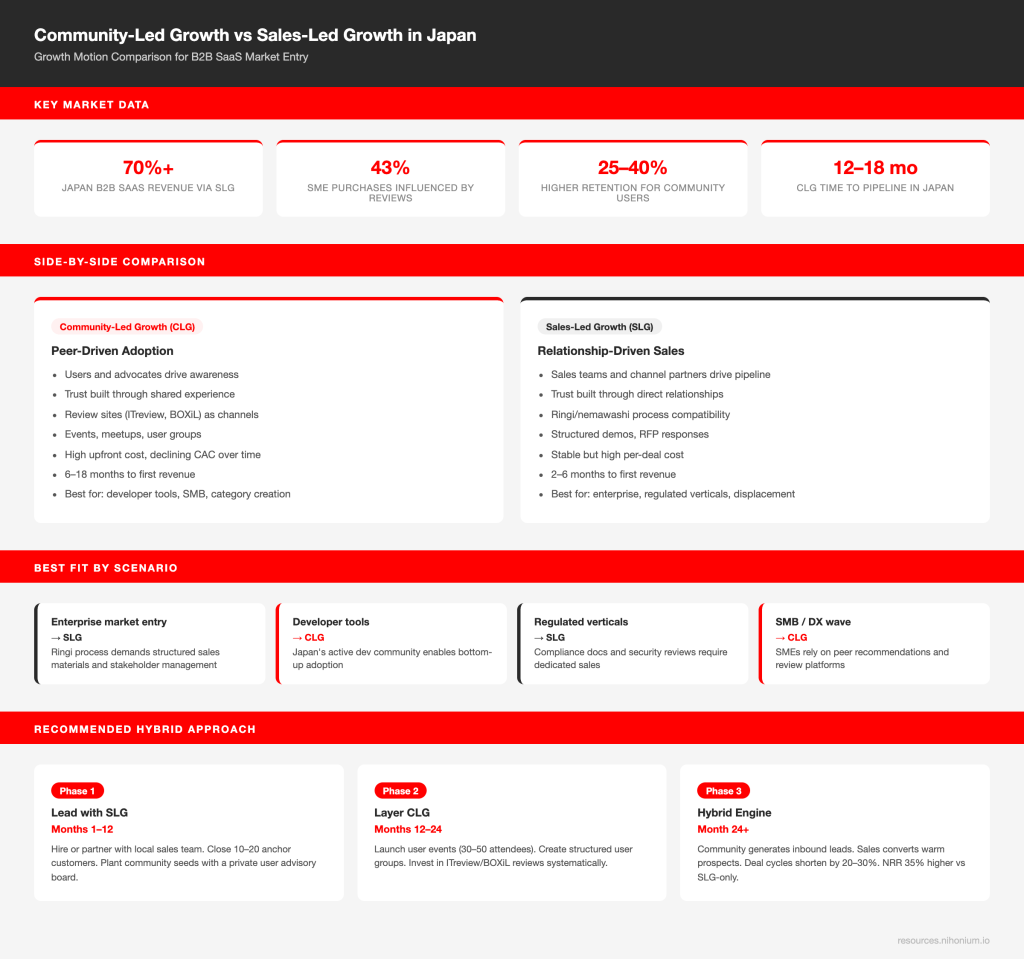
CLG vs SLG at a Glance
| Attribute | Community-Led Growth (CLG) | Sales-Led Growth (SLG) |
|---|---|---|
| Primary acquisition channel | User communities, forums, meetups, peer advocacy | Outbound sales teams, channel partners, direct enterprise sales |
| Weight in Japan B2B SaaS | A complement; no reliable figure measures its share of revenue | The default motion; indirect channels carry unusual weight (Zoom, for example, made about 70% of its Japan sales through partners against about 90% direct in the US) |
| Buyer trust mechanism | Peer validation, user-generated proof, shared experience | Relationship-based trust, in-person demos, reference customers |
| Sales cycle length | A long build before the community produces pipeline, then compounding | As a planning assumption, two to three quarters for mid-market deals and nine months to a year or more for enterprise deals |
| CAC trajectory | High upfront, declining over time as the community scales | Relatively stable but high per-deal cost, especially for enterprise |
| Cultural alignment with Japan | Strong fit with peer validation norms; weak fit with formal procurement | Strong fit with ringi, nemawashi and a relationship-first culture |
| Scalability | Highly scalable once the community reaches critical mass | Linear scaling: revenue grows roughly with headcount |
| Time to first revenue | Slower: community building comes before conversion | Faster: direct outreach to qualified accounts, though enterprise approval still takes quarters |
| Best company stage | Post-PMF with an engaged user base, or category creators | Any stage with a clear ICP and willingness to invest in a local team |
| Retention impact | Engaged community members are a common source of renewals and references; measure the effect in your own data | Retention depends on customer success quality and ongoing relationship management |
| Content and knowledge sharing | User-generated content, community case studies, organic evangelism | Vendor-produced collateral, sales decks, analyst reports |
| Japan-specific examples | Cybozu’s kintone hive user events and the user-run kintone Café study groups; Sansan’s Innovation Award for customers | Enterprise vendors such as Salesforce, SAP and Oracle selling through account teams and partners; Atlassian selling through local partners |
Core Distinction: Who Drives the Buying Decision
CLG lets peers drive demand through shared experience; SLG gives that job to a dedicated sales organization.
The fundamental difference between community-led and sales-led growth is not just a question of channels: it is a question of who holds persuasive authority in the buyer’s journey. In a sales-led motion, an account executive or channel partner guides the prospect through evaluation, objection handling and procurement. In a community-led motion, existing users and advocates create the pull that draws new buyers toward a product.
In Japan, this distinction carries particular weight. Japanese B2B procurement relies heavily on internal consensus: the ringisho (稟議書, the written proposal) circulates to every manager the decision affects, and nemawashi means the decision is effectively made before the formal approval. The bigger the purchase, the more people are involved: in One Marketing’s 2025 survey of 600 Japanese B2B buyers (all purchases, not only software), the average rose from 5.6 people for purchases under JPY 3 million to 18.3 in the highest price band. A strong community presence gives internal champions what they need during nemawashi: user testimonials, peer case studies and evidence that respected companies in their industry already use the product.
Consider how Cybozu built the kintone ecosystem. Alongside its sales and partner channels, Cybozu has run kintone hive, an official user event where customers present their own use cases, since 2015, while users themselves started kintone Café study groups in 2013. A department head evaluating workflow tools meets not only a sales pitch but practitioners who have solved similar problems. Large enterprise vendors such as Salesforce took the other route in Japan: account teams and a partner ecosystem embedded in enterprise accounts, a classic SLG approach that matches the expectations of large Japanese buyers.
Building Community in Japan’s B2B SaaS Market
Japanese business culture is receptive to CLG, but it needs a more structured and formal approach than Western community playbooks assume.
Japan has an active tech community that many foreign SaaS companies underestimate. Developer relations events, user group meetups and industry conferences are well attended and influence purchasing. Building community in Japan, however, follows different norms than in the United States or Europe.
Community-Led Growth: The Japan Playbook
Successful CLG in Japan differs from Western models in several ways. Japanese user communities tend to operate with more structure and formality.
- Review sites as quasi-community: Platforms like ITreview and BOXIL work as hybrid community and review channels. In a March 2026 survey of 300 people involved in IT purchases, run by ITreview’s operator, 37.7% of those who answered had found candidate products on comparison or review sites, and 79.7% always or usually check user reviews.
- Event-driven engagement: User events such as Cybozu’s kintone hive and customer awards such as Sansan’s Innovation Award create in-person trust networks and public success stories that feed referrals.
- Slow trust, deep loyalty: A CLG strategy in Japan can take a long time to produce measurable pipeline, but members who invest in a community tend to become references and advocates.
- Language and localization: Community content must be native Japanese, not translated English. User-generated content in Japanese carries more trust than translated vendor materials.
Sales-Led Growth: The Proven Path
Sales-led growth remains the default for good reason. Japan’s enterprise procurement process is designed around human relationships and structured evaluation.
- Ringi compatibility: Sales teams can produce the specific documents (ROI analyses, security questionnaires, comparison matrices) that ringi approval requires.
- Channel partner leverage: Japan’s IT distribution ecosystem, with distributors and resellers such as Otsuka Corporation, Macnica and SB C&S, gives SLG-oriented companies access to established enterprise relationships. Indirect channels matter because so much IT work sits with vendors: about 72% of Japan’s ICT professionals work at IT vendors rather than at user companies (MIC White Paper 2018).
- Executive relationship mapping: SLG allows deliberate relationship building at executive level through structured account plans, which matters for large deals.
- Faster initial revenue: A well-equipped sales team usually closes its first deals sooner than a community can produce them, providing the cash flow to fund longer-term investments such as community building.
When to Choose Each
Choose SLG for immediate enterprise pipeline in Japan; choose CLG when building a category or targeting mid-market and SMB segments.
Best Fit by Scenario
| Scenario | Best Fit | Why |
|---|---|---|
| First-year Japan market entry targeting enterprise | SLG | Enterprise buyers expect direct sales engagement; ringi demands structured materials a sales team can provide efficiently |
| Developer-focused or horizontal SaaS tool | CLG | Japan’s developer community is active and self-organizing; bottom-up adoption through user advocacy eases slow top-down procurement |
| Established product with a base of Japan customers | CLG + SLG Hybrid | Existing customers become community advocates who warm up new prospects before sales engages, which can lower acquisition cost |
| Targeting SMEs in Japan’s DX wave | CLG | SMEs adopting SaaS as part of digital transformation (DX) rely heavily on peer recommendations and review platforms |
| High-ACV vertical SaaS (e.g., healthcare, finance) | SLG | Regulated industries require compliance documentation, security reviews and procurement processes that need dedicated sales support |
| Category creation, no established Japan market | CLG | When buyers do not yet recognize the category, community education and practitioner evangelism build awareness more credibly than outbound sales |
| Competing against an entrenched local incumbent | SLG | Displacing a known vendor requires direct competitive selling, reference customers and executive-level relationship work |
| Product with strong self-serve or freemium motion | CLG | Self-serve users form natural community nuclei; tech-forward SMBs in Japan increasingly adopt through peer discovery |
Can You Use Both Together?
Yes, and for Japan specifically, a hybrid is usually the most effective strategy for SaaS companies past the initial entry phase.
The CLG-versus-SLG framing suggests a binary choice, but in practice community and sales reinforce each other. The key is sequencing: most foreign SaaS companies entering Japan should lead with SLG to generate initial revenue and reference customers, then layer CLG on top once they have a critical mass of users. The phases below are a planning outline, not a benchmark.
In the first phase, roughly the first year, the primary motion is sales-led. Hire or partner with a local sales team that understands enterprise procurement, and close a first group of anchor customers who can serve as references. Plant the seeds of community by inviting early customers into a private user group or advisory board.
In the second phase, begin formalizing the community. Hold a first user event, set up a user group that meets regularly, and ask customers for reviews on ITreview and BOXIL within each site’s rules (BOXIL, for example, bans reviews paid for or solicited by the vendor outside campaigns run with SmartCamp, its operator). This is where CLG begins generating inbound interest that the sales team can convert.
In the third phase, the community becomes a genuine growth engine. User-generated case studies, community-sourced leads and peer referrals begin to supplement outbound sales, and the sales team shifts from cold outreach to warm conversations with community-influenced prospects. Track deal cycle length and net revenue retention for community-engaged accounts to see whether the investment is paying off.
Key Takeaways
Japan rewards patience and cultural alignment whatever the growth motion: the right strategy depends on your stage, segment and willingness to invest for the long term.
- SLG remains the dominant growth motion in Japan. Enterprise procurement processes (ringi, nemawashi) are structurally aligned with sales-led approaches, and indirect channels carry unusual weight; this will not change quickly.
- CLG is emerging as an accelerant, not a replacement. Cybozu’s kintone community shows that community-driven adoption can work in Japan, but it takes sustained investment before it produces measurable pipeline.
- Review platforms function as Japan’s quasi-community layer. With 37.7% of IT buyers finding candidate products on comparison or review sites (ITreview survey, March 2026), a steady flow of genuine reviews on ITreview and BOXIL delivers community-like benefits faster than building a community from scratch.
- The optimal Japan strategy is sequenced: SLG first, CLG second, hybrid always. Lead with sales to establish credibility and reference customers, then build community on that foundation.
- Cultural nuance determines CLG success in Japan. Japanese user communities are more formal, event-driven and relationship-oriented than Western ones. Content must be native Japanese, events must be structured, and community management must respect hierarchical norms.
Working with Nihonium. We are a Japan go-to-market partner for B2B SaaS companies: Japan go-to-market strategy. Talk to us about your Japan entry.
Sources
- Research Nester, Japan Software as a Service (SaaS) Market Size and Growth Outlook 2035: USD 13.8 billion in 2026, about 13.5% a year to 2035.
- ITcrowd (ITreview), IT product selection white paper (300 people involved in IT purchases, March 2026).
- One Marketing, BtoB Purchasing Process White Paper 2025 (600 buyers): people involved by price band.
- Zoom’s Japan partner share, via Firstlight Capital (Zoom’s figure, not a market statistic); MIC, Information and Communications White Paper 2018 (72% of ICT professionals at IT vendors).
- Company and event pages: Cybozu kintone hive (since May 2015) and kintone Café (user-run, since December 2013); Sansan Innovation Award 2026; Atlassian, ten years in Japan; BOXIL review guidelines.
Frequently Asked Questions
Is community-led growth viable for enterprise SaaS in Japan?
Yes, but it works differently at enterprise level. Rather than driving self-serve adoption, CLG in enterprise accounts works as a trust-building and demand-generation layer. Executive user groups, invitation-only roundtables and industry communities create peer validation that influences the people involved in nemawashi. In Japanese enterprises, CLG speeds up and de-risks the sales process rather than replacing it.
How long does it take to build a meaningful user community in Japan?
No public benchmark exists, so plan in stages and judge progress by activity rather than a calendar. First, identify and nurture a core group of advocates among existing customers. Next, formalize the community with regular events and structured knowledge sharing. A community is meaningful once it produces user content, referrals and event attendance without heavy vendor orchestration, which usually takes well over a year of consistent investment.
What role do channel partners play in a hybrid CLG-SLG strategy?
Channel partners bridge the two motions. Indirect channels carry unusual weight in Japan: Zoom made about 70% of its Japan sales through partners, and most of Japan’s IT professionals work at vendors rather than user companies. In a hybrid model, partners carry the SLG function while the vendor invests in community that builds awareness and demand. Invite partner teams to community events so that they benefit from community-generated leads.
How should a foreign SaaS company measure CLG ROI in Japan?
Track leading and lagging indicators over a long horizon. Leading indicators include community membership growth, event attendance and repeat attendance, user-generated content in Japanese, and review counts on ITreview or BOXIL. Lagging indicators include community-sourced pipeline, community-influenced revenue, net revenue retention among community-engaged accounts, and acquisition cost over time. Judge the return over at least eighteen months to two years.