
A SaaS company selling in Japan meets a small set of core rules: the Act on the Protection of Personal Information (APPI) for personal data, including breach reports to the regulator within about three to five days and rules for transfers abroad; ISMAP for cloud sales to central government; the Qualified Invoice System for consumption tax; and sector rules in finance, healthcare and telecommunications. APPI fines reach JPY 100 million for a company that breaches a regulator’s order.
APPI: Japan’s Data Privacy Framework
The Act on the Protection of Personal Information (APPI, 個人情報保護法) is Japan’s main data protection law. It was enacted in 2003 and took full effect in 2005; the 2020 amendment (in force since 1 April 2022) added mandatory breach reporting and stricter transfer rules, and an amendment passed in July 2026 adds a gain-based surcharge by July 2028. The regulator is the Personal Information Protection Commission (PPC). APPI also reaches foreign businesses: under Article 171, the Act applies to a business abroad that handles the personal information of people in Japan in connection with supplying goods or services to them, wherever the business is incorporated and wherever its servers are.
APPI defines personal information broadly: any information about a living individual that can identify that person, alone or when easily matched with other information, plus individual identification codes. For a SaaS product, that covers names, email addresses, employee IDs and usage data linked to a person. The 2020 amendment added “personally referable information” (個人関連情報): data such as cookie IDs or browsing histories that identifies no one on its own but may become personal data in the recipient’s hands.
The core obligations differ from the GDPR in one important way: APPI does not require consent to collect ordinary personal information. A business must specify the purpose of use and notify the individual or publish it, keep data accurate and secure, supervise employees and contractors (entrusted parties) who handle it, and respond to requests for disclosure, correction and, under set conditions, suspension of use or deletion. Consent is required to acquire sensitive (“special care-required”) information such as medical history, criminal records or race, to use data beyond the stated purpose, to provide data to a third party (with exceptions such as entrustment to a processor and joint use), and to transfer data to a third party abroad unless another legal route applies. Third-party provision must be recorded by both sides and the records kept for one or three years (Articles 29 and 30); data handled for a customer under entrustment is outside this, and there is no GDPR-style register of processing activities.
In practice, publish a Japanese privacy policy stating the purposes of use, security measures and how data is shared. APPI has no general cookie-consent rule: consent is needed when a recipient is expected to link cookie data or similar to a person. The Telecommunications Business Act separately requires many sites and apps to tell users what data they send to third parties (see the FAQ below).
Breach Notification Requirements
Since 1 April 2022, APPI requires a business that suffers a qualifying data breach to report it to the PPC and to notify the people affected.
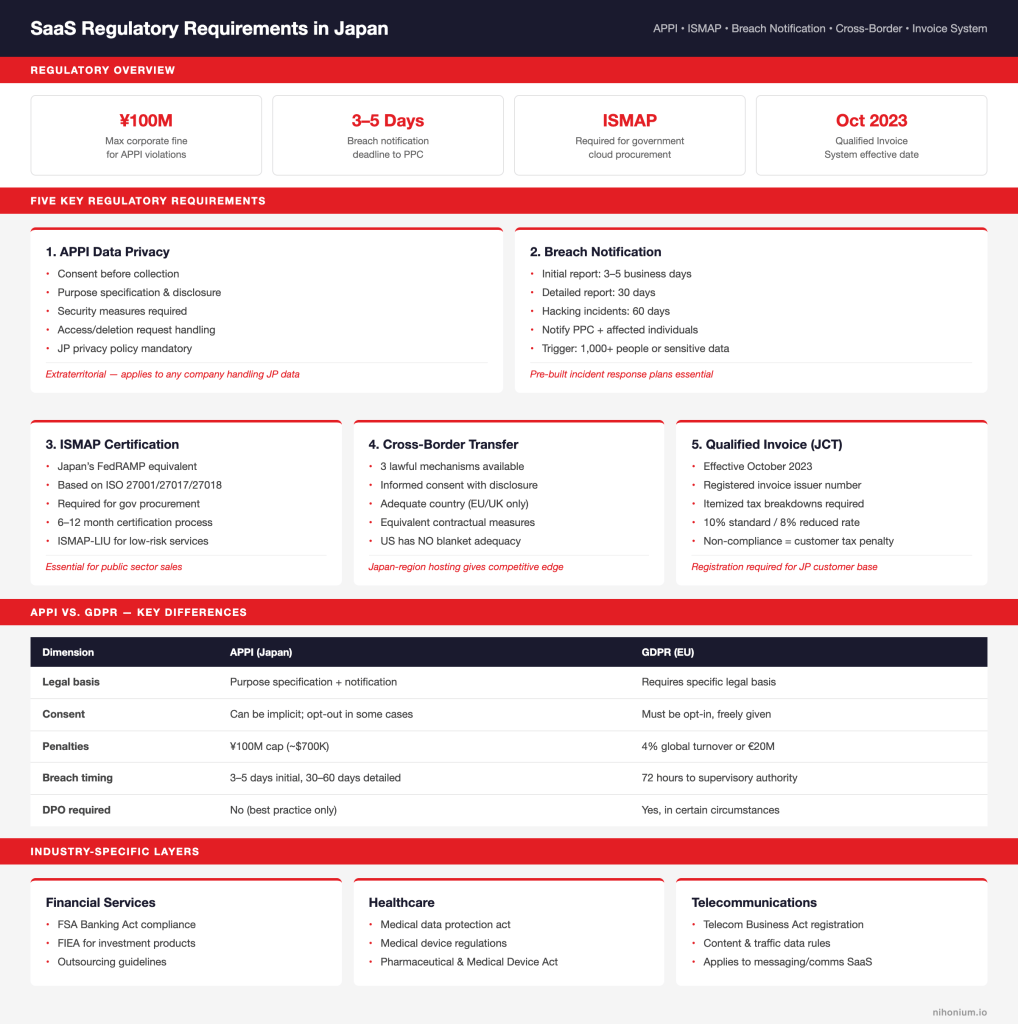
The PPC’s guidelines set the timing: a preliminary report “promptly”, which the PPC puts at about three to five days after the business learns of the breach (calendar days, not business days), and a final report within 30 days, or 60 days where the breach may involve a wrongful purpose, which includes unauthorized access. That is slightly longer than the GDPR’s 72 hours but still leaves little time to investigate, so have incident response ready in advance.
A breach must be reported if it involves sensitive personal information (even a single record), data whose misuse could cause financial damage (such as card numbers), a possible wrongful purpose (such as an attack or theft), or more than 1,000 people. For SaaS companies that process data for Japanese customers, these triggers mean even a small incident can require a report. A SaaS provider that handles data for its customer under entrustment can meet the duty by promptly informing the customer, which then reports to the PPC (Article 26(1) proviso; PPC General Rules guidelines).
Penalties and Enforcement
The 2020 amendment raised APPI’s penalties from 12 December 2020. An individual who breaches a PPC order faces up to one year of imprisonment (拘禁刑) or a fine of up to JPY 1 million, and the company can be fined up to JPY 100 million. These amounts are far below the GDPR’s turnover-based fines, but the 2026 amendment adds a surcharge based on the gain from serious violations affecting 1,000 or more people, expected in force by July 2028.
The PPC can collect reports, inspect, give guidance, issue recommendations and orders, and publish the fact that an order was breached (Article 148). Publication alone can damage a vendor’s reputation in Japan.
The PPC’s annual report for fiscal 2025 (April 2025 to March 2026) shows the scale of its work: 17,139 breach reports handled, 455 cases of guidance and advice, 2 recommendations and 1 order.
Cross-Border Data Transfer Rules
For SaaS companies that process Japanese customer data outside Japan, which includes most international providers hosted on global cloud platforms, APPI’s rules for providing personal data to a third party abroad matter a great deal.
There are three routes. The first is a recipient in a country the PPC has designated as having an equivalent level of protection: the PPC has designated the states of the European Economic Area (the EU plus Iceland, Liechtenstein and Norway) and the United Kingdom, based on the mutual arrangement with the EU in force since 23 January 2019. The second is a recipient that maintains a system meeting APPI’s standards, usually set up through a contract or internal rules with data protection terms (comparable in purpose to the GDPR’s Standard Contractual Clauses); the provider must then check on the recipient’s compliance. The third is the individual’s consent, given after being told the destination country, its data protection system and the recipient’s measures. The United States has no designation.
In practice, data processing agreements must address transfers abroad, and customers need to know where their data is stored. Many Japanese enterprise customers, particularly in finance and healthcare, prefer data to stay in Japan, so a Japan-region hosting option helps.
ISMAP: Government Cloud Certification
The Information system Security Management and Assessment Program (ISMAP) is Japan’s security assessment scheme for cloud services bought by central government. It began operating in June 2020 and is run by the National Cybersecurity Office (NCO, which replaced NISC on 1 July 2025), the Digital Agency, the Ministry of Internal Affairs and Communications (MIC) and the Ministry of Economy, Trade and Industry (METI). Government agencies procure cloud services, in principle, from the ISMAP cloud service list, so a SaaS company that wants to sell to them needs to be on it.
Listing requires an audit by an ISMAP-registered audit body against ISMAP’s management criteria. These are based on Japan’s cloud information security management standard, which draws on JIS Q 27001, 27002 and 27017 (the Japanese versions of ISO/IEC 27001, 27002 and 27017), with reference to the Government Unified Standards and NIST SP 800-53, plus governance criteria based on JIS Q 27014.
Preparation and audit take substantial documentation, work and cost; no official figure for the time involved exists. The criteria are being revised: a draft went to public consultation in autumn 2025 and was still being tested in 2026, with no date set for when it applies, so check the ISMAP portal before you plan an audit. For the public sector, ISMAP is a prerequisite, not an option.
Since 1 November 2022, ISMAP-LIU (Low-Impact Use) has offered a lighter route for SaaS used for low-risk work and information. ISMAP is not required for private-sector sales, though some large buyers ask about it.
The Qualified Invoice System (Invoice System)
Japan’s Qualified Invoice System (適格請求書等保存方式, tekikaku seikyūsho tō hozon hōshiki), in effect since 1 October 2023, matters to any SaaS company that charges Japanese customers consumption tax. Under it, a business customer can claim input tax credit on a purchase only if it holds a qualified invoice from a registered issuer.
A registered seller’s invoices must carry the registration number (T plus 13 digits), the rate (10% standard or 8% reduced) and the tax per rate, as the National Tax Agency (NTA) sets out. Japanese customers buying from an unregistered seller can claim only part of the input tax under transitional relief, which the fiscal 2026 tax reform extended: 70% from 1 October 2026, 50% from 1 October 2028, 30% from 1 October 2030, and nothing from 1 October 2031 (with a cap of JPY 100 million of purchases a year per supplier).
Foreign SaaS sellers face different rules for these “electronic services”. Business-type services (normally limited to business customers by their nature or terms) fall under the reverse charge: the Japanese customer accounts for the tax. Consumer-type services, which include most SaaS that anyone can sign up for, are taxed on the foreign seller, and a Japanese business customer can claim input credit only if the seller is a registered qualified invoice issuer; the transitional relief does not apply to them. Which regime applies to your product is a question for a Japanese tax adviser.
Industry-Specific Regulations
Beyond these general rules, SaaS companies serving specific sectors meet further requirements. In financial services, the Financial Services Agency (FSA) supervises banks, insurers and securities firms under the Banking Act, the Financial Instruments and Exchange Act (FIEA) and other laws, and its supervisory guidelines set rules for outsourcing (外部委託) that reach cloud and SaaS vendors through their customers; many also expect the voluntary FISC Security Guidelines (14th edition, March 2026). In healthcare, APPI applies, together with the Ministry of Health, Labour and Welfare (MHLW) Guidelines for the Security Management of Medical Information Systems (version 7.0, June 2026) and the MIC and METI guidelines for providers of information systems and services that handle medical information (version 2.0, March 2025); software that qualifies as a medical device is regulated under the Pharmaceuticals and Medical Devices Act (薬機法). Communication services fall under the Telecommunications Business Act (see the FAQ below).
All of this calls for Japanese legal and tax counsel and regular monitoring, because the rules are changing quickly. SaaS companies that can show how they meet them make approval easier for Japanese buyers.
Key Takeaways
- APPI applies to foreign SaaS providers too: Under Article 171, APPI covers foreign businesses that handle personal information of people in Japan while supplying goods or services to them, wherever the company is headquartered or its servers are located.
- Breach reporting is fast: APPI requires a preliminary report to the PPC within about three to five days of learning of a qualifying breach and a final report within 30 days (60 days for wrongful-purpose cases such as unauthorized access); have a response plan ready.
- Transfers abroad need a legal route: Transferring Japanese personal data to a third party outside Japan needs the individual’s informed consent, a recipient with an APPI-standard system, or a designated country (the EEA states and the UK); the United States has no designation.
- Industry rules add layers: Financial services, healthcare, telecommunications and central government sales each bring requirements beyond APPI that affect SaaS product design and operations.
- Compliance helps sales: Japanese enterprise buyers check regulatory compliance during vendor evaluation, and documented compliance makes their approval easier.
Working with Nihonium. We are a Japan go-to-market partner for B2B SaaS companies: Japan go-to-market strategy. Talk to us about your Japan entry.
Sources
- Personal Information Protection Commission, Act on the Protection of Personal Information, guidelines and the 2020 amendment (in force 1 April 2022); General Rules guidelines (breach reporting, personally referable information); EU and UK designation; Annual report, fiscal 2025.
- e-Gov Laws, Act on the Protection of Personal Information (Act No. 57 of 2003) Articles 17 to 31, 148, 171, 178 and 184.
- National Cybersecurity Office (NCO), ISMAP: operation since June 2020, the cloud service list, management criteria, ISMAP-LIU and the criteria revision
- National Tax Agency (NTA), Consumption tax on cross-border electronic services and the qualified invoice system review (fiscal 2026 reform).
- Ministry of Internal Affairs and Communications (MIC), External transmission rule (Telecommunications Business Act, in force 16 June 2023); notification and registration procedures.
- Ministry of Health, Labour and Welfare (MHLW), Guidelines for the Security Management of Medical Information Systems (version 7.0). Financial Services Agency, supervisory guidelines for major banks (outsourcing, III-3-3-4).
Frequently Asked Questions
Do we need to store data in Japan to comply with APPI?
No. APPI has no data localization requirement, but transfers to a third party abroad need a legal route: informed consent, a recipient with an APPI-standard system (usually set up by contract), or a designated country (the EEA states and the UK). A Japan-region hosting option (such as AWS Tokyo) simplifies this, and some enterprise buyers require data residency regardless of the law.
How does APPI compare to GDPR for companies already GDPR-compliant?
GDPR compliance is a strong foundation, but APPI needs no legal basis or consent to collect ordinary data; it relies on stating the purpose of use, with consent for sensitive data, third-party provision and transfers abroad. A preliminary breach report is due within about three to five days under APPI against 72 hours under the GDPR. APPI has no DPO or local representative requirement, and its fines are fixed amounts (up to JPY 100 million for breaching a PPC order) rather than a share of turnover, with a gain-based surcharge to come. Run a gap analysis rather than assuming GDPR compliance covers APPI, and confirm the result with Japanese counsel.
What telecommunications regulations apply to SaaS companies?
The Telecommunications Business Act (電気通信事業法) applies to SaaS that carries communications between other people, such as chat, messaging or some collaboration features. Most such services need to file a notification with MIC; registration is required only for operators with their own network facilities above a set scale, and SaaS that neither carries others’ communications nor runs its own network is generally exempt. Since 1 April 2021, a foreign company providing such services in Japan must appoint a representative or agent in Japan. Secrecy of communications (Article 4) applies even then. Since 16 June 2023, many sites and apps must also tell users, by notice or publication, what user data they send to third parties through cookies or tags. Ask a Japanese lawyer whether your product needs to notify.
What are the penalties for non-compliance with Japanese regulations?
Under APPI, a company that breaches a PPC order can be fined up to JPY 100 million, and the responsible individual faces up to one year of imprisonment (拘禁刑) or a fine of up to JPY 1 million; the 2026 amendment adds a gain-based surcharge for serious violations by July 2028. A publicized failure can also cost a vendor its place in enterprise procurement.