
Japan is one of the largest cloud markets in Asia, yet many Western developer tools struggle to gain traction there without a dedicated go-to-market strategy. Japanese enterprises are short of engineers: ISC2 estimated Japan’s cybersecurity workforce gap at about 110,000 people in 2023, up 97.6% in a year, and a METI study of March 2019 projected a shortage of IT professionals in 2030 of about 160,000 to 790,000 people depending on the scenario, about 450,000 in the middle case. That shortage pushes enterprises toward DevOps tooling, CI/CD pipelines and cloud-native infrastructure that let them do more with fewer engineers. IDC Japan puts the domestic public cloud services market at JPY 4.14 trillion in 2024 and forecasts JPY 8.82 trillion in 2029.
Nihonium helps DevOps and cloud infrastructure companies enter this market through localization by SaaS experts, a sales and marketing funnel aimed at developers, SIer channel strategy and a fractional sales team, all adapted to the technical buyer journey in Japan. Instead of setting up a local entity before validating demand (JETRO’s Tokyo model case puts a two-person subsidiary at USD 264,000 to 289,000 including JPY 30 million of capital, before salaries), DevOps vendors can build pipeline, close deals and test product-market fit with a team already selling in Japan.
Key Capabilities
A DevOps entry into Japan covers product adaptation, developer marketing, partners and sales. Nihonium’s part is the five services on our services page (strategy, localization, the sales and marketing funnel, fractional sales and local thought leadership); the table also shows the engineering and compliance work your own team and specialists carry.
| Capability | What It Does | Benefit |
|---|---|---|
| DevOps Tool Localization | Native Japanese adaptation of UI, CLI output, error messages and in-product workflows by translators who understand DevOps terminology | Closes the localization quality gap that can get a tool rejected during SIer or enterprise evaluation |
| Technical Documentation Localization | API references, integration guides, runbooks and getting-started tutorials rewritten for Japanese developers, not just translated | Reduces time to value for Japanese engineering teams evaluating your product |
| Developer Marketing | Technical content on platforms like Qiita and Zenn, plus Japanese-language blog posts, SEO, webinars and case studies | Builds inbound pipeline from the platforms where Japanese engineers discover tools |
| Community Building | Study sessions (benkyōkai, 勉強会), meetups listed on connpass, and hackathon sponsorships in Tokyo, Osaka and Fukuoka | Builds grassroots adoption and word-of-mouth credibility in Japan’s trust-driven developer ecosystem |
| SIer Partnerships | Selection of and outreach to system integrators such as NTT Data, Fujitsu and NEC, with a partner pitch and enablement materials in Japanese | Opens the indirect channel many enterprises buy through: about 72% of Japan’s ICT professionals work at IT vendors (MIC, 2018) |
| Compliance Readiness (your team and specialists) | Documents the product’s position on ISMAP, the Government Cloud technical requirements and APPI cross-border rules, prepared by your security team and confirmed by Japanese counsel | Answers the gating questions in government and regulated-industry procurement |
| Technical Sales Support | Japanese-speaking sales who run live demos and proof-of-concept engagements, with your sales engineers on technical objections | A credible local technical presence without hiring a full Japan-based team first |
| Integration Ecosystem | Maps the integrations Japanese teams expect, such as Backlog, Chatwork, Cybozu’s kintone and domestic CI/CD workflows, for your engineers to build | Fits the product into existing Japanese engineering workflows rather than asking teams to change their stack |
How It Works
A DevOps go-to-market in Japan usually runs in four overlapping phases, matched to how Japanese engineering organizations evaluate, procure and adopt developer tooling. The phase lengths are planning assumptions, not commitments.
Phase 1: Market Validation & Product Readiness
A technical market assessment covers competitor mapping against domestic alternatives, a localization audit of UI, documentation and CLI, and the segments with the most potential, such as enterprise manufacturing, fintech or government. The output is a Japan go-to-market plan with prioritized buyer personas and a localization roadmap.
Phase 2: Localization & Channel Development
Product localization starts in parallel with SIer and technology partner outreach. Developer marketing assets are created for Qiita, Zenn and Japanese search, and the first study sessions or webinars are scheduled to seed community awareness.
Phase 3: Pipeline Generation & Sales Activation
The fractional sales team begins outreach, using nemawashi (根回し, informal consensus-building before a decision), which Japanese B2B procurement depends on. Technical demos run in Japanese, proofs of concept are managed with your engineers, and SIer partners receive enablement materials to position your tool in their proposals.
Phase 4: Revenue Growth & Expansion
With the first customers signed, the focus shifts to account management and expansion in Japanese and to scaling the partner ecosystem. Results then show whether to continue the fractional model or set up a Japan entity with validated revenue behind the decision.
Industry Applications
Each category of DevOps and cloud tooling faces different market dynamics in Japan.
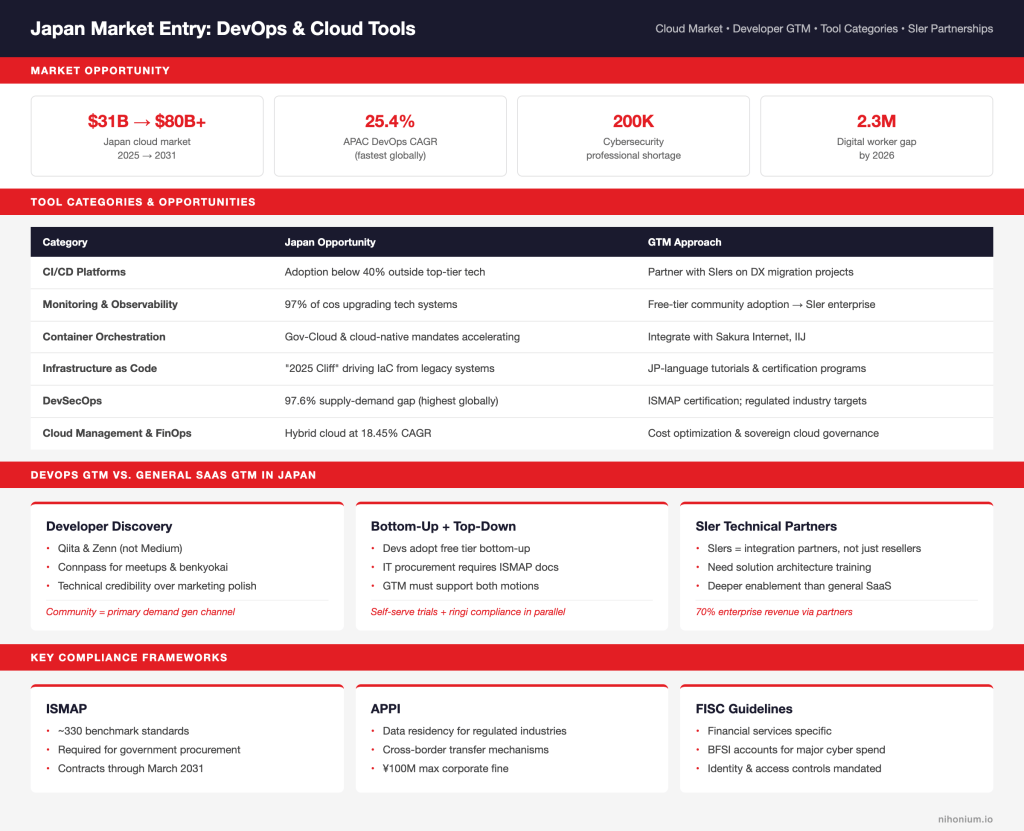
| Tool Category | Japan Market Opportunity | GTM Approach |
|---|---|---|
| CI/CD Platforms | Many Japanese enterprises still build systems with SIers in waterfall projects and are moving toward agile delivery as part of DX | Partner with SIers running DX transformation projects; position the tool as the pipeline backbone for cloud migration |
| Monitoring & Observability | As microservices and cloud adoption grow, so does the need for visibility; in MIC’s 2025 survey, 83.5% of companies with 100 or more employees used cloud services | Lead with Japanese-language technical content and free-tier community adoption; convert enterprise accounts through SIer-led proofs of concept |
| Container Orchestration | The Government Cloud and enterprise cloud migration are moving workloads to managed cloud platforms where containers are the default | Target managed Kubernetes users; build integrations with Japan-based cloud providers such as Sakura Internet and IIJ |
| Infrastructure as Code | METI’s 2018 DX Report warned of losses of up to JPY 12 trillion a year from 2025 if legacy systems were not modernized (the “2025 digital cliff”), which keeps infrastructure modernization on the agenda | Produce Japanese-language tutorials and training content; partner with cloud training providers to embed IaC tooling in upskilling programs |
| Security Tools (DevSecOps) | ISC2 put Japan’s cybersecurity workforce gap at about 110,000 people in 2023, up 97.6% in a year, which makes automation-first security tools attractive | Align with government cybersecurity frameworks and ISMAP where you sell to government; target regulated industries (finance, healthcare, manufacturing) where security reviews drive procurement |
| Cloud Management & FinOps | Japanese enterprises balance data residency expectations with global cloud scale, and many run hybrid environments | Position around cost optimization and cloud governance; engage CFO and CIO stakeholders through ROI-focused Japanese-language collateral |
DevOps Market Entry vs. General SaaS Entry
Entering Japan with a DevOps or developer-focused tool differs from entering with general business SaaS, and a generic playbook tends to underperform.
Developer buyers evaluate differently. Japanese developers are used to English-language tools and incomplete documentation, and they judge on technical merit first. A phased localization strategy, documentation and community content before full UI localization, can work for developer tools where it would fail for business software.
Bottom-up adoption coexists with top-down procurement. DevOps tools often enter organizations through individual developers before formal procurement. Your go-to-market must serve both the developer who finds your tool on Qiita and the IT procurement committee that asks for security documentation, an ISMAP listing for government work, and a local SIer support contract.
The SIer dynamic shifts for developer tools. For general SaaS, SIers act mainly as resellers. For DevOps tools, they need to be technical partners who can implement, integrate and support the tool in complex engineering environments. That takes deeper enablement: solution architecture training, integration playbooks and co-selling support. Our guide to SIer partner management covers how to run those relationships.
Community is a pipeline channel, not just a brand exercise. For DevOps tools, study sessions and the open-source community are where engineers build conviction before they bring a tool to their teams. Investing in community is a primary demand generation channel, and local thought leaders who already speak at those events carry more weight than a foreign vendor.
Technical credibility must be demonstrated, not claimed. Japanese developers value substance over marketing polish. Open-source contributions, technical posts on Qiita or Zenn and transparent benchmarking carry more weight than polished landing pages. Your Japan presence needs a technical voice, not just a sales voice.
Key Takeaways
- Japan’s cloud market is large and growing: IDC Japan forecasts public cloud services of JPY 8.82 trillion in 2029, up from JPY 4.14 trillion in 2024, which makes Japan one of the biggest opportunities in Asia for DevOps and cloud tooling.
- SIer partnerships open enterprise sales: about 72% of Japan’s ICT professionals work at IT vendors, and DevOps tools need deeper technical enablement of those partners than general SaaS does.
- The engineering shortage drives demand: a cybersecurity workforce gap of about 110,000 (ISC2, 2023) and a projected IT talent shortage of up to about 790,000 in 2030 (METI’s high scenario) push enterprises toward automation-first DevOps tooling.
- Developer community investment on Qiita, Zenn and connpass is a primary demand generation channel for DevOps tools, because Japanese engineers build technical conviction through peer communities before formal procurement.
- A fractional go-to-market lets DevOps companies validate the market with localization, SIer channel strategy and Japanese-language sales before committing to an entity, which JETRO’s model case prices at USD 264,000 to 289,000 to set up with two people.
Sources
- U.S. International Trade Administration, Japan, Cloud Computing: Country Commercial Guide
- Digital Agency of Japan, Government Cloud Policy
- Firstlight Capital, System Integrators, the Key to Success for SaaS in Japan (source of Zoom’s Japan partner share)
- IDC Japan, domestic public cloud services market forecast
- ISC2, Cybersecurity Workforce Study 2023
- National Cybersecurity Office, ISMAP
- JETRO, Setting up a business in Tokyo: model case
- Also relied on, cited in plain text: METI, IT talent supply and demand study (March 2019; METI blocks automated fetches, figures corroborated by the Japan Institute for Labour Policy and Training); MIC Information and Communications White Paper 2018; MIC Communications Usage Trend Survey 2025; METI DX Report (September 2018); EF English Proficiency Index 2026.
Frequently Asked Questions
Do DevOps tools need full Japanese localization before entering the Japan market?
Not necessarily. Japan ranks 86th of 117 countries in the EF English Proficiency Index 2026, but developers read English documentation more readily than most business users and are used to evaluating tools with incomplete localization. A phased approach works: start with Japanese documentation, API references and community content, then localize the UI based on customer feedback. Full localization becomes essential once you move beyond early adopters into enterprise procurement, where SIers and IT committees expect native-language support as a baseline.
How important are SIer partnerships for DevOps tools specifically?
Very. IDC Japan puts the domestic IT services market at about JPY 7.0 trillion in 2024, and the SIers that deliver much of it act as gatekeepers to enterprise procurement. One vendor’s numbers show the effect: about 70% of Zoom’s Japan sales go through partners, against about 90% direct in the US (Zoom’s figure, not a market statistic). For DevOps tools the SIer relationship needs more technical depth (solution architecture training and integration playbooks, not just sales decks), but the reach is substantial once a partner is active.
What is the timeline to generate revenue in Japan for a DevOps tool?
There is no public benchmark, so use planning assumptions: 6 to 12 months to first mid-market revenue, and enterprise deals through SIer partners of nine to twelve months or more, because nemawashi requires several stakeholders to align before a purchase. Developer-led adoption can give faster early traction, with teams using free or self-serve tiers while formal procurement runs in parallel.
How does Japan’s Government Cloud initiative affect DevOps tool vendors?
The Digital Agency’s Government Cloud is shared infrastructure for national and local government systems. Providers must meet a long list of technical requirements (305 in the fiscal 2023 round), and for fiscal 2026 the agency selected AWS, Google Cloud, Microsoft Azure, Oracle Cloud Infrastructure and Sakura Internet’s Sakura Cloud. As agencies migrate to these platforms they need CI/CD, monitoring, security scanning and IaC tools that work there. A SaaS tool sold to central government agencies is expected to be on the ISMAP list (ISMAP-LIU covers low-risk SaaS); ISMAP is not required for private-sector sales, although some regulated buyers look at it.