

ISMAP, launched in 2020, is Japan’s centralized framework for evaluating cloud service providers working with government agencies. It simplifies compliance by unifying security standards across all public sector organizations. Built on ISO/IEC 27001:2013, ISMAP includes over 1,200 cloud-specific controls, addressing challenges like data isolation, service continuity, and incident response. Major providers like Microsoft and Google Cloud are already certified, signaling its importance in accessing Japan’s growing cloud market.
Key Takeaways:
- What ISMAP Does: Streamlines security compliance for cloud providers working with Japan’s government.
- Why It Matters: Certification is essential for SaaS companies aiming to secure public sector contracts.
- Certification Process: Involves a 4-phase audit and documentation submission, all in Japanese.
- Market Opportunity: Japan’s SaaS market is projected to grow 3.7x, making ISMAP certification a gateway to both public and private sector opportunities.
ISMAP certification not only facilitates government partnerships but also builds trust with private clients, positioning companies for success in Japan’s cloud market.
Understanding the ISMAP Framework
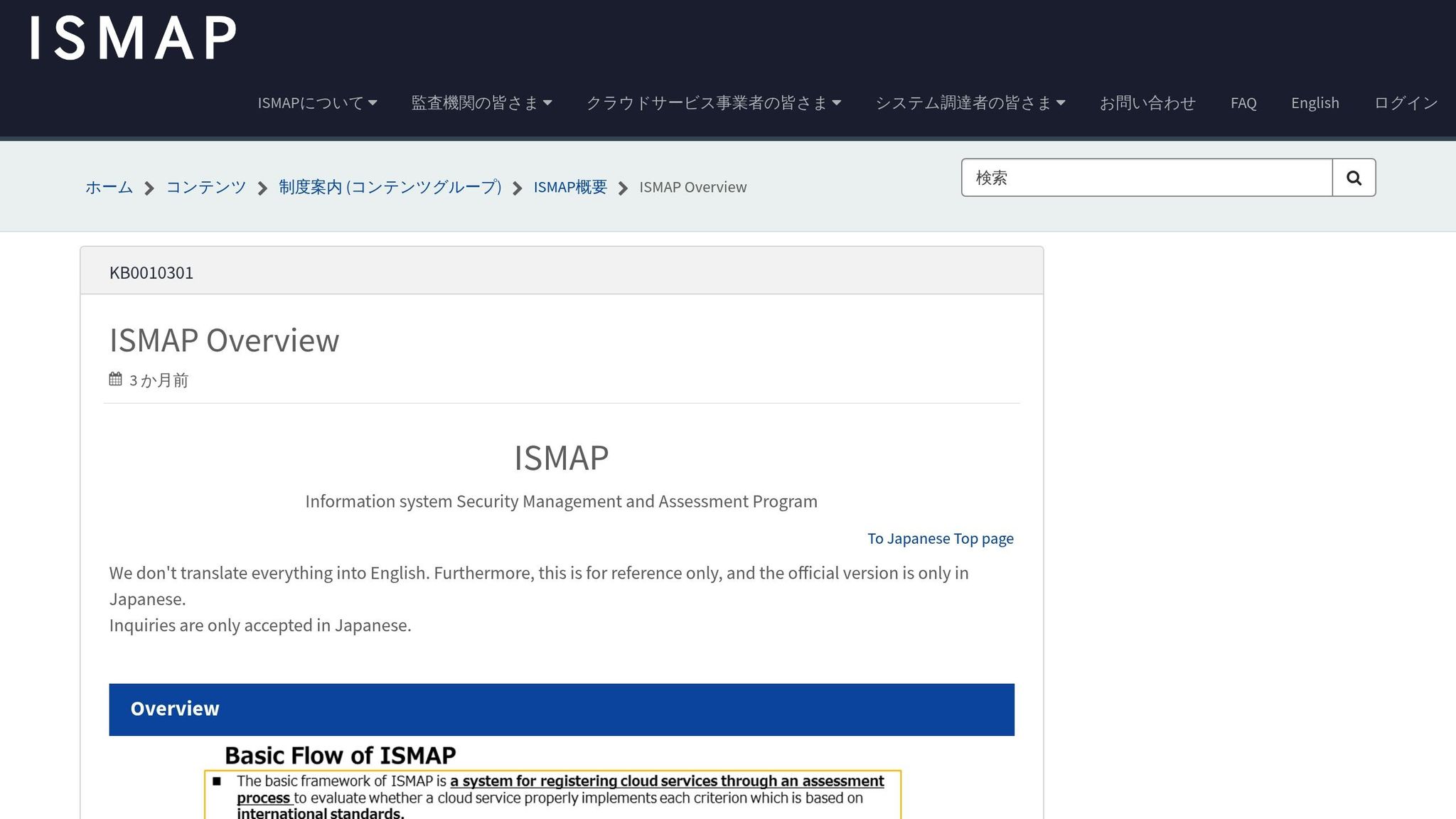
The ISMAP framework strikes a careful balance between established global security standards and the unique demands of cloud computing. By building on proven security principles, it addresses the specific challenges that come with delivering cloud services.
ISMAP’s Foundation in ISO Standards
At its core, ISMAP is built on ISO/IEC 27001:2013 (Information Security Management System). This internationally recognized standard provides a strong governance structure, ensuring that organizations have effective security management processes in place. Chapter 4 of ISMAP incorporates clauses 4–10 of ISO/IEC 27001:2013, covering key areas like organizational context, leadership, planning, operational controls, performance evaluation, and ongoing improvement efforts.
For organizations already certified under ISO/IEC 27001:2013, ISMAP offers a significant advantage. More than half of its controls align directly with ISO/IEC 27001:2013 and SOC 2 frameworks. This overlap allows companies to map their existing controls to ISMAP requirements, helping them identify gaps without starting from scratch. The result? A faster, less disruptive, and more cost-effective implementation process.
But ISMAP doesn’t stop at ISO/IEC 27001:2013. It extends beyond traditional standards to address security challenges specific to cloud environments. Issues like multi-tenancy, data residency, virtualized infrastructure, and the distributed nature of cloud services require specialized controls that go beyond what ISO/IEC 27001:2013 was designed to handle. ISMAP builds on this foundation with detailed measures tailored to the complexities of cloud computing.
Key Components of the ISMAP Framework
ISMAP includes a comprehensive set of controls, reflecting the Japanese government’s commitment to ensuring cloud service providers meet rigorous security standards before handling sensitive government data.
A significant portion of the framework focuses on cloud-specific controls, addressing operational realities unique to cloud services. These controls cover critical areas such as:
- Data isolation between government and non-government customers
- Service availability and continuity
- Vendor management and data portability
- Incident response procedures tailored for cloud environments
- Security management in virtualized infrastructures
- Audit trails and monitoring capabilities
The framework is jointly managed by key government agencies and supported by the IPA, ensuring consistent compliance across all agencies.
For smaller organizations or services handling lower-risk operations, ISMAP-LIU (ISMAP for Low-Impact Use) provides a simplified pathway. This version is designed for low-risk SaaS services and skips the full four-phase audit process. Instead, providers report on their internal audit implementation, ensuring all control objectives are addressed at least once within a three-year period.
ISMAP-LIU determines risk levels based on six categories, including potential inconvenience, reputational harm, financial loss, unauthorized information release, personal safety issues, and legal violations. This streamlined approach makes compliance more accessible for startups and smaller SaaS providers while maintaining appropriate security for lower-risk government cloud services.
Simplifying Compliance with a Centralized System
ISMAP’s centralized structure eliminates the fragmented compliance landscape that cloud providers previously faced in Japan. Before ISMAP, different government agencies had separate security requirements, forcing providers to undergo multiple assessments for the same security measures. ISMAP resolves this by creating a single certification process that satisfies security requirements across all government entities. This unified system reduces duplicative work and allows agencies to confidently choose from a pre-vetted list of providers.
Major cloud service providers have already embraced this framework. Microsoft Azure, for instance, achieved ISMAP certification across regions like Japan East and Japan West, with 40 additional regions worldwide available under contract to Japanese customers. Certified services include Azure, Dynamics 365, Office 365, and other Microsoft online offerings. Similarly, Google Cloud and Palo Alto Networks have also obtained ISMAP certification, demonstrating the framework’s viability for organizations with strong security programs.
The ISMAP Certification Process
The ISMAP certification process involves a detailed assessment carried out by authorized auditors to confirm compliance with nearly 1,200 specific controls.
4 Phases of ISMAP Certification
The certification process is divided into four key phases, each building on the ISMAP framework:
- Gap Analysis: Auditors review your Information Security Management System (ISMS) to identify existing controls and any gaps. They also outline necessary steps to meet ISMAP requirements.
- Control Description Validation: Auditors examine your documented controls to ensure they align with ISMAP standards and are suitable for your operations.
- Design Phase: A sample of evidence is inspected to confirm that the design of your controls meets ISMAP specifications. This phase ensures your security architecture is theoretically sound and capable of achieving its objectives.
- Operation Phase: Auditors test a sample of your controls during the audit period to verify that they function as intended, proving their effectiveness in real-world scenarios.
After completing these audit phases, providers must prepare and submit detailed documentation to finalize the certification.
Documentation and Application Requirements
Once the four-phase audit is complete, your application to the ISMAP Steering Committee must include several critical components:
- Third-party Attestation: A formal document from your authorized auditor confirming that your ISMS complies with ISMAP requirements.
- Cloud Service Provider Application Documentation: Comprehensive details about the services covered under your certification.
- Management Confirmation: A statement from your organization’s leadership affirming that the ISMS is both operational and actively maintained.
- Organization-specific Appendices: Additional materials tailored to your situation, such as disclosures of any security incidents during the audit, plans for addressing audit findings, or explanations of how non-ISMAP registered tools or services are managed. The Information-technology Promotion Agency (IPA) may also request further details about technologies within your ISMS that are not ISMAP registered.
All application documents, control descriptions, and responses to the IPA must be translated into Japanese. This includes technical documentation, audit reports, and related correspondence. While the documentation demands can be extensive, organizations already certified under ISO/IEC 27001:2013 or SOC 2 can simplify the process by mapping their existing controls to ISMAP standards. This rigorous documentation ensures a thorough evaluation and upholds the framework’s high security standards.
Using Existing Certifications for ISMAP Compliance
If your SaaS company already holds certifications like ISO/IEC 27001:2013 or SOC 2, you’re in a strong position for ISMAP compliance. These certifications cover more than half of ISMAP’s controls, meaning you won’t need to rebuild your security infrastructure from scratch. Instead, the focus shifts to mapping your existing controls to meet ISMAP’s specific requirements.
Mapping ISMAP to Existing Frameworks
ISMAP’s framework includes over 1,200 controls, and more than 50% of these align directly with ISO/IEC 27001:2013 and SOC 2. That’s because ISMAP builds on the foundation of ISO/IEC 27001:2013, adding cloud-specific requirements to address the unique needs of cloud services. For organizations with SOC 2 attestations, existing documentation and audit evidence can also be leveraged to speed up the ISMAP compliance process.
Take Adobe as an example. When the company sought ISMAP certification for its Acrobat AI Assistant, it relied on its Common Control Framework (CCF). This framework is designed to align with multiple global security standards, including SOC 2, ISO 27001, and FedRAMP. By using the CCF, Adobe streamlined its audit process and efficiently addressed nearly all of ISMAP’s controls.
For smaller SaaS companies handling low-risk data, ISMAP-LIU offers a streamlined compliance path. This alternative focuses on evaluating risks like reputational damage, financial loss, or unauthorized data exposure. ISMAP-LIU requires internal audits of all control objectives at least once every three years and mandates annual external audits for governance and management standards.
This mapping approach simplifies the certification journey, making it more manageable for organizations of various sizes.
Practical Steps for Certification Efficiency
Start by conducting a gap analysis to compare your current ISO/IEC 27001:2013 or SOC 2 controls with ISMAP’s requirements. This will help identify which controls are already in place, highlight gaps, and document how your existing controls align with ISMAP. This documentation becomes a critical part of your ISMAP application and supports auditors during the Control Description Validation phase.
Next, enhance your existing Information Security Management System (ISMS) documentation to include controls specific to ISMAP’s cloud requirements. If your ISMS relies on non-ISMAP-registered cloud services or tools, you’ll need to provide additional details to the Information-technology Promotion Agency (IPA) during the application process. This includes explaining how the technology is used within your ISMS and the types of data it processes, which the IPA will evaluate.
Keep in mind that all application documents and responses to the IPA must be submitted in Japanese. Using professional translation services throughout the process is crucial to ensure compliance and accuracy.
Finally, consider adopting a unified framework approach, similar to Adobe’s CCF. Developing a common control framework that addresses multiple compliance standards can reduce the overhead of managing separate programs. This strategy not only simplifies long-term maintenance but also prepares your organization for future compliance needs. The control mapping documentation you create will be reviewed during ISMAP’s four-phase audit process. During the Control Description Validation phase, third-party auditors will evaluate your descriptions to ensure they meet ISMAP standards, effectively assessing your existing ISO/IEC 27001:2013 or SOC 2 controls for compatibility.
sbb-itb-a752276
ISMAP Registration: Benefits for SaaS Companies
ISMAP registration offers SaaS providers a streamlined path to meet security requirements for multiple government agencies in Japan. By achieving a single certification, companies can bypass repetitive security assessments, making it easier to enter the market and comply with government standards.
Improved Access to Government Contracts
When dealing with Japanese government agencies, vendors often face rigorous security evaluations for each contract. ISMAP simplifies this process by allowing agencies to procure cloud services from registered providers without additional reviews. This means you only need to prove your security compliance once, instead of separately to entities like the Ministry of Economy, Trade and Industry (METI) or the Ministry of Internal Affairs and Communications (MIC).
ISMAP’s credibility is bolstered by its governance structure, which includes oversight from the National Center of Incident Readiness and Strategy for Cybersecurity, the National Strategy Office of Information and Communications Technology, MIC, and METI. Technical support from the Information-technology Promotion Agency (IPA) ensures its recognition across Japan’s public sector.
For services handling lower-risk operations, ISMAP-LIU (Low-Impact Use) provides a more accessible pathway. This option involves annual external audits and standardized reviews of governance standards, making it a practical choice for smaller or less complex services. These streamlined compliance processes not only save time but also enhance your market reputation.
Market Credibility and Competitive Positioning
Securing ISMAP registration does more than simplify government interactions – it also strengthens your market position. It signals your adherence to stringent global security standards, and being listed on the official IPA registry of ISMAP-certified providers immediately builds trust with both public and private sector clients.
This certification sets you apart from competitors who lack similar credentials. In Japan, where government procurement trends heavily influence private sector decisions, ISMAP registration can open doors far beyond public contracts. Companies like Microsoft, Google Cloud, and Adobe have already achieved ISMAP certification, highlighting its strategic importance.
How Nihonium Supports ISMAP Compliance
Achieving ISMAP certification isn’t just about mastering technical security requirements – it also means understanding Japan’s regulatory environment and business culture. For global SaaS companies, this can be a tall order, especially when trying to break into Japan’s government sector. That’s where localized expertise becomes a game-changer.
Nihonium’s Role in ISMAP Certification
Nihonium bridges the gap between global SaaS providers and Japan’s stringent compliance requirements. With a team experienced in both global SaaS operations and Japan’s unique regulatory landscape, they simplify the complexities of ISMAP’s 1,200 controls.
One of the biggest hurdles in ISMAP certification is documentation translation. Nihonium ensures your compliance materials not only reflect your security protocols but also meet the linguistic and cultural expectations of Japanese auditors and the IPA. This goes far beyond basic translation – it’s about aligning your documentation with Japan’s standards.
Nihonium also helps map your existing ISO/IEC 27001:2013 or SOC 2 controls to the ISMAP framework. This process identifies where your current controls align and where additional measures are needed, particularly for ISMAP’s cloud-specific demands. Their expertise in both international and Japanese standards ensures a streamlined certification process tailored to your existing security setup.
The ISMAP audit process itself is rigorous, involving four phases: Gap Analysis, Control Description Validation, Design Phase, and Operation Phase. Each stage requires detailed documentation, from control descriptions to evidence of implementation and operational records proving control effectiveness. Nihonium provides guidance in organizing and localizing this documentation to meet the expectations of Japanese auditors, minimizing potential delays or inquiries from the IPA.
But ISMAP compliance is just the start. To truly succeed in Japan, companies need a strategy that goes beyond certification.
Custom Market Entry Services for Japan
ISMAP certification opens doors, but entering Japan’s market requires more than just compliance. Nihonium offers a full suite of services to help SaaS companies establish a strong presence in Japan’s rapidly expanding market, which is expected to grow 3.7 times.
Their product localization services extend beyond compliance documentation. Nihonium ensures your entire SaaS platform – user interfaces, customer support materials, and even security incident response procedures – aligns with Japanese regulations and user expectations. This process is managed by native experts who understand the nuances of both your product and the local market.
To help you connect with Japanese government procurement teams, Nihonium develops effective marketing strategies using tools like SEO, webinars, and local partnerships. They also create sales and marketing materials that highlight your ISMAP certification and security capabilities in ways that resonate with local decision-makers.
For sales, Nihonium offers fractional support, providing a dedicated Japanese sales team to handle everything from initial outreach to closing deals with government agencies. Their approach emphasizes relationship-building and cultural understanding, which are critical in Japan’s unique procurement environment.
If you’re unsure whether to pursue full ISMAP certification or the lighter ISMAP-LIU pathway (designed for lower-risk operations), Nihonium can help you assess your risk profile. They evaluate factors such as potential reputational damage, financial loss, and the risk of unauthorized data release. This ensures your resources are allocated to the certification level that best matches your services and market goals.
Nihonium’s approach goes beyond treating ISMAP compliance as a technical checklist. By combining compliance expertise, localization, and sales support, they help global SaaS companies establish credibility and seize opportunities in Japan’s competitive government sector.
Conclusion
ISMAP certification isn’t just about meeting regulatory requirements – it’s a game-changer for SaaS companies aiming to work with Japanese government agencies. By standardizing what was once a fragmented approval process, ISMAP has become the go-to framework for cloud service procurement in Japan’s public sector.
With its nearly 1,200 controls, ISMAP offers SaaS providers a streamlined path to bypass repetitive security assessments and gain direct access to government contracts. This pre-qualified status not only reduces administrative workload but also opens doors to valuable opportunities in the public sector.
But the benefits don’t stop there. ISMAP certification sends a strong message about a company’s commitment to safeguarding sensitive information. It reassures both public and private clients that the company meets stringent security standards – an essential factor in building trust in today’s competitive market.
For companies already certified under ISO/IEC 27001:2013 or SOC 2, compliance with ISMAP becomes more manageable, as over half of the controls overlap with these frameworks.
Whether a company opts for full ISMAP certification or the lighter ISMAP-LIU pathway for lower-risk scenarios, this certification positions them to capitalize on a growing market. As Japanese government agencies continue to modernize and embrace cloud technologies, ISMAP-certified providers stand ready to meet the demand with proven security and trusted third-party validation.
FAQs
What are the key benefits of ISMAP certification for SaaS companies entering the Japanese market?
Achieving ISMAP certification can be a game-changer for SaaS companies targeting the Japanese market. It signals that your business meets Japan’s rigorous cloud security standards, which helps establish trust and credibility with local customers.
Beyond trust, this certification can unlock new business opportunities, especially with Japanese government agencies and major corporations that prefer to partner with certified providers. For SaaS companies aiming to thrive in Japan, ISMAP certification can be a key to gaining a competitive edge.
What makes ISMAP certification different from ISO/IEC 27001:2013 and SOC 2, and why is it crucial for cloud service providers in Japan?
ISMAP, short for Information System Security Management and Assessment Program, is a framework developed by the Japanese government to safeguard cloud services used by public sector organizations. While international standards like ISO/IEC 27001:2013 focus on general information security management, and SOC 2 emphasizes data security practices for service providers, ISMAP zeroes in on the specific regulatory and operational needs of Japan’s government agencies.
For cloud service providers aiming to operate in Japan, obtaining ISMAP certification is more than just a formality – it’s a necessity. This certification signals adherence to rigorous security standards tailored to local regulations. Beyond compliance, it establishes trust with government clients and unlocks opportunities to collaborate with public institutions in Japan’s tightly regulated cloud services market.
What are the common challenges companies face in achieving ISMAP certification, and how can they address them?
Achieving ISMAP certification is no easy task. The framework’s strict requirements and Japan-specific standards often pose significant hurdles for companies. Common challenges include deciphering the intricate compliance criteria, adjusting security protocols to meet local regulations, and dealing with the language barrier when preparing the necessary documentation.
To tackle these obstacles, businesses should prioritize a comprehensive review of ISMAP requirements and ensure their cloud security practices are fully aligned with the framework. Collaborating with experts who understand Japan’s regulatory environment – such as localization and market entry specialists – can make a world of difference. These professionals can assist by translating complex requirements and crafting strategies tailored to meet ISMAP standards efficiently.
Related Blog Posts
- Regulatory Compliance for SaaS in Japan: Key Rules
- Multi-Cloud in Japan: Enterprise Case Studies
- Ultimate Guide to Japan SaaS Data Compliance
- Japan SaaS Market: Data Privacy as a Selling Point
 English
  Japanese