
Japan’s HR tech market was worth USD 2.31 billion in 2026 and is projected to reach USD 3.93 billion by 2034 (IMARC Group). Demand comes from a structural labour shortage, projected at 11 million workers by 2040, and an ageing population with 29.4% aged 65 or over, which push employers to automate HR, payroll, attendance and recruiting. For foreign HR SaaS, payroll and people analytics platforms, the opportunity is real, but entry depends on fitting Japanese labour law, payroll practice and buying habits.
The Recruit Works Institute projects an 11 million worker shortfall by 2040, and the Persol Research Institute and Chuo University estimate a shortage of 17.75 million work hours a day in 2035, equivalent to 3.84 million workers. The shortage is forcing employers to rethink how they manage people. Domestic platforms are well funded: SmartHR, the best-known Japanese cloud HR platform, raised a US$140 million (JPY 21.4 billion) Series E in July 2024, led by KKR and Teachers’ Venture Growth. Japan’s 3.36 million small and medium-sized enterprises (99.7% of all enterprises in 2021) employ about 70% of people working in private companies, so the mid-market and SME segments are large.
Entering without local guidance is where many foreign platforms stall. Japanese labour law is detailed and changes often, buyers expect Japanese-language products that fit local rules, and sales move through consensus-building. Nihonium is a Japan go-to-market partner for B2B SaaS: our strategy, localization, sales and marketing funnel, fractional sales and local thought leadership services turn that demand into pipeline, while labour law and payroll questions go to specialists.
Key Capabilities
An HR and people tech entry into Japan needs these capabilities, from product adaptation to revenue; the compliance rows are confirmed by labour law and payroll specialists.
| Capability | What It Does | Benefit |
|---|---|---|
| HR Product Localization | Adapts UI, workflows and terminology for Japanese users, including the right level of keigo (敬語, polite business language), Japanese name and date formats, and My Number (マイナンバー, the national ID number) fields labelled the way HR teams expect. | A product that feels built for Japan, which enterprise HR buyers expect when they compare it with domestic platforms such as SmartHR. |
| Labour Law Fit in the Entry Plan | Lists which features touch the Labour Standards Act, the Labor Contracts Act, work-style reform rules and APPI (overtime logic, leave, dismissal workflows), for a labour and social security attorney (社会保険労務士, sharoushi) or Japanese lawyer to confirm. | Gaps are found before procurement finds them, so the product is not disqualified late in a deal. |
| Payroll & Benefits Positioning | Positions payroll and benefits modules against income tax withholding, social insurance and the year-end tax adjustment (年末調整, nenmatsu chōsei), with the calculations validated by payroll specialists. | Addresses the gap that most often disqualifies foreign HR tech: Japan-specific payroll obligations with no Western equivalent. |
| Japanese Marketing Funnel | Builds demand generation through Japanese SEO, webinars, case studies, and event strategy tailored to how HR buyers discover products. | Generates qualified pipeline in a market where HR decision-makers want Japanese-language content and peer validation before they meet sales. |
| Channel Strategy | Selects target partners (HR consulting firms, system integrators, payroll outsourcers and sharoushi firms) and builds the partner pitch. | Access to the advisers employers already rely on: sharoushi handle social insurance and labour filings for many small and mid-sized companies. |
| Fractional Japan Sales Team | Japanese-speaking sales professionals run the cycle from the first email to closing and account management: outreach, demonstrations, proposals, consensus-building and negotiation. | Sales start before a full-time Japan team is justified, without waiting for an entity or a hire. |
| Enterprise Buyer Navigation | Guides your team through ringi (稟議, the written approval process), multi-stakeholder alignment, nemawashi (根回し, informal consensus-building) and formal proposal documents in Japanese. | Fewer deals stall in internal approval, a step foreign vendors routinely underestimate. |
| Competitive Positioning | Maps differentiation against SmartHR, KING OF TIME, COMPANY, Money Forward and freee, identifying angles that resonate with Japanese buyers. | Messaging that highlights genuine advantages rather than features domestic platforms already deliver. |
How It Works
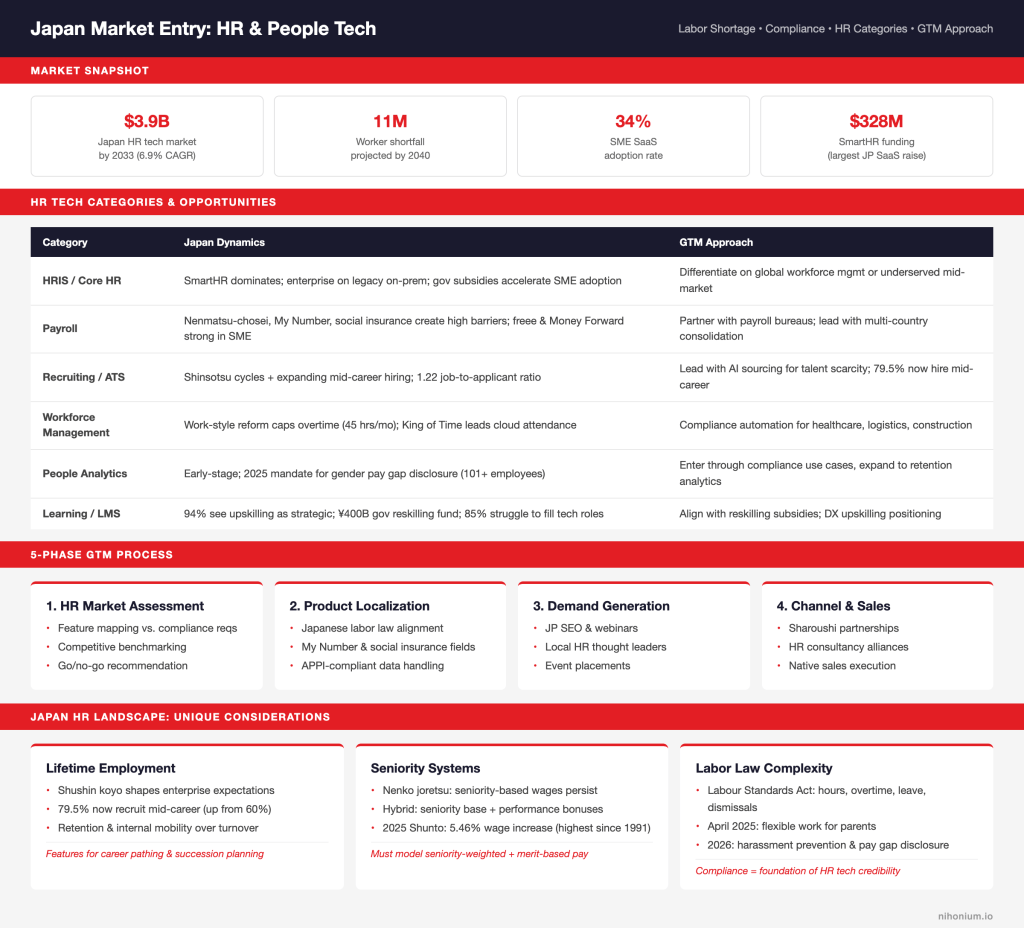
Nihonium’s go-to-market process for HR and people tech platforms entering Japan runs in five phases.
-
Japan HR Market Assessment
We map your features against Japanese HR practice, benchmark against domestic competitors, identify target segments, and assess which capabilities address Japan-specific needs such as labour shortage or work-style reform. The output is a go/no-go recommendation with a prioritized entry roadmap, including the labour law questions your specialists need to answer.
-
Product & Compliance Localization
Beyond language, we localize workflows and terminology for Japanese HR teams and Japan-specific data fields (My Number, social insurance categories, fiscal year settings), and prepare Japanese materials on how the product handles personal data under APPI, for counsel to confirm. Engineering changes stay with your team.
-
Demand Generation & Market Seeding
We build a Japanese presence through localized content, Japanese-language SEO, webinars with local HR thought leaders and event placements, developing the social proof Japanese buyers look for before engaging sales.
-
Channel Activation & Sales Execution
The fractional sales team starts prospecting and converting leads, and approaches the partners chosen in the channel strategy: sharoushi firms, HR consultancies and integrators. Each deal follows the Japanese enterprise buying process through to a signed contract.
-
Scale & Optimize
Focus shifts to account management, reference customers and pipeline growth, feeding product insights and competitive intelligence back so your Japan offering evolves with the market.
HR Tech Categories in Japan
Each HR tech category has its own dynamics and competitors in Japan, and needs its own go-to-market approach.
| Category | Japan Dynamics | GTM Approach |
|---|---|---|
| HRIS / Core HR | SmartHR is the best-known domestic cloud HR platform and raised a US$140 million Series E in 2024. Many large enterprises run established HR systems. | Differentiate on global workforce management for multinationals or target underserved mid-market segments rather than competing head-to-head with SmartHR on domestic SME core HR. |
| Payroll | The year-end tax adjustment, social insurance calculations, My Number handling and resident tax collected for each employee’s municipality create high barriers. freee and Money Forward are widely used by SMEs, and many companies outsource payroll. | Partner with payroll outsourcers as the technology layer behind their service. Global platforms should lead with multi-country consolidation for the Japan subsidiaries of multinationals. |
| Recruiting / ATS | Structured around shinsotsu (新卒, new graduate) hiring cycles, with mid-career hiring growing. The jobs-to-applicants ratio was 1.19 in September 2026 (MHLW, seasonally adjusted). Domestic ATS platforms are established but none dominates. | Lead with sourcing and automation that address talent scarcity, and align messaging with mid-career hiring. |
| Workforce Management | Overtime is capped at 45 hours a month and 360 a year; with a special agreement, 720 hours a year, under 100 hours in any month including holiday work, and an 80-hour average over two to six months, with penalties for breaches. KING OF TIME is a widely used cloud attendance system. Labour shortages drive demand for shift optimization in services, retail and healthcare. | Position around automating overtime compliance. Target shortage-hit industries (healthcare, logistics, construction) where scheduling optimization pays off quickly. |
| People Analytics | Early-stage but growing as enterprises face retention and diversity pressure. Since 1 April 2026, employers with 101 or more employees must publish the gender pay gap and the share of women in management (301 or more employees have published the pay gap since July 2022). | Enter through compliance use cases (pay gap reporting, diversity disclosure), then expand into workforce planning and retention analytics. |
| Learning / LMS | The government pledged JPY 1 trillion over five years for reskilling in October 2022, raised from an earlier JPY 400 billion three-year package, and DX skills are a priority for employers. | Align with reskilling subsidies to lower the customer’s cost. Position around DX upskilling, matching funding priorities and enterprise urgency to close digital skills gaps. |
Japan HR Landscape: Unique Considerations
Japan’s HR market works within cultural and legal frameworks with no close Western parallel, and any platform that touches how Japanese companies manage people has to fit them.
Lifetime Employment Culture
Lifetime employment (終身雇用, shūshin koyō) still shapes expectations at large enterprises. Mid-career hiring is growing, but the culture of long-term employment persists. HR tech features designed around high-turnover Western markets need repositioning around retention, internal mobility and long-term development. Products supporting career paths, internal talent marketplaces and succession planning fit Japanese workforce management more naturally.
Seniority-Based Systems
The nenkō joretsu (年功序列) system of seniority-based pay and promotion remains influential even as companies add merit-based elements. Many organizations run hybrid systems with seniority-weighted base pay and performance bonuses. Pay is also rising fast: Rengo’s final tallies of the spring wage negotiations (shuntō) show increases of 5.25% in 2025 and 5.01% in 2026, the third year in a row above 5%. Compensation and analytics modules must handle these hybrid structures; a platform that cannot model seniority-weighted pay alongside performance metrics will struggle in demonstrations to Japanese HR leaders.
Labor Law Complexity
The Labour Standards Act governs hours, overtime, leave and dismissals in detail. Recent amendments keep adding obligations: the Child Care and Family Care Leave Act changes of April and October 2025 require flexible working options for parents of children aged three to school age; customer harassment measures became mandatory on 1 October 2026; and pay gap disclosure widened to employers with 101 or more staff in April 2026. Labour Standards Inspection Offices (労働基準監督署) inspect employers. For HR tech platforms, compliance is the foundation of credibility: any platform touching time tracking, leave, payroll or scheduling must show it follows current law and can absorb the next change.
Key Takeaways
- Japan’s demographics create lasting HR tech demand. An 11 million worker shortfall projected by 2040, 29.4% of the population aged 65 or over and a jobs-to-applicants ratio of 1.19 push employers toward HR automation.
- The market is mid-sized and growing. IMARC Group puts it at USD 2.31 billion in 2026 and USD 3.93 billion by 2034, and Japan’s 3.36 million SMEs are a large segment beyond the enterprises.
- Compliance is the entry barrier and the moat. Detailed labour law, frequent amendments and inspections reward platforms that settle their compliance position with specialists early.
- Domestic incumbents are strong but not unassailable. SmartHR in core HR and freee and Money Forward in SME payroll are well established; there is room in people analytics, global workforce management, recruiting automation and workforce optimization.
- Go-to-market needs Japan-specific execution. Consensus-driven procurement, sharoushi-influenced buying and seniority-aware culture call for Japanese-speaking sales, local partners and localization by people who know the market.
Working with Nihonium. We are a Japan go-to-market partner for B2B SaaS companies: Japan go-to-market strategy. Talk to us about your Japan entry.
Sources
- IMARC Group, “Japan HR Tech Market Size, Share, Trends and Forecast 2026–2034” (updated 14 October 2026): USD 2.16 billion (2025), USD 2.31 billion (2026), USD 3.93 billion (2034), 6.87% a year.
- Recruit Works Institute, “Future Predictions 2040”: a labour supply shortfall of about 11 million workers by 2040.
- Ontario Teachers’ Pension Plan, “KKR and Teachers’ Venture Growth Lead US$140 Million Series E Round in SmartHR” (1 July 2024).
- Ministry of Health, Labour and Welfare: employment referrals, September 2026; overtime caps; gender pay gap disclosure (in Japanese).
- Rengo, 2026 spring wage negotiations, final tally (3 July 2026, in Japanese).
- Also relied on: Statistics Bureau, 2025 Census; Persol Research Institute and Chuo University, projection 2035 (October 2024); SME Agency, SME count (2021 Economic Census); Prime Minister’s policy speech, 3 October 2022; MHLW notices on the 2025 leave and harassment amendments.
Frequently Asked Questions
How does Japan’s labor shortage affect demand for foreign HR tech platforms?
The shortage is demographic and long-term: the working-age population shrinks while the share aged 65 or over grows. Employers are investing in workforce optimization, automated recruiting and retention analytics out of necessity, and government support for SME digitalization and the JPY 1 trillion reskilling pledge lower the cost for buyers.
What are the biggest obstacles to entering Japan’s HR tech market?
The three failure points are compliance gaps, thin localization and mismatched sales. Japanese labour law is detailed and changes often, and platforms that cannot show they fit it are dropped in procurement. Buyers expect native interfaces, Japan-specific workflows and documentation in appropriate keigo, and without Japanese-speaking sales who can work through nemawashi and the ringi process, deals stall.
Should we target SMEs or enterprise buyers in Japan?
Both are viable, with different dynamics. SMEs are numerous, but budgets are tight and freee and Money Forward have strong distribution. Enterprises pay more but buy through complex procurement; many foreign vendors start with the mid-market, where DX pressure is high and procurement is lighter.
How long does it take to generate revenue from Japan’s HR tech market?
There is no public benchmark. As a planning assumption, allow 6 to 12 months to first mid-market revenue and 12 to 18 months to meaningful enterprise revenue, with enterprise deal cycles of nine to twelve months or more. Running localization, demand generation and sales in parallel rather than one after another shortens the path; skipping localization or selling without Japanese speakers lengthens it.